


Commercial air balancing is the systematic process of measuring and adjusting airflow in HVAC systems so it matches design specifications at every supply and return register throughout a building. Known formally as Testing, Adjusting, and Balancing (TAB), it is the difference between an HVAC system that merely runs and one that performs.
The role of commercial air balancing extends well beyond comfort. It directly affects energy costs, equipment lifespan, indoor air quality, and regulatory compliance.
Standards from the National Environmental Balancing Bureau (NEBB) and the Associated Air Balance Council (AABC) define how TAB work must be documented and verified. For facility managers and building owners, understanding this process is the foundation of sound HVAC management.
How does commercial air balancing optimize HVAC efficiency and reduce costs?
Balanced airflow is the single most direct path to reducing HVAC operating costs in a commercial building. When airflow is unbalanced, some zones receive too much conditioned air while others receive too little.
The system compensates by running longer and working harder, burning energy without delivering comfort. TAB services pay for themselves through energy savings within months. Balanced systems operate much closer to design specifications, which eliminates the waste caused by improper zone conditioning.
The process starts at the register level. A TAB technician measures cubic feet per minute (CFM) at every supply and return register, then compares those readings to the original design drawings.
Where readings fall short or run over, the technician adjusts dampers, diffusers, and fan speeds until each zone hits its target. This is not a rough approximation. It is a calibrated correction that brings the entire system into alignment.

The financial case is straightforward. An HVAC system running out of balance forces motors and fans to work against pressure differentials they were never designed to handle.
Balanced systems reduce mechanical wear by preventing stress on motors and components. That translates directly to longer equipment life and lower maintenance budgets. A motor that does not overstrain lasts years longer than one that fights constant pressure imbalance.
Pro Tip: Always request a formal “as-left” report from your TAB contractor. This document records design CFM versus measured CFM at every register and is your primary reference for future troubleshooting, warranty claims, and compliance audits.
Facility managers who skip TAB documentation often discover the gap when a comfort complaint arises and there is no baseline to compare against.
The as-left balancing report is not optional paperwork. It is the evidence that the system was delivered to specification, and the starting point for every future assessment.
What are the key air balancing techniques and instrumentation used in commercial buildings?
Professional air balancing relies on calibrated instrumentation and a disciplined, zone-by-zone methodology. The tools are not generic. They are purpose-built to measure airflow, static pressure, and temperature with the accuracy that NEBB and AABC standards require.
Core instrumentation
Commercial air balancing depends on five core instruments, each with a specific measurement role:
- Pitot tube manometers measure static and velocity pressure in ductwork to calculate airflow volume.
- Capture hoods (flow hoods) measure CFM directly at diffusers and grilles without requiring duct access.
- Anemometers measure air velocity at registers and open-face grilles.
- Digital manometers track static pressure differentials across fans, filters, and coils.
- Tachometers verify fan and motor RPM against design specifications.
Each instrument must be calibrated before use. Readings taken with out-of-calibration equipment produce corrections that miss the mark, which defeats the entire purpose of the process.
The TAB process step by step
The TAB process follows six sequential steps, from reviewing the design documents to recording the final measurements:
- Review design documents. The technician studies the mechanical drawings to understand design CFM for every zone, the fan schedule, and the duct layout.
- Conduct a preliminary system check. All equipment runs at full capacity. Filters are clean, dampers are open, and controls are in manual mode.
- Measure existing conditions. CFM readings are taken at every supply and return register. Static pressure is measured across fans and coils.
- Adjust dampers and diffusers. Starting from the farthest register and working back toward the air handler, the technician adjusts each damper to bring airflow into balance.
- Verify fan performance. Fan speed is adjusted if total system airflow does not match the design total.
- Document all readings. Final “as-left” measurements are recorded against design values for every measurement point.
Calibration and documentation per NEBB or AABC standards are not optional steps. They are the standard of care that separates professional TAB work from informal adjustments. Facility managers should verify that any TAB contractor they hire holds current certification from one of these bodies.
Understanding how commercial ductwork differs from residential systems is also relevant here. Commercial duct systems carry far greater air volumes across longer runs, which makes pressure balancing more complex and the consequences of imbalance more severe.
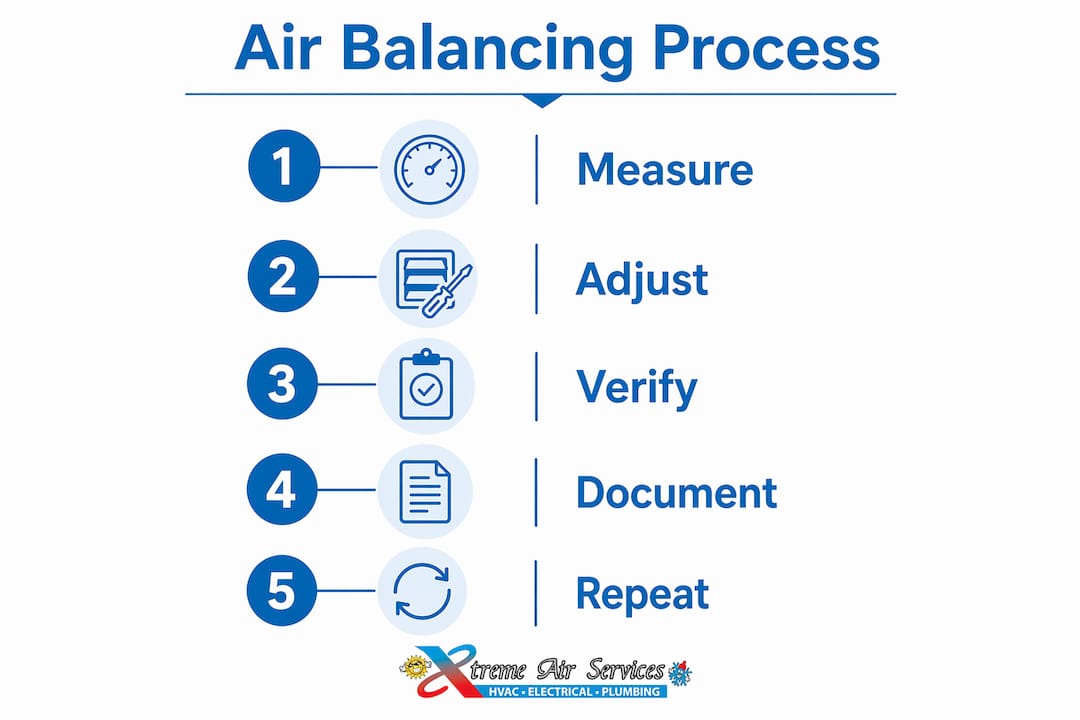
Why is recurring air balancing essential for commercial HVAC performance?
Recurring air balancing is essential because a building that was perfectly balanced at commissioning will drift out of balance over time. This is not a failure of the original TAB work. It is a predictable consequence of how buildings change.
The system must keep meeting airflow demands that keep shifting. Three forces drive that drift:
- Occupancy changes that redirect airflow, block registers, and create new pressure differentials.
- Seasonal load variation that changes how much cooling or heating each zone needs.
- Structural modifications such as new walls and reconfigured floor plans.
Consider a common scenario. A tenant reconfigures an open floor plan into private offices. New walls redirect airflow, block supply registers, and create pressure differentials the original design never anticipated.
The HVAC system does not know the layout changed. It continues operating on its original settings, now delivering too much air to some spaces and starving others. Comfort complaints follow within weeks.
Structural changes are not the only trigger. Several other conditions shift airflow distribution just as much:
- Seasonal load shifts change how much cooling or heating each zone needs.
- Equipment upgrades, such as replacing a fan motor with a different model, alter system curves.
- Filter loading between maintenance cycles changes static pressure enough to move airflow across zones.
Air balancing requires ongoing evaluation to maintain compliance and system health as these conditions evolve.
Pro Tip: Schedule a TAB verification every time your building undergoes a significant renovation, tenant change, or major equipment replacement. Waiting for comfort complaints to surface costs more in energy waste and occupant dissatisfaction than the cost of a proactive re-balance.
The mechanical consequences of neglecting re-balancing are real. Regular rebalancing prevents mechanical stress such as motor burnout caused by imbalanced static pressures.
A fan motor running against excessive static pressure draws more current, generates more heat, and fails sooner than its rated lifespan. Replacing a commercial fan motor costs far more than a scheduled TAB visit.
Facility managers who build re-balancing into their preventive maintenance program consistently report fewer emergency repairs and more predictable equipment replacement cycles.
How does air balancing improve indoor air quality and occupant comfort?
Air balancing improves indoor air quality by delivering conditioned air to every zone at the volume the ventilation design requires. Balanced ventilation removes indoor pollutants, allergens, and moisture effectively.
Proper air distribution does more than keep temperatures even. It controls the quality of the air that building occupants breathe every hour of the workday.
When airflow is unbalanced, under-served zones develop stale air pockets. Volatile organic compounds (VOCs) from office equipment, cleaning products, and building materials accumulate in areas where fresh air exchange is insufficient.
Humidity builds in zones with inadequate supply air, creating conditions that promote mold growth. These are not theoretical risks. They are documented outcomes in buildings where air distribution has never been verified against design.
The comfort dimension is equally direct. Hot and cold spots are the most common occupant complaint in commercial buildings, and they are almost always a symptom of unbalanced airflow rather than equipment failure.
A zone receiving 30% less air than its design CFM will feel warm in summer and cold in winter, no matter how hard the chiller or boiler works. Correcting the airflow balance resolves the complaint without replacing any equipment.
| Condition | Balanced airflow | Unbalanced airflow |
|---|---|---|
| Temperature uniformity | Consistent across all zones | Hot and cold spots throughout |
| Pollutant removal | Effective dilution and exhaust | Stale air pockets accumulate |
| Humidity control | Maintained within design range | Excess moisture in under-served zones |
| Occupant comfort complaints | Minimal | Frequent and recurring |
| Energy consumption | At or near design levels | Above design due to compensation |
Uniform air delivery to all building areas eliminates comfort complaints and supports the ventilation rates required by ASHRAE Standard 62.1, the primary indoor air quality benchmark for commercial buildings.
Meeting that standard is not just a comfort goal. It is a liability management issue for building owners. Facilities that cannot demonstrate adequate ventilation face exposure in tenant disputes and health-related claims.
The air handler unit sits at the center of this equation. When the air handler delivers the correct total airflow and the distribution system delivers it to the right zones, the entire ventilation design works as the engineer intended.
Key Takeaways
The role of commercial air balancing is to convert a standard HVAC installation into a verified, high-performance system. A balanced system controls energy costs, protects equipment, and delivers the indoor air quality that occupants and regulations require.
| Point | Details |
|---|---|
| TAB pays for itself quickly | Balanced systems eliminate energy waste from over-conditioned and under-served zones, recovering costs within months. |
| Documentation is non-negotiable | An “as-left” report recording design versus measured CFM is required for compliance, troubleshooting, and future assessments. |
| Buildings drift out of balance | Occupancy changes, renovations, and seasonal shifts require periodic re-balancing to maintain design performance. |
| Air quality depends on distribution | Balanced ventilation removes pollutants and controls humidity; unbalanced airflow creates stale zones and moisture buildup. |
| Equipment lasts longer when balanced | Eliminating pressure imbalances reduces motor stress, extends component life, and lowers long-term maintenance costs. |
What I’ve learned after years of watching buildings underperform
The most common misconception I encounter is that air balancing is a one-time commissioning task. Building owners sign off on the original TAB report, file it away, and assume the job is done.
Three years later, after a tenant buildout and two equipment replacements, the system is running 25% over design energy consumption and the facilities inbox is full of comfort complaints. Nobody connects the dots back to airflow distribution.
The second misconception is that air balancing is a luxury service for large, complex buildings. I’ve seen 8,000-square-foot medical offices with chronic humidity problems that a single TAB visit resolved completely.
The building was small, but the consequences of unbalanced ventilation were significant: mold risk in exam rooms, patient complaints, and a facilities team chasing a problem they couldn’t identify.
Air balancing elevates HVAC systems from basic construction standards to high-performance assets that affect budgets and comfort in measurable ways. That framing matters.
When facility managers present TAB services to ownership as a capital protection measure rather than a maintenance expense, the conversation changes. You are not spending money on air balancing. You are protecting the investment already made in the HVAC system and the building it serves.
The buildings that perform best over a 10-year horizon are not the ones with the most expensive equipment. They are the ones where someone verified that the equipment was actually doing what the design said it should do, and kept verifying it as the building changed.
— Xtreme
How Xtreme Air Services supports your commercial HVAC performance
Xtreme Air Services works with facility managers and commercial building owners across Dallas, Plano, Irving, and Sunnyvale, TX to keep HVAC systems performing at design specification.
The team brings TAB expertise to commercial properties of all sizes, from medical offices to multi-tenant retail centers. It builds air balancing verification into structured maintenance programs that prevent the drift that leads to energy waste and comfort failures, reinforcing the role of commercial air balancing in long-term building performance.

A professional HVAC maintenance plan from Xtreme Air Services includes scheduled inspections, airflow verification, and documentation that keeps your system compliant and your occupants comfortable year-round.
If your building has never had a formal TAB assessment, or if it has been more than two years since the last one, that is the right place to start. Contact Xtreme Air Services to schedule a commercial HVAC evaluation and get a clear picture of where your system stands.
FAQ
What is the role of commercial air balancing?
Commercial air balancing, formally called Testing, Adjusting, and Balancing (TAB), is the process of measuring CFM at every supply and return register and adjusting dampers, diffusers, and fan speeds to match design specifications. NEBB and AABC certifications define the professional standard for this work.
How often should a commercial building be re-balanced?
A commercial building should be re-balanced after any significant renovation, tenant change, or major equipment replacement, and verified on a regular maintenance schedule. Buildings that skip re-balancing after occupancy changes typically develop energy waste and comfort problems within one to two heating or cooling seasons.
What is an “as-left” TAB report and why does it matter?
An “as-left” report documents the design CFM versus the measured CFM at every register after balancing is complete. Without this formal balancing report, future troubleshooting and compliance assessments have no verified baseline to work from.
Can air balancing fix hot and cold spots in my building?
Yes. Hot and cold spots are almost always caused by zones receiving less airflow than their design CFM requires. Correcting the airflow distribution through TAB resolves the temperature variance without requiring equipment replacement.
Does air balancing improve indoor air quality?
Balanced ventilation delivers fresh air to every zone at the volume the design requires, which dilutes pollutants, controls humidity, and prevents the stale air pockets that form in under-served areas. Meeting ASHRAE Standard 62.1 ventilation rates depends on airflow distribution being verified and maintained.