
Fresh air intake in commercial buildings is defined as the engineered process of drawing controlled amounts of outdoor air into an HVAC system to maintain healthy indoor air quality and meet ventilation code requirements. The industry standard term for this process is outdoor air ventilation, and understanding what does fresh air intake mean commercial is the first step toward managing a building that keeps occupants healthy and energy costs under control. Key components include intake louvers, motorized dampers, filtration media, and in modern systems, Energy Recovery Ventilators (ERVs) and Dedicated Outdoor Air Systems (DOAS). Get this system wrong and you face rising CO2 levels, volatile organic compound buildup, and potential code violations. Get it right and you have a building that performs well on every metric that matters.
What does fresh air intake mean in commercial HVAC?
Fresh air intake is the point where outdoor air enters a commercial HVAC system before it is filtered, conditioned, and distributed throughout the building. This is not a passive gap in the wall. It is a precisely engineered assembly that controls how much outside air enters, when it enters, and in what condition it arrives at the air handling unit.
The core components work together as a system:
- Intake louvers sit on the building exterior and act as the first line of defense. They block rain, debris, birds, and insects while allowing air to pass through.
- Motorized dampers sit behind the louvers and open or close based on signals from building controls, occupancy schedules, or CO2 sensor readings.
- Pre-filters and main filters strip particulates from the incoming air before it reaches heating or cooling coils.
- Mixing plenums blend outdoor air with return air from inside the building before the combined stream is conditioned and delivered to occupied spaces.
The ratio of outdoor air to recirculated air is not fixed. It shifts based on occupancy, time of day, and outdoor conditions. A conference room packed with 40 people needs far more outdoor air per minute than the same room holding 5 people at 7 a.m. This is why modern systems use CO2 as a proxy for occupancy. When CO2 rises, dampers open wider. When the room empties, they close back down to save conditioning energy.
Pro Tip: Install CO2 sensors at return air grilles rather than in the supply duct. Return air readings reflect actual occupant load more accurately and prevent over-ventilation during low-occupancy periods.
Understanding commercial HVAC system types is the foundation for sizing and specifying the right fresh air intake configuration for your building.
How do commercial fresh air intake systems work?
Three distinct system architectures handle outdoor air ventilation in commercial buildings. Each suits a different building type, occupancy pattern, and budget.
Conventional mixed-air systems
Conventional systems blend outdoor air directly into the return air stream before it passes through the main air handling unit. The AHU then conditions the blended air together. This approach is simple and cost-effective for smaller buildings with moderate occupancy. The downside is that the main cooling or heating coil must handle the full load of conditioning outdoor air, which increases energy consumption during peak weather.
Dedicated Outdoor Air Systems (DOAS)
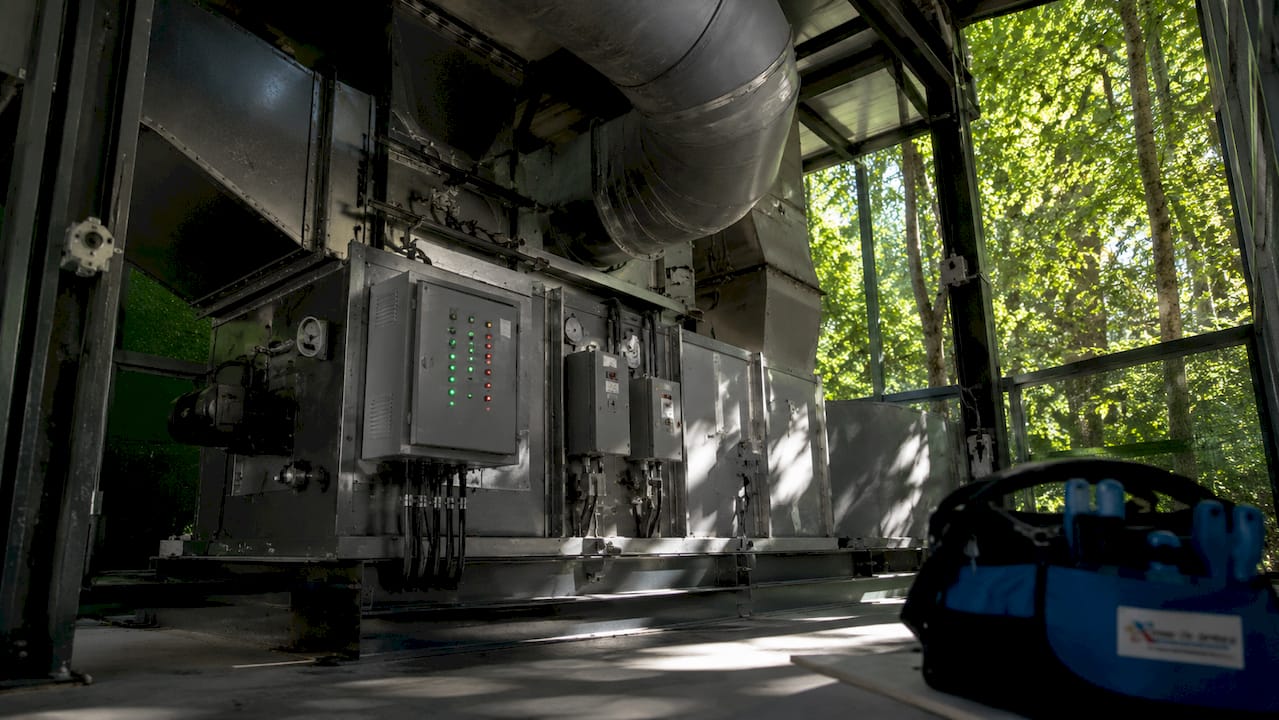
DOAS units handle 100% fresh air, preconditioning it separately from recirculated air before delivering it to occupied zones. This separation gives facility managers precise control over outdoor air quality and quantity independent of the main HVAC loop. Hospitals, laboratories, and schools rely on DOAS because their ventilation requirements are strict and their occupancy patterns are predictable. A DOAS unit serving multiple zones delivers clean, temperature-controlled air to each space without cross-contamination from return air.
Energy Recovery Ventilators (ERVs)
ERVs reduce energy load by transferring heat and moisture from outgoing stale air to incoming fresh air. The outgoing and incoming airstreams pass through a heat exchange core without mixing. In summer, the ERV pre-cools incoming hot outdoor air using the cooler exhaust air. In winter, it pre-warms cold outdoor air using warm exhaust. Modern commercial ERVs support airflow from 1,250 to 5,500 CFM, while larger make-up air units can handle up to 75,000 CFM for warehouses, manufacturing floors, and large assembly spaces. That range means ERVs scale from a mid-size office to a distribution center.
Heat Recovery Ventilators (HRVs) work on the same principle but transfer heat only, not moisture. HRVs suit dry climates where humidity transfer is not a priority. ERVs suit humid climates like the Gulf Coast and Southeast where controlling moisture in incoming air directly reduces cooling loads.
Pro Tip: In Texas and other high-humidity markets, specify an ERV over an HRV. Transferring moisture from incoming outdoor air to the exhaust stream cuts latent cooling loads significantly during summer months.
Why is fresh air intake critical for commercial buildings?
Fresh air intake boosts indoor air quality by diluting pollutants, controlling CO2 and humidity, and reducing odors. This matters most in tightly sealed modern buildings where there is almost no natural air leakage to provide passive ventilation.
The health case is direct. Elevated CO2 causes fatigue, reduced concentration, and headaches in occupants. Volatile organic compounds from carpets, furniture, cleaning products, and adhesives accumulate when outdoor air supply is insufficient. Proper fresh air ventilation dilutes both. The result is a measurable improvement in occupant comfort and cognitive performance.
The compliance case is equally direct. ASHRAE Standard 62.1 sets minimum outdoor air ventilation rates for commercial occupancies. Local building codes adopt ASHRAE 62.1 as their baseline. Failing to meet these rates during a building inspection or after a tenant complaint creates liability. Facility managers who cannot document their ventilation rates are exposed.
The energy management case is more nuanced. Tighter building envelopes in modern commercial buildings increase reliance on mechanical fresh air intakes as passive leaks are minimized. That shift is good for energy efficiency overall, but it places the entire ventilation burden on the mechanical system. A well-designed fresh air intake system with demand-controlled ventilation handles that burden without inflating utility bills.
The four primary benefits of a properly sized commercial air intake system are:
- Pollutant dilution. Outdoor air displaces CO2, VOCs, and biological contaminants that accumulate in occupied spaces.
- Humidity control. Conditioned outdoor air prevents moisture buildup that leads to mold growth in wall cavities and ductwork.
- Code compliance. Meeting ASHRAE 62.1 rates protects the building owner from liability and satisfies occupancy permits.
- Occupant productivity. Controlled fresh air delivery supports alertness and reduces sick-building complaints, which directly affects tenant retention.
Improving indoor air quality through a correctly configured fresh air system is one of the highest-return investments a facility manager can make per dollar spent on HVAC.
How do you choose the right fresh air intake system?
The right system depends on building size, occupancy type, climate, and budget. The table below compares the three primary options across the criteria that matter most to facility managers.
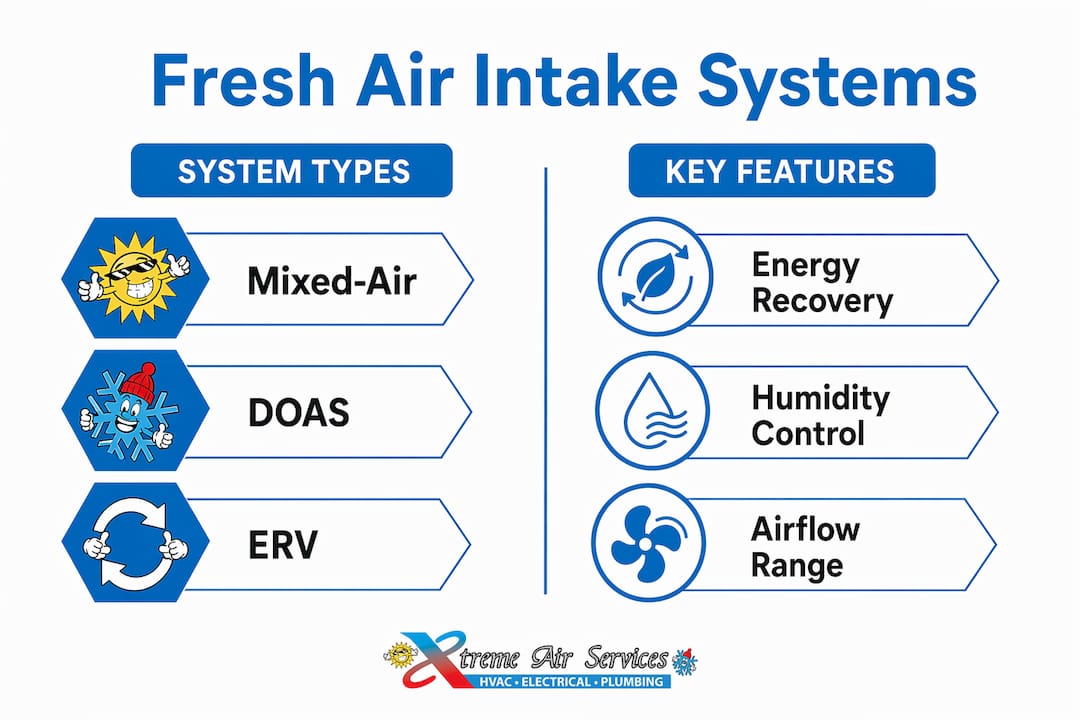
| System type | Best for | Airflow range | Energy recovery | Humidity control | Complexity |
|---|---|---|---|---|---|
| Conventional mixed-air | Small to mid-size offices | Varies by AHU | None | Limited | Low |
| DOAS | Hospitals, labs, schools | Varies by unit | Optional add-on | High | Medium |
| ERV | Offices, retail, healthcare | 1,250–75,000 CFM | Yes, heat and moisture | High | Medium |
| HRV | Dry-climate buildings | 1,250–5,500 CFM | Yes, heat only | Low | Medium |
Louver selection is a detail that facility managers frequently overlook until water appears inside the air handling unit. Drainable architectural louvers prevent water intrusion by channeling rainwater away from air openings. Non-drainable louvers allow water to pass through the blade assembly and into the ductwork, where it creates conditions for mold growth. Drainable louvers are the industry standard for commercial HVAC intake applications. Specifying anything else on a new installation or a retrofit is a maintenance liability from day one.
Climate is the other major variable. A building in Dallas, Texas faces extreme summer heat and humidity. An ERV with high-latent-load capacity is the right call. A building in Denver faces dry cold winters. An HRV handles that load efficiently without over-drying the incoming air. Building size and occupancy density determine airflow requirements. A 200,000-square-foot distribution center with 50 workers needs a very different solution than a 20,000-square-foot medical office with 300 daily patient visits.
Pro Tip: Run an HVAC air balancing test before specifying a new intake system. Actual measured airflows often differ from design values by 15% or more, and that gap changes your equipment selection.
What are the main maintenance challenges for fresh air intake systems?
Fresh air intake systems fail in predictable ways. Knowing the failure modes lets you prevent them before they become expensive.
Maintaining fresh air intake systems requires monitoring for water intrusion, adjusting intake rates based on occupancy, and regular service to avoid mold and energy waste. The most common maintenance failures are:
- Wrong louver type installed at commissioning. Non-drainable louvers allow water into the air stream. The fix is replacement with drainable louvers, not patching.
- Dampers stuck in fixed positions. A damper that cannot modulate defeats the entire demand-controlled ventilation strategy. Inspect actuators and linkages annually.
- Clogged pre-filters. Dirty filters restrict airflow, force the fan to work harder, and increase energy consumption. Replace on schedule, not on complaint.
- CO2 sensor drift. CO2 sensors lose calibration over time. A sensor reading 600 ppm when the actual level is 1,100 ppm will keep dampers closed when they should be open. Calibrate sensors annually.
- Mold in mixing plenums. Water intrusion from a failed louver or condensation from an undersized drain pan creates mold colonies that distribute spores throughout the building. Inspect plenums at every maintenance visit.
Modern commercial fresh air intake systems use BACnet-enabled fans and CO2 sensors to dynamically adjust fresh air in response to real-time occupancy. This smart control approach separates high-performance buildings from legacy ones. Buildings without these controls run at fixed outdoor air fractions regardless of actual occupancy, which wastes conditioning energy during nights, weekends, and low-occupancy periods.
The financial case for proper maintenance is straightforward. A damper stuck open on a 10,000-square-foot office floor in Dallas during August means the cooling system is conditioning full outdoor air volume around the clock. That single failure can add hundreds of dollars per month to utility costs. Regular preventive maintenance for commercial HVAC catches these failures before they show up on the utility bill.
Key Takeaways
Fresh air intake in commercial buildings is a mechanical ventilation process that requires the right system type, correct louver specification, and active controls to deliver indoor air quality without inflating energy costs.
| Point | Details |
|---|---|
| Define the system correctly | Fresh air intake is engineered outdoor air ventilation, not a passive gap in the building envelope. |
| Match system type to building | Choose ERVs for humid climates, HRVs for dry climates, and DOAS for hospitals, labs, and schools. |
| Specify drainable louvers | Non-drainable louvers cause water intrusion and mold; drainable louvers are the commercial standard. |
| Use demand-controlled ventilation | CO2 sensors and BACnet controls modulate outdoor air based on real occupancy, cutting conditioning costs. |
| Maintain on a fixed schedule | Annual damper inspection, filter replacement, and CO2 sensor calibration prevent the most common system failures. |
What most guides get wrong about fresh air intake
The prevailing advice tells facility managers to maximize fresh air. That advice is wrong. Precise ventilation tailored to occupancy is more energy-efficient and more effective than simply opening the dampers wide.
At Xtreme Air Services, we have seen this mistake repeatedly. A building manager reads that fresh air is good, so they set the outdoor air damper to maximum and leave it there. The indoor air quality numbers look fine. The utility bill does not. The cooling system runs at full load conditioning 100% outdoor air on a 98-degree August afternoon in Texas, and the equipment wears out years ahead of schedule.
The buildings that perform best are the ones where ventilation is treated as a dynamic variable, not a fixed setting. They use CO2 sensors to read actual occupancy. They use BACnet controls to modulate dampers in real time. They integrate fresh air intake with the building automation system so that a conference room gets more outdoor air at 2 p.m. on a Tuesday and almost none at 6 a.m. on a Sunday.
The other oversight I see constantly is louver specification. Architects and contractors sometimes install non-drainable louvers because they are cheaper. Within two years, the facility manager is dealing with water stains, mold remediation costs, and an IAQ complaint from a tenant. Specifying drainable architectural louvers at the design stage costs less than one mold remediation job.
The future of fresh air intake is tighter integration with building automation, real-time air quality monitoring, and predictive maintenance triggered by sensor data rather than calendar dates. Buildings that invest in that infrastructure now will outperform their peers on energy costs, tenant satisfaction, and asset value for the next decade.
— Xtreme
Professional fresh air intake services from Xtreme Air Services
Your building’s fresh air intake system directly affects occupant health, energy costs, and code compliance. A system that was correctly specified five years ago may be running on drifted sensors, clogged filters, and stuck dampers today.
Xtreme Air Services provides commercial HVAC maintenance, fresh air system inspections, ERV and DOAS servicing, and full system upgrades for facility managers across Dallas, Plano, Irving, and Sunnyvale, TX. Our technicians calibrate CO2 sensors, inspect louvers and dampers, and verify that your outdoor air rates meet ASHRAE 62.1 requirements. An HVAC maintenance plan from Xtreme Air Services puts your fresh air intake system on a fixed service schedule so failures get caught before they cost you. Contact Xtreme Air Services to schedule a commercial ventilation assessment.
FAQ
What does fresh air intake mean in a commercial building?
Fresh air intake is the engineered process of drawing outdoor air into a commercial HVAC system to dilute indoor pollutants, control CO2 levels, and meet ASHRAE 62.1 ventilation requirements. It includes louvers, dampers, filters, and in modern buildings, ERVs or DOAS units.
How much fresh air does a commercial building need?
ASHRAE Standard 62.1 sets minimum outdoor air ventilation rates based on occupancy type and floor area. Actual requirements vary by building use, so a medical office needs more outdoor air per person than a warehouse.
What is the difference between an ERV and a DOAS?
An ERV recovers heat and moisture from exhaust air to precondition incoming outdoor air, reducing HVAC load. A DOAS handles 100% outdoor air independently from the recirculated air loop, giving facility managers separate control over fresh air delivery to each zone.
Why do fresh air intake louvers matter?
Drainable louvers channel rainwater away from the air opening, preventing water intrusion and mold growth inside ductwork. Non-drainable louvers allow water to pass through and are not suitable for commercial HVAC intake applications.
How often should a commercial fresh air intake system be serviced?
Annual service is the minimum standard, covering damper actuator inspection, filter replacement, CO2 sensor calibration, and louver condition checks. Buildings with high occupancy or strict IAQ requirements benefit from semi-annual inspections.
Recommended
- Why Commercial Ductwork Differs From Residential Systems
- Types Of Commercial HVAC Systems: 2026 Facility Guide
- What Is Demand Controlled Ventilation? A 2026 Guide
Need professional help? Explore our commercial air conditioning and heating.