
Indoor air quality (IAQ) is the cleanliness and safety of the air inside buildings. It directly determines how healthy and productive the people inside those buildings are.
The EPA classifies IAQ as a top environmental health concern, and for good reason. People in developed countries spend about 90% of their time indoors. That makes the air inside your home or office your primary long-term pollutant exposure.
Understanding why indoor air quality matters is the first step toward protecting yourself, your family, and your team.
Why indoor air quality matters more than most people realize
Indoor air quality matters because the air inside is often dirtier than the air outside, and you breathe it far more often. Most people assume outdoor air is the bigger threat. The data says otherwise.
Indoor pollutant levels can be 2 to 5 times higher than outdoor levels. That gap exists because buildings trap contaminants, while people, appliances, and building materials keep generating new ones.
The scale of the problem is serious. Indoor air pollution ranks as the third leading cause of air quality related death globally. Only outdoor air pollution and cooking related pollution rank higher.
That statistic reframes IAQ from a comfort issue into a genuine public health priority.
Business managers often underestimate this risk. A workplace that smells clean can still contain elevated carbon dioxide or volatile organic compounds (VOCs). Those levels reduce focus and increase sick days.
The WHO confirms that improved IAQ policies deliver dual benefits: better occupant health and reduced environmental burden.
For homeowners and business managers alike, the importance of indoor air is not abstract. It shows up in how people feel, think, and perform every single day.

What are common indoor air pollutants and their sources?
The most common indoor pollutants are carbon monoxide, smoke, radon, mold, particulate matter, and VOCs, all identified by the EPA. Each one has a different source, and most originate inside the building itself.
Here is where the major pollutants come from:
- Particulate matter (PM2.5 and PM10): Cooking, candles, fireplaces, and tobacco smoke are the primary generators. Fine particles penetrate deep into lung tissue.
- Volatile organic compounds (VOCs): Paints, adhesives, cleaning products, furniture, and new flooring off-gas VOCs continuously, especially in the first months after installation.
- Carbon monoxide (CO): Gas stoves, furnaces, water heaters, and attached garages produce CO. It is colorless and odorless, making it invisible without a detector.
- Radon: This radioactive gas seeps up from soil through foundation cracks. The EPA estimates it causes tens of thousands of lung cancer deaths in the U.S. annually.
- Mold spores: Moisture from leaks, poor ventilation, or high humidity feeds mold growth. Attic mold is a particularly overlooked source that spreads spores throughout a home’s air supply.
- Biological contaminants: Dust mites, pet dander, and bacteria thrive in poorly ventilated, humid spaces.
The concentration problem compounds indoors because buildings are sealed for energy efficiency. Outdoor air dilutes pollutants naturally. Indoors, without active ventilation, those same pollutants accumulate.
A freshly painted room, a gas range running at dinner, and a damp basement corner can combine to create air that is measurably harmful, even if it smells normal.
Pro Tip: Open windows during and after painting, cooking, or using cleaning sprays. Even 10 minutes of cross ventilation cuts VOC concentrations significantly.
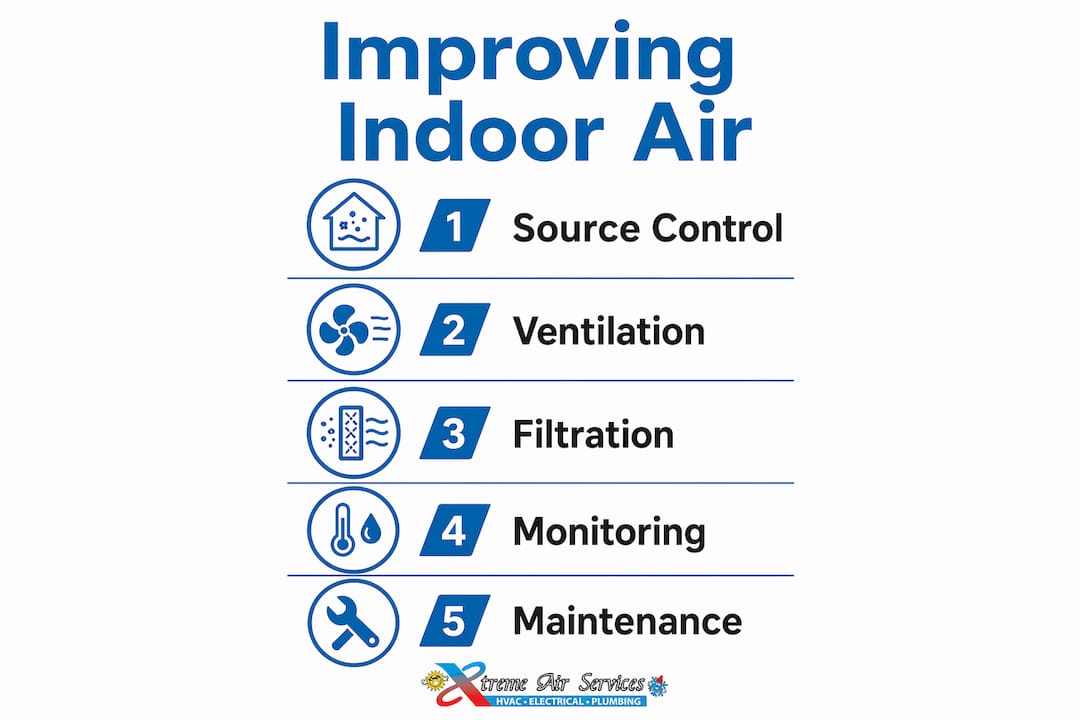
Source control is the first line of defense. Removing or reducing the pollutant at its origin is always more effective than trying to filter or dilute it after the fact.
What are the health impacts of poor indoor air quality?
Poor IAQ produces both immediate and long-term health effects. The short-term symptoms are easy to dismiss because they mimic common illnesses.
Immediate effects include:
- Headaches and dizziness
- Eye, nose, and throat irritation
- Fatigue and difficulty concentrating
- Skin irritation and nausea
These symptoms often disappear when a person leaves the building, which is a key diagnostic clue. If you or your team feel better on weekends or away from the office, IAQ deserves investigation.
The long-term picture is more serious. Chronic exposure to indoor pollutants is linked to three major health outcomes:
- Respiratory diseases like asthma and chronic obstructive pulmonary disease (COPD)
- Cardiovascular risks
- Measurable cognitive decline
Children, pregnant women, and older adults face the highest risk. Children exposed to poor IAQ during development show smaller lung capacity and cognitive impairments that persist into adulthood. That is not a recoverable outcome.
“Healthy indoor air is a core public health infrastructure issue, not a niche concern. Poor IAQ acts as a threat multiplier, amplifying biological and chemical risks indoors.” — Health Policy Watch
The productivity data is equally striking. Meeting air quality standards above the minimum can reduce absenteeism and infections by over 33% and improve cognitive function by up to 50%.
For a business manager, that is not a wellness initiative. It is a performance investment.
| Health impact | Affected group | Consequence |
|---|---|---|
| Reduced lung development | Children | Lifelong reduced lung capacity |
| Cognitive decline | All occupants | Impaired focus, memory, and decision-making |
| Respiratory disease | Adults with chronic exposure | Asthma, COPD, increased hospitalization |
| Cardiovascular risk | Older adults | Elevated risk of heart disease and stroke |
| Increased absenteeism | Employees | Lost productivity and higher healthcare costs |
How can ventilation, filtration, and source control improve air quality?
Ventilation, filtration, and source control improve air quality by attacking pollutants in three different ways: removing them at the source, diluting them with fresh air, and cleaning what remains. Each plays a different role, and none of them works well in isolation.
Source control
Source control is the most effective and cost-efficient strategy. It means eliminating or reducing the pollutant before it enters the air.
Practical examples include:
- Switching to low-VOC paints
- Sealing radon entry points
- Fixing moisture leaks before mold establishes
- Replacing gas appliances with electric alternatives where feasible
Ventilation
Ventilation dilutes indoor pollutants by bringing in outdoor air. Increasing outdoor air ventilation correlates directly with lower absenteeism and better cognitive test scores. Understanding how home ventilation works is the foundation for making smart decisions about your system.
The limitation is that ventilation depends on outdoor air quality. On high-pollution days, bringing in more outdoor air can worsen IAQ rather than improve it.
Air cleaning and filtration
Air cleaning captures the pollutants that source control and ventilation miss. HVAC filters are rated by their Minimum Efficiency Reporting Value (MERV). A MERV 8 filter catches large particles like dust and pollen. A MERV 13 filter captures fine particles including some bacteria and smoke.
Upgrading your HVAC air filter is one of the simplest improvements a homeowner can make. Whole-home air purifiers, such as the Trane Clean Effects system, go further by capturing ultrafine particles that standard filters miss.
Here is a practical sequence for improving IAQ in any building:
- Identify and eliminate or reduce pollutant sources first.
- Assess your current ventilation rate and fix any ductwork or mechanical issues.
- Upgrade HVAC filters to at least MERV 11 for residential use.
- Add supplemental air cleaning for spaces with persistent pollutant issues.
- Test and monitor results with CO2 meters or VOC detectors.
Pro Tip: A common mistake is relying on odor or comfort as a proxy for air quality. Air can smell completely neutral and still contain CO2 or VOC levels high enough to impair judgment. Use a monitor, not your nose.
Many HVAC systems are designed to meet comfort targets, not health-based air quality standards. That distinction matters. A system that keeps your home at 72°F may still be recirculating air with elevated pollutant concentrations if filtration and ventilation are not properly configured.
What steps can homeowners and business managers take to monitor IAQ?
You monitor IAQ by installing detectors, using CO2 and VOC meters, scheduling professional assessments, and maintaining your HVAC system. Monitoring is what separates guessing from knowing. You cannot manage what you do not measure.
Start with these practical steps:
- Install CO and radon detectors. Carbon monoxide detectors are required by code in most states. Radon test kits are inexpensive and available at hardware stores. The EPA recommends testing every two years and after any major renovation.
- Use a CO2 monitor. Elevated CO2 is a reliable proxy for poor ventilation. Levels above 1,000 parts per million (ppm) indicate inadequate fresh air exchange. Levels above 1,500 ppm correlate with measurable drops in cognitive performance.
- Add a VOC detector. These devices flag off-gassing from furniture, flooring, and cleaning products. They are especially useful in newly renovated spaces or offices with new furnishings.
- Schedule professional IAQ assessments. A certified technician can test for radon, mold, particulate matter, and combustion byproducts simultaneously. This gives you a complete picture that consumer devices cannot replicate.
- Maintain your HVAC system on a regular schedule. Dirty coils, clogged filters, and degraded ductwork all reduce air quality. Xtreme Air Services recommends changing filters every 1 to 3 months depending on filter type and household conditions. Watch for signs you need HVAC repair before small issues become air quality problems.
- Inspect for mold annually. Check attics, crawl spaces, and areas around HVAC equipment. Negative air pressure techniques used during mold remediation prevent spores from spreading to clean areas of the building.
- Review ventilation before and after renovations. New flooring, cabinetry, or insulation can introduce significant VOC loads. Plan ventilation upgrades as part of any remodel budget.
Business managers should treat IAQ monitoring as a facilities management standard, not an optional upgrade. The productivity and absenteeism data alone justify the investment. A CO2 monitor in a conference room costs less than one sick day per employee.
Key takeaways
Clean indoor air is the single most controllable environmental health factor for people who spend most of their lives inside buildings. That is exactly why indoor air quality matters for every household and workplace.
| Point | Details |
|---|---|
| IAQ directly affects health | Indoor pollutants reach 2 to 5 times outdoor levels, causing both immediate and chronic health effects. |
| Source control comes first | Eliminating pollutant sources is more effective than filtration or ventilation alone. |
| Vulnerable groups face higher risk | Children, older adults, and pregnant women experience lasting harm from chronic IAQ exposure. |
| Better air improves performance | Meeting health-based air quality standards can reduce absenteeism by over 33% and boost cognitive function by up to 50%. |
| Monitoring is non-negotiable | CO2 meters, VOC detectors, and professional assessments give you real data to act on. |
What I’ve learned after years of working inside people’s homes and buildings
The most common misconception I encounter is that if the air smells fine, it is fine. That belief causes more preventable health problems than almost any other IAQ myth.
Carbon monoxide has no smell. Radon has no smell. VOCs from new flooring off-gas for months without any detectable odor at low concentrations. The air quality problems that hurt people the most are the ones they never notice.
The second thing I have observed is that energy efficiency upgrades and IAQ often work against each other when they are not planned together. Tighter building envelopes trap more pollutants.
Homeowners who seal their attics and add insulation without upgrading ventilation frequently see a spike in indoor humidity, mold risk, and VOC concentration.
The fix is not to avoid efficiency upgrades. The fix is to plan ventilation as part of every efficiency project from the start.
Business managers tend to respond faster once they see the productivity numbers. The cognitive function data is the argument that lands.
When I explain that a poorly ventilated conference room can reduce decision-making performance by a measurable margin, the conversation shifts from “is this worth the cost” to “how do we fix it this quarter.”
The good news is that IAQ is one of the most fixable environmental health problems you face. Unlike outdoor air pollution, you control the sources, the ventilation, and the filtration inside your own building. That control is worth using.
— Xtreme
Professional HVAC services that protect your indoor air
Xtreme Air Services provides HVAC maintenance, inspections, and air quality upgrades for homes and businesses across the Dallas area. A well-maintained HVAC system is the foundation of healthy indoor air.
Regular professional service keeps filters, coils, and ductwork performing at the level your family or team needs. Industry groups like the Air Conditioning Contractors of America recommend routine professional maintenance to sustain long-term indoor air performance.

Xtreme Air Services offers HVAC maintenance plans designed to keep your system running cleanly year-round. Each plan includes scheduled filter changes, coil cleaning, and system checks that catch air quality problems before they affect your health.
For homeowners ready to take a more active approach, the home air quality page outlines specific upgrades available for your system. Contact Xtreme Air Services to schedule an assessment and get a clear picture of what your indoor air actually contains.
FAQ
What is indoor air quality (IAQ)?
Indoor air quality refers to the cleanliness and safety of the air inside buildings. The EPA defines it by the presence and concentration of pollutants like particulate matter, VOCs, carbon monoxide, radon, and mold spores.
How do I know if my indoor air quality is poor?
Persistent headaches, fatigue, eye irritation, or symptoms that improve when you leave the building are common warning signs. CO2 monitors, VOC detectors, and professional IAQ assessments provide objective measurements.
What is the most effective way to improve indoor air quality?
Source control is the most effective strategy, meaning you eliminate or reduce pollutants at their origin. Combining source control with proper ventilation and MERV-rated filtration delivers the best results.
How often should HVAC filters be changed for good air quality?
Most residential filters should be changed every 1 to 3 months. Higher-MERV filters and homes with pets, allergies, or recent renovations typically require more frequent changes.
Are children more at risk from poor indoor air quality?
Children face higher risk because their lungs and nervous systems are still developing. Chronic exposure to indoor pollutants can cause smaller lung development and cognitive impairments that persist into adulthood.