


A building automation system (BAS) is a centralized network that monitors and controls a building’s mechanical, electrical, lighting, security, and safety systems from a single platform.
The role of BAS technology is to replace manual, reactive management with automated, data-driven control. That control cuts energy waste, improves occupant comfort, and reduces operating costs. Industry standards from ASHRAE and NFPA define the performance benchmarks these systems must meet.
A well-configured BAS reduces total energy consumption by 10% to 30%. For a typical commercial building, that translates to $50,000 to $150,000 in annual savings.
What is the role of building automation systems in modern buildings?
A BAS acts as the operational brain of any commercial property. It connects sensors, controllers, and actuators across every major building system and coordinates their behavior based on real-time data.
Without that coordination, three problems take over:
- HVAC runs on fixed schedules regardless of occupancy
- Lights stay on in empty rooms
- Maintenance teams respond to failures instead of preventing them
The true purpose of a BAS is balancing three competing priorities: occupant comfort, life safety, and energy efficiency. Getting all three right at once requires integrated control, not three separate systems run by three separate teams.
That integration is what separates a modern automated building from a conventionally managed one.

Property managers who treat a BAS as just an HVAC controller miss most of its value. The system also manages lighting zones, access control, fire suppression coordination, and energy metering.
Each of those functions generates data. Analyzed together, that data gives you a complete picture of how your building performs and where money is being lost.
What are the main components and features of building automation systems?
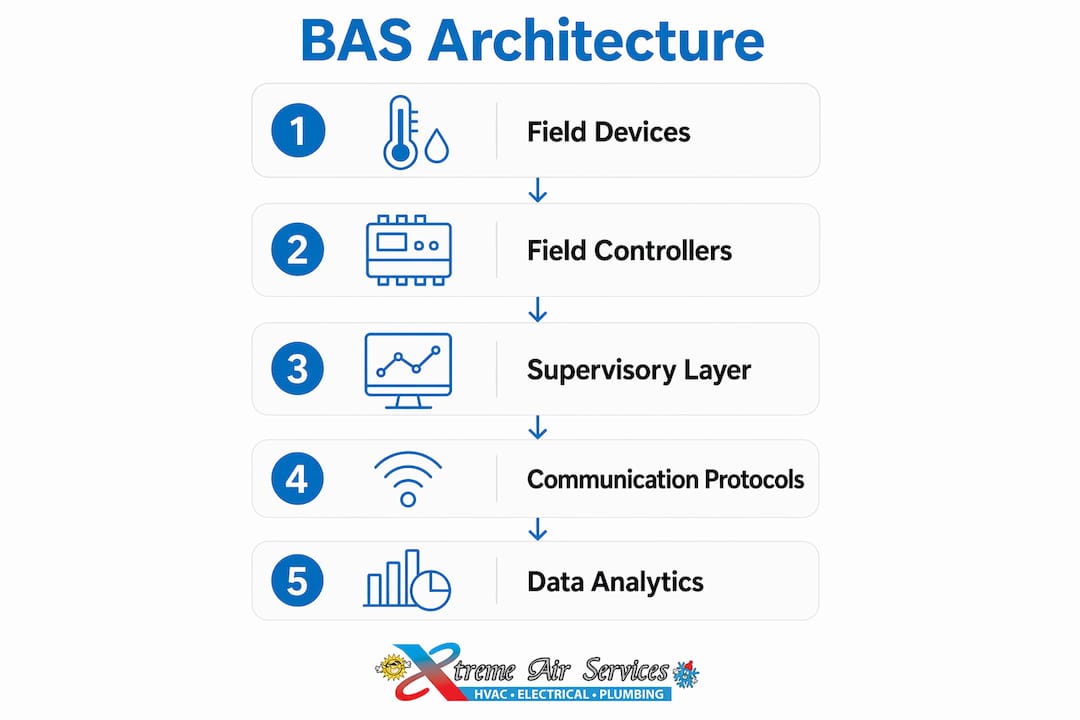
Every BAS is built from three functional layers: field devices, field controllers, and a supervisory platform. Understanding that architecture helps you ask the right questions when evaluating or upgrading a system.

The three core layers of BAS architecture
BAS architecture has three core layers, each with a distinct job. The field device layer collects data, the field controller layer runs the logic, and the supervisory layer manages the whole system.
Field Device Layer contains the physical hardware: temperature sensors, CO2 sensors, occupancy sensors, variable frequency drives, damper actuators, and valve actuators. These devices collect raw data and execute commands. The quality and placement of sensors at this layer directly determines how accurately the system can respond.
Field Controller Layer is where the logic lives. Direct Digital Controllers (DDC) process sensor inputs and run programmed sequences to control equipment. Critically, field controllers operate independently even when the central network goes down. That local resilience keeps your building comfortable and safe during network outages. Many property managers overlook this detail when comparing systems.
Supervisory Layer is the dashboard and analytics platform your team interacts with daily. This layer aggregates data from all controllers, generates reports, sends alerts, and allows remote adjustments. Modern supervisory platforms connect to cloud services and mobile apps, giving facility managers real-time visibility from anywhere.
Key BAS features by function
BAS features fall into five functional categories, each controlling a different building system and delivering a specific benefit.
| Function | What BAS controls | Primary benefit |
|---|---|---|
| HVAC regulation | Air handlers, chillers, boilers, VAV boxes | Energy savings, comfort |
| Lighting automation | Occupancy-based dimming and scheduling | Reduced electricity use |
| Security integration | Access control, cameras, door locks | Centralized monitoring |
| Fire and life safety | Smoke dampers, elevators, alarms | Emergency response |
| Energy metering | Real-time consumption tracking | Cost visibility and reduction |
Communication protocols tie all three layers together. Open protocols like BACnet/IP and tagging standards like Project Haystack let devices from different manufacturers communicate without proprietary middleware.
That interoperability is not a technical nicety. It is financial protection against being locked into one vendor’s ecosystem for the life of your building.
How does building automation improve energy efficiency and operational control?
Energy management is where a BAS delivers its most measurable financial return. BAS systems manage roughly 40% of building energy usage, and up to 70% when lighting is included.
That concentration of energy control in one system means even modest configuration improvements produce significant savings.
The Dubai World Trade Center documented over $136,000 in annual energy savings after implementing a fully integrated BAS. That figure is not exceptional. It reflects what happens when HVAC and lighting schedules align with actual occupancy patterns instead of fixed clock timers.
From reactive maintenance to predictive control
A BAS moves your building from reactive repairs to predictive control, and the payoff goes beyond energy bills. A properly configured system extends mechanical equipment lifespan by 20% to 40%. It does this by catching performance degradation before it becomes equipment failure.
Consider a chiller running 5% outside its normal operating parameters. That anomaly shows up in BAS trend data weeks before the unit fails. Your maintenance team can then schedule a repair during off-hours instead of managing an emergency on a summer afternoon.
The financial gap between planned and emergency maintenance is substantial. Emergency HVAC repairs on commercial equipment routinely cost three to five times more than scheduled service, and that does not count tenant complaints or lease risk.
Pairing a BAS with a structured commercial HVAC preventive maintenance program compounds those savings further.
Sustainability and compliance benefits
Sustainability mandates are becoming financial obligations, not just corporate values. ESG reporting requirements and carbon penalty frameworks in major markets mean buildings without documented energy performance data face real financial exposure.
A BAS generates that data automatically. It creates an audit trail for compliance reporting without additional staff time.
- Automated demand response reduces peak load charges from utilities
- Occupancy-based ventilation cuts HVAC runtime without sacrificing air quality
- Real-time energy dashboards identify waste within hours, not months
- Integration with renewable energy sources allows dynamic load balancing
Pro Tip: Set your BAS to generate a weekly energy variance report. Any zone consuming more than 15% above its baseline for three consecutive days signals either a control fault or an occupancy change worth investigating.
What are the best practices for implementing a BAS?
The best practices for implementing a BAS come down to decisions made at the planning stage. Those decisions determine whether your system delivers its projected savings or becomes an expensive maintenance burden. The most common mistake is prioritizing upfront cost over long-term flexibility.
-
Choose open protocols from the start. Specify BACnet/IP as the required communication standard in your procurement documents. Proprietary protocols lock you into one vendor’s hardware and software for every future upgrade. Open standards let you swap components or add AI analytics services without replacing the entire system.
-
Integrate life safety systems with proper override priority. NFPA 72 and NFPA 92 standards govern how fire alarms, smoke dampers, and emergency elevators interact with BAS controls. Life safety commands must always override comfort and energy controls. Confirm that your system design documents this hierarchy explicitly before installation begins.
-
Plan for the Field Controller Layer to operate independently. Every field controller should run its programmed sequences without relying on the supervisory network. If your central server goes offline, the building should continue operating normally. This is a design requirement, not a default feature in every system.
-
Treat building data as a financial asset. Buildings viewed as data-generating assets consistently outperform conventionally managed properties on Net Operating Income. Structure your BAS data architecture so that occupancy trends, energy consumption, and equipment performance feed into your property management reporting, not just your engineering team’s dashboards.
-
Plan for scalability before you need it. Adding a new tenant floor or integrating an EV charging station should not require replacing your BAS backbone. Specify controller capacity headroom and network bandwidth margins in your initial design. Upgrading a system that was designed for growth costs a fraction of replacing one that was not.
Pro Tip: When evaluating BAS vendors, ask specifically which data you own and in what format you can export it. If the answer is unclear or proprietary, that is a warning sign worth taking seriously. Engaging an HVAC project manager with BAS experience during procurement can prevent costly specification errors.
What future trends are shaping building automation systems?
The BAS market is moving from isolated control systems toward unified building ecosystems that generate operational intelligence. Several specific shifts are already affecting purchasing decisions in 2026.
- AI-driven occupancy control replaces static time schedules with adaptive algorithms that learn occupancy patterns and adjust HVAC and lighting in real time. AI-based occupancy control is now considered best practice, with static schedules increasingly viewed as a source of unnecessary energy waste.
- Cloud connectivity and data orchestration allow property managers to compare performance across a portfolio of buildings from a single dashboard. Anomalies in one building trigger alerts before they affect tenant experience.
- Carbon penalty frameworks are creating financial urgency around energy performance. Buildings that cannot document their consumption and reduction efforts face regulatory penalties in an expanding number of jurisdictions.
- Modular AI services can now be added to existing BAS infrastructure without full system replacement, provided the underlying architecture uses open protocols. This makes upgrading incrementally financially practical for most commercial properties.
- Buildings as living assets is the framing gaining traction among institutional property owners. A building that generates continuous operational data is worth more than one that does not, because that data directly supports NOI improvement decisions.
The property managers who will benefit most from these trends are the ones who start treating their BAS not as a mechanical control system but as a data platform. The hardware controls the building. The data tells you how to run the business.
Key Takeaways
A building automation system is the single most effective tool for reducing energy costs, extending equipment life, and generating the operational data that drives property value.
| Point | Details |
|---|---|
| Energy savings are quantifiable | A well-configured BAS cuts energy use by 10% to 30%, with documented cases exceeding $136,000 in annual savings. |
| Open protocols protect your investment | Specifying BACnet/IP prevents vendor lock-in and keeps future upgrades affordable. |
| Life safety always takes priority | NFPA 72 and NFPA 92 compliance must be built into BAS design, not added as an afterthought. |
| Data is a financial asset | Building performance data directly supports NOI improvement and ESG compliance reporting. |
| Predictive maintenance pays | BAS-enabled predictive maintenance extends equipment lifespan by 20% to 40% and eliminates most emergency repair costs. |
What I’ve learned about BAS after years in building services
Most property managers I talk to think about a BAS in terms of what it controls. I think about it in terms of what it reveals. The control functions are table stakes. The real value is the continuous stream of performance data that tells you exactly where your building is losing money and why.
The biggest mistake I see is buying a BAS and then configuring it once at installation and never touching it again. Buildings change. Tenants change. Occupancy patterns shift. A system configured for a building’s original use case will drift out of alignment with actual conditions within 18 months. That drift is where the energy waste and comfort complaints come from.
I am also skeptical of proprietary systems, and I say that directly. Any vendor who cannot clearly explain how you export your own data in a standard format is selling you a dependency, not a solution. Open standards like BACnet/IP exist precisely because the industry learned this lesson the hard way.
The property managers I respect most treat their BAS the way a CFO treats a financial reporting system. They review the data regularly, they act on anomalies quickly, and they use the trend information to make capital planning decisions. That discipline is what separates buildings that consistently perform from ones that consistently surprise their owners with repair bills.
— Xtreme
How Xtremeairservices supports your building automation goals
A BAS is only as effective as the mechanical systems it controls. If your HVAC equipment is degraded, your automation system will work harder to compensate and still fall short of its efficiency targets.

Xtremeairservices provides HVAC maintenance plans designed specifically for commercial properties where building automation systems are in place. Regular preventive maintenance keeps your equipment performing within the parameters your BAS expects, which is what allows the system to deliver its projected energy savings.
Xtremeairservices also provides electrical services that support BAS infrastructure, including panel upgrades and wiring for sensor and controller installations.
If you manage a commercial property in the Dallas, Plano, Irving, or Sunnyvale area, Xtremeairservices is ready to help you get more from your building systems.
FAQ
What is a building automation system?
A building automation system is a centralized control network that monitors and manages a building’s HVAC, lighting, security, and life safety systems from a single platform. Its primary purpose is to improve energy efficiency, occupant comfort, and operational control.
How much energy can a BAS save?
A properly configured BAS reduces total building energy consumption by 10% to 30%. The Dubai World Trade Center documented over $136,000 in annual savings as a direct result of BAS implementation.
What communication protocol should a BAS use?
BACnet/IP is the industry-standard open protocol for building automation systems. It prevents vendor lock-in and allows components from different manufacturers to communicate without proprietary middleware.
How does a BAS handle fire and life safety emergencies?
Life safety systems integrated with a BAS must comply with NFPA 72 and NFPA 92 standards. During an emergency, fire alarms automatically control smoke dampers, override HVAC, and manage elevator functions, with life safety commands always taking priority over comfort or energy controls.
What happens to a BAS if the central network goes down?
Field controllers at the equipment level continue running their programmed sequences independently, even without a connection to the supervisory network. This local control capability keeps building systems operating normally during network outages.