

Poor HVAC air balancing in a commercial space shows up fast. One side of the floor is too hot, the other too cold, occupants are filing complaints, and your energy bills keep climbing with no obvious explanation. These are not random equipment failures. They are symptoms of a system that has drifted out of balance. This guide walks you through exactly what facility managers need to know about hvac air balancing commercial space work: from the tools you need before you start, to the step-by-step execution process, to the verification routines that keep performance locked in long after the initial balance is done.
Table of Contents
- Key Takeaways
- What HVAC air balancing in a commercial space actually requires
- Step-by-step execution for balancing commercial HVAC airflow
- Verification and maintenance after balancing
- Troubleshooting common air balancing problems
- My honest take on air balancing and what most facilities get wrong
- How Xtreme Air Services helps you keep your system in balance
- FAQ
Key Takeaways
| Point | Details |
|---|---|
| Prepare before you measure | Gather duct layout documents, verify damper accessibility, and collect design airflow specs before touching any settings. |
| Adjust gradually, not drastically | Incremental damper adjustments prevent pressure cascades that throw other zones out of balance. |
| Hidden faults waste real money | 30% of VAV boxes operate with faults invisible to BAS alarms, wasting up to 30% of HVAC energy. |
| Verify with data, not just feel | Post-balance temperature uniformity checks and AFDD monitoring confirm success more reliably than occupant feedback alone. |
| Ongoing maintenance sustains results | Regular sensor calibration, damper inspections, and setpoint audits prevent gradual performance drift after balancing. |
What HVAC air balancing in a commercial space actually requires
Before you pick up a balancing hood or touch a damper, you need a clear picture of what the system was designed to do versus what it is actually doing. That gap is where most air balancing problems live.
The tools you need on site
Effective commercial HVAC airflow management starts with the right instruments. A balancing hood (also called a flow hood) captures airflow volume directly at supply and return registers. An anemometer measures air velocity at grilles. A pitot tube with a manometer reads static pressure inside ductwork. You also need a digital pressure gauge to check duct static pressure differentials across the system.
| Tool | Purpose | Usage tip |
|---|---|---|
| Balancing hood | Measures CFM at registers | Position flush against grille face to avoid leakage errors |
| Anemometer | Measures air velocity at diffusers | Average multiple readings across the grille face |
| Pitot tube + manometer | Reads duct static pressure | Use in straight duct sections at least 10 duct diameters from fittings |
| Digital pressure gauge | Checks pressure differentials | Zero the gauge before each use for accuracy |
| Data logger | Tracks temperature and humidity over time | Place in occupied zones, not near supply registers |
Documentation and damper access
Pull the original mechanical drawings and any as-built documents for the building. You need the design airflow values for every zone, the duct layout, and the location of every balancing damper. Damper accessibility and function are preconditions for effective air balancing. Without physically reachable, operable dampers, your calculations stay on paper.
Walk the building before you start measuring. Confirm that access panels exist above ceilings where dampers are located. Flag any dampers that are painted shut, corroded, or buried behind finished ceilings with no access point. Resolving those issues before you begin saves you from discovering mid-process that you cannot implement the adjustments you calculated.
Pro Tip: Create a simple spreadsheet that maps every zone to its design CFM, current measured CFM, and damper location before the balancing session. This single document will cut your on-site time significantly.
Step-by-step execution for balancing commercial HVAC airflow
With your tools ready and documentation in hand, the actual balancing process follows a specific sequence. Skipping steps or jumping to adjustments before completing measurements is the most common reason a balance job has to be redone.
The balancing sequence
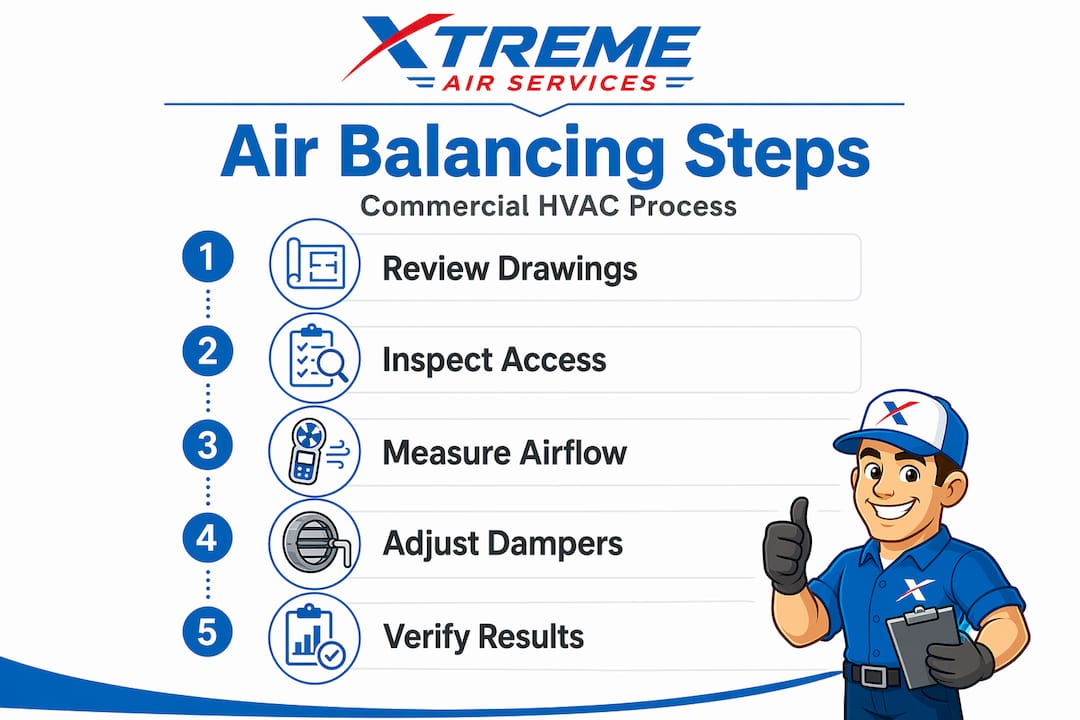
- Measure all supply registers first. Record actual CFM at every supply outlet in the system before adjusting anything. This gives you a complete baseline and shows you the full distribution pattern.
- Measure all return registers. Return airflow imbalances are often overlooked. A zone that receives proper supply air but has an undersized return path will still feel stuffy and pressurized.
- Calculate the ratio of actual to design airflow for each zone. Zones delivering more than 110% of design CFM are over-served. Zones below 90% are under-served.
- Start adjustments at the zone farthest from the air handler. Restrict over-served zones first by partially closing their balancing dampers. This pushes pressure toward under-served zones.
- Make gradual adjustments. Incremental airflow changes using balancing dampers prevent system-wide pressure imbalances that occur when you make large, sudden changes.
- Re-measure after each round of adjustments. One adjustment affects the entire system. Measure again after each pass before making additional changes.
- Adjust VAV box minimum and maximum airflow setpoints. Use the building automation system to verify that VAV box settings match current occupancy patterns and zone requirements, not just original commissioning values.
- Check and correct static pressure imbalances. If the supply fan is running at a static pressure setpoint that is too high or too low, adjust the setpoint or fan speed to match the balanced condition.
Manual vs. automated adjustment techniques
| Method | Best use case | Tradeoff |
|---|---|---|
| Manual damper adjustment | Initial balancing, older systems without controls | Time-intensive, requires re-measurement after each change |
| VAV box setpoint adjustment via BAS | Zones with variable occupancy or load changes | Requires accurate sensors; sensor drift degrades results over time |
| Automated pressure-independent VAV control | High-performance systems with ASHRAE Guideline 36 sequences | Higher upfront cost, but self-corrects and supports AFDD |
| Fan speed adjustment (VFD) | Systems where duct static pressure is consistently off | Must be rebalanced after fan speed changes |
Pro Tip: When adjusting VAV box setpoints, correcting minimum airflow settings to match actual occupancy can reduce energy consumption by 10 to 30%. Most systems are still running the minimum setpoints from original commissioning, which rarely reflects how the space is actually used today.
Verification and maintenance after balancing
Completing the balance is not the finish line. It is the starting point for a performance baseline you need to protect.
How to verify the balance worked
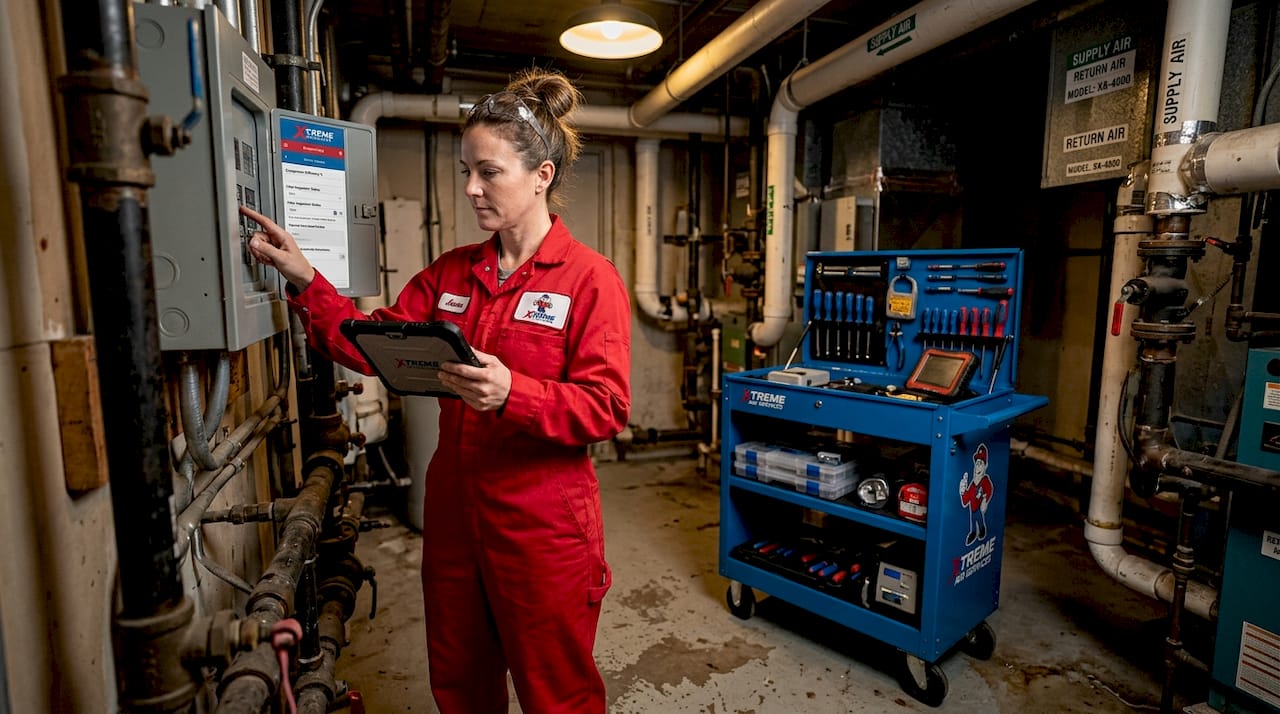
After completing adjustments, walk every zone with a temperature probe and compare readings to the thermostat setpoints. Proper air balancing ensures temperature uniformity across zones, and that uniformity is your primary confirmation that the work succeeded. Zones within plus or minus 2°F of setpoint across the floor indicate a well-balanced system.
Review your BAS data for supply and return airflow readings over the first two weeks after balancing. Look for zones that drift back toward their pre-balance condition. Drift usually points to a damper that is not holding position or a VAV actuator that is losing calibration.
Using AFDD to protect your results
ASHRAE Guideline 36 now mandates automated fault detection and diagnostics for high-performance VAV sequences. AFDD catches stuck dampers, sensor drift, and control deviations before they trigger occupant complaints or show up in your energy bill. If your BAS supports AFDD, activate it immediately after balancing so you have a clean baseline to compare against.
The maintenance tasks that preserve your balance long-term include:
- Calibrate airflow and temperature sensors on a scheduled basis, at minimum annually
- Inspect balancing dampers for corrosion, slippage, or actuator failure every six months
- Audit VAV box minimum airflow setpoints quarterly and compare against current occupancy schedules
- Review BAS trend data monthly for zones that show consistent deviation from setpoint
- Verify that space use changes (new conference rooms, server rooms, densified workstations) are reflected in updated airflow setpoints
Balanced cooling solutions can reduce pumping energy consumption by up to 40% in continuously operating commercial facilities when the system is properly maintained after balancing. That number does not materialize from a one-time balance job. It comes from sustained discipline.
Troubleshooting common air balancing problems
Even a well-executed balance can unravel. Here are the problems facility managers encounter most often and how to address them.
Inaccessible or stuck dampers
If a damper cannot be reached or will not move, no amount of measurement or calculation fixes the zone it controls. The only path forward is installing an access panel or replacing the damper. This is a capital cost, but without operable dampers, air balancing efforts fail at the physical level.
Silent VAV faults
This is the most underappreciated problem in commercial HVAC airflow management. Approximately 30% of VAV boxes in typical commercial buildings operate with faults that are invisible to BAS alarms because the faults do not exceed threshold limits. Stuck dampers, sensor drift, and control deviations sit below the alarm threshold while wasting 5 to 30% of HVAC energy. You will not find these through visual inspection or occupant feedback. You need data logging and AFDD to surface them.
Operational patterns that do not match design assumptions
Real-world monitoring consistently shows that spaces operate differently than the design assumed. Conference rooms running 24/7 instead of scheduled hours inflate energy consumption by 40 to 50% per room. Occupancy-based controls in conference rooms alone can reduce HVAC energy consumption by 35 to 45% while maintaining comfort. If your air balance is based on design assumptions that no longer reflect actual use, you are optimizing for a building that does not exist anymore.
Pro Tip: Deploy data loggers in zones that generate repeated complaints before starting a balance. Temperature and humidity trends over 48 to 72 hours reveal whether the problem is airflow, occupancy patterns, or equipment behavior.
The biggest gap between a correctly commissioned VAV system and one performing well years later is maintenance and monitoring discipline. A balance job without a follow-up monitoring plan is a temporary fix.
My honest take on air balancing and what most facilities get wrong
I’ve seen hundreds of commercial HVAC systems that were balanced at commissioning and never touched again. The facility manager inherits a system that was once correct, with no way of knowing how far it has drifted. That gap between original commissioning and current performance is where most energy waste and comfort complaints actually live.
What I’ve learned working with commercial facilities is that the tools for catching this drift already exist in most buildings. BAS trend data, AFDD capabilities, and occupancy scheduling are all sitting there, underused. The problem is not a lack of technology. It is a lack of routine. Facilities that run monthly BAS reviews and quarterly setpoint audits consistently outperform those that wait for complaints before investigating.
The damper accessibility issue is one I feel strongly about. I’ve watched facilities invest in sophisticated balancing instruments and detailed measurement campaigns, only to find that a third of the dampers in the building are behind finished ceilings with no access panels. That is not an HVAC problem. It is a building infrastructure problem that has to be solved before any air balancing work has a chance of sticking.
My recommendation: treat air balancing as an ongoing program, not a project. Schedule it. Budget for it. Connect it to your energy reporting so the results are visible to building ownership. That visibility is what turns a one-time balance into a sustained performance improvement.
— Xtreme Air Services
How Xtreme Air Services helps you keep your system in balance

If you’ve worked through this guide and realized your building needs a professional assessment, Xtreme Air Services has the diagnostic tools and field experience to get it done right. From full commercial HVAC airflow management audits to ongoing maintenance programs that include sensor calibration, damper inspection, and VAV setpoint optimization, the team at Xtreme Air Services handles the technical work so you can focus on running your facility. Whether you need a one-time balance or a recurring service agreement, professional air balancing services are available for commercial buildings of any size and complexity. Reach out through the website to schedule a system performance evaluation.
FAQ
What is HVAC air balancing in a commercial space?
HVAC air balancing in a commercial space is the process of measuring and adjusting airflow at every supply and return register so each zone receives the correct volume of conditioned air according to its design specifications. The goal is temperature uniformity and energy efficiency across the entire building.
How often should a commercial building be air balanced?
Most commercial buildings benefit from a full air balance every two to three years, with quarterly setpoint audits and annual sensor calibration in between. Any significant change in space use, occupancy density, or HVAC equipment warrants an immediate rebalance.
Why are some VAV box faults invisible to BAS alarms?
About 30% of VAV boxes run with faults that stay below BAS alarm thresholds. Stuck dampers and sensor drift can waste 5 to 30% of HVAC energy without triggering any alert, which is why AFDD and data logging are necessary for accurate system performance evaluation.
Can air balancing reduce energy costs in commercial buildings?
Yes. Correcting minimum airflow setpoints to match actual occupancy reduces energy consumption by 10 to 30%, and properly balanced cooling systems can cut pumping energy by up to 40% in continuously operating facilities.
What causes a commercial HVAC system to go out of balance over time?
Systems drift out of balance due to sensor calibration loss, VAV actuator wear, changes in space use that were never reflected in setpoint updates, and damper slippage. Operational patterns that differ from design assumptions are a particularly common and overlooked cause of performance degradation.
Article generated by BabyLoveGrowth
Need professional help? Explore our commercial air conditioning and heating.