
When an HVAC system fails mid-July in a commercial building, the costs go far beyond the repair bill. Tenant complaints, emergency service premiums, and lost productivity stack up fast. Commercial HVAC preventive maintenance — known formally in the industry as a planned maintenance program — is what separates facilities that manage their systems proactively from those that react to crises. This guide gives facility managers and business owners a practical, structured path to building a PM program that saves money, reduces downtime, and extends the life of equipment that represents hundreds of thousands of dollars in capital investment.
Table of Contents
- Key Takeaways
- Commercial HVAC Preventive Maintenance: Scope and Benefits
- Building your PM program: inventory, schedules, and roles
- Executing PM tasks: inspections, cleaning, and adjustments
- Verification and troubleshooting your PM program
- Budgeting for your PM program
- What I have learned after years of commercial HVAC service
- Let Xtreme Air Services handle your commercial HVAC maintenance
- FAQ
Key Takeaways
| Point | Details |
|---|---|
| PM reduces operating costs | Well-maintained HVAC systems use 15–25% less energy than neglected ones, cutting utility spend significantly. |
| Reactive repairs cost more | Unplanned breakdowns cost 3–5× more than scheduled maintenance visits. |
| Scheduling must be systematic | Build a frequency matrix for each component, monthly filter checks, quarterly coil cleaning, and twice-yearly professional inspections at minimum. |
| Documentation drives results | Record measured temperatures, pressures, and amps on every visit to create an audit-ready condition history. |
| Budgeting prevents surprises | Mid-size commercial buildings spend $18,000–$65,000 annually on HVAC upkeep; structured programs cut that spend by 25–40%. |
Commercial HVAC Preventive Maintenance: Scope and Benefits
Commercial HVAC systems are not simply larger versions of residential equipment. A typical commercial installation includes air handling units (AHUs), rooftop units (RTUs), chillers, boilers, variable air volume boxes, exhaust fans, cooling towers, and building automation systems. Each component has its own failure modes, maintenance intervals, and performance tolerances. Understanding that scope is the foundation of any effective planned maintenance program.
Preventive maintenance, in this context, means scheduled inspections and service tasks performed before failures occur. The goal is not simply to fix what is broken. It is to detect wear, correct small deviations, and keep every component operating within design parameters.
The financial case for regular HVAC upkeep is concrete. Dirty filters alone increase HVAC energy consumption by 5–15%, and structured PM programs reduce overall operating energy costs by 20–30%. The benefits of HVAC preventive maintenance extend well beyond energy:
- Equipment longevity: PM programs extend equipment life by 30–40%, deferring costly capital replacements.
- Fewer emergencies: Structured programs reduce emergency call-outs by approximately 65%.
- Warranty protection: Most manufacturer warranties require documented maintenance to remain valid.
- Code compliance: HVAC PM planning is often mapped to ASHRAE standards to support inspection and warranty documentation requirements. The Air Conditioning Contractors of America (ACCA) also publishes maintenance guidelines that many PM programs reference.
Unmaintained systems have a predictable pattern: minor deferred maintenance accumulates silently, then triggers emergency HVAC downtime exactly when seasonal demand peaks. Spring and fall transitions are the highest-risk windows.
Neglected equipment does not just break down more. It operates inefficiently every single day before the breakdown, quietly inflating utility bills and stressing related components.
Building your PM program: inventory, schedules, and roles
Before scheduling a single inspection, you need a complete picture of what you are maintaining. Start with a physical equipment inventory that captures each unit’s make, model, serial number, location, installation date, and design capacity. Without this, you cannot assign correct maintenance frequencies or track deterioration over time.
Once the inventory is complete, build a frequency matrix. Most commercial facilities should follow this baseline structure:
- Monthly (in-house): Inspect and replace filters based on pressure differential readings, check thermostat setpoints, and walk units for unusual noise or visible leaks.
- Quarterly (in-house or contractor): Flush condensate drain lines, inspect belts and pulleys, check electrical connections for looseness, and document any visible coil fouling.
- Semi-annually (qualified contractor): Full coil cleaning, refrigerant level and leak checks, motor amperage draws, fan blade inspection, heat exchanger inspection on boilers and furnaces, and full controls calibration.
- Annually: Comprehensive system performance test, review of energy consumption trends, update of equipment inventory records, and revision of the PM schedule based on actual condition data.
Commercial HVAC PM frequency should be twice per year at minimum for professional visits, with monthly filter checks and quarterly drain flushes handled in-house. Facilities running continuous operations — hospitals, data centers, manufacturing plants — may require monthly professional visits for critical systems.
Assigning task ownership clearly prevents tasks from being silently skipped. Use the table below as a starting framework:
| Task | Recommended Owner | Frequency |
|---|---|---|
| Filter inspection and replacement | In-house facilities staff | Monthly |
| Condensate drain flush | In-house or junior contractor | Quarterly |
| Coil cleaning | Certified HVAC contractor | Semi-annually |
| Refrigerant level check | Licensed HVAC technician | Semi-annually |
| Controls and calibration | Controls specialist or contractor | Annually |
| Full system performance audit | Senior HVAC contractor | Annually |
For scheduling and tracking, a computerized maintenance management system (CMMS) is the professional standard. If budget is a constraint, a well-structured spreadsheet with auto-reminders works. What matters is that every PM visit generates a work order, every work order gets closed with documented findings, and that history is searchable.
Pro Tip: Attach a QR code to each piece of equipment that links directly to its digital service history. Technicians scan the code on arrival and see every past reading, photo, and finding in seconds. This eliminates the paper chase and dramatically reduces the chance that a known issue gets overlooked between visits.
Executing PM tasks: inspections, cleaning, and adjustments
Knowing the schedule matters less than executing it correctly. Here is how the core PM tasks should be performed in practice.
Filter management
Replace filters based on measured pressure differential, not a fixed calendar. Pre-filters should be replaced when the pressure drop exceeds 0.5 in. w.g. above the clean baseline; final filters typically last three to six months depending on occupancy and air quality conditions. Record the differential pressure reading at every visit. A rising trend tells you the filter is loading faster than expected, which may indicate a dust event, construction activity, or a failed upstream filter.
Coil cleaning protocols
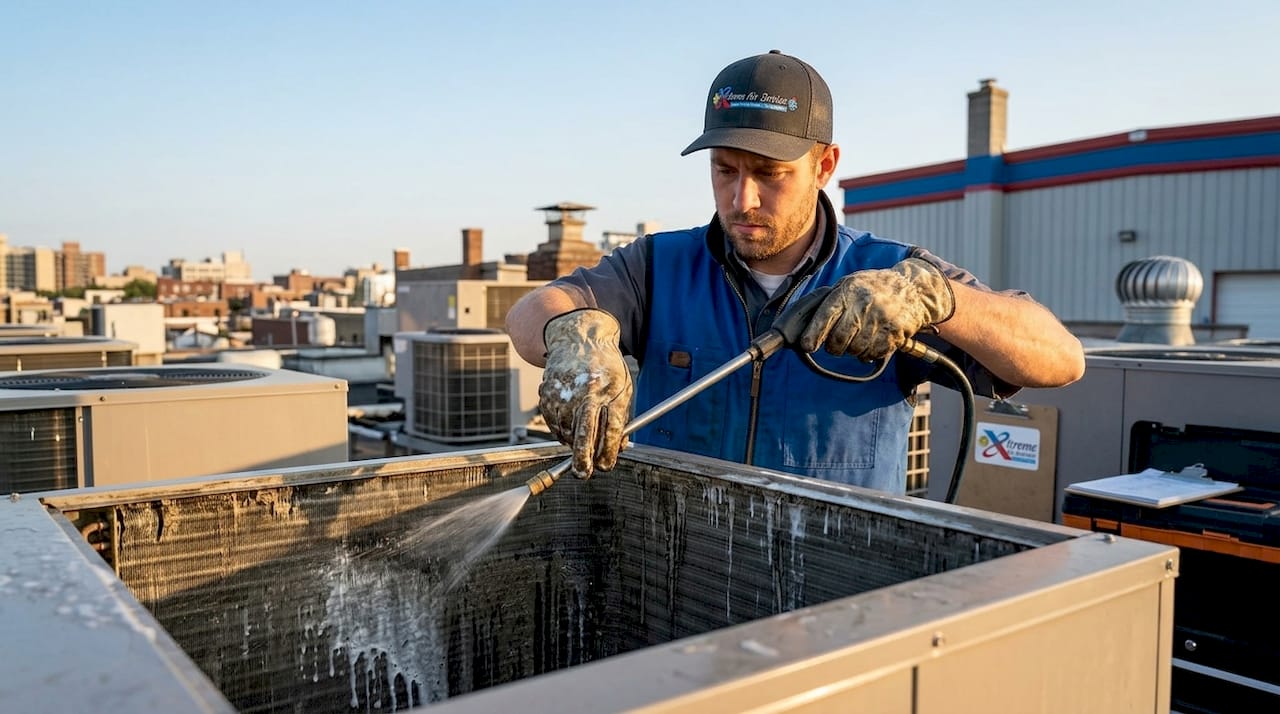
Evaporator and condenser coils accumulate dirt and biological growth that degrades heat transfer and strains the compressor. For most commercial systems, coil cleaning twice per year is the minimum. Use a no-rinse coil cleaner on accessible evaporator coils and a low-pressure rinse on condenser coils. Never use high-pressure spray directly on fin surfaces. After cleaning, document the visual condition with photos and record supply and return air temperature differential to confirm heat transfer has improved.
Electrical and mechanical checks
During every semi-annual visit, technicians should:
- Tighten all electrical connections in control panels, disconnect boxes, and terminal blocks. Loose connections cause arc faults and component failures.
- Measure motor amperage draws and compare against nameplate ratings. A motor drawing 10% or more above its rated amps is a failure candidate.
- Inspect belts for cracking, glazing, and tension. A belt that is 10% out of tension spec increases motor load and wear.
- Lubricate motor bearings and fan shaft bearings with the manufacturer-specified grease quantity. Over-lubrication is a real risk on sealed bearings.
Safety note: Always lock out and tag out electrical power before inspecting internal components. Refrigerant handling requires EPA Section 608 certification. Never attempt refrigerant recovery or recharge without a licensed technician.
Condensate drain and thermostat work
Flush condensate drain pans and drain lines with a diluted biocide solution quarterly. Blocked drains cause water damage, mold growth, and system shutdowns. After flushing, confirm the float switch activates correctly by pouring water into the pan.
Thermostat calibration is frequently skipped. A thermostat reading two degrees off setpoint keeps the system running longer than needed, burning energy on every cycle. Use a calibrated reference thermometer to verify accuracy and adjust the setpoint offset in the controller if needed.
Pro Tip: During each PM visit, photograph the filter condition before and after replacement, the coil surface before and after cleaning, and the control panel interior. These photos become your evidence for warranty claims, tenant disputes, and insurance purposes.
The HVAC maintenance checklist used on each visit should have space for measured values next to every task. A checkbox alone is not enough. Numbers tell you whether the system is trending toward a problem.
Verification and troubleshooting your PM program
Executing tasks is not the same as running a successful PM program. You need to verify that the work is producing results and catch problems before they become expensive.
The clearest leading indicators that your PM program is working include stable or declining energy consumption per square foot, fewer unplanned repair work orders month over month, and filter pressure differentials that stay within expected ranges. When these metrics move in the wrong direction, something in the program needs adjustment.
Watch for these specific warning signs:
- Rising utility costs without a change in occupancy or weather. This almost always points to dirty coils, failing economizers, or controls drift.
- Repeat repair calls on the same unit. A unit that is being repaired repeatedly is not being maintained correctly. Revisit the PM task list for that asset.
- Filter pressure spikes between scheduled visits. This suggests an upstream problem such as a failed pre-filter or an unusual dust load in the building.
- Condensate overflow events. If drain pans are flooding, the quarterly flush interval is not sufficient for that unit’s load.
Photographic evidence and measured data captured on every PM visit create an audit-ready condition history that allows you to spot trends, generate proactive work orders, and defend your maintenance decisions to ownership, tenants, or insurers.
One of the most commonly missed tasks in commercial HVAC service programs is coil cleaning. Facility teams often deprioritize it because the impact is invisible until the system fails or an energy audit reveals efficiency losses that have been accumulating for years. The second most missed task is condensate drain inspection on ceiling-mounted fan coil units, which are out of sight and easy to forget until water damage appears in the ceiling tiles below.
Review your PM schedule at least annually. If a unit is running in a high-load environment, its filter replacement interval should shorten, not stay fixed at what the manufacturer specified for typical conditions. Adjust frequencies based on actual readings, not assumptions.
Budgeting for your PM program
The financial justification for commercial HVAC preventive maintenance gets easier once you put actual numbers on the comparison. Annual HVAC maintenance spend for mid-size commercial buildings averages $18,000 to $65,000 depending on system complexity and square footage. Structured PM programs reduce total maintenance costs by 25–40% compared to reactive-only approaches.
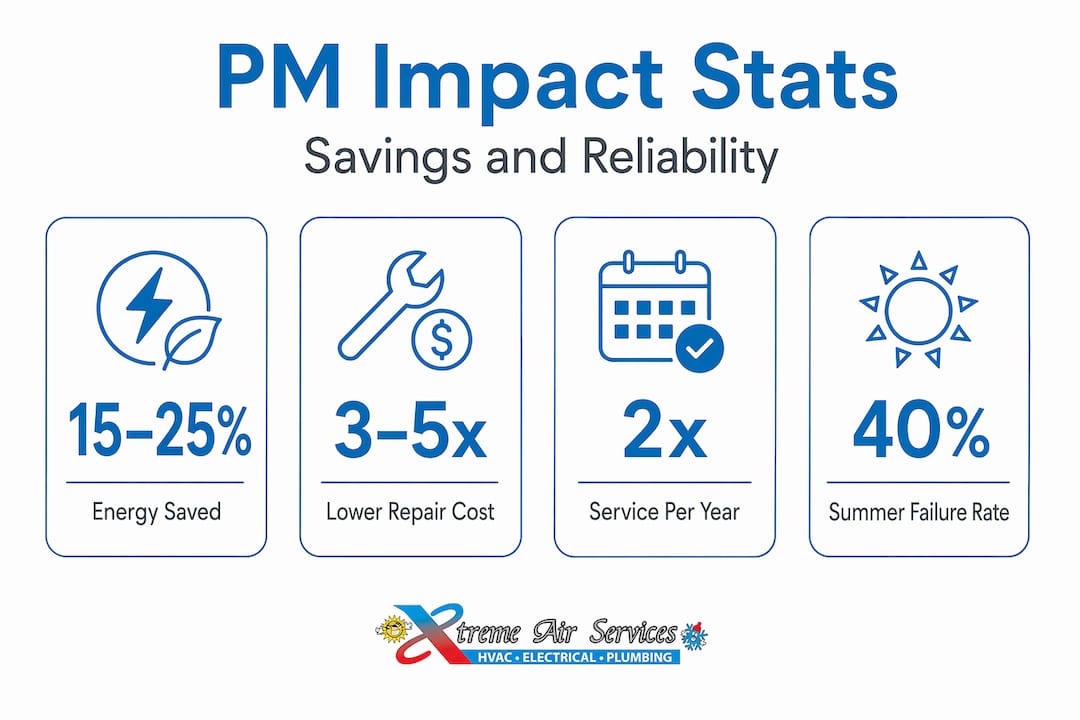
The mechanism is straightforward. Unplanned breakdowns cost three to five times more than the equivalent planned maintenance visit once you account for emergency labor rates, expedited parts shipping, and collateral damage from the failure. A compressor that fails because nobody caught a low refrigerant charge costs far more than the refrigerant leak check that would have prevented it.
Service contract structures vary significantly. Understanding the tradeoffs before signing helps you avoid paying for coverage you do not need or discovering gaps at the worst moment:
| Contract Type | What Is Included | Best For |
|---|---|---|
| Full coverage | Labor, parts, refrigerant, emergency calls | Older equipment with higher failure risk |
| Labor only | Service visits and diagnostics; parts extra | Newer equipment still under component warranty |
| Hybrid | Scheduled visits included; emergency calls and major parts extra | Most mid-size commercial facilities |
| Time and materials | Pay per visit with no contract commitment | Very small systems or low-criticality equipment |
Maintaining a basic parts inventory on-site for your most common wear items, including belt sizes, filter media, and common fuses, cuts emergency procurement costs and reduces the time a unit sits down waiting for parts.
Pro Tip: When evaluating service contracts, ask specifically whether coil cleaning is included and how many visits per year are covered. Many “full maintenance” contracts are written to cover only filter changes and basic inspections. Coil cleaning is often a line-item add-on that facilities managers discover is missing only when they get an extra invoice.
What I have learned after years of commercial HVAC service
I have seen the same pattern play out dozens of times. A facility runs its HVAC systems without a structured PM program for two or three years. Everything seems fine. Then one August, a compressor fails, a chiller goes down, or three rooftop units need emergency service in the same week. The repair bills are painful. The downtime is worse. And every time, the inspection reveals problems that were visible for months before the failure.
What I find most interesting is that the facilities with the best outcomes are not necessarily the ones with the largest maintenance budgets. They are the ones with the best records. When technicians capture actual measured values rather than just checking boxes, patterns emerge. A motor drawing slightly higher amps each quarter is telling you something. A coil that looks marginally dirtier each semi-annual visit is telling you something. The data does not lie, but you have to capture it first.
I also see a persistent misconception that more frequent filter replacement is always better. It is not. Replacing a filter before it reaches its working differential pressure wastes money and, in some cases, reduces the filter’s efficiency because a filter with some loading actually captures finer particles better than a brand-new one. The right answer is to measure the pressure differential and replace based on that threshold.
The most effective PM programs I have seen treat in-house staff and contractors as partners. In-house teams handle the monthly visual checks and filter work because they know the building. Contractors bring calibrated instruments, refrigerant certifications, and the pattern recognition that comes from servicing hundreds of similar systems. Neither group alone is as effective as both working from the same documented plan.
The shift from reactive to proactive HVAC management does not happen overnight. But once you have a full equipment inventory, a frequency matrix, and two or three cycles of documented PM visits, you will see the emergency repair calls drop and the energy bills stabilize. That is when the program pays for itself, and then some.
— Xtreme
Let Xtreme Air Services handle your commercial HVAC maintenance
If building a structured PM program from scratch sounds like a significant lift on top of everything else your facility demands, you do not have to do it alone. Xtreme Air Services works with commercial facility teams across Dallas, Plano, Irving, and Sunnyvale to design and execute scheduled HVAC maintenance programs that fit your building’s actual needs, not a generic service template.
Our certified technicians handle the full range of commercial PM services, including coil cleaning, refrigerant checks, filter replacement, condensate drain flushing, electrical connection inspections, and controls calibration. We work around your operating schedule to minimize disruption, and every visit is documented with measured values and photos that feed directly into your maintenance records. Whether you need a full-coverage service contract, a labor-only agreement, or a hybrid structure, we can build the right arrangement for your system complexity and budget. Contact Xtreme Air Services to schedule a facility assessment and get a PM program built around your equipment.
FAQ
How often should commercial HVAC systems be professionally serviced?
At minimum, commercial HVAC systems should receive professional preventive maintenance twice per year, with monthly filter inspections and quarterly condensate drain flushes handled in-house. High-demand facilities may need monthly professional visits for critical systems.
What does a commercial HVAC maintenance checklist typically include?
A standard commercial HVAC maintenance checklist covers filter inspection and replacement, coil cleaning, refrigerant level checks, electrical connection tightening, motor amperage measurement, belt inspection, condensate drain flushing, and thermostat calibration. Every line item should include space for measured values, not just a checkbox.
How much does commercial HVAC preventive maintenance cost per year?
Annual HVAC maintenance spend for mid-size commercial buildings typically ranges from $18,000 to $65,000 depending on system size and complexity. Structured PM programs reduce total maintenance costs by 25–40% compared to reactive repair strategies.
Why do unmaintained HVAC systems fail more often in summer?
Unmaintained AC systems have 40% higher failure rates during peak summer months because accumulated dirt, low refrigerant, and worn components reach their failure threshold under maximum load. Spring PM programs reduce mid-season failures by 70%.
When should commercial HVAC filters be replaced?
Filters should be replaced based on measured pressure differential, not a fixed calendar date. Replace pre-filters when the pressure drop exceeds 0.5 in. w.g. above the clean baseline. Calendar-only replacement wastes money and misses early loading problems driven by unusual dust events or occupancy changes.