

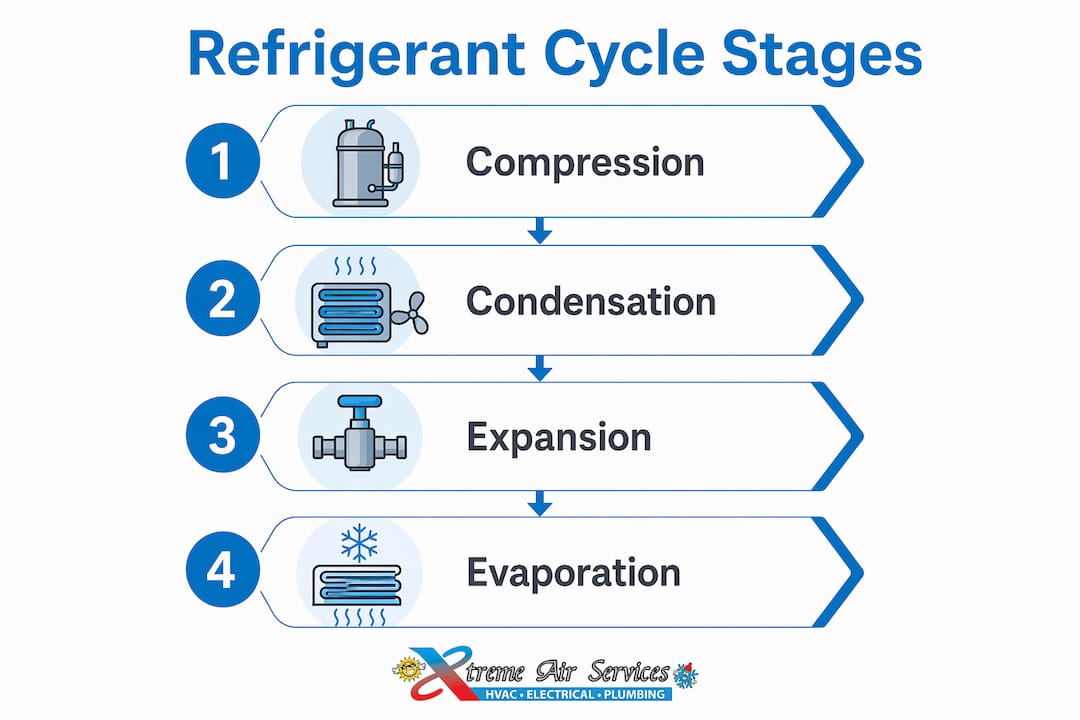
The refrigerant cycle is a continuous closed-loop thermodynamic process that moves heat from inside your home to the outdoors, making your living space cooler without ever “creating cold.” Understanding how refrigerant cycle works gives you real power over your HVAC system. You stop panicking at strange noises, you catch problems early, and you make smarter decisions about maintenance. The vapor-compression refrigeration cycle is the standard industry term for this process, and it runs in nearly every residential and commercial air conditioner on the market today. Four components drive the entire system: the compressor, condenser, metering device, and evaporator.
How does the refrigerant cycle work step by step?
The refrigerant cycle process is a loop with no beginning and no end. Refrigerant travels through four components continuously, changing pressure and physical state at each stage to move heat from one place to another. The vapor-compression cycle is used in virtually every residential, commercial, automotive, and industrial cooling application. That near-universal adoption reflects how well the physics work.
The compressor: the engine of the cycle
The compressor pulls in low-pressure refrigerant vapor from the evaporator and squeezes it. That compression raises both the pressure and the temperature of the refrigerant dramatically. Compressor work is the largest energy cost in the cycle, but it is also what creates the pressure difference that drives heat transfer in the right direction. Without the compressor, refrigerant would not move, and heat would not flow from cool indoors to warm outdoors.
The condenser: dumping heat outside
Hot, high-pressure refrigerant vapor leaves the compressor and enters the condenser, which sits in your outdoor unit. The condenser rejects heat to the outside air in three distinct stages: desuperheating, condensing, and subcooling. Desuperheating drops the vapor temperature down to its saturation point. Condensing changes the vapor into liquid at constant pressure. Subcooling then cools the liquid refrigerant further, which improves overall system efficiency. By the time refrigerant leaves the condenser, it is a warm liquid ready for the next stage.
The metering device: the pressure drop
The metering device, often a thermostatic expansion valve or a fixed orifice, creates a sudden pressure drop. That drop causes the refrigerant’s boiling point to fall sharply. The refrigerant enters the evaporator as a cold, low-pressure mixture of liquid and vapor, ready to absorb heat. This stage is what makes the evaporator cold enough to actually cool your indoor air.
The evaporator: absorbing indoor heat
The evaporator coil sits inside your air handler or furnace cabinet. Warm indoor air passes over the cold coil, and the refrigerant inside absorbs that heat, boiling and vaporizing in the process. The evaporator cools indoor air by absorbing heat at a constant saturation temperature, which is a critical design feature. The refrigerant must fully vaporize before returning to the compressor. Liquid refrigerant entering the compressor causes serious mechanical damage.
Pro Tip: If your home feels warm even with the AC running, the evaporator coil may be frozen or dirty. Both conditions block heat absorption and stall the refrigerant cycle process.
How does thermodynamics explain the refrigerant cycle?
The refrigeration cycle explanation gets much clearer once you understand two physical principles: latent heat and the pressure-temperature relationship. These two concepts explain why the cycle works at all.
Latent heat: the secret to massive energy transfer
When a substance changes phase, it absorbs or releases a large amount of energy without changing temperature. This energy is called the latent heat of vaporization. The refrigerant absorbs heat during phase changes without a temperature change, which is what makes the system so effective at moving energy. A pound of refrigerant can carry far more heat energy through a phase change than it could through a simple temperature rise.
Think of it this way: boiling water stays at 212°F no matter how much heat you add, until every drop has vaporized. Your evaporator works the same way. The refrigerant boils at a low temperature inside the coil, absorbing large amounts of heat from your indoor air while staying at a steady, cold saturation temperature.
Pressure controls boiling point
Refrigerant does not boil at a fixed temperature. Its boiling point changes with pressure. Lower pressure means a lower boiling point. Higher pressure means a higher boiling point. The metering device exploits this directly: it drops the pressure so the refrigerant boils at a temperature well below your indoor air temperature, which is what forces heat to flow from the air into the coil.
The following sequence shows how pressure and phase change connect across the four stages:
- Compressor: Pressure rises sharply. Refrigerant becomes a hot, high-pressure vapor.
- Condenser: Refrigerant releases heat to outdoor air and condenses into a warm liquid at high pressure.
- Metering device: Pressure drops suddenly. Refrigerant temperature falls below indoor air temperature.
- Evaporator: Refrigerant boils at low pressure, absorbing indoor heat and returning to vapor.
Superheating and subcooling protect the system
Superheating and subcooling are two fine-tuning stages that protect equipment and improve efficiency. Superheat means the refrigerant vapor leaving the evaporator is slightly warmer than its boiling point. That margin guarantees no liquid refrigerant reaches the compressor. Subcooling means the liquid leaving the condenser is slightly cooler than its condensing temperature. That margin improves the refrigerant’s capacity to absorb heat in the next cycle.
Your AC system does not create cold. It moves heat. The refrigerant is the vehicle, and phase changes are the engine. Every component in the system exists to control when, where, and how the refrigerant changes state.
What do homeowners get wrong about their refrigerant cycle?
Several persistent myths lead homeowners to make poor decisions about their HVAC systems. Clearing them up saves money and prevents unnecessary repairs.
-
“The AC creates cold air.” The system moves heat out of your home. The air feels cold because heat has been removed from it, not because cold was added. Understanding refrigerant cycle basics corrects this mental model entirely.
-
“That gurgling or hissing sound means something is broken.” Normal AC noises often come from refrigerant changing phase inside the coils. A gurgling sound as the system shuts off is refrigerant equalizing pressure. A hiss during operation is often refrigerant flowing through the metering device. These are normal sounds of a working system.
-
“Refrigerant gets used up like gasoline.” Refrigerant circulates in a closed loop and does not get consumed. If your system is low on refrigerant, it has a leak. Topping off without finding and fixing the leak is a temporary fix that wastes money.
-
“I can open the system myself to check it.” Opening the refrigerant loop introduces non-condensable gases like air and moisture into the system. Those contaminants cause compressor damage and system failure. Refrigerant work requires EPA Section 608 certification for a reason.
-
“A refrigerant leak is a minor issue.” A leak reduces the system’s ability to absorb heat, forces the compressor to work harder, and can cause the evaporator to freeze. Left unaddressed, it shortens the compressor’s life significantly. If you notice signs of a refrigerant leak, call a licensed technician immediately.
Pro Tip: If your energy bill spikes without a change in usage habits, a refrigerant leak or dirty coil is often the cause. Both force the compressor to run longer to achieve the same cooling effect.
How does maintenance affect your refrigerant cycle’s performance?
The refrigerant cycle depends on clean heat exchange surfaces to work efficiently. Dirt, debris, and neglect degrade every stage of the cycle and compound over time.
Condenser coil cleanliness
Dirty condenser coils reduce the system’s ability to reject heat to the outdoor air. When heat cannot escape efficiently, refrigerant pressure builds higher than designed. The compressor strains to maintain the cycle, energy use rises, and the equipment ages faster. Cleaning the condenser coil once a year, typically in spring before cooling season, is one of the highest-return maintenance tasks a homeowner can perform.
Evaporator coil and airflow
A dirty evaporator coil insulates the refrigerant from the indoor air it needs to cool. Restricted airflow from a clogged filter has the same effect. Both conditions cause the evaporator to run colder than designed, which can freeze the coil and halt cooling entirely. Replacing your air filter every 30–90 days, depending on filter type and household conditions, keeps airflow consistent and protects the evaporator. A clean evaporator also supports better indoor air quality by preventing mold growth on wet coil surfaces.
Leak detection and refrigerant charge
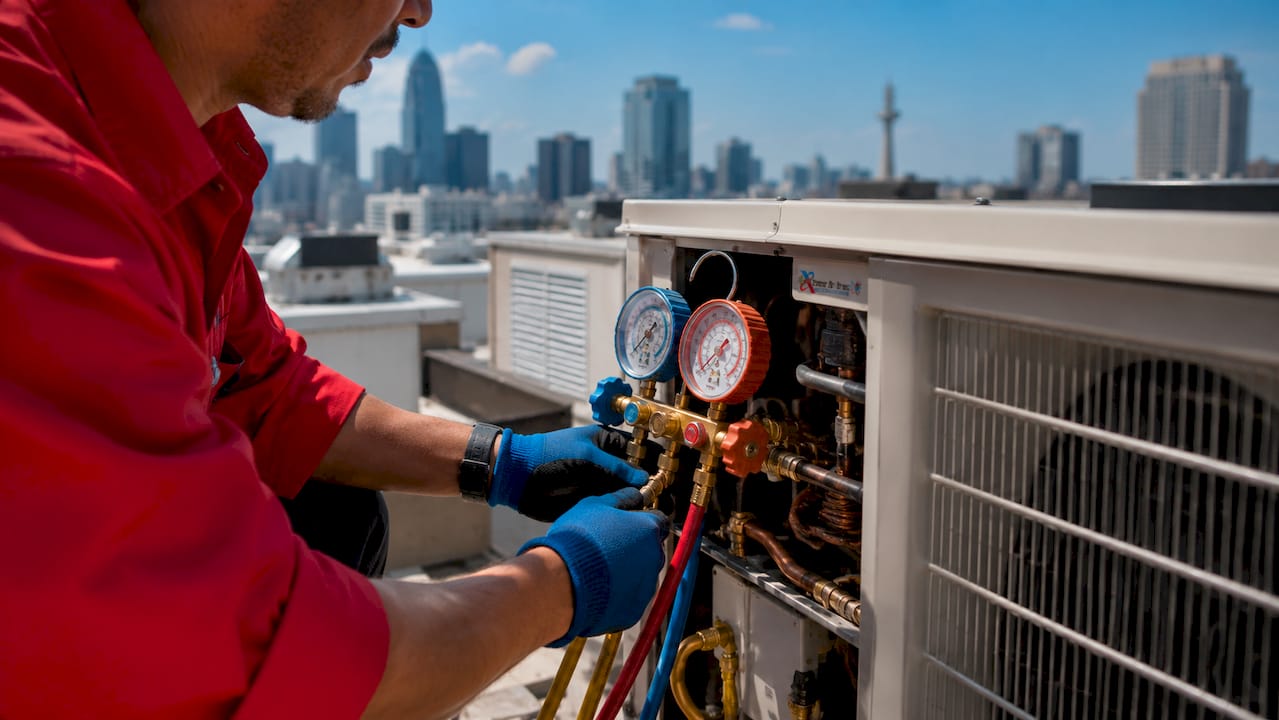
A properly charged system runs at the pressures its manufacturer designed for. Low refrigerant charge shifts every pressure and temperature in the cycle away from the design point. The compressor works harder, the evaporator runs too cold, and the condenser cannot reject heat properly. A technician checks refrigerant charge using manifold gauges and verifies superheat and subcooling values to confirm the system is operating correctly. For a full picture of what AC maintenance involves, a structured checklist helps homeowners stay on schedule.
| Maintenance Task | Impact on Refrigerant Cycle | Recommended Frequency |
|---|---|---|
| Clean condenser coils | Restores heat rejection capacity | Once per year (spring) |
| Replace air filter | Maintains evaporator airflow | Every 30–90 days |
| Check refrigerant charge | Confirms correct pressure and temperature | Annually by a technician |
| Inspect for leaks | Prevents compressor damage | Annually or when symptoms appear |
| Clear condensate drain | Prevents moisture backup near evaporator | Once per year |
Pro Tip: Schedule your annual HVAC tune-up in early spring, before the first hot week hits. Technicians are less busy, and you avoid the risk of your system failing on the hottest day of the year.
Key Takeaways
The refrigerant cycle is a closed-loop thermodynamic process that moves heat from indoors to outdoors through four components: compressor, condenser, metering device, and evaporator.
| Point | Details |
|---|---|
| Four components drive the cycle | Compressor, condenser, metering device, and evaporator each play a distinct role in moving heat. |
| Phase changes carry the energy | Refrigerant absorbs and releases large amounts of heat during evaporation and condensation, not through temperature change. |
| Refrigerant does not get consumed | Low refrigerant always means a leak; fix the leak before recharging the system. |
| Clean coils protect efficiency | Dirty condenser or evaporator coils force the compressor to work harder and shorten equipment life. |
| DIY system opening causes damage | Opening the refrigerant loop introduces contaminants that destroy the compressor; always use a licensed technician. |
What I’ve learned from explaining refrigerant cycles to homeowners
After years of working with homeowners on HVAC systems, one pattern stands out clearly. The homeowners who panic the least and spend the least on unnecessary repairs are the ones who understand the basics of how their system actually works.
The biggest misconception I see is the idea that refrigerant is a consumable. Homeowners sometimes ask for a “refrigerant refill” the way they ask for an oil change. When I explain that refrigerant circulates in a sealed loop and that low refrigerant means a leak, the conversation changes completely. They stop accepting a temporary top-off as a solution and start asking the right question: where is the leak?
The second thing I have noticed is that homeowners who understand phase changes stop fearing their AC unit’s sounds. A gurgling noise at shutdown is not a broken pump. A hiss near the air handler is not a gas leak. These sounds are the refrigerant doing exactly what it is supposed to do. That knowledge alone reduces unnecessary service calls.
My honest advice is this: you do not need to understand refrigeration engineering to be a good steward of your HVAC system. You need to understand the loop, the four components, and what breaks the cycle. Change your filter, keep your outdoor unit clear of debris, and get a professional inspection once a year. Those three habits protect a system that costs thousands of dollars to replace.
When something does go wrong, knowing the basics helps you describe the problem accurately and evaluate whether a technician’s diagnosis makes sense. That knowledge is worth more than any single repair.
— Xtreme
Xtremeairservices keeps your refrigerant cycle running right
Your refrigerant cycle works best when every component is clean, charged, and operating at the right pressures. Xtremeairservices provides professional HVAC maintenance that covers condenser and evaporator coil cleaning, refrigerant charge verification, leak inspection, and full system performance checks.
A trained technician from Xtremeairservices checks superheat and subcooling values, inspects for refrigerant leaks, and confirms your system is running at peak efficiency before the season demands it most. Explore HVAC maintenance plans designed to protect your system year-round and catch problems before they become expensive failures. Your refrigerant cycle does the work. Xtremeairservices keeps it ready.
FAQ
What are the four stages of the refrigerant cycle?
The four stages are compression, condensation, expansion, and evaporation. Each stage changes the refrigerant’s pressure and physical state to move heat from indoors to outdoors continuously.
Why does my AC make gurgling or hissing sounds?
Those sounds are normal and come from refrigerant changing phase or equalizing pressure inside the system. The vapor-compression cycle produces these sounds as part of regular operation.
Does refrigerant run out over time?
Refrigerant does not get consumed. It circulates in a closed loop indefinitely. Low refrigerant always indicates a leak that requires professional diagnosis and repair before recharging.
What happens if the evaporator coil gets dirty?
A dirty evaporator coil blocks heat transfer between indoor air and the refrigerant. The coil runs too cold, ice forms, airflow drops, and the system loses cooling capacity until the coil is cleaned.
How often should a technician check my refrigerant system?
A licensed technician should inspect refrigerant charge, check for leaks, and verify superheat and subcooling values once per year, ideally in spring before the cooling season begins.