


Types of commercial HVAC systems are the primary architectural frameworks used to deliver heating, ventilation, and air conditioning in commercial buildings, each designed for specific building sizes, occupancy profiles, and energy targets. The five primary system families are packaged rooftop units, variable refrigerant flow (VRF), chilled-water systems, dedicated outdoor air systems (DOAS), and variable air volume (VAV). Building gross square footage is the critical first filter in any selection decision, and lifecycle cost analysis over 20 to 30 years is the most reliable method for choosing the right system. Facility managers and business owners who understand these distinctions make better capital decisions and avoid costly retrofits down the road.
1. Packaged rooftop units and split systems for small commercial buildings
Packaged rooftop units (RTUs) and split systems are the workhorses of small commercial buildings, and they dominate the market for spaces under 10,000 square feet. An RTU houses the compressor, condenser, evaporator, and air handler in a single cabinet mounted on the roof, which simplifies installation and frees up interior mechanical space. Split systems separate the condenser unit outdoors from the air handler indoors, giving architects more flexibility in equipment placement. Both configurations are widely available from manufacturers like Trane, Carrier, and Lennox, and they carry relatively low upfront costs compared to central plant systems.
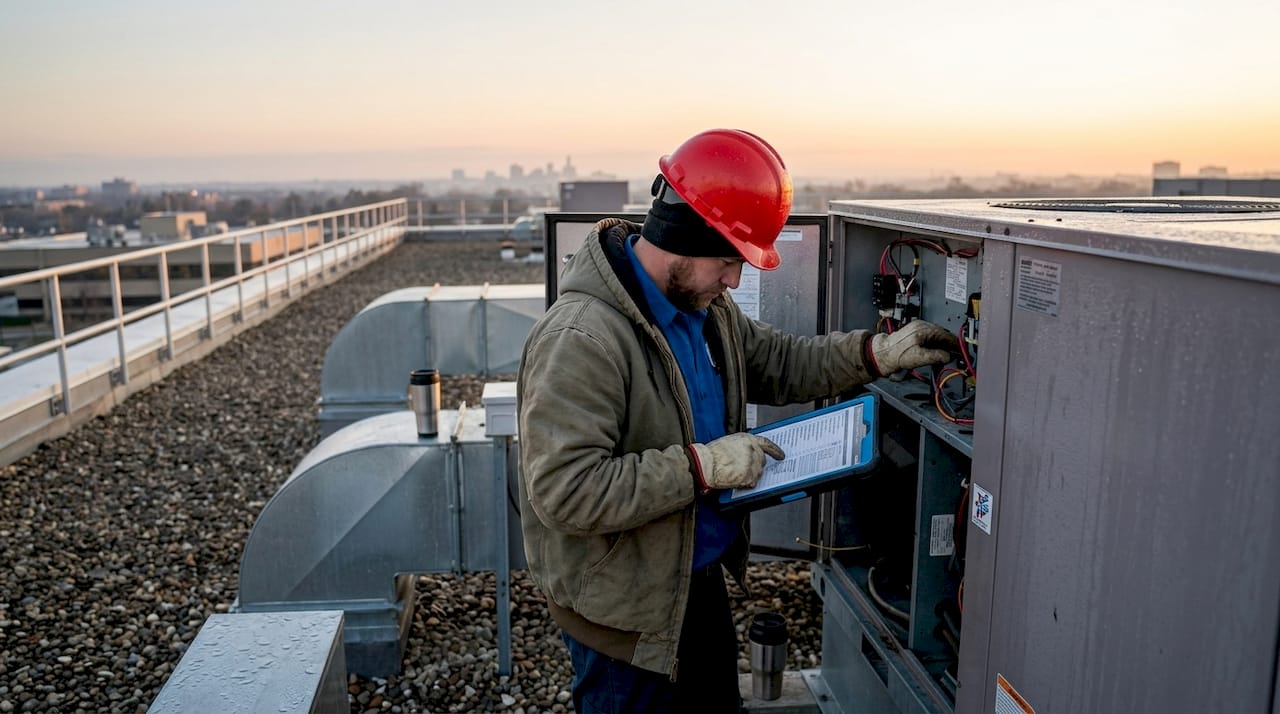
RTUs and split systems suit retail stores, small medical offices, restaurants, and light industrial spaces where a single zone or a small number of zones covers the entire footprint. Their main limitation is scalability. Once a building exceeds roughly 10,000 square feet with diverse occupancy zones, the number of units required and the associated ductwork complexity begin to erode the cost advantage.
Key advantages and limitations:
- Low first cost and straightforward installation
- Wide availability of replacement parts and service technicians
- Limited zone control compared to VRF or VAV
- Rooftop exposure accelerates wear on compressors and heat exchangers
- Energy efficiency ratings (SEER2 and EER2) vary widely by model
Pro Tip: Schedule rooftop unit inspections every six months rather than annually. Rooftop exposure to UV, wind, and temperature swings degrades economizer dampers and coil fins faster than ground-level equipment. Catching a failed economizer early can save thousands in cooling costs over a single summer.
2. Variable refrigerant flow (VRF) systems for mid-size buildings
Variable refrigerant flow technology is the most significant shift in commercial HVAC design over the past two decades, and it is now the preferred solution for buildings between 10,000 and 100,000 square feet with diverse simultaneous heating and cooling needs. VRF systems use inverter-driven compressors to modulate refrigerant flow precisely to each indoor unit, which means a south-facing conference room can receive cooling while a north-facing server room receives heating from the same outdoor unit. This heat recovery capability is what separates VRF from conventional multi-split systems.
VRF systems achieve a maximum COP of approximately 5.0 under optimal conditions, which means they deliver five units of thermal energy for every unit of electrical energy consumed. That figure represents a substantial efficiency advantage over standard split systems operating at COP values of 2.5 to 3.5. The efficiency gain is most pronounced in climates with moderate temperatures and buildings with mixed occupancy schedules, such as hotels, mid-rise office buildings, and mixed-use developments.
Where VRF excels and where it falls short:
- Excellent zone-level control with individual thermostat management per indoor unit
- Heat recovery models can simultaneously heat and cool different zones
- Higher first cost than RTUs, typically 20 to 40 percent more per ton of capacity
- Requires dedicated ventilation strategy, often paired with a DOAS unit
- Complex refrigerant piping requires certified commissioning technicians
VRF commissioning focused on control sequences is not optional. Poorly commissioned VRF systems routinely underperform their rated efficiency by 15 to 25 percent, which erases the payback advantage over simpler systems.
Pro Tip: Specify a VRF system with a centralized building management system (BMS) interface from day one. Retrofitting BMS integration after installation adds cost and often limits the data granularity you need to identify underperforming indoor units before they become comfort complaints.
3. Chilled-water systems for large commercial buildings
Chilled-water HVAC systems are the standard solution for buildings above 100,000 square feet, including hospitals, universities, large office towers, and convention centers. Rather than circulating refrigerant directly to terminal units, a chilled-water system produces cold water at a central plant and distributes it through insulated piping to air handling units (AHUs) and fan coil units throughout the building. This separation of the refrigeration cycle from the distribution system is what makes chilled-water plants so maintainable and scalable.
A typical chilled-water plant includes chillers, cooling towers (for water-cooled configurations), condenser water pumps, chilled water pumps, and a building automation system (BAS) to coordinate all components. Each element has a distinct role. The chiller removes heat from the water loop. The cooling tower rejects that heat to the atmosphere. The pumps maintain flow rates that match the building’s real-time load. The BAS sequences equipment to minimize energy consumption at part-load conditions, which is where large buildings spend most of their operating hours.
Water-cooled vs. air-cooled chillers:
| Feature | Water-cooled chiller | Air-cooled chiller |
|---|---|---|
| Efficiency (kW/ton) | 0.45 to 0.65 | 0.90 to 1.20 |
| First cost | Higher (requires cooling tower) | Lower (no tower needed) |
| Mechanical space | Requires dedicated plant room | Smaller footprint, rooftop viable |
| Maintenance complexity | Higher (tower water treatment needed) | Lower |
| Best application | Buildings above 200,000 SF | Buildings 100,000 to 200,000 SF |
Water-cooled chillers are significantly more efficient than air-cooled models, but the cooling tower adds water treatment costs and legionella management requirements. For buildings where energy cost is the dominant operating expense, water-cooled plants deliver better long-term economics. Balancing fan curves, static pressure, and pump controls throughout the system lifecycle is what separates a well-performing chilled-water plant from one that consumes 30 percent more energy than designed.
4. Dedicated outdoor air systems (DOAS) for ventilation and humidity control
A dedicated outdoor air system is not simply a ventilation upgrade. DOAS decouples ventilation air processing from sensible heating and cooling, which is a fundamentally different approach to managing the two biggest loads in a commercial building: latent (moisture) and sensible (temperature). Traditional HVAC systems handle both loads with the same equipment, which forces compromises in humidity control. DOAS handles 100 percent outdoor air separately, conditioning it to neutral conditions before it enters the occupied space.
“DOAS systems are not just more outdoor air. They represent a strategic separation of latent load ventilation control from temperature control, which is the correct engineering approach for buildings where indoor air quality and humidity precision matter.” — Trane Commercial HVAC
The practical benefit is significant. Buildings with DOAS report fewer mold and moisture complaints, lower sick-building syndrome incidents, and more consistent comfort across zones. Healthcare facilities, laboratories, schools, and high-occupancy office buildings are the primary candidates. DOAS units almost always incorporate energy recovery ventilators (ERVs) or heat recovery ventilators (HRVs) to precondition incoming outdoor air using the energy in the exhaust stream, which reduces the conditioning load on the primary HVAC system.
Common DOAS integration scenarios:
- Paired with VRF systems to handle ventilation separately from zone temperature control
- Integrated with chilled-water AHUs in large buildings to offload latent load
- Used in schools and healthcare facilities where ASHRAE 62.1 ventilation rates are mandatory
- Combined with radiant heating and cooling systems where traditional ductwork is impractical
DOAS system failures most often stem from control sequence errors rather than equipment faults. A DOAS unit that is not properly commissioned to maintain neutral supply air conditions will dump unconditioned humid air into the building, which defeats its purpose entirely.
5. Variable air volume (VAV) systems: energy savings and code compliance
Variable air volume systems are the dominant HVAC solution for mid-to-large commercial office buildings, and they carry a regulatory mandate that many facility managers overlook. ASHRAE 90.1 requires VAV systems for commercial buildings above 25,000 square feet to meet minimum energy efficiency standards. That requirement alone makes VAV the default specification for most new construction in this size range.
The core principle of VAV is straightforward. Rather than supplying a constant volume of conditioned air to every zone regardless of load, VAV terminal boxes modulate airflow to match the actual heating or cooling demand in each zone. The efficiency gain comes from the fan power relationship: VAV systems reduce fan power by approximately 87 percent at 50 percent airflow because fan power scales cubically with airflow. Most commercial offices operate at 30 to 60 percent of peak cooling load for the majority of occupied hours, which means VAV systems spend most of their runtime at dramatically reduced energy consumption.
How VAV systems deliver efficiency in practice:
- The air handling unit supplies conditioned air at a fixed temperature (typically 55°F).
- VAV terminal boxes at each zone modulate a damper to control airflow volume.
- A variable frequency drive (VFD) on the supply fan reduces speed as zone dampers close.
- Static pressure sensors in the duct system signal the VFD to maintain target duct pressure.
- Reheat coils at terminal boxes add heat when airflow reduction causes overcooling.
VAV energy impact depends heavily on static pressure control and how well control sequences are implemented. A VAV system with a poorly tuned static pressure setpoint will run the supply fan at near-full speed even when most zones are satisfied, eliminating the efficiency advantage entirely.
Pro Tip: Reset the duct static pressure setpoint dynamically based on zone damper positions rather than using a fixed setpoint. This single control change typically reduces annual fan energy by 20 to 35 percent in office buildings without any hardware modifications.
6. Comparing commercial HVAC system types: costs, efficiency, and fit
Choosing between the major types of HVAC systems requires a structured comparison across the factors that drive long-term operating cost and occupant satisfaction. The table below synthesizes the key decision variables for facility managers evaluating commercial HVAC solutions.
| System type | Best building size | Zone control | First cost | Energy efficiency | Mechanical space |
|---|---|---|---|---|---|
| Packaged RTU / Split | Under 10,000 SF | Low to moderate | Low | Moderate | Minimal (rooftop) |
| VRF | 10,000 to 100,000 SF | Excellent | Moderate to high | High (COP up to 5.0) | Minimal |
| Chilled-water | Above 100,000 SF | Excellent | High | Very high (water-cooled) | Dedicated plant room |
| DOAS | Any size (supplemental) | N/A (ventilation only) | Moderate | High with ERV/HRV | Moderate |
| VAV | 25,000 SF and above | Good | Moderate | High at part-load | Moderate AHU room |
The comparison reveals a clear pattern. Smaller buildings trade zone control precision for simplicity and low first cost. Larger buildings justify the capital investment in chilled-water or VAV infrastructure because the energy savings compound over decades of operation. For buildings in the 10,000 to 100,000 square foot range, VRF with DOAS integration represents the best HVAC system for business owners who prioritize both zone comfort and energy performance.
Lifecycle cost is the metric that resolves most debates in this comparison. A chilled-water plant may cost three times more to install than an equivalent RTU array, but its operating cost advantage over 20 years frequently makes it the lower-cost option in total. Reviewing the repair versus replacement decision with a qualified engineer before committing to a system type is always worth the time.
Key takeaways
The right type of commercial HVAC system is determined first by building size, then by zone control requirements, energy targets, and lifecycle cost, not by upfront price alone.
| Point | Details |
|---|---|
| Building size drives system selection | Under 10,000 SF suits RTUs; 10,000 to 100,000 SF suits VRF; above 100,000 SF suits chilled-water. |
| VRF delivers the best zone control | VRF heat recovery systems simultaneously heat and cool different zones from a single outdoor unit. |
| VAV is code-required above 25,000 SF | ASHRAE 90.1 mandates VAV for larger buildings; fan power savings reach 87% at 50% airflow. |
| DOAS solves humidity, not temperature | DOAS handles latent load and ventilation separately, improving IAQ without oversizing the primary system. |
| Lifecycle cost beats first cost | A 20 to 30 year cost analysis consistently favors higher-efficiency systems over low-bid installations. |
What I’ve learned selecting HVAC systems for complex facilities
After working with facility managers and business owners across hundreds of commercial projects, the single most consistent mistake I see is selecting a system based on the lowest bid rather than the lowest 20-year cost. A packaged RTU array installed in a 50,000 square foot office building will cost less on day one than a VRF system with DOAS integration. By year eight, the energy bills tell a completely different story.
The second mistake is skipping commissioning. VRF systems, VAV systems, and DOAS units all have control sequences that require expert tuning after installation. I have walked into buildings where a brand-new VRF system was running at 60 percent of its rated efficiency because the commissioning agent signed off without verifying refrigerant charge and control logic. The equipment was fine. The setup was not.
Humidity control is the issue that gets the least attention and causes the most complaints. Buildings that skip DOAS in humid climates end up with mold problems, occupant health complaints, and expensive remediation. Pairing a DOAS unit with your primary system is not a luxury for healthcare facilities. It is the correct engineering decision for any building in a climate with significant outdoor humidity.
The emerging trend worth watching in 2026 is heat pump VRF systems that operate efficiently down to 0°F outdoor temperatures. For commercial buildings in northern climates that currently rely on gas-fired heating, these systems offer a credible path to electrification without sacrificing comfort. The commercial HVAC air balancing work that follows installation is where the real performance gains are locked in.
My honest recommendation: run a lifecycle cost analysis before you finalize any system selection. The math almost always points to a different answer than the initial budget conversation suggests.
— Xtreme
Protect your HVAC investment with a professional maintenance plan
Commercial HVAC systems represent some of the largest capital expenditures in any facility budget, and the gap between a well-maintained system and a neglected one shows up directly on the energy bill and in occupant comfort scores.
Xtreme Air Services provides commercial HVAC maintenance plans designed specifically for facility managers who need scheduled inspections, filter changes, coil cleaning, refrigerant checks, and control system verification on a predictable calendar. Whether your building runs packaged RTUs, a VRF system, or a chilled-water plant, a structured maintenance program extends equipment life, preserves energy efficiency, and catches failures before they become emergency replacements. Contact Xtreme Air Services to build a preventive maintenance strategy tailored to your system type and building size.
FAQ
What are the main types of commercial HVAC systems?
The five primary types are packaged rooftop units, variable refrigerant flow (VRF) systems, chilled-water systems, dedicated outdoor air systems (DOAS), and variable air volume (VAV) systems. Each serves a different building size range and occupancy profile.
What size building needs a chilled-water HVAC system?
Chilled-water systems are typically specified for buildings above 100,000 square feet where the energy efficiency and maintainability of a central plant justify the higher first cost. Smaller buildings generally use VRF or packaged RTU configurations.
Is a VAV system required by code for commercial buildings?
ASHRAE 90.1 requires variable air volume systems for commercial buildings above 25,000 square feet as a minimum energy efficiency standard. Buildings below that threshold have more flexibility in system selection.
How does a DOAS differ from standard commercial ventilation?
A dedicated outdoor air system processes 100 percent outdoor air separately from the primary heating and cooling system, which gives precise control over humidity and indoor air quality. Standard commercial ventilation mixes outdoor air with return air in the main air handler, which limits humidity control.
How do I choose between VRF and a packaged RTU for my building?
Building size and zone diversity are the deciding factors. Packaged RTUs are cost-effective for buildings under 10,000 square feet with simple zoning needs. VRF systems are the better choice for buildings between 10,000 and 100,000 square feet where simultaneous heating and cooling in different zones is required.
Recommended
Need professional help? Explore our commercial air conditioning and heating.