Most people know HVAC keeps them comfortable. But ask what an HVAC system exactly is, and you’ll get a blank stare. That’s a problem, because your HVAC system controls more than just temperature. It manages humidity, air quality, and energy costs across every season.
Whether you own a home in Dallas or manage a commercial property, understanding how this system works gives you real power over comfort and operating expenses. This guide breaks down every layer of HVAC, from components to costs. Use it to make smarter decisions about installation, maintenance, and upgrades.
Table of Contents
- Key takeaways
- What is an HVAC system and what does HVAC stand for?
- How an HVAC system works from start to finish
- Energy use and the real cost of running your HVAC
- Maintenance, common problems, and making your system last
- My take on what most people get wrong about HVAC
- Get expert HVAC service for your home or business
- FAQ
Key takeaways
| Point | Details |
|---|---|
| HVAC stands for three functions | Heating, Ventilation, and Air Conditioning work together as one integrated system, not three separate units. |
| Components determine performance | Furnaces, air handlers, compressors, and ductwork each play a role — weak links in any one area drag down the whole system. |
| Energy costs are significant | HVAC uses up to 39% of building energy in the U.S., making system efficiency a direct financial issue. |
| Installation quality matters most | Proper duct sealing and correct sizing often matter more than the brand of equipment you choose. |
| Optimization pays back fast | A well-optimized HVAC system can cut annual energy costs by 30%, with payback typically in 3 to 5 years. |
What is an HVAC system and what does HVAC stand for?
HVAC stands for Heating, Ventilation, and Air Conditioning. Those three words describe three distinct jobs that one integrated system performs inside your home or building.
The heating side keeps you warm in winter. The air conditioning side cools you down in summer. The ventilation side moves air in, out, and around the building while filtering pollutants and controlling moisture.
Where most people go wrong is treating these as separate appliances. They are not.
According to HVAC system integration data, HVAC systems regulate indoor temperature, humidity, and air quality through one coordinated process of air circulation and exhaust. When one part underperforms, all three functions suffer.
The major components you need to know
The major HVAC components are the furnace, air conditioner or heat pump, air handler, ductwork, thermostat, filters, humidifiers, and economizers. Understanding these parts is what separates informed owners from people who get surprised by repair bills. Here is what each one actually does:
- Furnace: The furnace burns fuel (natural gas, propane, or oil) or uses electricity to generate heat. It is typically the largest component in a residential HVAC setup and sits in a basement, attic, or utility closet.
- Air conditioner or heat pump: The outdoor unit houses the compressor and condenser coil. The compressor circulates refrigerant through the system to move heat out of your home. Scroll compressors dominate residential split-systems because of their reliability and low vibration output.
- Air handler: This indoor unit contains the blower motor and evaporator coil. It pulls air from your living space, conditions it, and pushes it back through the duct system.
- Ductwork: The network of metal or flexible channels that distribute conditioned air throughout the building and return used air back to the system for reconditioning.
- Thermostat or control system: The brain of the operation. Modern smart thermostats can learn your schedule and adjust conditions automatically, cutting waste without sacrificing comfort.
- Filters: Air filters trap dust, allergens, pollen, and other particles before they recirculate. They protect both the occupants and the mechanical components.
- Humidifiers and dehumidifiers: These manage moisture levels. Relative humidity between 30% and 60% is the target range for both comfort and mold prevention.
- Economizers and dampers: Found more commonly in commercial systems, these control how much outside air enters the building, reducing the energy needed to condition fresh air.
Pro Tip: When replacing any single component, ask your HVAC technician to verify that the new part is properly matched to the rest of your system. Mismatched equipment is one of the most common and costly mistakes in residential HVAC.
Residential vs. commercial components
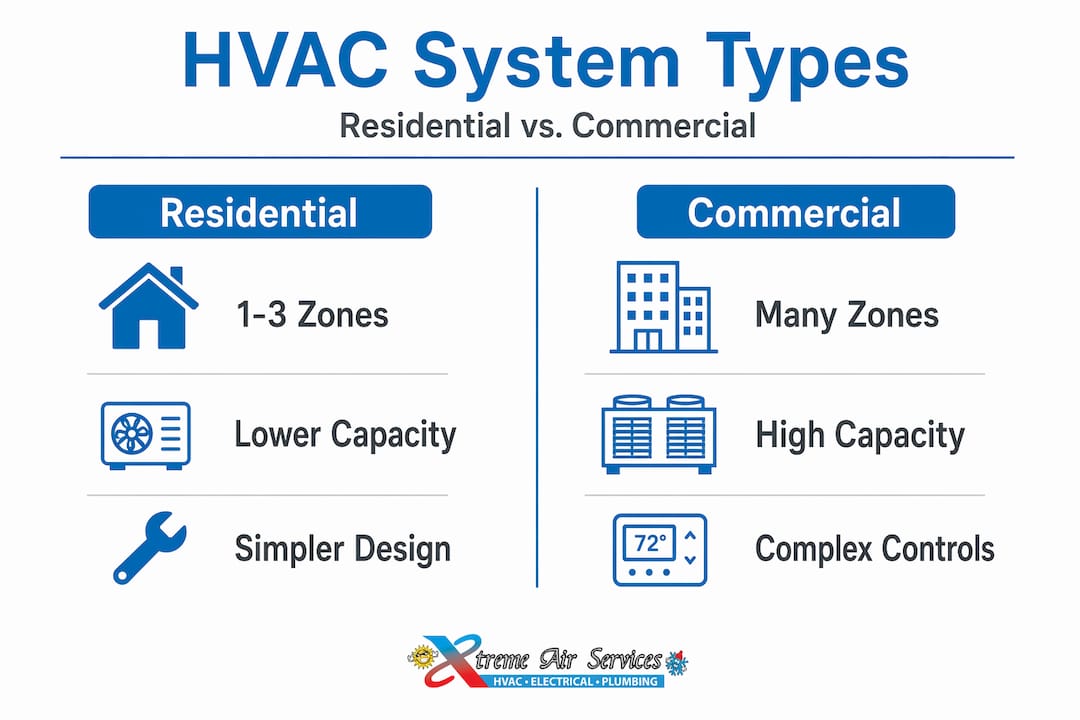
Residential and commercial HVAC differ mainly in scale. Residential systems serve one zone or a few zones in a single structure. Commercial HVAC systems are built for scale.
A commercial system often does far more than a home unit:
- Serves dozens of independent zones
- Integrates with building management systems for real-time control
- Includes redundancy features, so a single failure does not shut down an entire facility
The scale difference also changes the equipment. Commercial rooftop units, chillers, and cooling towers replace the familiar backyard condensing units you see in neighborhoods. This distinction matters most when you compare the best commercial HVAC systems for a property investment or facility upgrade.
How an HVAC system works from start to finish
An HVAC system works by heating, cooling, ventilating, and filtering air on a continuous cycle that the thermostat coordinates. Knowing what the parts are is one thing. Watching them function as a system is where real understanding begins.
Here is a sequential look at how an HVAC system works through each of its core functions.
-
The heating cycle starts at the thermostat. When the indoor temperature drops below your set point, the thermostat signals the furnace or heat pump to activate.
A gas furnace ignites a burner and heats a metal heat exchanger. The blower motor then forces air across that exchanger, warming it before pushing it through the ducts. A heat pump works differently. It extracts heat energy from outdoor air, even in cold weather, and moves it indoors using refrigerant. That is more efficient than generating heat from scratch.
-
The cooling cycle runs in reverse. The thermostat calls for cooling, and the compressor begins circulating refrigerant between the indoor evaporator coil and the outdoor condenser coil.
Warm indoor air passes over the cold evaporator coil, and the refrigerant absorbs that heat. The refrigerant then travels outside, releases the heat through the condenser, and cycles back in. The result is cooler, drier air pushed back into your living space.
-
Ventilation works continuously. While heating and cooling run on demand, ventilation never fully stops.
The system continuously exchanges stale indoor air with filtered fresh air, diluting pollutants, carbon dioxide, and excess moisture. In tightly sealed modern buildings, mechanical ventilation is not optional. Without it, indoor air quality can become significantly worse than outdoor air.
-
Humidity control happens in parallel. HVAC design balances thermal comfort with energy conservation, and humidity is a big part of that equation.
The cooling cycle naturally removes moisture from the air as it passes over the cold evaporator coil. In dry climates or winter months, a separate humidifier adds moisture back. This keeps conditions in the range where your body stays comfortable without conscious effort.
-
Filtration runs every time air moves. Every pass through the air handler runs air through at least one filter. High-efficiency filters catch finer particles but also restrict airflow if not changed regularly. Balance is key.
Energy use and the real cost of running your HVAC
HVAC is the single largest energy expense in most buildings. It accounts for about 39% of building energy use in the U.S., climbing as high as 70% in demanding facilities like hospitals and hotels. That means your biggest lever for cutting utility bills is almost always your HVAC system.
Energy consumption by building type
| Building type | Typical HVAC energy share | Key driver of high usage |
|---|---|---|
| Single-family home | 40–50% of total energy | Poorly sealed ducts, aging equipment |
| Small commercial office | 35–45% of total energy | Continuous operation, zone imbalances |
| Hospital or hotel | 60–70% of total energy | 24/7 operation, ventilation requirements |
| Retail space | 30–40% of total energy | High occupancy loads, variable hours |
For business managers, this table clarifies why what is a commercial HVAC system matters as an investment question, not just a comfort question. A poorly designed or maintained commercial system bleeds money every hour it runs.
The good news: optimizing your HVAC system can cut annual energy costs by 30%. Payback periods typically fall between 3 and 5 years.
For a business spending $60,000 per year on energy, that is an $18,000 annual saving after the upfront investment in upgrades or replacements.
Pro Tip: Before buying new equipment, have a qualified technician perform a load calculation for your specific space. Oversized systems short-cycle (turn on and off too frequently), which increases wear and fails to control humidity properly, even though the air temperature feels fine.
Residential owners face a different but related challenge. Most home systems exceed $10,000 to install.
Many homeowners delay maintenance to save money in the short term, only to pay far more when a neglected system fails prematurely. Treating your HVAC as infrastructure, not an appliance, changes your financial calculus entirely.
Maintenance, common problems, and making your system last
The benefits of HVAC systems only materialize if the system is maintained properly. The gap between a 12-year system and a 20-year system almost always comes down to maintenance and installation quality, not the brand on the cabinet.
Signs your system is losing efficiency
Watch for these warning signs that your HVAC system is losing efficiency:
- Uneven temperatures between rooms, with some areas too hot and others too cold
- Utility bills rising without a clear change in usage habits
- The system running longer than usual to reach the set temperature
- Unusual noises like grinding, banging, or rattling from any component
- Excess humidity indoors even when the system is running
These symptoms point to a range of issues: clogged filters, failing capacitors, refrigerant leaks, or duct problems. Catching them early is almost always cheaper than waiting.
The maintenance tasks that actually move the needle
These are the maintenance tasks that actually protect performance and extend system life:
- Change filters every 1 to 3 months. The specific interval depends on filter type and whether you have pets or allergies. A clogged filter is the number-one cause of avoidable service calls.
- Schedule professional inspections twice a year. Once before the heating season and once before cooling season. A technician checks refrigerant levels, electrical connections, coil condition, and thermostat calibration.
- Seal your ducts. Leaky ducts are a leading cause of energy loss and uneven temperatures. Mastic sealant or metal tape applied professionally can recover significant efficiency.
- Keep the outdoor unit clear. At least two feet of clearance around the condenser unit allows proper airflow. Trim plants, remove debris, and never stack anything against it.
- Clean the evaporator and condenser coils annually. Dirty coils force the system to work harder to transfer heat, reducing efficiency and shortening component life.
For commercial properties, the stakes are even higher. Commercial HVAC systems run almost continuously, and a single fault can trigger cascading failures across interconnected systems.
Many facility managers integrate their HVAC with building management platforms for real-time monitoring. This allows early fault detection before problems escalate into costly downtime. The difference in HVAC demands between a home and a commercial facility is substantial, similar to how residential and commercial service needs differ in other building service industries.
Proper installation is the foundation everything else builds on, especially duct sizing according to ACCA Manual D standards. No amount of maintenance fixes a system that was installed wrong from the start.
If you are managing a new build or a major retrofit, hire a contractor who performs a Manual D duct design, not one who eyeballs it.
My take on what most people get wrong about HVAC
I’ve spent years helping homeowners and business managers work through HVAC decisions, and the same misunderstandings come up repeatedly. The biggest one: people focus entirely on the equipment brand and almost never ask about the installation.
In my experience, a properly installed mid-tier system beats a premium brand every time. The premium brand loses when it goes in with leaky ducts and a mismatched air handler.
Installation quality, duct sealing, and correct sizing determine how well your system performs. Those factors matter far more than the name on the unit.
The second thing I’ve learned: comfort is not just about temperature. Balancing energy use with occupant comfort is genuinely the hardest part of HVAC design, because comfort is subjective.
Two people in the same room will disagree on whether it feels right. Humidity, air movement, and radiant heat from walls all contribute. When a client tells me their system runs fine but they still feel uncomfortable, I go straight to humidity and airflow before touching the thermostat.
For business managers specifically, treating HVAC as an afterthought during a renovation or a new lease negotiation is one of the most expensive decisions you can make. The system you inherit or specify will shape your operating costs for the next 15 to 20 years.
Get an independent assessment before you sign anything.
— Xtreme
Get expert HVAC service for your home or business
At Xtreme Air Services, we work with homeowners and commercial property managers across Dallas, Plano, Irving, and Sunnyvale, TX. We keep HVAC systems running at their best year-round.
Whether you need a full system inspection before summer, emergency repairs, or guidance on a new installation, our licensed technicians handle residential and commercial HVAC with the same standard of care.
We do not just fix what is broken. We look at your system as a whole, identify efficiency losses, and give you honest recommendations that protect your investment and your comfort.
From routine maintenance to major retrofits, Xtreme Air Services has the experience to get it right the first time. Reach out to our HVAC repair and maintenance team today and find out what a properly functioning system can do for your energy bills.
FAQ
What does HVAC stand for?
HVAC stands for Heating, Ventilation, and Air Conditioning. These three functions work together as one integrated system to control indoor temperature, humidity, and air quality.
How does an HVAC system work in a home?
A home HVAC system heats air via a furnace or heat pump, cools it using a refrigerant-based air conditioner, and continuously circulates and filters air through ductwork connected to an air handler. The thermostat coordinates when each function activates based on your set temperature.
What is the difference between a residential and commercial HVAC system?
Residential systems typically serve one structure with a few zones, while commercial HVAC systems manage multiple independent zones, integrate with building management systems, and include redundancy features to prevent operational failures. Commercial systems also run continuously, which makes maintenance far more critical.
How often should an HVAC system be serviced?
Most HVAC professionals recommend servicing your system twice a year, once before the heating season and once before the cooling season. Filters should be checked and replaced every one to three months depending on usage and air quality needs.
What are the biggest benefits of an HVAC system?
A properly functioning HVAC system maintains comfortable indoor temperatures, controls humidity to prevent mold growth, improves air quality through filtration, and can reduce energy costs significantly when optimized. Homes and businesses with well-maintained systems also see longer equipment life and fewer emergency repairs.