Your HVAC system rarely announces its own death. It quietly becomes less effective, more expensive, and less reliable over time.
Then one July afternoon it simply quits. You are left in a sweltering house wondering what went wrong.
Knowing the signs your HVAC needs replacement before that moment is the difference between a planned purchase and an emergency one. Professionals call this recognizing HVAC replacement indicators. Learning them now protects your comfort, your budget, and your home.
Table of Contents
- Key takeaways
- 1. Signs your HVAC needs replacement start with age
- 2. Your refrigerant type is a financial time bomb
- 3. Unusual noises your HVAC system makes that you should not ignore
- 4. Odors that signal something worse than a dirty filter
- 5. Weak or uneven airflow throughout your home
- 6. Your home never reaches the right temperature
- 7. Energy bills climbing without explanation
- 8. Repair costs that cross the financial line
- 9. Signs commercial HVAC needs replacement mirror what homeowners face
- My take on timing: stop waiting for total failure
- See how Xtreme Air Services can help you decide
- FAQ
Key takeaways
These five signals most often justify replacing an HVAC system rather than repairing it again:
| Point | Details |
|---|---|
| Age is the starting line | Systems 15+ years old enter a zone where repairs become less cost-effective than full replacement. |
| Multiple signs mean act now | One odd symptom may only need a repair, but several signs together point strongly toward replacement. |
| The 50% rule protects your wallet | If a repair quote exceeds half the cost of a new system, replacement almost always wins financially. |
| Rising bills are a hidden signal | Energy costs climbing 15 to 25% without a lifestyle change are a clear sign of HVAC failure brewing. |
| Safety signs need immediate action | Yellow furnace flames and gas odors are not repair items to schedule. They require same-day attention. |
1. Signs your HVAC needs replacement start with age
Age is the most reliable HVAC replacement indicator, and it requires no diagnosis. You only need the installation date.
Most central air conditioners and heat pumps last 15 to 20 years. Furnaces typically run 20 to 30 years when maintained well. Once your system crosses those thresholds, the math of repair versus replace shifts dramatically.
Here is the practical breakdown by equipment type:
- Central AC units: 15 to 20 years is the standard lifespan. At 15 years, treat every repair as a signal.
- Heat pumps: Similar 15 to 20-year window, though they run year-round and tend to wear faster in extreme climates.
- Gas furnaces: 20 to 30 years, but efficiency drops significantly in the final decade.
- Boilers: Can push 25 to 35 years with consistent maintenance, but older models waste significant energy.
Age alone does not always trigger replacement. But age combined with anything else on this list usually does.
The replacement often makes sense when multiple criteria align, including system age, rising costs, and declining performance. Think of age as the first filter you apply before evaluating everything else.
Pro Tip: Check your home inspection report or the manufacturer’s label on the outdoor unit. The first two digits of the serial number often indicate the year of manufacture.
2. Your refrigerant type is a financial time bomb
Your refrigerant type becomes a costly liability when the system uses R-22, commonly known as Freon. If your unit was installed before 2010, you are likely sitting on a slow-moving cost problem.
The federal government phased out R-22 production and import by 2020, and the remaining supply is scarce. A refrigerant leak in an R-22 system is no longer a straightforward repair.
R-22 leaks are expensive to fix because the refrigerant costs several times more per pound than modern alternatives like R-410A or the newer R-454B. A single leak repair can run hundreds of dollars in refrigerant costs alone, before labor is added.
Replacing the refrigerant is not a fix either. You cannot simply swap refrigerant types in an existing system without replacing components.
Once an R-22 system starts leaking, the financially sound move is almost always replacement. Modern systems using current refrigerants are also far more efficient, which means lower monthly bills going forward.
3. Unusual noises your HVAC system makes that you should not ignore
A healthy HVAC system hums. It does not bang, screech, rattle, or hiss. When those sounds appear, they point to something specific failing inside the unit.
Here is what different sounds typically mean:
- Banging or clanging: Often a loose or broken component inside the blower assembly or compressor. It can indicate a failing compressor, which is one of the most expensive parts in the system.
- Screeching or squealing: Usually a worn belt or failing motor bearing. In newer systems without belts, screeching often points to a motor on its way out.
- Hissing: Refrigerant leaks are the most common culprit. A hissing sound combined with reduced cooling is almost always a leak.
- Rattling: Loose panels, debris in the unit, or failing motor mounts. Usually lower severity, but worth investigating.
- Clicking that does not stop: A control board or relay issue. Occasional clicking at startup is normal. Continuous clicking is not.
Safety note: If you hear a hissing sound combined with a rotten egg or sulfur smell, leave the house and call your gas company immediately. That combination suggests a gas leak, not an HVAC issue, and it requires emergency response.
The critical point is simple. Occasional noises after years of quiet operation often signal mechanical wear that requires professional assessment.
One unusual noise might mean a minor repair. Multiple noises appearing at once typically means the system is degrading broadly.
4. Odors that signal something worse than a dirty filter
Odors from your vents or unit are among the most overlooked signs of HVAC failure. Homeowners often assume the smell is temporary. Sometimes that is true, but other times the odor points to a serious problem.
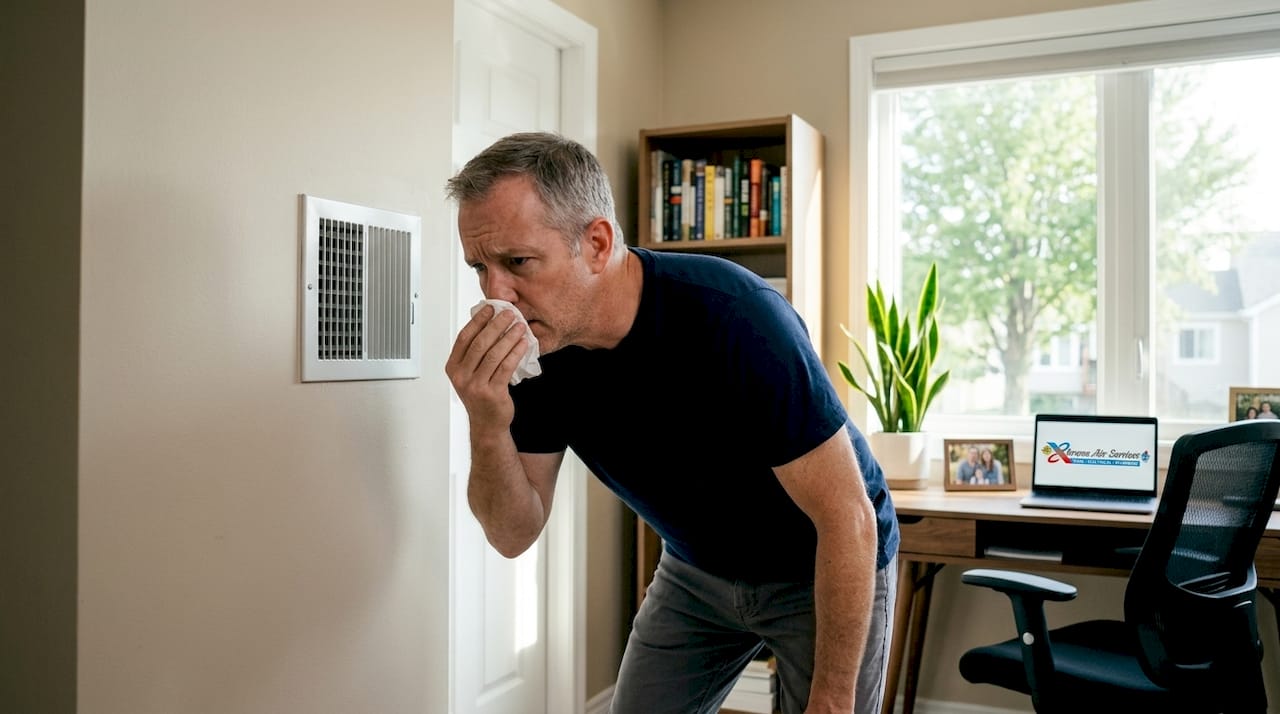
Musty or mildew smells usually indicate mold growing inside the air handler, evaporator coil, or ductwork. This is both a health concern and a performance issue.
If cleaning the coil and replacing the filter does not clear the smell within a day or two of normal operation, you may have mold deeper in the system or ducts.
Burning smells at startup are common after a system sits idle for months. That smell usually comes from dust burning off the heat exchanger and clears within a few minutes.
If the burning smell persists or returns, that is a different problem. It often points to an overheating motor or a failing electrical component.
The most serious odor pairs with a yellow or orange flame inside your furnace. A healthy gas furnace burns with a steady blue flame. A yellow flame indicates incomplete combustion, which means carbon monoxide may be present in your home.
A yellow furnace flame is a safety emergency in older systems. It demands immediate attention, often replacement.
5. Weak or uneven airflow throughout your home
Weak or uneven airflow signals a system that can no longer distribute conditioned air evenly. Walk through your home while the system runs and hold your hand near each vent. If some rooms feel strong and others feel like a whisper, you have an airflow problem.
Weak airflow may result from dirty filters, motor issues, or duct leaks. It directly affects both comfort and energy efficiency.
The key distinction is between a duct issue and a system issue. Duct repairs are usually affordable, while a failing blower motor or compressor in an aging system is a much bigger investment. If airflow problems appear alongside other signs on this list, it is less likely to be a simple duct fix.
Pro Tip: Before assuming the worst, replace your air filter and check that all vents are open and unobstructed. If the airflow problem persists after those steps, schedule a professional inspection.
Here is how to assess airflow symptoms at home:
- Check all return and supply vents for blockages, closed dampers, or furniture positioned over floor vents.
- Replace the air filter if it has been more than 60 days since the last change.
- Listen for the blower running at consistent speed. A motor that surges or slows erratically suggests wear.
- Note whether weak rooms are on the same duct branch or spread randomly. Random weakness points more toward the equipment itself.
Comfort complaints linked to uneven temperatures may stem from airflow or duct issues rather than the thermostat or a single failing component. Testing airflow professionally before committing to replacement is always worth doing.
6. Your home never reaches the right temperature
When your home never reaches the set temperature, the equipment has lost core capacity. Set the thermostat to 72 degrees, and if the house consistently settles at 78 no matter how long the system runs, that is a performance failure. It is one of the clearest when-to-replace-HVAC signals available.
Several aging problems drive this failure:
- Aging compressors lose the ability to generate adequate cooling capacity.
- Heat exchangers in older furnaces crack and lose efficiency.
- Short cycling, where the system turns on and off rapidly without completing a full run cycle, signals a system struggling to manage load.
Constant thermostat adjustments are a softer version of the same problem. Subtle aging signs like frequent thermostat changes and declining comfort together point to a system that can no longer perform its core function reliably.
If you adjust your thermostat several times a day chasing comfort, the system is failing you.
Humidity is part of this equation too. A properly functioning air conditioner removes humidity as it cools. A home that feels clammy even when the AC runs constantly has lost its ability to dehumidify effectively.
7. Energy bills climbing without explanation
Energy bills climbing without a lifestyle change often mean your HVAC system is losing efficiency. Pull your utility bills from the past 12 months and compare them to the same period two years ago.
If your electricity or gas costs are rising 15 to 25% with no new appliances, no change in occupancy, and no lifestyle shifts, your HVAC system is the most likely culprit.
Efficiency degrades gradually in aging systems. The system runs longer to achieve the same output, which means it consumes more energy. This is not a dramatic overnight drop. It creeps up month over month, which is exactly why many homeowners miss it until the increase is substantial.
The important context is that modern HVAC systems are dramatically more efficient than units built 15 or more years ago.
A new high-efficiency system can cut cooling and heating costs by 20 to 40% compared to an aging unit. That monthly savings factors directly into the payback period on a replacement investment.
8. Repair costs that cross the financial line
Repair costs cross the line when a quote exceeds half the price of a new system. This is where the decision becomes mathematical.
The industry standard is the 50% rule. If a repair quote exceeds 50% of the cost of a comparable new system, and your current unit is already old, replacement makes more financial sense in almost every scenario.
| Situation | Recommended action |
|---|---|
| System under 10 years, repair under 25% of replacement cost | Repair and maintain |
| System 10 to 15 years, repair under 50% of replacement cost | Repair if recent history is clean |
| System 15+ years, repair over 50% of replacement cost | Replace |
| R-22 system with refrigerant leak, any age | Replace |
| Multiple repairs in 24 months totaling $1,500+ | Evaluate replacement seriously |
The 50% rule helps homeowners make this call objectively rather than emotionally. It is easy to want to repair a familiar system. But pouring $2,000 into a unit that will need another repair in 18 months is a costly habit.
Repair cost history matters as much as any single quote. Keep a simple log of every service call, what was repaired, and what it cost.
If that total over 24 months approaches $1,500 or more, you have crossed a threshold where replacement deserves serious consideration regardless of your system’s age.
When comparing costs, remember that true replacement cost includes installation, matching indoor and outdoor components, and potential ductwork updates. Get a complete replacement quote before comparing it against a repair estimate.
9. Signs commercial HVAC needs replacement mirror what homeowners face
The signs commercial HVAC needs replacement follow the same logic as residential systems, with one key difference. Commercial systems run harder and longer, so age milestones arrive sooner and repair-versus-replace decisions carry higher financial stakes.
Commercial rooftop units typically last 15 to 20 years. Split systems in commercial settings may reach similar lifespans but accumulate more wear from extended daily run times.
The same noise, odor, airflow, and efficiency signals apply, and the 50% rule applies with equal force.
The practical addition for commercial settings is the impact on tenants or customers. A failing system in a rental unit or retail space creates liability and occupancy problems, which makes proactive replacement more defensible than it might seem on paper alone.
My take on timing: stop waiting for total failure
Stop waiting for total failure, because the cheapest next repair is rarely the cheapest overall path. I have talked to hundreds of homeowners who made the same mistake.
They kept repairing a system that was clearly past its useful life because the next repair was always cheaper than replacement. Then one summer it simply stopped. No warning, no gradual decline they noticed. Just done.
What I have learned working both sides of this decision is that the financial damage of waiting rarely shows up in the repair bill.
It shows up in the energy bills you paid for 18 months of declining efficiency, the weekend you spent without air conditioning waiting for emergency service, and the premium you paid for a rushed replacement instead of a planned one.
My honest advice: if your system is 15 years old and gives you two or more signs from this list, do not wait for the third. Get a professional assessment that includes an airflow test, not just a visual inspection.
Comfort problems rooted in airflow or duct issues deserve a different solution than comfort problems caused by a dying compressor. Those are not the same repair.
I have also seen homeowners spend $3,000 on repairs to a 17-year-old system because they were attached to the brand or reluctant to manage the replacement process. That rarely works out well. The HVAC repair or replacement decision deserves a clear-eyed look at the full picture, not just the next repair quote.
— Xtreme
See how Xtreme Air Services can help you decide
Knowing the signs is only half the work. The other half is a professional assessment from a team that gives you straight answers instead of a sales pitch.
Xtreme Air Services serves homeowners and businesses across Dallas, Plano, Irving, and Sunnyvale, TX with honest HVAC repair and replacement evaluations.
Whether your system shows one sign or several, the team can test airflow, evaluate efficiency, and tell you plainly whether repair or replacement makes the most sense for your situation.
You can also stock up on MERV 8 air filters to keep your system running cleaner between service visits. For a full review of your HVAC repair or replacement options, reach out before the next heat wave forces the decision for you.
FAQ
How long should an HVAC system last?
Most central air conditioners and heat pumps last 15 to 20 years, while gas furnaces typically run 20 to 30 years with proper maintenance. Age beyond these ranges is one of the strongest signs that HVAC replacement deserves serious consideration.
What is the 50% rule for HVAC replacement?
The 50% rule states that if a repair cost exceeds 50% of the price of a new system and your current unit is already aging, replacement is usually the smarter financial choice. This threshold helps homeowners avoid pouring money into a system with limited useful life remaining.
Why are my energy bills suddenly higher?
Energy bills rising 15 to 25% without a change in usage habits often point to declining HVAC efficiency. An aging system runs longer to achieve the same output, consuming more energy each cycle.
What noises mean my HVAC needs replacing?
Banging, screeching, hissing, and continuous clicking are the most serious sounds. A hissing noise combined with reduced cooling almost always indicates a refrigerant leak, while banging often points to a failing compressor, both of which can make replacement the more cost-effective path on older systems.
Is uneven cooling a sign my HVAC is failing?
Uneven temperatures and a home that never reaches the set thermostat point are clear signs of HVAC failure in aging systems. Before replacing, have a professional test airflow and ducts, since the root cause may be ductwork rather than the equipment itself.