The most dangerous DIY electrical habits are simple ones: guessing instead of testing, mismatched wire and breaker sizes, buried splices, skipped GFCI and AFCI protection, and overloaded circuits fed by extension cords. If you’ve done any of these, the single move that matters right now is to stop, cut power at the breaker, test before you touch anything, and call a licensed electrician for anything beyond a basic outlet or switch swap.
Here’s how the risk breaks down:
- High danger: wrong wire gauge for the circuit, buried or uncovered splices, skipped GFCI/AFCI protection in required locations
- Medium danger: backstabbed connections, overloaded circuits, overfilled or neglected panels
- Low danger: wrong bulb wattage, undersized fan boxes, cosmetic wear on faceplates
None of that is a reason to panic. It’s a reason to know exactly what you’re looking at before you pick up a screwdriver.
Key Takeaways
Most electrical fires trace back to a handful of preventable habits: mismatched wire and breaker size, buried splices, skipped GFCI/AFCI protection, and circuits pushed past their limit.
| Point | Details |
|---|---|
| Test before you trust | Confirm “dead” with both a non-contact tester and a multimeter, never one alone. |
| Match wire to breaker | Never upsize a breaker without upgrading the wire gauge behind it; the mismatch is a HIGH danger. |
| Protect wet and living areas | Install GFCIs near water and AFCIs in living spaces; test both every few months. |
| Watch the panel, not just the outlets | Scorch marks, buzzing, or a warm enclosure mean stop and call a pro immediately. |
| Know your limit | Bulb swaps and breaker resets are DIY. Panel work and in-wall wiring belong to Xtreme Air Services’ licensed electricians. |
Table of Contents
- Common Home Electrical Mistakes: A Fast Safety Checklist
- Why Testing and Preparation Mistakes Cause the Most Injuries
- The Wiring and Connection Mistakes That Age Badly
- Wire Gauge, Breaker Size, and Circuit Overload Mistakes
- GFCI and AFCI Protection: The Safety Step Homeowners Skip
- The Panel Mistakes That Sit There Quietly Getting Worse
- Fixture Mistakes: Overlamping and Undersized Boxes
- Skipping Permits Costs More Than It Saves
- Warning Signs You Should Never Wait On
- The Tools Every Homeowner Should Actually Own
- When to Call a Licensed Electrician
- A Quick Panel Checklist Before You Book a Service Call
- What Fifteen Years of Panel Calls Teaches You
- Get an Electrical Safety Inspection Before Small Problems Get Expensive
- Sources
- FAQ
Common Home Electrical Mistakes: A Fast Safety Checklist
Before touching anything, run this sequence:
- Cut power at the breaker, not just the wall switch
- Test the outlet or fixture with a non-contact voltage tester
- Confirm “dead” with a digital multimeter, not the tester alone
- Look for scorch marks, melted plastic, or discoloration
- Unplug devices before resetting a tripped GFCI or breaker
- Press “test” and “reset” on any nearby GFCI receptacle
- Sniff for a burning smell. If present, stop and call a pro
- Note any buzzing or crackling before you reset power
Pro Tip: Always check your tester on a known live outlet first, then test your work area. A dead battery or faulty tester reading “no power” on a live wire is how experienced electricians still get surprised, and it’s one of the most-cited DIY mistakes in the trade.
Keep a non-contact tester, a digital multimeter, a flashlight, insulated screwdrivers, and a handful of wire strippers and wire nuts in one drawer. You’ll use that kit more than you expect.
Why Testing and Preparation Mistakes Cause the Most Injuries
Relying on a non-contact tester alone is one of the most common wiring mistakes homeowners make, and it’s also one of the easiest to fix. These testers detect a field, not a confirmed voltage reading, so they can give a false “safe” signal if the battery is weak or the wire is shielded. A multimeter check after the non-contact test is what actually confirms a circuit is dead.
The safe sequence looks like this:
- Identify the correct breaker (label it if it isn’t already)
- Shut the breaker off, not just the switch at the wall
- Verify “dead” with the non-contact tester
- Confirm again with the multimeter on a known live source, then the work area
Work dry, with good lighting, insulated gloves if you have them, and a clear path to the panel. Skipping any one of these steps is how a “quick fix” turns into an ER visit.
The Wiring and Connection Mistakes That Age Badly
Backstabbing, where you push a wire into the spring-clip hole on the back of an outlet instead of wrapping it around a screw terminal, is faster. It’s also weaker. That spring-clip connection loosens over time from heat cycling and vibration, and a loose connection is exactly what causes arcing and heat buildup behind a wall you can’t see. Re-terminate to the screw terminals whenever you’re already inside a box, or add a pigtail, a short jumper wire connecting the device to the circuit wiring with a wire nut, instead.
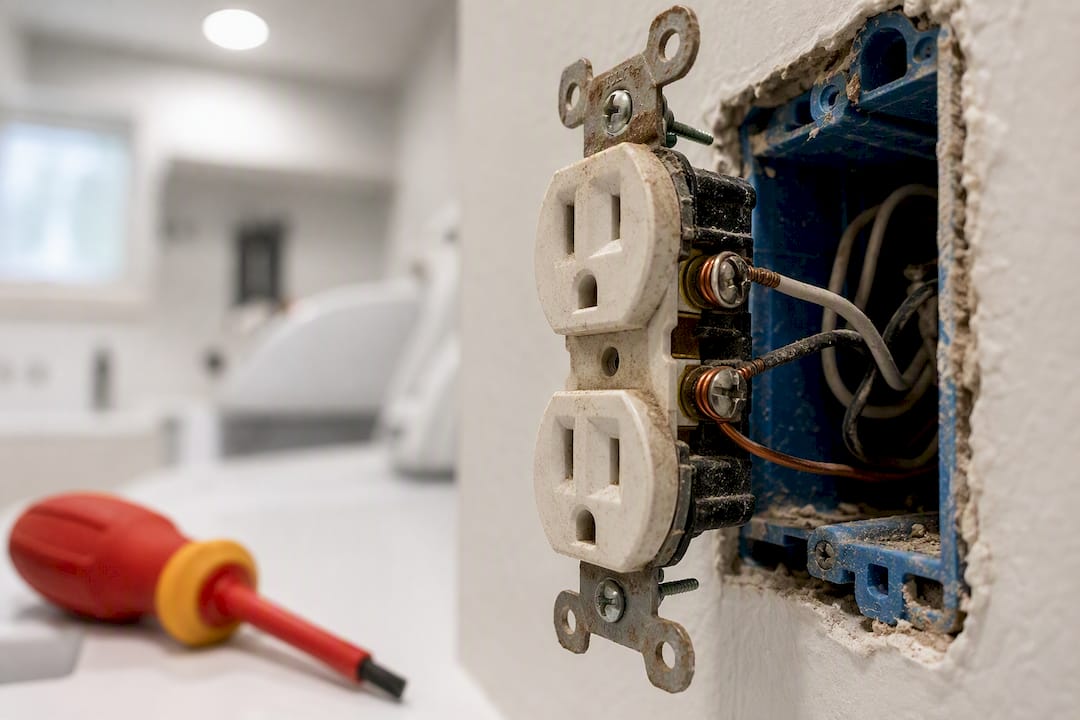
Cutting wires too short is another one that doesn’t show up until later. A future electrician, or you in six months, needs enough slack to pull the device out and work on it without fighting the box. Leave yourself several inches of extra wire and pigtail your connections rather than jamming bare conductors straight onto a device.
Splicing outside of a covered, accessible junction box is a code violation for good reason: those splices can loosen, oxidize, and arc without any way for anyone to know until there’s smoke. This Old House’s electrical troubleshooting guide flags uncovered junction boxes as one of the most common problems inspectors find, right alongside nicked conductors from careless wire stripping.
Pro Tip: When twisting on a wire nut, strip about three-quarters of an inch, twist the bare wires clockwise with pliers before capping, and tug gently to confirm it holds. A wire nut that spins freely isn’t a connection, it’s a fire waiting for a reason.
Wire Gauge, Breaker Size, and Circuit Overload Mistakes
Wire gauge and breaker size have to match, and mixing them up is arguably the single most dangerous common home electrical mistake on this list. The National Electrical Code sets wire sizing per circuit rating for a reason: 14-gauge wire is rated for 15 amps, 12-gauge for 20 amps, and 10-gauge for 30 amps. Put a 20-amp breaker on 14-gauge wire, and the wire can overheat well before the breaker ever trips to protect it.
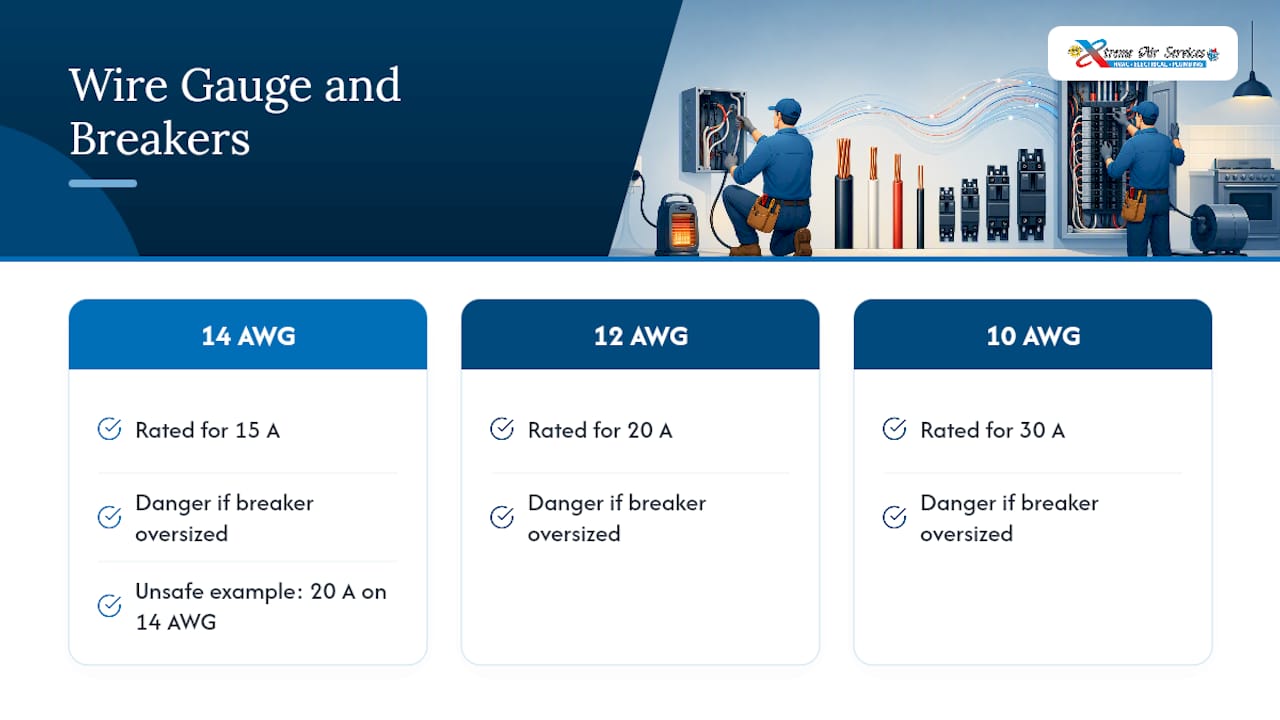
Danger level: HIGH. Swapping in a bigger breaker to stop nuisance tripping, without upgrading the wire, is one of the most unsafe fixes a homeowner can attempt. It removes the one safeguard keeping that circuit from overheating silently inside your walls.
Overloading shows up in more mundane ways too: a space heater and a hair dryer on the same 15-amp circuit, six devices daisy-chained through power strips, or an extension cord doing the job of permanent wiring for months at a time. If a circuit trips whenever you run two appliances together, that’s your circuit telling you it’s maxed out. Spreading loads across circuits or adding a dedicated circuit for a heavy appliance typically runs a few hundred dollars and a half-day for a licensed electrician, depending on panel access and wire run length. Rewiring an entire room or an older home with undersized wiring throughout is a bigger job, but it’s the right call when the pattern of tripped breakers keeps repeating.
GFCI and AFCI Protection: The Safety Step Homeowners Skip
Ground-fault circuit interrupters (GFCIs) and arc-fault circuit interrupters (AFCIs) solve two different problems, and skipping either one is a frequent oversight noted across common home electrical problem guides. GFCIs protect people from shock by cutting power the instant they detect current leaking to ground, something they’re engineered to do in a few milliseconds, fast enough to prevent a lethal shock. AFCIs protect against fire by detecting the electrical signature of a dangerous arc inside a wall, something a GFCI can’t catch.
Where you need GFCI protection: kitchens, bathrooms, garages, basements, outdoor outlets, and anywhere near a sink or water source. Where you need AFCI protection: most habitable rooms under current code, including bedrooms and living areas.
Testing takes thirty seconds:
- Press the “test” button on the GFCI. It should trip and cut power immediately.
- Press “reset.” Power should return.
- If it won’t reset, or trips constantly with nothing plugged in, replace the receptacle.
Danger level: HIGH for missing GFCI protection near water, MEDIUM for missing AFCI protection in living spaces. A GFCI receptacle swap is homeowner-friendly. Anything involving AFCI breakers or panel-level protection is a call-a-pro job.
The Panel Mistakes That Sit There Quietly Getting Worse
Most panel problems don’t announce themselves until they do. Loose connections, double-tapped breakers (two wires jammed under one screw meant for one), overfilled panels with no room for proper heat dissipation, and moisture or dust intrusion all sit quietly behind a metal door for years. Electricians consistently point to neglected panels as one of the habits that raises fire risk the most, precisely because homeowners rarely look.
You can inspect without opening anything past the breaker door:
- Scorch marks or discoloration around any breaker
- A buzzing sound from inside the enclosure
- A panel cover that’s warm to the touch
- Any burning or ozone-like smell near the panel
- Breakers with missing or illegible labels
Working inside the panel itself, tightening lugs, replacing breakers, adding circuits, is a licensed-electrician job every time. The bus bar inside stays live even with the main breaker off.
Pro Tip: Photograph your panel and its label list before any service call. It saves the electrician time diagnosing on-site, and that usually means a faster, cheaper visit.
Fixture Mistakes: Overlamping and Undersized Boxes
Putting a 100-watt bulb in a fixture rated for 60 watts, known as overlamping, is a genuine code and fire concern because it can scorch the socket and insulation around it. Check the wattage label inside every fixture, and when in doubt, an LED retrofit bulb runs cooler and usually solves the problem outright.
Ceiling fans need a fan-rated box, not a standard light box, because a standard box can’t handle the vibration and weight over time. Swapping a like-for-like fixture or bulb is a reasonable DIY task. Installing a new fan or fixture where wiring or box type is in question is not.
Skipping Permits Costs More Than It Saves
New circuits, panel upgrades, and service changes typically require a permit, and inspectors specifically look for buried splices, mismatched wire gauge, and missing GFCI protection. Skipping that step doesn’t just risk a fine. Unpermitted work commonly surfaces during a home sale, complicates insurance claims after a fire or water loss, and forces costly retrofits when a later buyer’s inspector finds it. If you’re not sure whether a project needs a permit, hiring a licensed electrician who pulls the permit as part of the job removes the guesswork entirely.
Warning Signs You Should Never Wait On
Some signs mean stop now, not “get to it this weekend.”
Act immediately: any burning smell, visible smoke, sparks, or arcing. Power off and call a pro the same day.
Visual signs worth watching for: scorch marks around outlets or switches, discolored faceplates, melted insulation on any visible wire, a plug that won’t stay seated in the outlet, or a breaker that trips the instant you reset it.
Audible signs matter just as much. A steady buzz often points to a loose connection. Crackling or popping near an outlet or panel usually means arcing is already happening. None of these are “monitor it” situations.
The Tools Every Homeowner Should Actually Own
A non-contact voltage tester, a digital multimeter, insulated screwdrivers, wire strippers, a plug-in outlet tester, and a dedicated GFCI tester cover almost everything a homeowner needs for safe basic diagnostics. Test every tool on a known live source before trusting a “dead” reading elsewhere, store them dry, and retire anything with cracked insulation or a dead battery indicator.
If any tool reveals a hot panel cover, a scorch mark, or an exposed conductor, that’s the end of the DIY portion of the project. Stop there and bring in a licensed electrician.
When to Call a Licensed Electrician
- Any work inside the panel, including breaker replacement or adding circuits
- Wiring inside walls, ceilings, or anywhere requiring drywall access
- Water-damaged outlets or any aluminum wiring in the home
- A breaker that trips again the moment you reset it
- Persistent flickering across multiple rooms, not just one bulb
- A scorched or warm outlet, even if it still works
Lower-risk tasks stay firmly in DIY territory: swapping a bulb, resetting a tripped breaker once, or replacing a single GFCI receptacle if you’ve confirmed the circuit is dead and you’re comfortable with the wiring. Everything on the numbered list above belongs to a professional, no exceptions.
A Quick Panel Checklist Before You Book a Service Call
Before scheduling an inspection, check the panel enclosure for warmth, look for corrosion or moisture stains, scan for scorch marks near any breaker, confirm breaker labels are legible, and note any two wires sharing one screw terminal (double-tapping).
Pro Tip: Photograph the panel and jot down the label text for each breaker. It’s the fastest way to get an accurate quote before the electrician even arrives.
If you spot any red flag on that list, schedule a licensed inspection rather than waiting for a bigger problem to announce itself.
What Fifteen Years of Panel Calls Teaches You
The mistakes that cause real damage are rarely dramatic. They’re a backstabbed outlet that ran fine for three years before it didn’t, a splice buried behind drywall during a “quick” weekend project, a breaker upsized because the original kept tripping and nobody asked why. The homeowners who call early, before smoke or sparks, almost always spend less than the ones who wait. A five-minute panel inspection catching a double-tapped breaker is a lot cheaper than the rewiring job that follows a scorched junction box.
Get an Electrical Safety Inspection Before Small Problems Get Expensive
You’ve got the checklist. You know what a scorched outlet or a buzzing panel means. What you can’t do safely from a checklist is open the panel, replace a breaker, or run new circuit wiring, and that’s exactly where a professional inspection earns its cost. Xtreme Air Services runs a full electrical safety inspection covering panel condition, GFCI and AFCI function, and visible wiring throughout the home, with a licensed electrician who pulls permits when the job calls for one.

That permit piece matters more than most homeowners realize: unpermitted panel or circuit work can come back to bite you at resale or during an insurance claim, and a licensed electrician handles that paperwork as part of the job, not as an upsell. If your panel showed even one warning sign from the checklist above, or you just want a professional to confirm the wiring behind your walls matches current code, schedule an electrical inspection and get a straight answer instead of a guess.
Sources
- 7 Mistakes Electricians Wish Homeowners Would Stop Making
- Electrical Problems: 10 of the Most Common Issues Solved – This Old House
- 15 Electrical Mistakes Homeowners Make | Family Handyman
FAQ
What is the 2 6 12 rule for outlets?
It’s a spacing guideline some electricians use: no point along a wall should be more than 6 feet from an outlet, and outlets are commonly placed roughly every 12 feet, with 2 feet often cited as a minimum distance from a doorway or corner. Exact spacing requirements depend on your local electrical code, so confirm specifics with a licensed electrician before wiring a room.
Why do electricians keep one hand in their pocket?
It’s a safety habit that prevents current from crossing through the chest if a shock occurs. Keeping one hand free of contact with anything grounded reduces the chance of a shock path running through the heart.
What are common wiring mistakes to avoid?
Backstabbing outlets instead of using screw terminals, cutting wires too short, splicing outside a covered junction box, and mismatching wire gauge to breaker size top the list. Each one either loosens over time or removes a built-in safeguard against overheating.
What are the most common electrical problems that occur in homes?
Overloaded circuits, missing GFCI or AFCI protection, neglected panels, and overlamped light fixtures show up most often in home inspections. A licensed electrical inspection catches most of these before they become safety hazards.