


Generator Pad / Placement: Should We Repair Your Existing Pad or Replace It?
How we decide between releveling and replacing a generator pad at Sunnyvale, TX homes.
What’s Covered on This Page
- What Decides Whether We Repair or Replace Your Pad
- When We’d Repair or Relevel an Existing Pad
- When We’d Replace the Pad Instead
- What This Work Costs and What’s Included
- How We Help You Decide
- How do I know whether to repair or replace my generator pad?
- What do people get wrong when guessing repair versus replace?
- When would you tell me to replace instead of repairing, even if repair costs less?
- How much difference is there in price between repairing and replacing a pad?
- Does the service-call fee still apply if I decide not to move forward with the work?
What Decides Whether We Repair or Replace Your Pad
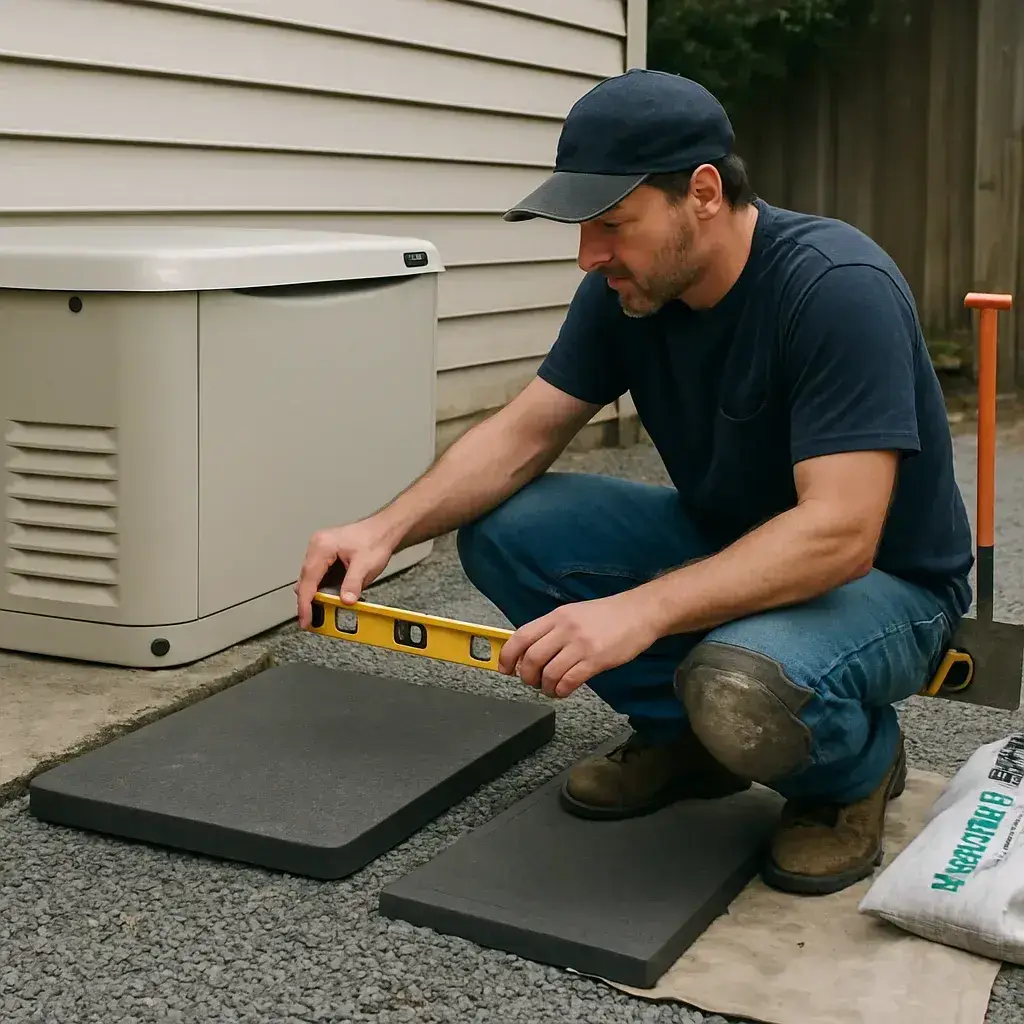
A generator pad looks simple, but it’s doing real work. It has to keep the unit level, keep it off wet or shifting soil, and hold the right clearance from your house, fence, and windows. When someone calls us about a pad, the first question isn’t repair or replace, it’s whether the existing pad is still doing those three jobs. If it’s flat, solid, and sitting at the correct clearance, there’s often nothing to replace at all.
- Pad condition: cracking, heaving, or sinking usually calls for replacement rather than a patch, since an uneven base can throw off the generator’s alignment and stress the fuel and electrical connections.
- Clearance to code: if the current pad puts the generator too close to a wall, window, or vent, we won’t just re-level it. That’s a placement problem, not a pad problem, and the fix is resetting the unit at the right distance.
- Site grading and drainage: a pad sitting in a low spot that collects water gets replaced along with better site prep, even if the pad itself looks fine.
- Pad material and size: a plastic composite pad and a poured concrete pad have different lifespans and different repair options. Concrete can sometimes be releveled; composite pads usually get swapped out.
- Access for the crew: harder-to-reach sites cost more to work on, which affects whether a repair or a full reset makes more financial sense.
Price tracks those same factors. Pad material and size, how much grading the site needs, distance from the home, clearance requirements, and any code upgrades all push the number up or down within that $200 to $1,200 range. Our pricing covers the pad materials, professional setting, and leveling and clearance verification. It doesn’t cover the generator itself, gas or electrical hookups, heavy site work, code corrections, or permits, unless we’ve said otherwise up front.
Sometimes the right answer is neither repair nor replace, it’s relocate. If a pad is sound but was set too close to the house or in a spot that floods every spring, we’d rather move the whole placement than keep patching around a bad location.
The $26 to $99 service-call fee gets credited toward the job if you move forward with us, so getting a look at your pad costs you the visit, not a second charge on top of the work.
When We’d Repair or Relevel an Existing Pad
We relevel or repair an existing pad when the pad itself is still sound but has shifted out of position over time. That’s more common than people expect on North Texas clay soil, which swells and contracts with the wet-dry cycle every year. A pad that was level when it was poured can tilt a half inch or more after a couple of seasons, and that tilt matters because most generators need to stay within a set range of level to run and drain oil correctly.
Here’s what we look for on a repair visit: the generator rocking slightly when you press on a corner, a gap opening under one edge of the pad, water pooling against the unit instead of running off, or hairline cracks that haven’t spread through the slab. If the concrete or composite material is still structurally intact and the footprint is still the right size for the unit, we can dig out, regrade, and reset the pad without pouring a new one. We also recheck code clearance while we’re there, since a fence line, AC condenser, or deck added after the original install can put a generator too close to a window or wall without anyone realizing it until an inspection flags it.
A relevel or reset job like this typically runs in the same range as a first-time pad placement, about $400 to $800 depending on how much regrading and clearance correction it needs, inside our overall generator pad and placement range of $200 to $1,200. If you’ve already paid the $26 to $99 service call fee for us to come look at it, that fee gets credited toward the repair if you move forward.
A repair isn’t always the right call. If the slab is cracked all the way through, if the ground underneath has settled unevenly rather than just shifted, or if the pad was undersized for the generator’s actual footprint from the start, releveling just delays the same problem. At that point we’re talking about a new pour or a new composite pad set.
A pad repair doesn’t include the generator itself, the gas or electrical hookups, or permit costs if your area requires one for the reset. Those stay separate line items whether you repair or replace.
When We’d Replace the Pad Instead
We pour or set a new pad instead of working with the old one when the surface itself can’t do its job anymore, not just because it’s old. Age alone doesn’t decide this. A pad from years back that’s still flat, still solid, and still sitting the right distance from your home can often stay right where it is.
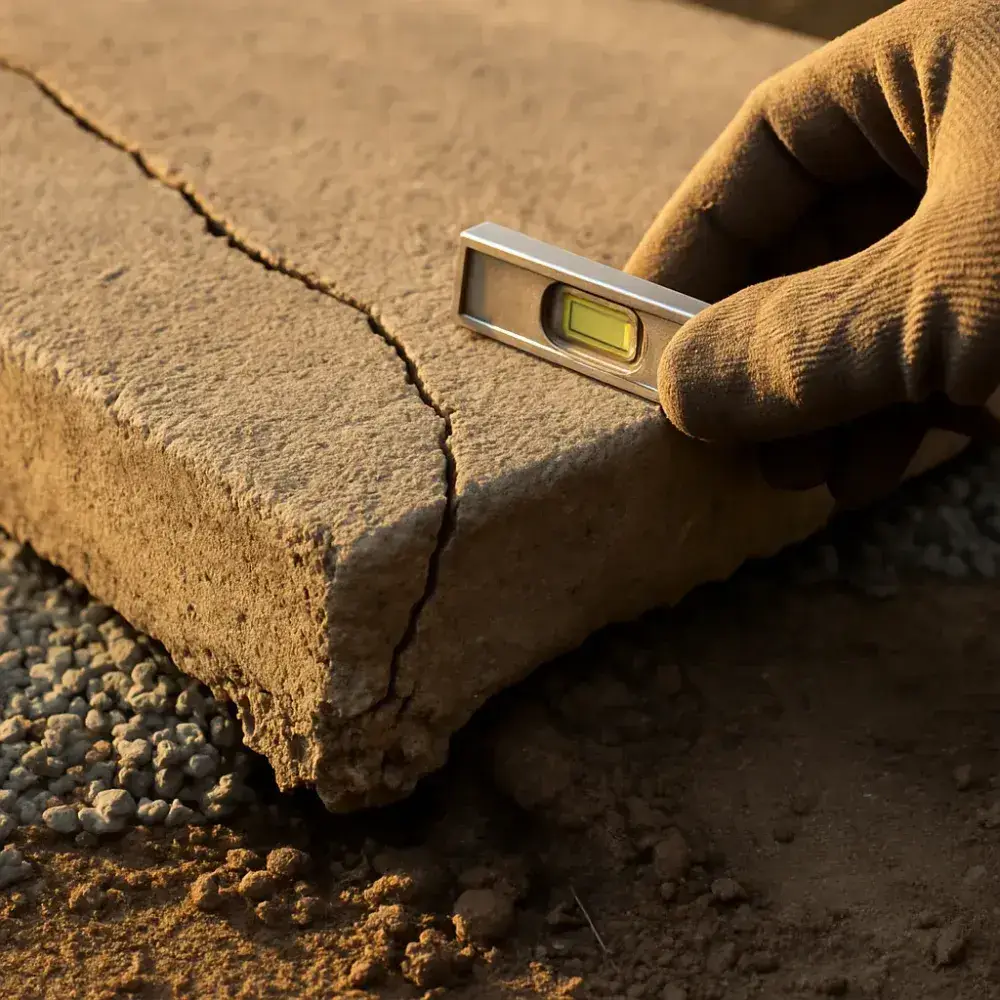
A few things push us toward a full replacement. If the existing pad has settled or shifted so the generator isn’t level, that’s a problem, because an unlevel unit runs harder on its bearings and vibrates more than it should. If the pad is too small for the unit you’re installing, or it sits closer to windows, doors, or a gas meter than code allows for clearance, we’re not going to set a generator on it as-is. Site grading matters too. Standing water around a pad after a storm, or a slope that drains toward your foundation instead of away from it, usually means new sub-base work before any pad goes down.
On pricing, generator pad and placement work typically runs $400 to $800 as its own job, inside a broader $200 to $1,200 range depending on what your site needs. What moves that number is pad material and size, how much grading or access work the site needs, how far the unit sits from the house, the clearance requirements for your specific generator, and any code upgrades the spot requires. That price covers the pad materials themselves, professional set and leveling, and verifying clearances. It doesn’t cover the generator, the gas or electrical hookups, heavy site work, or permits, we itemize those separately if your job needs them.
If you’re just weighing this now, that’s the right time to loop it into our generator sizing and placement work, since pad location and unit size affect each other. We usually walk that consultation before anything gets poured.
If your current pad is solid, level, and legally clear of your home and openings, we’d tell you to keep it. Swapping a good pad for a new one just adds cost you don’t need. We charge a $26 to $99 service call fee to come look, and that fee gets credited toward the job if you move forward with us.
Not sure what your Generator pad / placement project needs? Ask us.
Call Today, Get Service Today. Xtreme Air Services is ready to help.
What This Work Costs and What’s Included
A generator pad runs $200 to $1,200 in most cases, and the typical job across our service area lands between $400 and $800. That number covers pouring or setting a concrete or composite pad and positioning the generator so it meets code clearances, leveled and secured on solid ground. If someone quotes you far outside that range without seeing your yard first, ask what’s driving the difference.
Five things move the price up or down. Pad material and size matter, a small composite pad for a portable unit costs less than a poured concrete pad for a whole-home standby generator. Site grading and access play a role too, a flat, open side yard is a quicker job than a tight side-yard squeeze with a slope. Distance from the home affects clearance work, and any code upgrades needed to meet local setback or clearance rules add to the job.
- Pad material and size
- Site grading and access
- Distance from the home
- Clearance requirements
- Code upgrades if your site needs them
What’s included in that $400 to $800 range: the pad materials, a professional set, leveling, and a check that the generator sits at the required clearance from windows, doors, and vents. What’s not included: the generator itself, gas or electrical hookups, extensive site work like removing a tree stump or regrading a slope, code corrections, and permits, unless we’ve said otherwise up front in your quote.
We charge a $26 to $99 service-call fee to come look at your site and give you a firm number. If you move forward with the pad work, that fee gets credited toward the job, so you’re not paying twice just to get an answer.
Financing isn’t typically set up for a job this size. We do offer it for larger work, like a full generator installation or replacement, where the total cost is higher.
How We Help You Decide
Most generator pad and placement jobs in the Dallas-Fort Worth area run $400 to $800, with the full range landing between $200 and $1,200 depending on your site. The pad itself, whether it’s a poured concrete slab or a composite pad, is rarely the expensive part. What moves the number is everything around it.
Five things drive where you land in that range: the pad material and size you need, how much grading or leveling your yard requires, how far the unit sits from the house, code clearance requirements for windows, doors, and vents, and whether the site needs a code upgrade to pass inspection. A flat, easy-access spot with a standard composite pad is a straightforward job. A sloped yard, tight side setback, or a spot close to a window that needs re-thought is a different job.
- Pad type and size for your generator’s footprint
- Site grading, drainage, and access for our crew
- Length of run needed from the home
- Required clearances from windows, doors, and vents
- Any code corrections the site needs before we set the pad
If the only level spot in your yard doesn’t meet clearance code, we’re not going to set the pad there anyway and hope it passes inspection later. We’ll talk through moving the location or doing extra grading, and that pushes the job past the typical $400 to $800 range. It’s a real tradeoff between the easiest spot and the spot that’s allowed.
The pad price includes materials, professional setting and leveling, and clearance verification. It does not include the generator itself, gas or electrical hookups, major site work, code corrections, or permits, unless we’ve written those in ahead of time.
A service call runs $26 to $99, and that fee gets credited toward the job if you move forward with us. Financing usually isn’t needed for a pad this size, but it’s available if your project turns into a larger install or replacement.
See our full generator pad and placement service in Sunnyvale for what the complete job involves.
Frequently Asked Questions
Common questions about Generator Pad / Placement in Sunnyvale
How do I know whether to repair or replace my generator pad?
We look at three things: whether the pad is still flat and solid, whether it sits at the correct code clearance from your house and windows, and whether the ground under it has shifted or settled. If all three check out, we often relevel rather than replace. If the slab is cracked through or the ground has settled unevenly, replacement is the better call.
What do people get wrong when guessing repair versus replace?
Most people assume age is the deciding factor, but it isn’t. A pad poured years ago can still be flat, solid, and correctly placed, so we’d leave it alone. What matters is whether the pad still keeps the generator level, drains water away, and holds proper clearance. A newer pad with drainage or clearance problems can need replacing sooner than an older one that’s holding up fine.
When would you tell me to replace instead of repairing, even if repair costs less?
We’d tell you to replace if the slab is cracked all the way through, the ground beneath it has settled unevenly, or the pad was undersized for the generator from the start. Releveling in those cases just delays the same problem coming back. We’d rather say that upfront than sell you a temporary fix on a pad that can’t hold up.
How much difference is there in price between repairing and replacing a pad?
Both usually land in the same range, about $400 to $800, inside our overall $200 to $1,200 span for generator pad and placement work. The exact number depends on pad material and size, how much grading the site needs, distance from the home, and any clearance corrections. A repair and a full reset can cost close to the same if the site work is similar.
Does the service-call fee still apply if I decide not to move forward with the work?
The visit itself runs $26 to $99, and that fee gets credited toward the job if you move forward with us. If you decide not to proceed after we look at the pad, you’ve paid for the visit, not for anything beyond it. That way, getting an honest look at your pad doesn’t cost you a second charge on top of the work.
Ready to Get Started?
Call 972-288-2263 Today, Get Service Today.