

A chiller plant system is a centralized cooling setup that produces chilled water by removing heat through a refrigeration cycle, then distributes that cooling throughout a building to maintain indoor comfort and operational efficiency. Understanding how chiller plant system works is the foundation of effective HVAC management for any facility engineer or building operator. The system integrates chillers, cooling towers, pumps, and control systems into one coordinated plant. Comprehensive optimization strategies can save 15–40% in total plant energy consumption compared to non-optimized systems. That range represents millions of dollars annually in large commercial facilities.
What are the core components of a chiller plant?
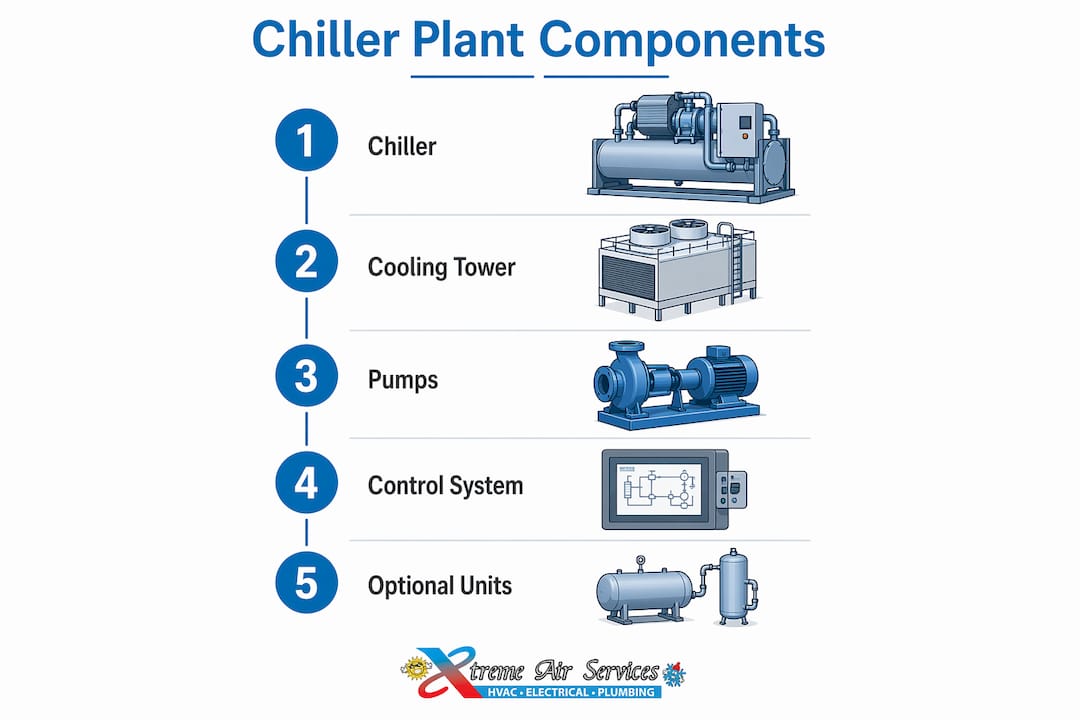
A chiller plant operates through four major hardware categories working in sequence: chillers, cooling towers, pumps, and control systems. Each category handles a distinct part of the heat transfer process. When one component underperforms, the entire plant pays the efficiency penalty.
Chillers
The chiller is the heart of the plant. It uses a refrigeration cycle to extract heat from building return water, producing chilled supply water typically at 44°F–54°F. Most commercial plants use either centrifugal, screw, or scroll chillers depending on capacity and load profile. The chiller passes chilled water to air handling units throughout the building, where it absorbs heat from indoor air before returning to the chiller.
Cooling towers
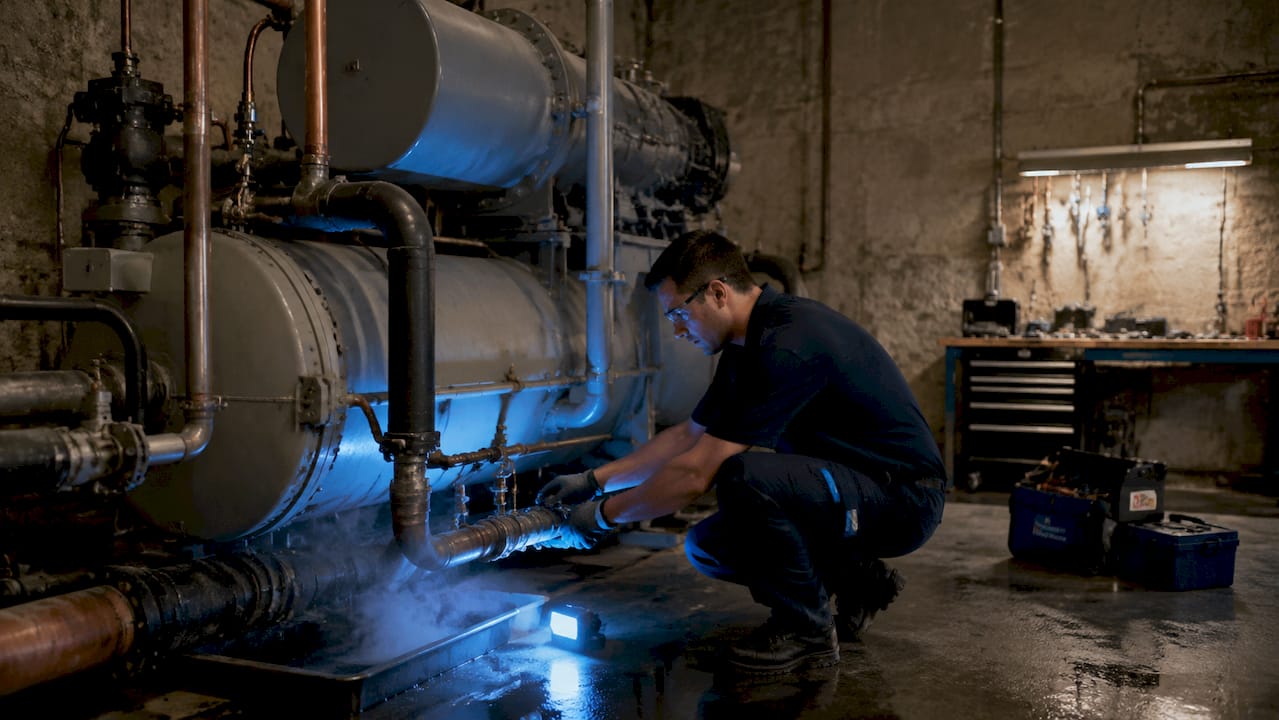
Cooling towers reject the heat the chiller pulls out of the building. Condenser water circulates from the chiller to the tower, where evaporative cooling releases heat into the atmosphere. Tower fan speed directly affects condenser water temperature, which in turn affects chiller efficiency. Running towers at lower condenser water temperatures reduces the chiller’s lift and cuts energy consumption.

Pumps
Two separate pump loops move water through the plant. Chilled water pumps circulate supply and return water between the chiller and the building’s air handling units. Condenser water pumps move water between the chiller’s condenser and the cooling tower. The industry standard flow formula is GPM = 24 × Tons / ΔT, where ΔT is the temperature difference in °F between supply and return water. For a 2,500-ton load at a 10°F ΔT, that equals 6,000 GPM of required flow.
Control systems and optional components
Building automation systems (BAS) coordinate all plant equipment in real time. Optional components include thermal storage tanks, bypass valves, isolation valves, and heat exchangers for heat recovery. These additions expand operational flexibility, especially during peak demand or off-peak charging periods.
Pro Tip: Install flow meters on both chilled water and condenser water loops from day one. Without flow data, you are guessing at ΔT, and guessing at ΔT means you cannot stage chillers accurately.
The table below summarizes each component’s primary function:
| Component | Primary function |
|---|---|
| Chiller | Removes heat from chilled water via refrigeration cycle |
| Cooling tower | Rejects condenser heat to atmosphere via evaporation |
| Chilled water pumps | Circulate chilled water between chiller and building |
| Condenser water pumps | Circulate condenser water between chiller and tower |
| BAS controls | Coordinate staging, resets, and flow management |
For a broader view of how chiller plants fit within commercial HVAC systems, understanding the full system context helps facility managers make better capital planning decisions.
How does the refrigeration cycle cool a building?
The refrigeration cycle is the engine behind every chiller. It moves heat from the chilled water loop to the condenser water loop using a refrigerant that changes state between liquid and vapor. The cycle runs continuously as long as the chiller is operating.
The four steps work as follows:
- Compression. The compressor raises the refrigerant’s pressure and temperature, turning low-pressure vapor into high-pressure, high-temperature vapor. This is the most energy-intensive step in the cycle.
- Condensation. High-pressure vapor flows into the condenser, where it releases heat to the condenser water and condenses into a high-pressure liquid. The condenser water carries that heat to the cooling tower.
- Expansion. The high-pressure liquid passes through an expansion valve, which drops its pressure rapidly. This pressure drop causes the refrigerant to partially flash into vapor and drop sharply in temperature.
- Evaporation. Cold, low-pressure refrigerant enters the evaporator, where it absorbs heat from the building’s return chilled water. The refrigerant boils back into vapor, completing the cycle. The chilled water exits cooled and ready to serve the building.
Two thermodynamic concepts matter most for chiller efficiency: lift and head pressure. Lift is the difference between the evaporating and condensing pressures. High lift means the compressor works harder and consumes more energy. Reducing condenser water temperature lowers lift and improves efficiency.
Head pressure management becomes critical in cold weather. When outdoor temperatures drop, condenser water can become too cold, causing the refrigerant to condense at pressures below safe operating limits. Efficient chiller operation depends on managing head pressure carefully in colder seasons to avoid compressor damage. Variable frequency drives on tower fans and bypass valves on the condenser loop are the standard tools for maintaining minimum head pressure.
Hot gas bypass is another control technique used at very low loads. It recirculates a portion of high-pressure refrigerant vapor back to the evaporator inlet, artificially loading the compressor to prevent surge or instability. This is a protective measure, not an efficiency tool, and should only activate when staging down to a smaller chiller is not practical.
Pro Tip: Monitor superheat and subcooling values at startup each season. Abnormal readings are the earliest warning signs of refrigerant charge issues, fouled heat exchangers, or expansion valve problems before they become expensive failures.
What are the common chiller plant configurations and control strategies?
Chiller plant system configurations determine how water flows through the plant and how much pumping energy the system consumes. Three architectures dominate commercial practice.
Primary-only constant flow runs all chilled water pumps at a fixed speed. Every chiller and coil receives the same flow rate regardless of actual load. This is the simplest design but wastes significant pumping energy at part load, which is where most buildings spend most of their operating hours.
Primary-secondary variable flow separates the plant into two loops with a decoupler pipe. Primary pumps serve the chillers at constant flow. Secondary pumps serve the building at variable flow, modulating speed based on demand. This protects chillers from low-flow conditions while allowing the building loop to save pumping energy.
Variable primary flow (VPF) eliminates the secondary loop entirely. Pumps vary flow through the chillers directly based on building demand. VPF systems offer the highest energy efficiency with fully variable chilled and condenser water flow, but require chillers rated for variable flow and minimum flow safeguards to prevent evaporator freeze-up.
Control strategy is as important as physical configuration. Key operational parameters include:
- Chiller staging thresholds. Stage a chiller on when the running chiller reaches approximately 85% of its capacity. Stage it off when load drops to approximately 45%. Maintaining a wide deadband of 40–50% between staging ON and OFF thresholds prevents rapid cycling and protects equipment.
- Chilled water temperature reset. Raise the chilled water supply setpoint when building load is low. Warmer supply water reduces chiller lift and cuts energy use without sacrificing comfort.
- Condenser water temperature reset. Lower the condenser water setpoint as outdoor wet-bulb temperature drops. This directly reduces chiller lift and is one of the highest-value control moves in the plant.
- Lead/lag rotation. Rotate which chiller runs as the lead unit to equalize runtime and wear across the fleet.
ASHRAE Guideline 36 defines high-performance sequences that enable dynamic temperature resets and coordinated chiller staging based on real-time loads. Plants following Guideline 36 sequences consistently outperform those running fixed setpoints.
Pro Tip: Never stage chillers based solely on total plant tonnage. Stage based on individual chiller efficiency curves. A chiller running at 35% load is burning money, even if the total plant load looks reasonable.
How can facility managers optimize chiller plant efficiency?
Optimization is a plant-wide discipline, not a chiller-only task. Facility managers often misinterpret optimization as maximizing chiller efficiency alone, overlooking total plant energy, which includes pumps and towers. The biggest gains come from coordinating all three.
The three highest-value efficiency levers are:
- Variable speed pumping. Adding variable frequency drives to chilled water and condenser water pumps delivers 10–20% savings in pumping energy. Pumping energy scales with the cube of flow rate, so even modest speed reductions produce large savings.
- Optimized chiller staging. Chiller staging that ignores efficiency curves wastes 15–25% energy by running chillers at low loads. Efficient staging keeps each chiller above 40–60% load where efficiency peaks.
- Temperature reset strategies. Combined chilled water and condenser water resets contribute 3–8% additional savings on top of pumping and staging gains.
The most common operational pitfall is simultaneous heating and cooling. The biggest energy waste in a typical chiller plant is simultaneous heating and cooling in building loops, ahead of improper chiller staging and inefficient tower fan control. This happens when zone controls are misconfigured or when reheat coils activate while the chiller is still running at full load.
Water quality is the most underestimated maintenance factor in chiller plant operation. Water quality issues causing corrosion and fouling degrade heat exchanger performance and can lead to catastrophic plant failure. A fouled evaporator or condenser forces the chiller to work harder for the same output, raising energy consumption and accelerating mechanical wear. Proactive water treatment, including chemical dosing, filtration, and regular water analysis, is as important as any control strategy.
Monitoring kW/ton for each chiller in real time gives the BAS the data it needs to stage equipment for minimum total plant energy. Real-time efficiency data enables dynamic, optimized chiller staging that no fixed schedule can match.
The comparison below shows the impact of key optimization measures:
| Optimization measure | Energy impact | Primary risk if skipped |
|---|---|---|
| Variable speed pumping | 10–20% savings | Excess pumping energy at part load |
| Optimized chiller staging | 15–25% waste avoided | Chillers running at inefficient low loads |
| Temperature resets | 3–8% additional savings | Unnecessary chiller lift and compressor strain |
| Water quality management | Prevents catastrophic failure | Fouling, corrosion, heat exchanger degradation |
Pro Tip: Track runtime hours per chiller monthly and use that data to rotate lead/lag assignments. Equal runtime across the fleet extends equipment life and avoids the scenario where one chiller carries 80% of annual hours while another sits nearly idle.
For facilities managing energy across multiple systems, reviewing energy-saving practices for facility systems offers complementary strategies that apply beyond the chiller plant itself.
Key Takeaways
A chiller plant system works efficiently only when chillers, pumps, cooling towers, and controls operate as a coordinated whole rather than as independent pieces of equipment.
| Point | Details |
|---|---|
| Refrigeration cycle drives cooling | The compressor, condenser, expansion valve, and evaporator work in sequence to transfer heat out of the building. |
| Component coordination is non-negotiable | Chillers, towers, and pumps must be controlled together to achieve real efficiency gains. |
| Staging thresholds prevent cycling | Set staging ON at 85% load and OFF at 45% to protect equipment and avoid energy waste. |
| Water quality determines long-term reliability | Fouling and corrosion from poor water treatment degrade performance and cause premature failure. |
| ASHRAE Guideline 36 sets the standard | Plants using Guideline 36 sequences achieve dynamic resets and coordinated staging that fixed setpoints cannot match. |
What facility managers get wrong about chiller plant management
After working with commercial HVAC systems across a wide range of building types, one pattern stands out clearly. Facility managers focus intensely on the chiller itself and treat everything else as secondary. That mindset is the single most expensive mistake in plant management.
The chiller is visible, expensive, and easy to point to. The pumps and towers feel like supporting equipment. But a chiller running at peak efficiency while the pumps are oversized and running at full speed is still a plant burning unnecessary energy. Total plant kW/ton is the only metric that tells the real story.
Seasonal transitions are where I see the most avoidable failures. Spring and fall bring fluctuating loads that expose staging logic written for peak summer conditions. A plant that runs perfectly in August can cycle chillers aggressively in October if nobody has adjusted the staging thresholds or enabled temperature reset schedules for shoulder-season conditions. ASHRAE Guideline 36 addresses this directly with dynamic reset sequences, but those sequences only work if someone commissions them correctly and verifies them each season.
Water quality is the issue that gets deferred until it becomes a crisis. I have seen facilities skip water treatment programs for two or three years because the plant “seemed fine.” Then a heat exchanger fails, or a tower basin corrodes through, and the repair cost dwarfs years of treatment program fees. Treat water quality as a continuous operational requirement, not a periodic maintenance item.
My recommendation for any facility manager taking over a chiller plant: spend the first 30 days reading trend data, not adjusting setpoints. Understand what the plant actually does before you change anything. The data will tell you where the waste is. Then fix the biggest problem first, verify the result, and move to the next one.
— Xtreme
Professional HVAC support for your chiller plant
Chiller plants deliver their best performance when maintenance is scheduled, documented, and performed by technicians who understand the full system, not just individual components.

Xtreme Air Services provides commercial HVAC maintenance plans built for facility managers who need consistent plant performance without managing every service call internally. From seasonal commissioning checks to water treatment coordination and BAS sequence verification, the team at Xtreme Air Services covers the full scope of chiller plant care. Contact Xtreme Air Services to schedule a professional plant assessment and get a maintenance plan matched to your building’s actual load profile and equipment fleet.
FAQ
What does a chiller plant system do?
A chiller plant system removes heat from a building by cooling water through a refrigeration cycle and distributing that chilled water to air handling units throughout the facility. It is the primary cooling source for most large commercial and institutional buildings.
How does the refrigeration cycle work in a chiller?
The refrigeration cycle compresses refrigerant to raise its temperature, condenses it to release heat to the cooling tower, expands it to drop its temperature, then evaporates it in the chiller to absorb heat from the building’s return water. This four-step process repeats continuously while the chiller operates.
What is the most efficient chiller plant configuration?
Variable primary flow systems offer the highest energy efficiency because they vary water flow directly through the chillers based on real-time building demand. They require chillers rated for variable flow and minimum flow protection to operate safely.
How often should chiller plant water quality be tested?
Water quality should be tested and treated on a continuous basis, not just during scheduled maintenance visits. Fouling and corrosion from poor water treatment degrade heat exchanger performance and can cause catastrophic equipment failure.
What does ASHRAE Guideline 36 do for chiller plants?
ASHRAE Guideline 36 defines high-performance control sequences that enable dynamic chilled water and condenser water temperature resets along with coordinated chiller staging based on actual building loads. Plants using these sequences consistently reduce energy consumption compared to fixed-setpoint operation.