


Cooling Tower Installation in Carrollton: Know Your Scope Before You Buy
Cooling tower installs for commercial chilled-water plants, with the permit and mechanical code requirements explained.
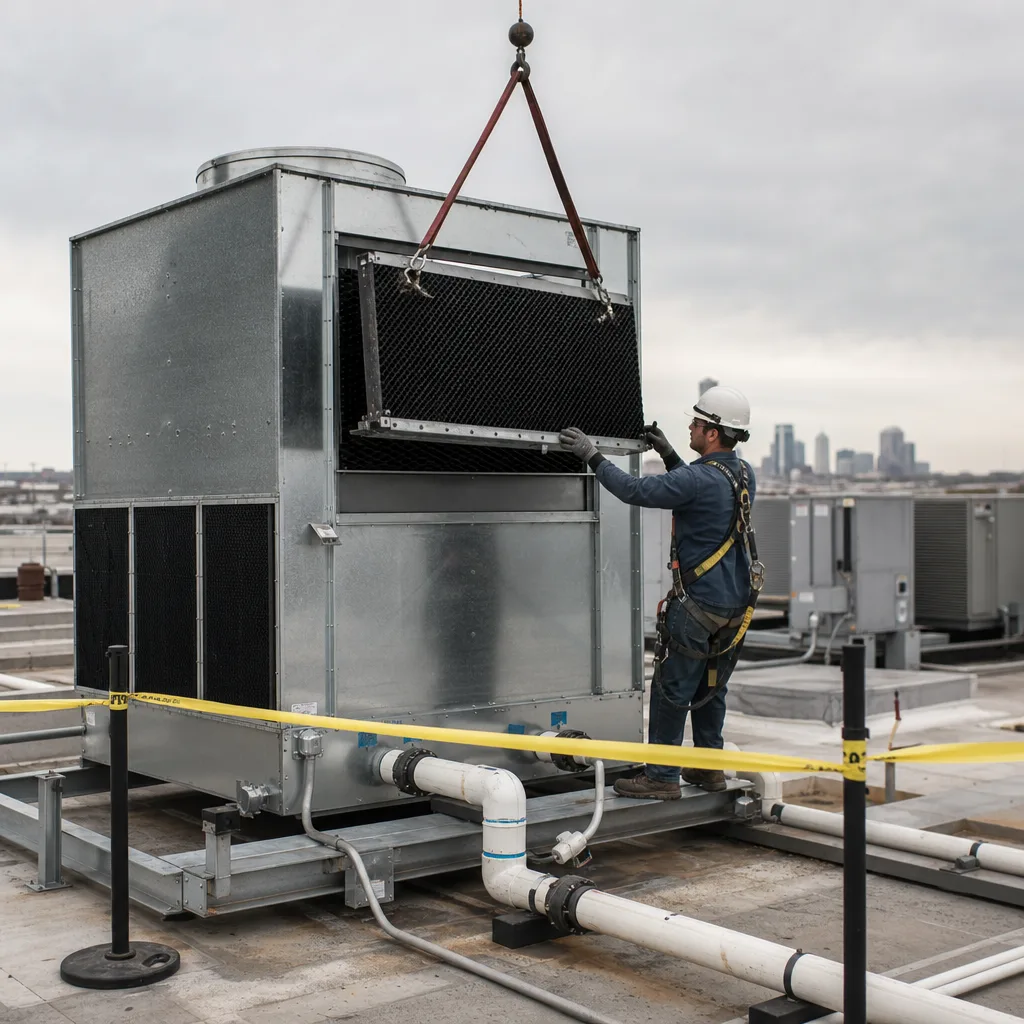
What’s Covered on This Page
- Standard Replacement vs. Modified Installation: Know Which One You Need
- What a Cooling Tower Installation Includes and What Costs Extra
- What Drives Your Price Up or Down
- Why Carrollton’s Commercial Buildings Depend on Reliable Cooling Towers
- When a Repair Is Enough and Installation Isn’t Needed
- How do I know if my cooling tower needs a repair or a full replacement?
- Can hard water in Carrollton shorten my cooling tower’s life?
- What should I check before calling for a cooling tower quote?
- Why does my chiller run longer without cooling the building better?
Standard Replacement vs. Modified Installation: Know Which One You Need
Before you compare quotes, figure out which kind of job you have. That one answer tells you more about your price and timeline than anything else.
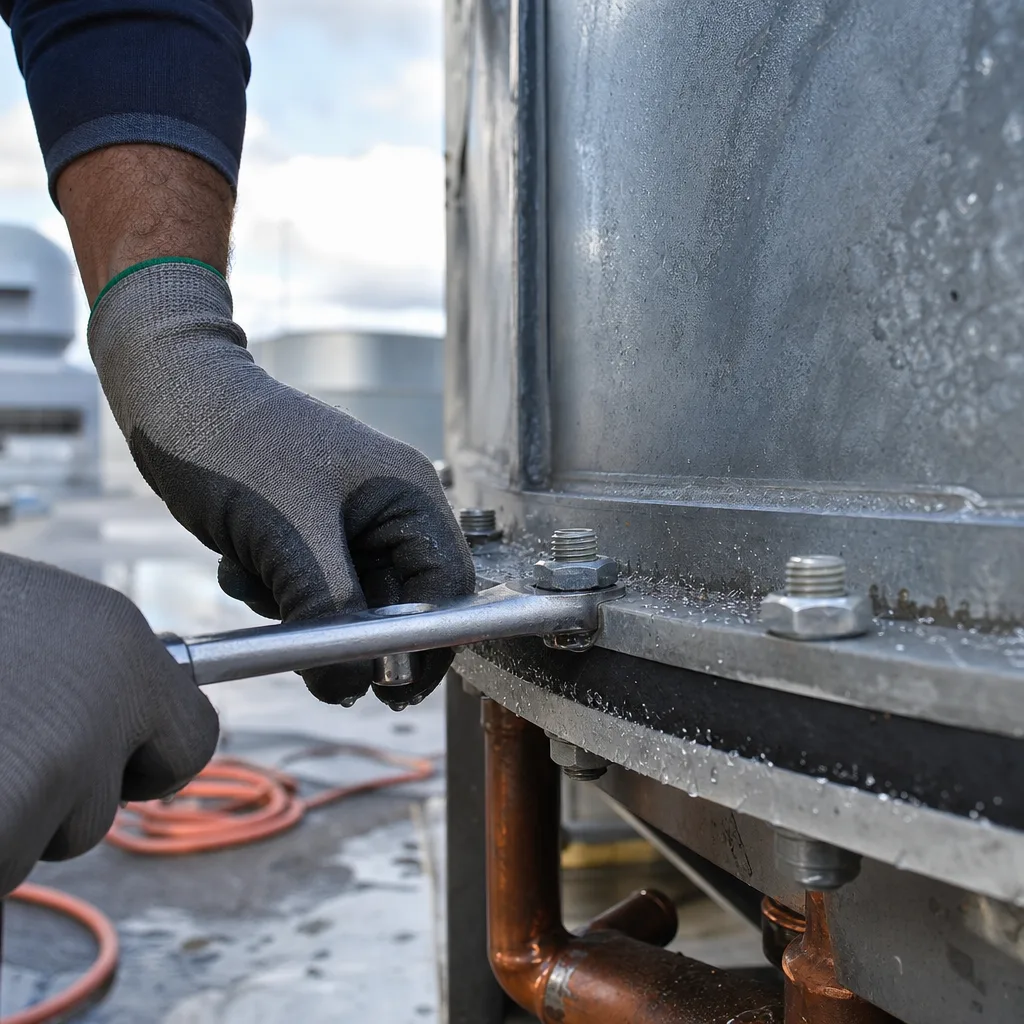
A standard replacement is the most common cooling tower installation we quote. It’s a like-for-like job. The new tower ties into your existing connections, with no major modifications. For that kind of job, our price is $28,000-$64,000. It covers the equipment and materials, professional installation, standard connections, startup and testing, and haul-away of the old unit.
You’re probably looking at a standard replacement if:
- Your building’s cooling load hasn’t changed much since the old tower went in.
- The new tower will sit in the same spot, at about the same size and capacity.
- Your condenser water piping, wiring, and water supply lines are in good shape.
- Nobody has flagged code problems with the current setup.
A modified installation is anything beyond that. Maybe you added space or equipment and need more tonnage, which is the amount of heat the tower can reject. Maybe the old piping is corroded and won’t hold up to a new tower. Maybe the electrical feed is too small for the new fan motors, or the tower is moving to a spot that’s harder to reach. Each of those adds work that isn’t part of a straight swap.
Here’s what our pricing does not include unless your quote says so: duct, electrical, and plumbing modifications, code corrections, and permits. Custom fabrication and tough access can also raise the cost. That’s why our full range for this work runs from $10,000 to $100,000. A small, easy swap sits near the bottom. A larger tower with new piping, electrical upgrades, and a hard-to-reach location can sit near the top.
Here’s the honest part. If your tower is the right size, your connections are sound, and nothing about your building has changed, you don’t need a bigger or fancier setup. A like-for-like replacement is the right call. Don’t let anyone talk you into modifications you can’t see a reason for.
On the flip side, don’t let a low quote hide a modified job. If the old piping is failing or the tower is undersized for your load, a straight swap just puts new equipment on old problems. When you get a quote, ask these three questions:
- Is this a like-for-like replacement, or does it include modifications?
- Which piping, electrical, or plumbing work is included, and which isn’t?
- Are permits and code corrections in this price, or will they be added later?
Clear answers to those questions mean you’re comparing the same job from one contractor to the next. If the project grows larger than you planned, flexible financing is available on qualifying installations and larger jobs, on approved credit.
What a Cooling Tower Installation Includes and What Costs Extra
You’ve seen the short list of what’s in and what’s out. Here’s what those words should mean when a crew is on your roof or your pad. This is how you spot a quote that’s thin on the parts that matter.
Standard connections means the new tower ties into the condenser water supply and return lines, the makeup water line, the drain and overflow, and the electrical feed you already have. If those lines line up and they’re in good shape, the tie-in is part of the job. If the new tower’s connections sit in different spots, adapting them can turn a simple tie-in into modification work.
Startup and testing is the step people skip past on a quote, and it’s the one that tells you the tower works. A proper startup usually covers these checks:
- Filling the basin and setting the float valve so the water level holds steady.
- Confirming the fan spins the right direction and runs without heavy vibration.
- Checking that water spreads evenly across the fill, so the whole tower does its share of the cooling.
- Watching the tower under load, so you know it’s pulling heat out of your building and not just running.
Haul-away of the old unit matters more than it sounds. An old tower is big, heavy, and often full of scale and sludge. Getting it off your property is part of the price, so you’re not left with a rusted shell behind the building.
The extras usually come from one of these places:
- Permits. Mechanical work on a commercial building in Carrollton generally needs one. Ask who pulls it and whether the fee is on your quote or billed later.
- Code corrections. If the old setup was never up to current code, an inspector may flag it once new equipment goes in. That fix is separate from the swap.
- Electrical work. A bigger or more efficient tower may need a larger feed, new disconnects, or new controls wiring. If the upgrade reaches the utility side, Oncor may need to be involved, and that can affect your timeline.
- Piping. North Texas water is hard, and years of scale and corrosion can leave old condenser piping too weak to reuse. Replacing it is modification work.
- Custom fabrication and access. New steel supports, curbs, or adapters, plus a crane for a rooftop lift, can all add cost.
None of these extras is a trick. They’re real conditions on your building. The goal is to find them before the work starts, not halfway through.
That’s why someone needs to look at your site before giving you a firm number. We charge a $26-$99 service-call fee for that visit, and it’s credited toward the work if you go ahead with Xtreme Air Services. You get a price built on your actual piping, wiring, and access, so the number you approve is the number you can plan around.
What Drives Your Price Up or Down
Once you know whether you need a straight swap or a modified job, the next big cost factor is the tower itself. Most of the spread in a cooling tower price comes from four choices: how big it is, how efficiently it runs, what it’s built from, and how hard it is to get into place.
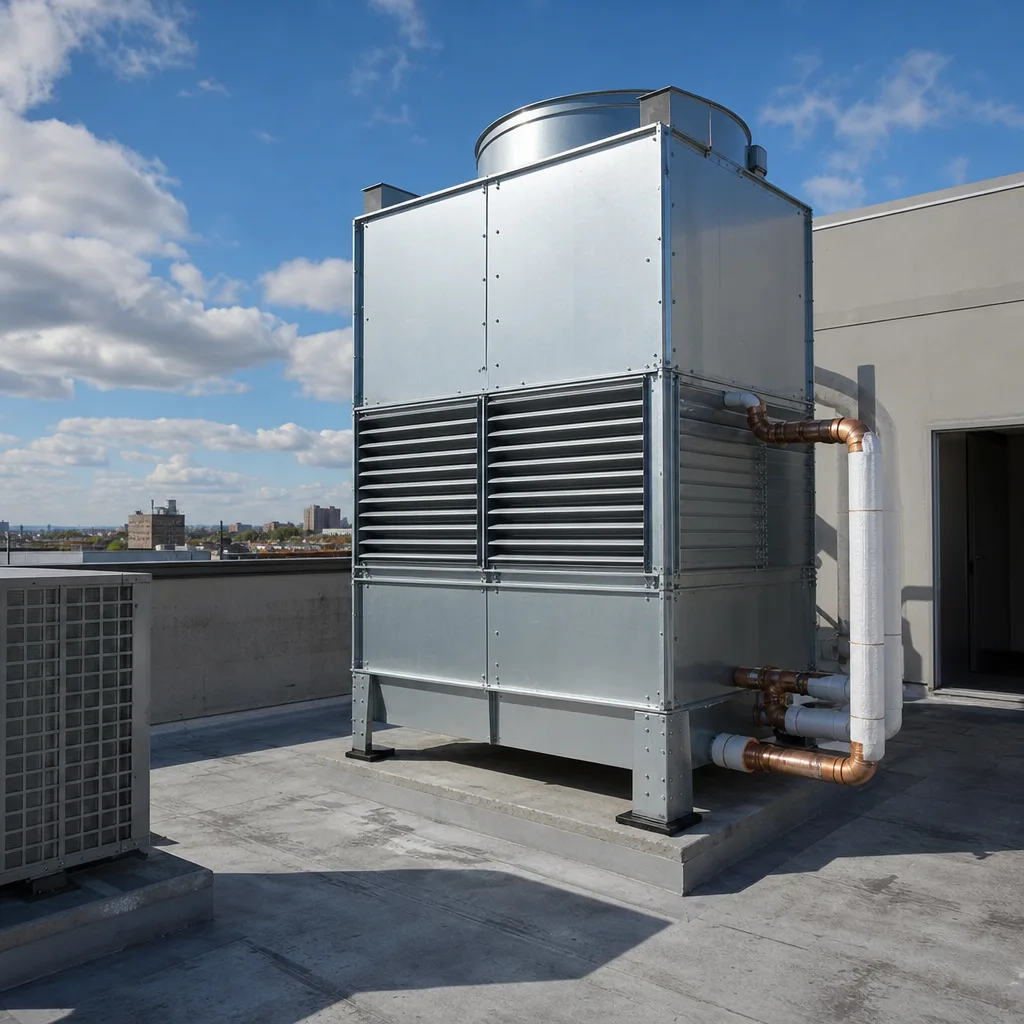
Size comes first. Cooling towers are rated by how much heat they can pull out of your building’s condenser water, usually in tons. More tons means a bigger tower, more fill, a larger fan, and more steel, so the price climbs with capacity. Bigger isn’t automatically better, though. An oversized tower costs more up front and can cycle on and off more than it should. An undersized one runs flat out on a July afternoon in Carrollton and still can’t keep up. The right size comes from your actual load, not from whatever happened to be on the roof before.
Efficiency works differently than it does on a home AC. You’ve probably heard of SEER2 and AFUE ratings. Those apply to residential air conditioners and furnaces, not cooling towers. On a tower, efficiency mostly shows up in the fan. Here’s what that looks like:
- Fan motor quality. A higher-efficiency motor costs more to buy but draws less power every hour the tower runs.
- Variable-speed fan drives. These slow the fan down when your building doesn’t need full cooling, which saves energy on mild days. They add cost to the install.
- Fill and water distribution design. Better fill spreads water more evenly, so the tower rejects more heat for the same fan power.
If your tower runs long hours through a North Texas summer, paying more for efficiency can make sense. If it only carries a light or seasonal load, the payback may never come. That’s a fair question to ask on any quote.
Materials and model come next. Towers are commonly built from galvanized steel, stainless steel, or fiberglass and plastic composites. Each one handles water and weather differently, and each one carries a different price. North Texas water is hard, and the scale and corrosion that come with it are rough on cheaper materials over time. A tower that holds up better against that water usually costs more on day one. Within any line, a heavier-duty model with better access panels and easier-to-clean parts also adds to the price.
Access ties it together. A ground-level pad with room for a truck is the simplest case. A rooftop lift that needs a crane, street coordination, or work around tenants and business hours adds labor and equipment time. The tower may be the same, but the job isn’t.
Add the site conditions covered above, like old piping, electrical feeds, and code issues, and you can see why one building lands near the low end of our range and another near the top. When you compare quotes, check that each one lists the tonnage, the fan and drive type, and the tower material. If one quote is much lower, the answer is usually in one of those three lines.
Have questions? We’re happy to help.
Call Today, Get Service Today. Xtreme Air Services — Carrollton is ready to help.
Why Carrollton’s Commercial Buildings Depend on Reliable Cooling Towers
If your building runs on a chiller, the cooling tower is the part that makes the whole system work. The chiller pulls heat out of your building. The tower dumps that heat outside. When the tower can’t keep up, the chiller has nowhere to send the heat. It may shut itself down to protect itself, and your building starts warming up.
In Carrollton, that tends to happen at the worst possible time. North Texas summers are long and hot, so your tower works hardest for months on end. A tower that limped through spring can give out in August, when your building needs it most.
For a business, a failed tower is about more than comfort. Tenants call. Server rooms heat up. Stock that has to stay cool is at risk. Customers walk into a warm lobby and notice. Every hour the tower is down costs you something.
These are signs your tower may be near the end of its life:
- The basin or casing leaks, and patches don’t hold for long.
- You can see rust or soft spots in the frame, supports, or panels.
- The fill is sagging, broken, or clogged, so water no longer spreads evenly.
- The fan shakes or makes noise even after the motor or bearings have been serviced.
- Your chiller runs longer and your power bills climb, but the building doesn’t feel any cooler.
Here’s the straight answer: one of those problems alone doesn’t always mean you need a new tower. A worn fan motor, a stuck float valve, a weak pump, or a section of bad fill can often be fixed without replacing the whole unit. If the frame and basin are sound, a repair may buy you years. We’d rather tell you that than sell you equipment you don’t need. Our team handles mechanical system troubleshooting and pump repair too, so a repair is a real option when it makes sense.
When the structure itself is failing, though, putting off replacement usually makes it harder. A tower you replace on your own schedule, in the cooler months, has a better chance of staying a standard like-for-like job. A tower that fails in July turns into an emergency. That means rushed decisions, rented cooling, and less time to sort out the permit, electrical, and piping questions covered above.
That’s the real reason to look at your tower now. When you know which kind of job you have before anything breaks, you control the timing and the budget, and the work fits around your business.
Xtreme Air Services is licensed and insured, holds HVAC License #TACLA29023C, and has earned a 4.8-star reputation across more than 2,900 reviews on Google, Angi, and HomeAdvisor. We’re local, at 2340 E Trinity Mills Rd in Carrollton. You’ll get upfront pricing before any work starts, and flexible financing is available on qualifying installations and larger jobs, on approved credit.
Call 469-269-6099
Watch Our Video
See How We Handle Cooling tower installation in Carrollton
Xtreme Air Services — Carrollton
When a Repair Is Enough and Installation Isn’t Needed
Plenty of towers that look tired don’t need to be replaced. One question usually settles it: is the body of the tower still sound? The basin, casing, frame, and supports are the skeleton. If those are solid, almost everything else on a cooling tower is a part that can be swapped on its own.
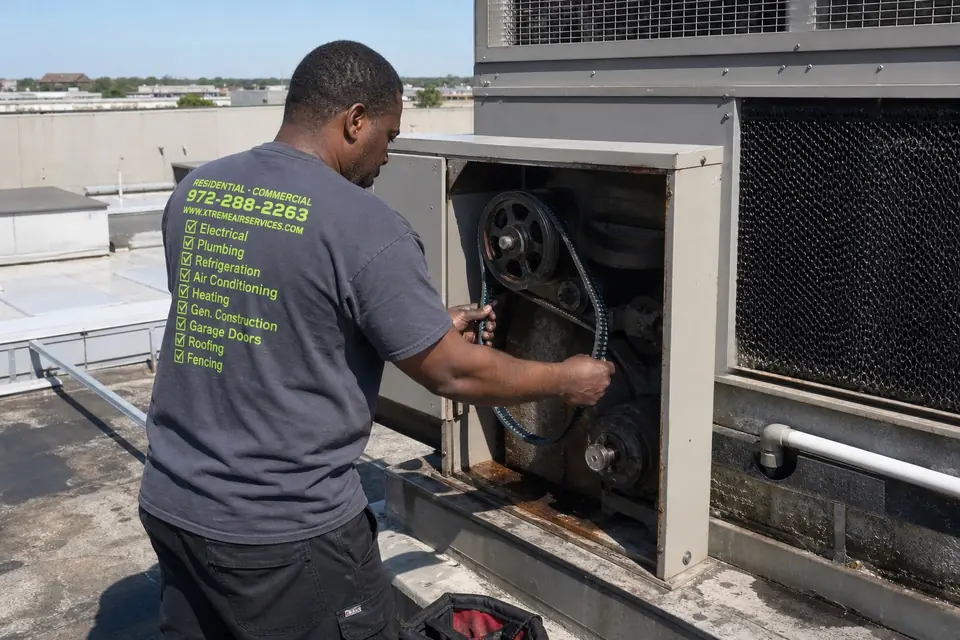
These parts wear out and can usually be replaced without touching the rest of the tower:
- Fan belts, bearings, and the gearbox, which take a beating from long run hours.
- The fan motor, if it’s burned out or worn but the fan blades and mounts are fine.
- The float or makeup water valve that keeps the basin at the right level.
- Spray nozzles and water distribution parts that clog over time.
- Drift eliminators, the panels that keep water droplets from blowing out of the tower.
- Sections of fill, if the damage is in one area and not all through it.
- The condenser water pump, which sits outside the tower but often gets blamed for tower trouble.
Sometimes the fix is even smaller. The hard-water scale mentioned earlier can coat the fill and plug the nozzles until the tower can’t shed heat like it used to. A good cleaning can bring a lot of that capacity back. And before you price a new tower because your building runs warm, make sure the tower is really the problem. A chiller issue, a weak pump, or a controls fault can look a lot like a worn-out tower.
Age alone isn’t a reason to replace. An older tower that holds water, stands straight, and keeps up on a hot Carrollton afternoon can keep working. If yours has a season or two left, it’s often smarter to keep it running and plan the replacement for the cooler months, when you’re not making decisions in a rush.
Repair stops making sense in a few clear cases:
- The basin or casing keeps leaking, and patches don’t last.
- Rust has reached the frame or supports, so the tower can’t safely keep carrying the weight of all that water.
- You’re fixing a different part every few weeks in the same season.
- Your building now needs more cooling than the tower was ever sized for. No repair adds capacity.
If you’re not sure which side your tower falls on, you can learn a lot just by looking. Does the basin hold a steady water level? Does water fall evenly across the fill, or do you see dry patches? Are there rust streaks or wet spots on the casing? Does the fan sound different than it did last summer? Write down what you notice and when. It helps any technician give you a straight answer faster.
If the skeleton is sound and the trouble is a part, fix the part. Save your money for the day your building really needs a new tower.
Frequently Asked Questions
Common questions about Cooling tower installation
How do I know if my cooling tower needs a repair or a full replacement?
Check whether the basin, casing, and supports are still sound. If that structure holds up, parts like the fan motor, belts, bearings, float valve, nozzles, and fill sections can usually be replaced on their own. Replacement becomes the right call when the basin or casing keeps leaking, rust reaches the frame, or you’re fixing something new every few weeks in the same season.
Can hard water in Carrollton shorten my cooling tower’s life?
Yes, North Texas water is hard, and scale buildup can coat the fill and clog nozzles until the tower can’t shed heat the way it used to. This also wears down cheaper piping and tower materials faster over time. A good cleaning can often restore lost capacity before you spend money on a full replacement.
What should I check before calling for a cooling tower quote?
Look at your basin water level, how evenly water spreads across the fill, and whether the fan sounds different than it used to. Rust streaks or wet spots on the casing are also worth noting. Writing down what you see and when helps a technician give you a faster, more accurate answer.
Why does my chiller run longer without cooling the building better?
This usually means your cooling tower can’t reject heat fast enough, so the chiller works harder without catching up. It can point to a worn tower, a weak pump, or a controls problem rather than the chiller itself. This pattern often shows up during long, hot Carrollton summers when towers are under the heaviest load.
Ready to Get Started?
Call (469) 269-6099 Today, Get Service Today.