


Commercial Refrigeration in Fort Worth: Is It a Quick Fix or a Bigger Problem?
Walk-in coolers, freezers and ice machines repaired by licensed refrigeration technicians – usually one part, not a whole new system.
What’s Covered on This Page
- Commercial Refrigeration Failures Put Your Fort Worth Business at Risk
- Signs You Need Commercial Refrigeration Service Right Now
- Check These Things Before You Call for Repair
- What Drives the Cost of Commercial Refrigeration Repair
- Repair or Replace: How to Decide
- How long does a typical commercial refrigeration repair take once a technician arrives?
- Can commercial refrigeration problems cause a health code issue for my business?
- Is it worth repairing an ice machine, or should I just replace it?
Commercial Refrigeration Failures Put Your Fort Worth Business at Risk
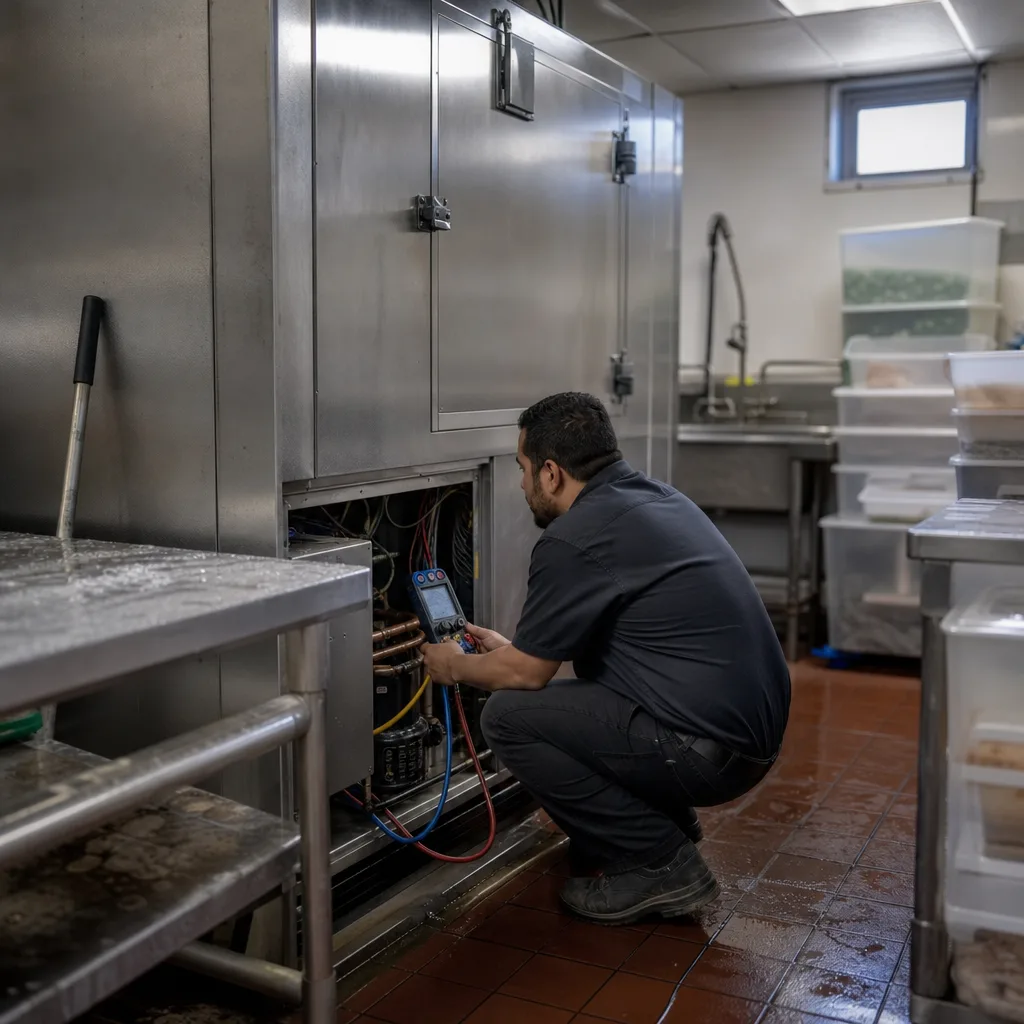
Commercial refrigeration never picks a good time to fail. It’s the walk-in that starts reading warm on a Friday afternoon. It’s the reach-in that won’t hold temperature an hour before the lunch rush. It’s the ice machine that stops dropping ice on the hottest day of the week. For your business, this isn’t a comfort problem. It’s product you might have to throw out, menu items you can’t serve, and customers you could lose.
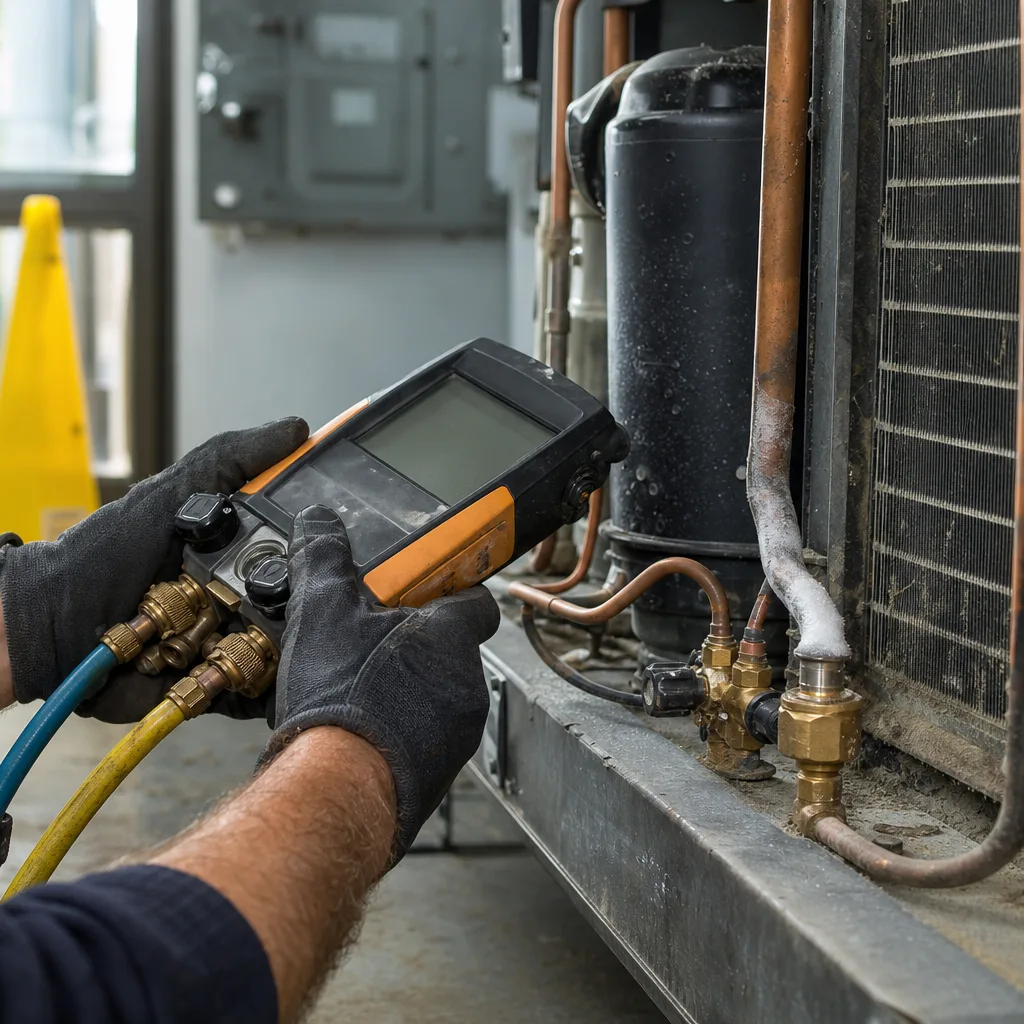
Fort Worth summers make this worse. Rooftop and outdoor condensers sit in direct Texas sun for months, and the equipment has to work harder just to keep up. A dirty coil, a weak fan motor, or a tired part that got by through spring often gives out right when the heat and your business are at their peak.
Most failures give you a warning first. Watch for these:
- The thermometer reads higher than normal, even with the doors shut
- The compressor runs and runs and never seems to cycle off
- Frost or ice building up on the evaporator coil inside the box
- Water pooling on the floor of the walk-in or under the ice machine
- New noises like buzzing, clicking, or grinding from the condenser
- Door gaskets that are torn or don’t seal tight anymore
- An ice machine making thin, cloudy, or very little ice
If you’re seeing one of these, don’t wait for it to turn into a full shutdown. A system that’s struggling today can quit tonight, and that’s usually when you’re closed and nobody’s there to notice.
Here’s the good news. A refrigeration failure feels huge when you’re staring at a warm cooler full of product, but the fix usually isn’t. Most calls are a single common failure fixed on the first visit. Our job is to find the part that failed, repair or replace it, and then check that your system is running right before we leave. You get your equipment back, not a list of maybes.
Timing matters as much as the repair. That’s why our licensed, background-checked technicians offer same-day service, and there’s no extra charge for nights or weekends. If your walk-in goes down on a Saturday, you shouldn’t have to choose between losing your stock and paying a premium to save it.
You’ll also know the price before any work starts. We give you upfront flat-rate pricing, so you can make a clear call for your business without a meter running in the background. And because we handle HVAC, plumbing, electrical, and refrigeration under one roof, a problem that turns out to be a bad circuit or a clogged drain line doesn’t mean calling a second company and waiting another day.
Signs You Need Commercial Refrigeration Service Right Now
You’ve noticed something’s off with your cooler, freezer, or ice machine. The real question is how fast you need help. Some problems are a quick fix you can handle yourself in five minutes. Others mean you should pick up the phone before your next shift starts.
Before you call anyone, including us, run through these quick checks. They’re free, and sometimes they solve the problem.
- Check the breaker and the unit’s power switch. A tripped breaker or a switch bumped during cleaning is easy to miss.
- Look at the temperature control. A busy kitchen can knock a dial or setting out of place without anyone noticing.
- Make sure the door closes all the way. A box, a pallet, or a strip curtain hung wrong can keep it from sealing.
- Move stock away from the fans and vents inside the box. Cold air has to move freely to reach your product.
- Clear anything stacked against the outdoor or rooftop condenser. It needs open space around it to get rid of heat.
If one of those fixes it, keep an eye on the thermometer for the next few hours. If the temperature comes back down and stays there, you may not need a technician at all. That’s a good outcome, and we’d rather you know it.
Call for service today if any of these are true:
- The temperature keeps climbing even after you’ve done the checks above.
- The compressor won’t start at all, or it runs nonstop while the box stays warm.
- Ice has built up thick on the evaporator coil. Don’t chip at it. You can puncture a line and turn a repair into a much bigger one.
- The breaker trips again after you reset it. Stop resetting it, because something is pulling too much power and needs to be found.
- You smell burning or see oily spots around the refrigerant lines or fittings. Oil there can point to a refrigerant leak.
One more thing to think about is timing. If the box is struggling at 4 p.m., it’s not likely to fix itself by morning. A unit that barely holds temperature while your staff is around can fall behind overnight with nobody there to see it. If you’re closing up and the thermometer’s still creeping up, that’s the time to call.
While you wait for a technician, it’s worth moving your most expensive stock into another working cooler if you have the room. Keep the door of the problem unit closed as much as you can, so the cold stays in longer.
If you’re on the fence, here’s what calling costs you. Our service-call fee is $26-$99, and it’s credited toward the repair if you proceed with Xtreme Air Services. You’ll know the price before any work starts. Compared to a walk-in full of product, finding out early is usually the cheaper bet.
Check These Things Before You Call for Repair
You’ve already done the basics. Here are a few more things worth a look. None of them need tools, and none of them mean opening up the unit.
- Try the dollar bill test on the door gasket. Close the door on a bill and pull it out. If it slides out with no grip, that spot isn’t sealing, and warm air is getting in all day long.
- Find out whether the unit is in a defrost cycle. Many coolers and freezers warm up a few degrees on purpose to melt frost off the coil. If the temperature comes back down within about half an hour, that’s normal.
- Look and listen for the evaporator fan inside the box. If the compressor outside is running but you don’t hear or feel air moving inside, write that down. It tells the technician where to start.
- Check for a clogged drain. Water on the walk-in floor often comes from a blocked drain line, not a refrigerant problem.
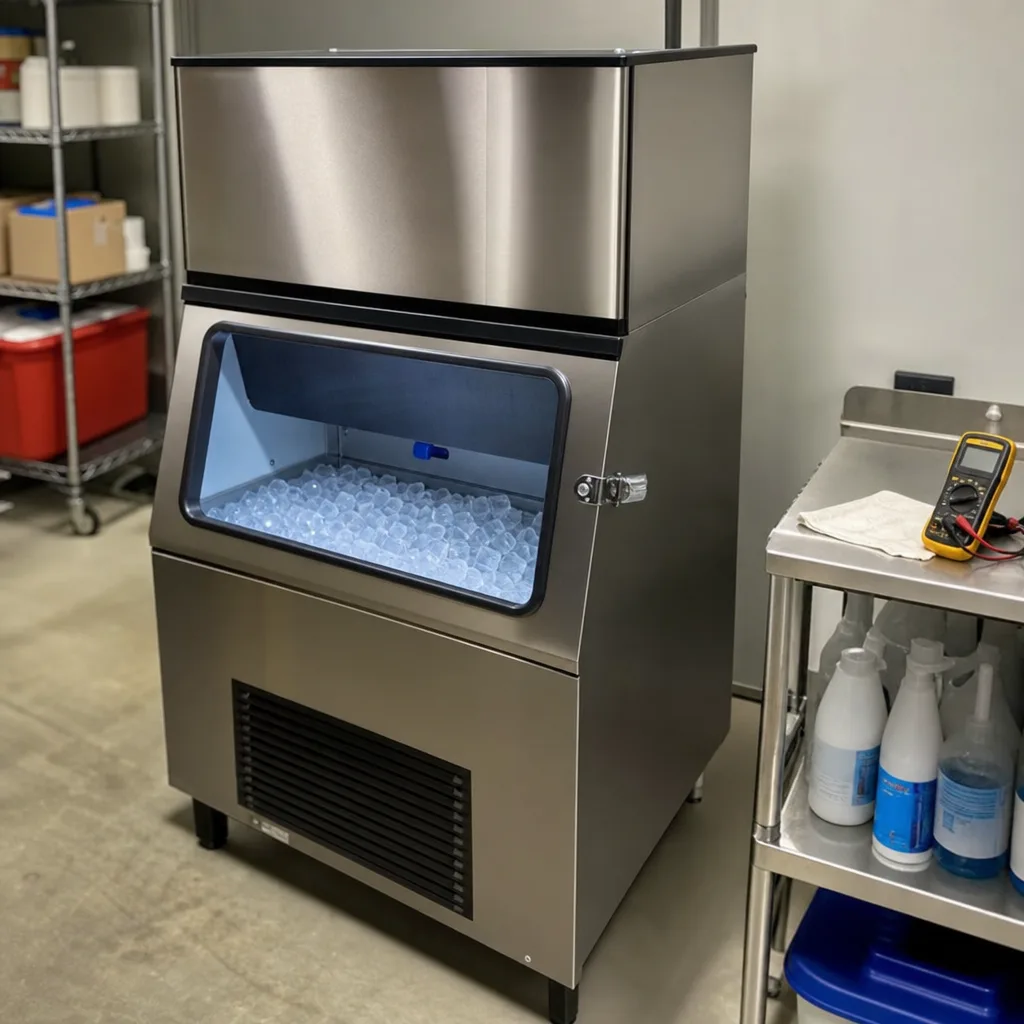
- On an ice machine, make sure the water supply valve is open and the water filter isn’t long overdue. A valve shut off during other plumbing work can stop ice production cold.
- Read the display. Many newer units show an error code or alarm. Snap a photo of it before anyone resets the unit.
If none of that turns up the cause, it’s time for a technician. A few minutes of prep now can save a lot of back-and-forth once someone’s on site.
Have these ready when you call:
- The brand, model, and serial number. They’re on a metal or sticker data plate, usually inside the door frame or on the condensing unit. A phone photo works fine. Part availability affects cost and timing, so this helps us find the right part sooner.
- A short temperature log. Two or three readings with the times next to them show whether the box is slowly drifting or has dropped off fast.
- When you first noticed the problem and anything that changed around then. That might be a storm, a power blip, a new employee on closing duty, or recent work on the building.
- What you’ve already tried, including any breaker resets. That keeps the technician from repeating your steps.
- How to reach the equipment. If the condenser is on the roof, know where the ladder or roof hatch is and who has the key. Let us know who’ll be on site to let a technician in.
Picture a manager who notices the walk-in at 41 degrees during prep. They snap a photo of the data plate and jot down three readings over an hour. They also notice the inside fan is quiet even though the outside unit is humming. That’s a call where the technician walks in already pointed toward the likely cause.
You don’t need to diagnose anything yourself. Clear details just help find the one failed part faster, and that’s the part that gets your business back up and running.
Not sure what your Commercial refrigeration project needs? Ask us.
Call Today, Get Service Today. Xtreme Air Services — Fort Worth is ready to help.
What Drives the Cost of Commercial Refrigeration Repair
Most commercial refrigeration repairs we do fall between $300-$5,000. The most common job is finding the one part that failed, repairing or replacing it, and making sure the system runs right. That job typically runs $300-$2,400. Most calls are a single common failure fixed on the first visit, so you’re usually looking at the lower part of that range, not the top.
Where your repair lands depends on a few things you can understand. Here’s what moves the price.
- How bad the failure is. A worn fan motor or a failed door gasket is a smaller job than a compressor that has quit. The more the failed part does, the more the repair costs.
- What the part costs and whether it’s easy to get. Some parts are common and stocked locally. Others are made for one model and have to be ordered, which can add cost and time.
- How old the equipment is and who made it. Older units and less common brands can have parts that are harder to find or cost more.
- Whether more than one part has failed. Sometimes one part wears out and takes another with it. If that happens, you’re paying for two repairs, not one.
- When the breakdown happens. A lot of companies charge more after hours. We don’t. There’s no extra charge for nights or weekends, so a walk-in that quits Saturday night costs the same to fix as one that quits Tuesday morning.
It helps to know what your price covers before anyone picks up a tool. Our quote includes the diagnosis, the labor, the standard replacement part, testing, and cleanup. It doesn’t include additional failed parts, major components, code upgrades, or permits unless we quote them separately. If we find a second problem, you’ll hear about it and see a price before we fix it. You’re never surprised by a line on the bill you didn’t approve.
That’s the point of upfront flat-rate pricing. You get one price for the job, and you decide yes or no. No meter runs while a technician works, so a tricky repair doesn’t quietly cost you more by the hour. And the service-call fee covered earlier gets credited toward the repair if you go ahead with us.
For bigger jobs, like a major component or new equipment, flexible financing is available on qualifying installations and larger jobs, on approved credit. That can help you get your cooler or freezer back in service without one large hit to your cash flow.
Whoever you call, these questions will tell you a lot before you say yes:
- Is this a flat price for the job, or are you charging by the hour?
- What exactly does the price include, and what would cost extra?
- If you find another failed part, will you stop and give me a price before you fix it?
- Do you charge more for nights, weekends, or holidays?
- Does the service-call fee count toward the repair?
A company that answers those clearly is a company you can plan around. When your product is sitting in a warm box, a clear price helps you make a fast decision you won’t regret later.
Watch Our Video
See How We Handle Commercial refrigeration in Fort Worth
Xtreme Air Services — Fort Worth
Repair or Replace: How to Decide
Most of the time, the answer is repair. When one part fails, fixing that part gets your equipment back fast and keeps money in your business. Equipment that’s still solid shouldn’t be replaced just because something broke.

Repair usually makes sense when:
- The unit has been reliable, and this is the first real problem in a long while.
- The failed part is a common one, like a fan motor, a door gasket, a thermostat, or a relay.
- The box, the cabinet, and the coils are in good shape, with no rust-through or heavy corrosion.
- The equipment still fits your business. It’s the right size, and it keeps up on a busy day.
Replacement starts to make more sense when the problem goes deeper than one part. Watch for these signs:
- You keep calling for repairs. One breakdown is bad luck. Three or four in a year means the whole unit is wearing out, and each fix only buys you a little time.
- The repair is a big one on an old unit. If the compressor fails on equipment that’s already near the end of its life, you may be putting a lot of money into a machine that has other tired parts close behind.
- Parts are hard to get. When a part has to be hunted down for an older or discontinued model, you lose more days waiting, and the next failure could take even longer.
- It uses an older refrigerant. Some older systems run on refrigerants that are being phased out. They can get harder to find and cost more to recharge over time.
- It can’t keep up anymore. If your menu or sales have grown, a unit that was the right size years ago may run nonstop through a Fort Worth summer and still fall behind. That’s a sizing problem, and no repair will fix it.
- The box itself is breaking down. Soft spots in the floor, torn panels, or doors that won’t line up let warm air in no matter how well the refrigeration parts work.
Here’s a simple way to think about it. Picture a reach-in that needed a fan motor in spring, a control part in summer, and now won’t hold temperature again. Each repair made sense when it happened. Put together, they tell you this unit is costing you more in fixes and lost product than it’s giving back.
Ask yourself two questions. If I fix this today, how confident am I that it’ll make it through the next busy season? And how much product and business would I lose if it fails again? If you’re not confident about the first answer and the second one worries you, replacement is worth pricing out.
You don’t have to decide alone or on the spot. You’ll see a price for the repair before any work starts, and you can weigh that against new equipment. We also handle commercial refrigeration installation, so if replacing turns out to be the better call, the same team can take it from there. For larger jobs, the financing mentioned earlier can help spread out the cost.
Either way, the goal is the same: equipment you can count on, so you’re not worrying about the cooler every time the temperature climbs.
Frequently Asked Questions
Common questions about Commercial refrigeration
How long does a typical commercial refrigeration repair take once a technician arrives?
Most repairs are finished in one visit because the job is usually a single failed part. A technician finds the part, repairs or replaces it, and tests the system before leaving. If a part has to be special-ordered for an older or less common unit, that can add time, which is why having your model and serial number ready helps speed things up.
Can commercial refrigeration problems cause a health code issue for my business?
Yes, a warm walk-in or reach-in can put stored food above a safe temperature fast, which is a real risk for any Fort Worth restaurant or kitchen. That’s why catching early warning signs, like a thermometer creeping up or a compressor that won’t cycle off, matters so much. Acting on those signs before a full shutdown protects both your product and your inspection record.
Is it worth repairing an ice machine, or should I just replace it?
It depends on how old the machine is and what’s failing. A valve or filter issue on a younger unit is usually a quick, affordable repair. But an ice machine making thin or cloudy ice repeatedly, especially an older model, often points to a bigger problem where replacement saves you more money over time than another round of repairs.
Ready to Get Started?
Call (817) 677-1907 Today, Get Service Today.