


Slab Leak Repair in Fort Worth: Know the Signs, Know the Fix
Leaks under your slab located and fixed with a spot repair or a reroute – whichever is right for your home.
What’s Covered on This Page
- Signs You May Have a Slab Leak
- When It’s Probably Not a Slab Leak
- How Slab Leak Repair Works: Spot Repair vs. Reroute
- What’s Included in a Slab Leak Repair Quote
- Why Fort Worth Soil and Older Plumbing Raise the Risk
- How long does a slab leak repair take from start to finish?
- Can I keep using water in my house while a slab leak is being fixed?
- Will a slab leak cause damage to my foundation if I wait to fix it?
Signs You May Have a Slab Leak
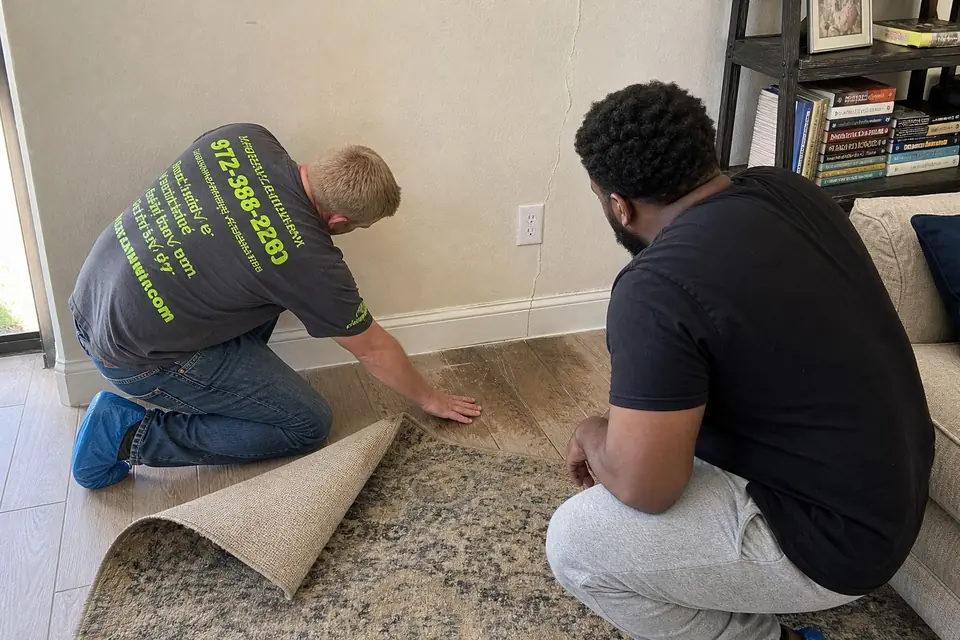
Most Fort Worth homes sit on a concrete slab, with water lines running through or under it. When one of those lines leaks, you can’t see it. You notice the leak by what it does to the rest of your home. Here’s what to watch for.
- Your water bill jumps and your habits haven’t changed. This is often the first clue, because water runs out around the clock even while you sleep.
- You hear water running when every faucet, toilet, and appliance is off. Put your ear close to the floor in a quiet room.
- A spot on the floor feels warm. If a hot water line is leaking, it can heat the slab above it. You might feel it barefoot on tile or notice the dog likes one spot a little too much.
- Carpet feels damp, wood floors cup or warp, or tile grout stays dark with no spill nearby.
- You smell mildew or a musty odor and can’t find where it’s coming from.
- Your water heater seems to run all the time. A hot side leak keeps pulling fresh water into the tank to heat.
- Water pressure drops at your faucets or shower for no clear reason.
- New cracks show up in walls or floors, or water collects near the edge of the foundation outside.
Here’s a check you can do yourself in a few minutes. Turn off every faucet, appliance, and sprinkler in and around the house. Then find your water meter, usually in a box near the street, and look at the dial or the small leak indicator. If it’s moving with everything off, water is going somewhere it shouldn’t. Write down the reading, wait an hour without using any water, and check again. If the number went up, you’ve confirmed a leak.
Before you assume the worst, rule out the easy stuff. A toilet that keeps running or a dripping outdoor spigot can move that meter too. Listen for a toilet refilling on its own, and walk the yard to look for soggy patches around the irrigation lines. If those all check out and the meter still moves, the leak is more likely inside the walls or under the slab.
North Texas ground plays a part here. Our clay soil swells when it’s wet and shrinks when it dries out, so foundations shift a little with every season. That movement, plus the hard freezes we get some winters, puts stress on pipes in the slab. Many older slab-on-grade ranch homes around Fort Worth also have pipes that have simply been in the ground a long time.
One thing to keep in mind: these signs tell you something is wrong, not where. A warm spot in the kitchen doesn’t mean the leak is right under it. Water can travel along a pipe or under the slab before it shows up. That’s why the next step is pinpointing the exact spot before anyone starts cutting into your floor.
When It’s Probably Not a Slab Leak
Many of the signs above have everyday causes that have nothing to do with your foundation. Before anyone cuts into concrete, it’s worth ruling these out. You can check or fix some of them yourself in an afternoon.
- Your bill spiked in summer. Fort Worth summers mean longer sprinkler runs and more watering. If the bill jumped in July but your meter holds still with everything off, the extra water most likely went on the lawn.
- There’s a musty smell near a hallway closet or utility room. That’s often the AC, not the plumbing. A clogged condensate drain line can back up and soak drywall or carpet near the indoor unit, or drip down from a unit in the attic. It smells like a slab leak, but the water is above the floor.
- There’s a wet spot by the water heater. Look at the pipe coming off the side of the tank. A dripping relief valve or a tank that’s weeping at the bottom is a water heater problem, not a slab problem.
- The floor is damp near the kitchen or laundry. Supply hoses on dishwashers, washing machines, and fridge ice makers crack with age. Pull the appliance out and look behind it before you blame the slab.
- Pressure is low at only one faucet. If it’s just one fixture, hard water scale in the aerator is a likely cause. Unscrew the aerator, soak it in vinegar overnight, and try again. If pressure is low everywhere, a worn pressure regulator near your meter can cause that too.
- Your water heater seems to run all the time. Hard water leaves sediment in the bottom of the tank, which makes the heater work longer to warm the same water. A flush may be all it needs.
- Water pools near the foundation after rain. Clogged gutters, downspouts that empty right at the wall, or soil that slopes toward the house can all leave water there. If it only shows up after a storm, look up before you look down.
Cracks alone aren’t proof of a leak either. Clay soil moves the slab through wet and dry seasons, as we covered above, so hairline cracks in drywall or tile can show up in a perfectly dry home. A crack by itself raises a foundation question. A crack plus a meter that keeps moving and a warm spot on the floor points to a leak.
Here’s a simple way to sort it out. One sign by itself, especially one that comes and goes with the weather, usually has a simple cause. Several signs together that don’t change with the season make a much stronger case for a leak under the slab. A high bill all year, a warm floor, and a meter that creeps with every tap closed would be one example.
If you’ve checked everything on this list and the clues still don’t add up, that’s when leak detection makes sense. It’s better to confirm where the water is going than to open up a floor on a guess.
How Slab Leak Repair Works: Spot Repair vs. Reroute
Once leak detection has pinned down the spot, there are two main ways to stop the water. You can open the slab and fix the pipe right where it failed. Or you can leave the bad pipe in place and run a new line around it. Neither one is always better. The right choice depends on where the leak sits and what shape the rest of your pipe is in.
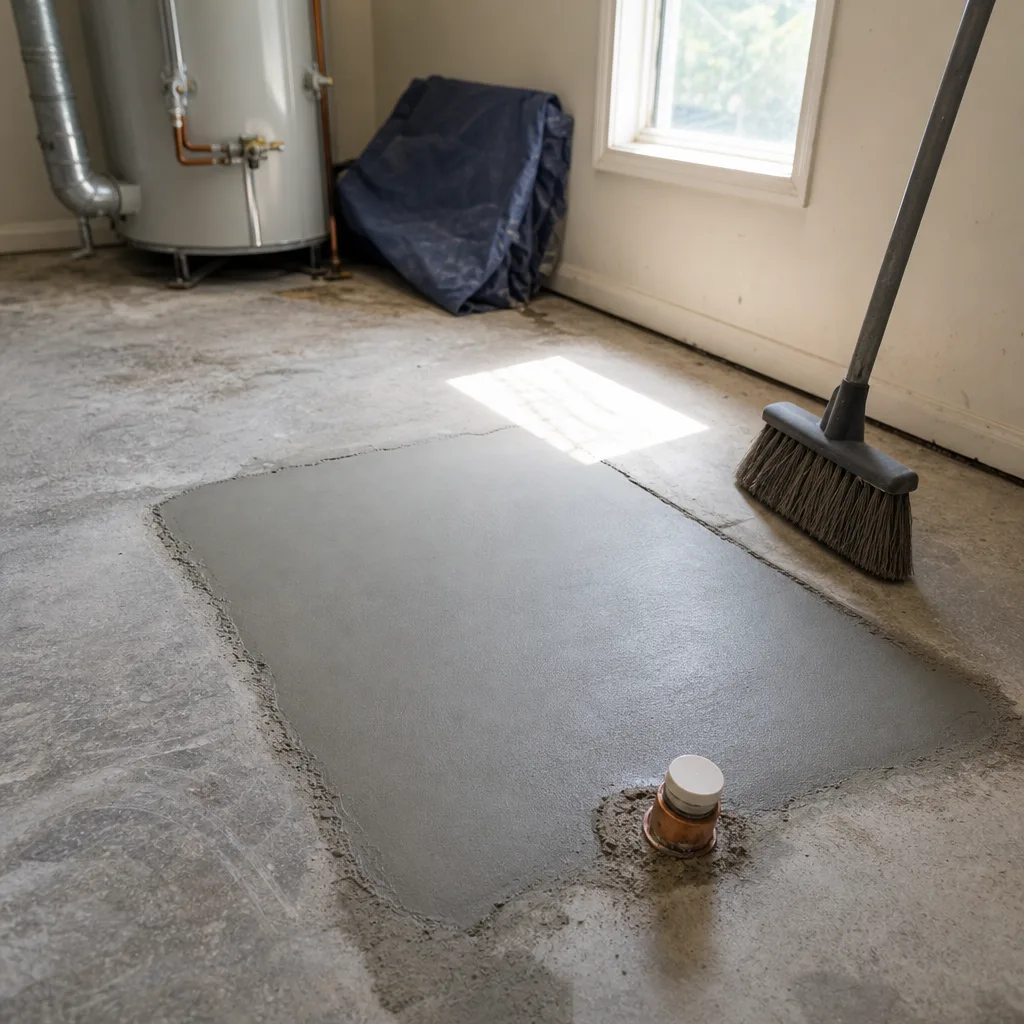
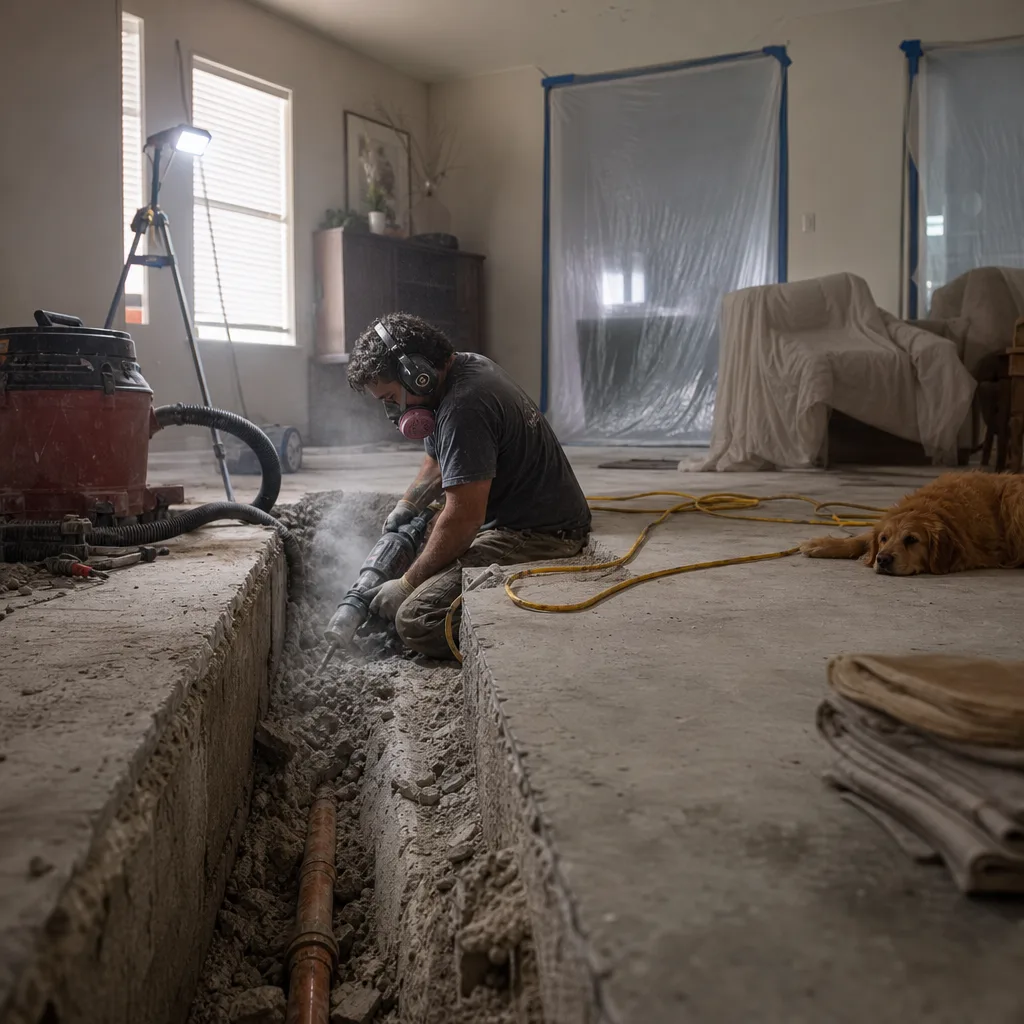
A spot repair goes straight to the problem. The plumber cuts or breaks an opening in the concrete right over the leak, usually a hole a few feet across. Then they dig down to the pipe, cut out the damaged piece, and splice in new pipe. After the line passes a test, the hole gets filled and the concrete patched. Sometimes the plumber can reach the pipe by tunneling in from outside the foundation instead of going through the floor. That’s more common when the leak is close to an outside wall.
A spot repair makes the most sense when:
- The rest of the pipe is in good shape and this is a single failure, like one joint that cracked when the slab shifted.
- The leak sits under a spot that’s easy to get to, like a closet, a garage, or a tile floor you don’t mind patching.
- The pipe runs deep or far under the house, and running a new line around it would mean opening a lot of walls.
A reroute skips the concrete. The leaking section under the slab gets capped off and abandoned. A new line, often flexible PEX tubing, runs through the walls or the attic to reach the same fixtures. You’ll have some drywall cuts to patch, but nobody breaks up your floor. In North Texas, any line run through the attic should be well insulated, because attics bake in August and can drop below freezing during a hard cold snap.
A reroute makes the most sense when:
- The pipe has leaked before, or detection finds more than one weak spot. Patching one leak in a worn line can just move the next leak a few feet over.
- The home is older and the original pipes have been under the slab for decades, as in many Fort Worth ranch homes built from the 1950s on.
- The leak sits under flooring that’s costly or hard to match, like hardwood, stone, or a kitchen island.
Say the leak is on a hot water line under your living room’s wood floor, and your house still has its original copper. Breaking through that floor fixes today’s leak but leaves the same aging pipe under the slab. A reroute could cost less in the long run. If it’s a newer home with one bad fitting under the laundry room tile, a spot repair is often the simpler fix.
Whichever way you go, the job isn’t finished until the line is tested and holds pressure. Our slab leak repair covers finding the leak, the repair or reroute, and that test. Restoring the slab and flooring, work on additional lines, and permits aren’t included unless your estimate says so. Ask about those up front so you know exactly what’s covered before any work starts.
Have questions? We’re happy to help.
Call Today, Get Service Today. Xtreme Air Services — Fort Worth is ready to help.
What’s Included in a Slab Leak Repair Quote
Most slab leak repairs we do fall between $2,000 and $6,000. The most common job is finding the leak under the slab and then repairing or rerouting that line to stop it. That usually runs $2,000 to $3,800. Where your job lands in that range depends on three things.
- Where the leak is and how deep it sits. A leak near an outside wall or under a garage floor is easier to reach than one buried under the middle of the house.
- Spot repair or reroute. The two approaches we covered above take different amounts of labor and material, so the one that fits your home changes the price.
- How much concrete has to be opened. Getting through the slab, or tunneling under it, is a big part of the work.
You’ll know the price before we start. We give you upfront flat-rate pricing, and you approve it before any work begins. There’s no meter running while we dig, and there’s no extra charge for nights or weekends. If your leak shows up on a Saturday night, you pay the same as you would on a Tuesday morning.
The service call is $26 to $99. If you go ahead with the repair with Xtreme Air Services, that fee gets credited toward the job. So you aren’t paying twice just to find out what’s wrong.
Know what the quote leaves out so nothing catches you off guard later. As we mentioned above, slab and flooring restoration, work on other lines, and permits aren’t part of the repair price unless your estimate says they are. If the leak is under hardwood or tile you love, plan on a separate cost to put the floor back the way it was. That’s one more reason a reroute through the walls can make sense for some homes.
Whoever you hire, ask these questions before you sign anything:
- Is this a flat price, or can it go up once the floor is open?
- Does the price include finding the leak, or is detection billed on its own?
- Will you test the line after the repair to make sure it holds?
- Who patches the concrete, and who handles the flooring?
- Does this job need a permit, and is that cost in the quote?
- Did you check the rest of the line, or just the spot that’s leaking?
A good plumber will answer every one of those without hedging. If someone can’t tell you what’s covered, keep looking.
Worried about paying for it all at once? We offer flexible financing on qualifying installations and larger jobs, on approved credit. Ask about it when you call, and we’ll tell you whether your repair qualifies.
Our team is licensed and insured, and our technicians are background-checked and drug-tested. That matters when someone is cutting into the floor of your home. If your meter keeps moving and the signs point under the slab, you don’t have to guess at the cost. We’ll find the leak, explain your options in plain English, and give you a firm price first.
Call 817-677-1907
Watch Our Video
See How We Handle Slab leak repair in Fort Worth
Xtreme Air Services — Fort Worth
Why Fort Worth Soil and Older Plumbing Raise the Risk
Your pipes under the slab deal with two kinds of stress at once. The ground under your home moves, and the pipes themselves get older every year. Either one can cause a leak. When both work on the same line, the risk goes up.

We mentioned how our clay soil swells and shrinks. Here’s why that’s hard on pipe. The slab doesn’t move evenly. One corner of the house can dry out in August while the side by the flowerbed stays damp. The concrete flexes a tiny bit, and any pipe locked inside it gets pulled or bent along with it. The weak points are joints, bends, and the spots where a pipe passes through concrete. A long dry spell followed by heavy spring rain is especially rough, because the soil goes from shrinking to swelling fast.
Hot water lines have an extra problem. They grow a little when hot water runs through them and shrink as they cool, many times a day. Where a pipe touches concrete, gravel, or another pipe, that small back-and-forth slowly rubs it thin. That’s part of why so many slab leaks turn up on the hot side, and why a warm spot on the floor is such a common clue.
The age of your home tells you a lot about what’s under it:
- Homes from the 1950s and 1960s may still have their original copper or galvanized steel lines. Galvanized pipe rusts from the inside out, and after this many years, copper has been through decades of soil movement.
- Homes from the 1970s through the 1990s often have copper under the slab. Copper lasts a long time, but hard water, high pressure, and years of shifting can wear it thin at joints and bends.
- Newer subdivisions often use PEX, a flexible plastic tubing that handles movement better and has fewer joints. It’s not leak-proof, though. Fittings can fail, and a line nicked during construction can show trouble years later.
Hard water and high pressure add to the strain. North Texas water carries a lot of minerals, and scale builds up inside pipes and fittings over time. High water pressure pushes on every joint in the system, all day and all night. If the pressure regulator near your meter wears out, pressure can creep up without you noticing. Replacing a worn regulator is a small job that takes some of that load off your pipes. If scale is building up around your home, a water softener can help too.
None of this means your home will leak. It means the age of your house, the pipe it was built with, and how much the ground moves around it all matter when a leak does show up. If you’re not sure what your pipes are made of, check your home inspection report or ask whoever finds the leak. A newer home with flexible pipe and one bad fitting is a very different job from a 1960s house with its original copper still in the ground. Knowing which one you have helps you pick between a spot repair and a reroute with your eyes open.
You can lower the strain a little yourself. Keep gutters and downspouts draining away from the house. During long dry spells, water the soil along your foundation evenly so one side doesn’t dry out much faster than the other.
Frequently Asked Questions
Common questions about Slab leak repair
How long does a slab leak repair take from start to finish?
Most spot repairs take one day once the leak is pinpointed, but a reroute can take two to three days because new line has to run through the walls or attic. Jobs take longer when the leak sits deep under the house or when more than one weak spot turns up during detection. Your technician can give you a realistic timeline once they know the leak’s location and which repair method fits your home.
Can I keep using water in my house while a slab leak is being fixed?
You can usually keep using water in the rest of the house during a slab leak repair, since the work stays focused on one line. Expect the water to be shut off for a short stretch while the damaged section is cut out and the new pipe gets tied in and tested. If a reroute is underway, fixtures tied to that specific line may be out longer than ones on a separate line.
Will a slab leak cause damage to my foundation if I wait to fix it?
Yes, water pooling under a slab for weeks or months can soften the soil beneath it and add to the uneven movement Fort Worth’s clay soil already causes. That extra moisture on one side of the house can make existing cracks worse or create new ones in walls and floors. Catching a leak early, once your water meter or a warm spot tips you off, keeps the damage to the pipe instead of the structure.
Ready to Get Started?
Call (817) 677-1907 Today, Get Service Today.