


Chiller Installation in Irving: Commercial Mechanical Work Done Right
Commercial chiller replacement sized for your building, with what's included and excluded explained before work starts.
What’s Covered on This Page
- Chiller Installation Is a Commercial Job, Not a Residential One
- What a Chiller Installation Project Includes
- What Drives Chiller Installation Cost Up or Down
- Why Mechanical Contractor Licensing Matters for This Job
- How the Installation Process Works From Evaluation to Startup
- How long does a chiller installation take from start to finish?
- Can my building run without cooling during the chiller swap?
- What happens to the old chiller once it’s removed?
- Does a chiller need special handling because of Irving’s summer heat?
Chiller Installation Is a Commercial Job, Not a Residential One
Before you go any further, let’s make sure you’re on the right page. Chiller installation is serious commercial work. It’s not the same as swapping out the AC unit beside your house, and it isn’t something a home ever really needs.
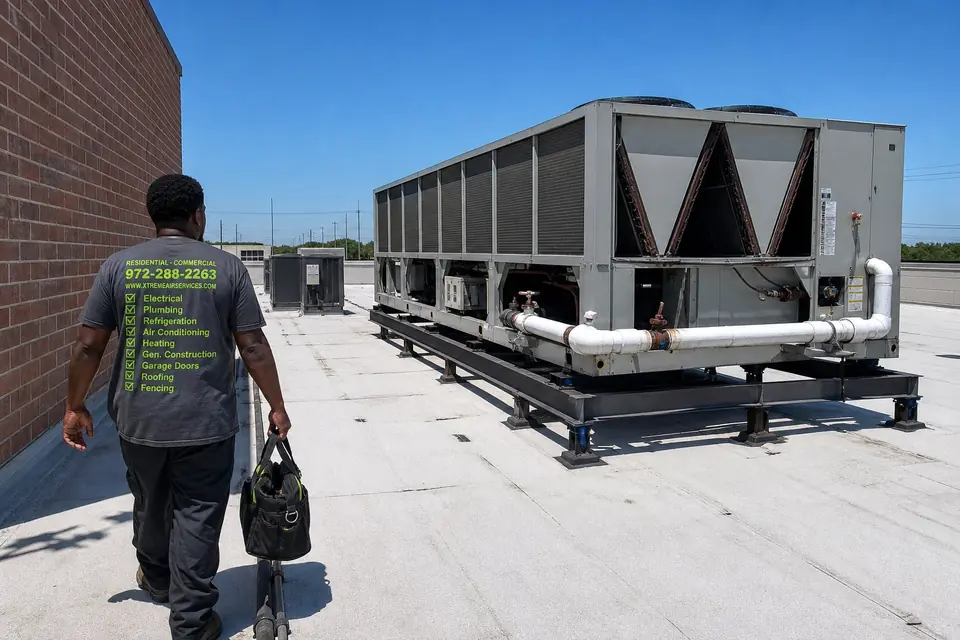
A chiller doesn’t blow cold air into rooms. It chills water, and pumps move that water through pipes to air handlers spread across a building. Each air handler uses the cold water to cool the air for its own floor or zone. That setup makes sense when you’re cooling a lot of space at once, under one roof, every single day of a long Texas summer.
That’s why you find chillers in buildings like these:
- Multi-story office buildings where many tenants share one central cooling plant
- Hotels, hospitals, and schools that need steady cooling in a lot of rooms at the same time
- Data rooms and server spaces where equipment heat never takes a day off
- Manufacturing and process spaces where cooling protects equipment or product, not just comfort
In buildings like these, the chiller isn’t a comfort upgrade. It keeps the doors open. When it goes down in July, tenants get hot, equipment can overheat, and business slows down. That’s the real reason a chiller install has to be planned around your building’s existing connections and how much downtime you can afford.
Scale is the other giveaway. Our typical price range for chiller work is $15,000-$150,000. That figure alone tells you this is building equipment, not house equipment.
If you’re a homeowner and your AC quit, a chiller isn’t your answer, and we’d rather tell you that now than waste your time. What you most likely need is one of these:
- Central air conditioning installation if you have ducts and an outdoor unit now
- Heat pump installation if you want one system that handles both cooling and heating
- Ductless mini-split installation for an addition, garage, or room your ducts don’t reach well
Each of those has its own page, with details that fit your home.
A few commercial owners land here when a chiller isn’t the right fit for them either. If your building is cooled by rooftop units, you’re usually looking at rooftop unit service or a commercial HVAC installation, not a chiller. Some owners also ask about variable refrigerant flow, or VRF, systems. These move refrigerant straight to indoor units and skip the water loop entirely. Whether that beats a chiller depends on your building’s size, layout, and what’s already in place. That’s a call to make after someone looks at your site, not one to guess at.
Here’s the plain version. If your building already runs on chilled water and the chiller is aging, failing, or too small for the load, you’re in the right place. The rest of this page covers what goes into doing that job right.
What a Chiller Installation Project Includes
When you’re putting a big check toward a new chiller, you want to know exactly what that money buys. Here’s the plain answer. Our most common chiller installation is a standard like-for-like job. The new chiller ties into your existing connections, with no major changes to the building. For that job, the price is $42,000-$96,000.
That price covers equipment, materials, and professional installation, plus startup and testing. Here’s what’s included:
- The chiller itself and the materials needed to install it
- Professional installation by our team
- Standard connections to your existing chilled-water piping and power
- Startup and testing, so the unit is running and checked before the job is called done
- Haul-away of the old unit, so you aren’t stuck figuring out how to get rid of it
Some things aren’t part of that standard price unless your quote says so. Unless stated, these are excluded:
- Duct, electrical, or plumbing modifications
- Code corrections
- Permits
Those exclusions matter more than they look. Say your building’s chilled-water lines don’t line up with the new unit, or the electrical service feeding the old chiller can’t handle the new one. That’s no longer a like-for-like swap. It’s real extra work, and you should see it spelled out in writing before anything starts, not find it on a surprise invoice later.
Why the wide price range? Every building is different. These are the things that push a chiller job up or down:
- Size and capacity. Chillers are rated in tons of cooling. A bigger building with more heat to remove needs more tons, and more tons cost more.
- Efficiency. A more efficient chiller usually costs more up front but uses less power to cool the same space. That matters through a long North Texas summer.
- Brand and model.
- Ease of access. A chiller on a ground-level pad is a very different job from one on a roof or deep inside a mechanical room, where getting old equipment out and new equipment in takes more planning and lifting.
- Condition of what’s already there. Worn piping, wiring, or connections can turn a simple swap into a bigger project.
- Code upgrades and permits.
- Custom fabrication, if parts have to be built to fit your space.
Before you sign with anyone, ask three questions. Is this quote for a like-for-like install, or does it include changes to my building? What’s excluded, and who handles permits? Are startup and testing part of the price? A good contractor will answer all three in plain English. If you can’t get straight answers, that tells you something too.
You don’t have to pay for all of it at once, either. Flexible financing is available on qualifying installations and larger jobs, on approved credit. That can help you replace a failing chiller now instead of nursing it through one more summer.
What Drives Chiller Installation Cost Up or Down
You’ve already seen the main things that move the price. What most owners really want to know is which side of that range their own building lands on. A few questions you can answer before anyone shows up will tell you a lot.
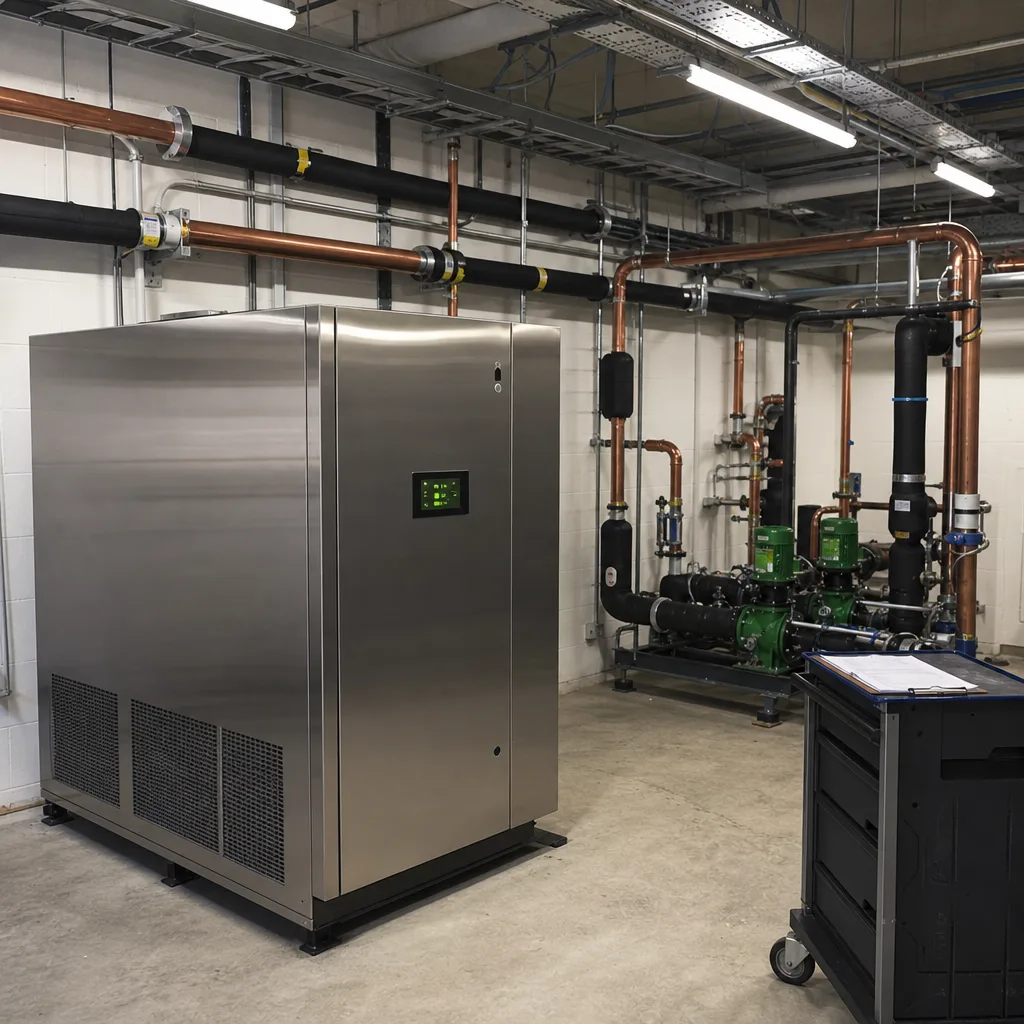
The first one is easy to miss. Was your old chiller ever the right size? A like-for-like job assumes it was. Buildings change, though. Maybe an office floor became a data room. Maybe a restaurant moved in where retail used to be, or you added tenants. If the cooling load has grown or shrunk, matching the old nameplate could leave you with a unit that runs too hard or cycles on and off too much. A different size can mean different piping or power, and that moves the job out of the simple swap category.
Next, look at how your chiller gets rid of heat.
- Air-cooled chillers sit outside and use fans to push heat into the air. They’re usually simpler to swap because there’s no extra water system tied to them.
- Water-cooled chillers sit indoors and send heat to a cooling tower. If that tower is old, scaled up, or leaking, putting a new chiller on a worn-out tower is a lot like putting new tires on a bent axle. Sometimes the smart move is planning cooling tower installation work at the same time.
Then think about everything around the chiller, not just the chiller itself. Chilled water moves because pumps push it. If your pumps are tired, noisy, or leaking at the seals, a new chiller won’t fix weak cooling on the top floors. Controls matter too. If your building runs on an automation system, the new chiller has to talk to it. Older controls don’t always speak the same language as new equipment, and getting them to work together can add work to the job.
Timing is the factor you control most. A chiller that’s limping along in March gives you options. You can compare models, plan the shutdown for a slow weekend, line up permits, and schedule cranes or rigging without rushing. A chiller that dies in the middle of an Irving July takes most of those options away. You take whatever equipment is available, and every day you wait means hot tenants, unhappy guests, or equipment that’s running too warm.
Here’s a quick way to size up your own project. If your building’s use hasn’t changed, your pumps and tower are in good shape, the new unit fits where the old one sat, and you’re replacing on your own schedule, you’re likely looking at a straightforward job. If two or more of those don’t apply, expect the quote to include extra work. That’s not a bad thing. It just means the price should spell it out in writing, line by line, before work begins.
The cheapest quote isn’t always the cheapest chiller. A unit that’s sized right and matched to healthy pumps, a healthy tower, and working controls costs less to run every summer. It also gives you fewer emergency calls down the road.
Ready when you are – get in touch today.
Call Today, Get Service Today. Xtreme Air Services — Irving is ready to help.
Why Mechanical Contractor Licensing Matters for This Job
A chiller install isn’t a job you hand to whoever gives you the lowest number. It’s a big piece of equipment tied into your building’s water, power, and controls. Someone has to get it in place, hook it up, and start it safely. If any of that goes wrong, the problem lands on you, your tenants, and your building.
That’s why licensing isn’t fine print. In Texas, HVAC contractors are licensed by the Texas Department of Licensing and Regulation, or TDLR. A license means the contractor has met the state’s rules for doing this kind of work. It also gives you a real place to go if something isn’t done right.
Here’s what a properly licensed and insured contractor protects you from on a chiller job:
- Unsafe hookups. Chillers run on heavy electrical loads and carry refrigerant that has to be handled the right way. Shortcuts here can damage the new unit or put people at risk.
- Liability for accidents. Moving a chiller can mean rigging, lifting, or working on a roof. If the contractor isn’t insured and something gets damaged or someone gets hurt, you could end up holding the bill.
- Failed inspections. If your job needs a permit, a city inspector may look at the work. Work done by an unlicensed crew can mean delays, rework, and a chiller that sits there unused while your building stays warm.
- Finger-pointing. When the HVAC, electrical, and piping work all come from different crews, it’s easy for each one to blame the other when something doesn’t work.
That last point ties back to the exclusions we covered earlier. If your project turns out to need electrical or plumbing changes, you don’t want to start hunting for another contractor halfway through the job. Xtreme Air Services is a licensed and insured HVAC, plumbing, and electrical contractor. One team handles the work, and one team is accountable for it.
You don’t have to take anyone’s word for it, including ours. Before you sign, ask for the contractor’s license number and look it up on the TDLR website. It takes a couple of minutes. Ask for proof of insurance too. A contractor you can trust will hand both over without a second thought.
Here’s ours. Our HVAC License is #TACLA29023C. Our technicians are background-checked, and we’re a Trane Comfort Specialist. Our office is at 5000 Riverside Dr in Irving, so we’re right here when you need us, not a name on a website two counties away.
If your chiller is aging, failing, or can’t keep up anymore, the next step is simple. We’ll look at your building, tell you whether it’s a like-for-like swap or something more, and put the price in writing before any work starts. You’ll talk to a real person, get straight answers, and know exactly what you’re paying for.
Call 469-200-2166
Watch Our Video
See How We Handle Chiller installation in Irving
Xtreme Air Services — Irving
How the Installation Process Works From Evaluation to Startup
A chiller replacement isn’t one big day. It’s a series of steps, and most of the real work happens before the old unit is ever unhooked. Here’s what that looks like from the first walk-through to the moment cold water is moving through your building again.

Step 1: The site evaluation. Someone has to see your mechanical room or roof in person. That visit should answer a few questions. What size and type of chiller do you have now? Does it still match how your building is used? What shape are the piping, pumps, power, and controls tied to it? And how will the old unit come out and the new one go in? A ground-level pad and a rooftop are very different jobs, so access gets checked up front, not on install day.
Step 2: The written quote. Once the site is understood, you should get a price in writing before any work starts. It should say plainly whether this is a like-for-like swap or whether your building needs extra work. That way you approve the real scope, not a guess.
Step 3: Planning the shutdown. This is the step that protects your tenants and your business. Your building will be without its chiller for part of the job, so the cutover gets set for the window that hurts least. That might be a weekend for an office or an overnight stretch for a hotel. Equipment orders, any permits, and crane or rigging time all get lined up around that date. Good planning keeps downtime short and predictable.
Step 4: Removing the old chiller. The system gets shut down and isolated from the rest of the building. Refrigerant has to be recovered the right way, not vented into the air. Then the old unit is disconnected and hauled away, which is part of our standard installation price.
Step 5: Setting and connecting the new unit. The new chiller is moved into place and tied into your chilled-water piping, power, and controls. On a like-for-like job, these are standard connections to what’s already there.
Step 6: Startup and testing. A chiller isn’t done just because it turns on. Startup is where the system gets checked under real conditions. Here’s what that check covers:
- Water is flowing through the chiller at the right rate
- The water leaving the chiller is as cold as it should be
- Electrical readings are where they belong for a unit that size
- The controls respond the way your building needs them to
- There are no leaks at the new connections
Startup and testing are included in our standard installation price, because skipping them is how small problems turn into a midsummer breakdown. In Irving, where a chiller may run hard from late spring into fall, you want to know it’s working right before the heat really piles on.
Step 7: The handoff. Before the job is called done, you or your building engineer should know what was installed, how it’s running, and what to watch for. You shouldn’t have questions left about your own equipment.
Frequently Asked Questions
Common questions about Chiller installation
How long does a chiller installation take from start to finish?
It depends on your building’s size and how the shutdown is scheduled, but the work always follows the same order: site evaluation, written quote, shutdown planning, removal, installation, then startup and testing. A straightforward like-for-like swap on a ground-level pad moves faster than a rooftop unit needing crane rigging. Planning the cutover for a slow weekend or overnight window, instead of waiting for a breakdown, is what keeps the timeline short and predictable.
Can my building run without cooling during the chiller swap?
You’ll lose chilled water for part of the job, so the goal is to schedule that window when it hurts your tenants or guests the least. For an office, that might mean a weekend. For a hotel, it could mean overnight. Equipment orders, permits, and any crane work get lined up around that date ahead of time, so the actual downtime stays as short as possible.
What happens to the old chiller once it’s removed?
It gets properly shut down and isolated, with refrigerant recovered the right way instead of vented into the air, then hauled away. Haul-away of the old unit is part of our standard installation price, so you’re not left figuring out how to dispose of a large piece of commercial equipment on your own.
Does a chiller need special handling because of Irving’s summer heat?
Yes, because a chiller in Irving often runs hard from late spring into fall with little downtime. That’s exactly why startup and testing check water flow rate, output temperature, electrical readings, and controls response before the job is called finished. Skipping that check is how a small issue turns into a breakdown in the middle of a hot stretch.
Ready to Get Started?
Call (469) 200-2166 Today, Get Service Today.