


Emergency / No-Heat Furnace Repair in Irving
When the heat quits, know whether it's an emergency tonight or can wait until morning – and what a repair visit involves.
What’s Covered on This Page
- Know If Your No-Heat Problem Is a True Emergency
- Rule Out a Few Things Before You Call
- What Happens During an Emergency Furnace Repair Visit
- What a No-Heat Repair Costs and What’s Included
- Why Cold Snaps Hit Irving Furnaces Hard
- Do you charge extra for a furnace repair at night or on a weekend?
- Can a no-heat problem really be an emergency even if it’s not freezing outside?
- What should I do if I smell gas near my furnace?
- Will one technician be able to fix my furnace in a single visit?
Know If Your No-Heat Problem Is a True Emergency
Not every cold house needs a technician tonight, but some do. Here’s how to tell the difference before you pick up the phone.
Treat it as urgent if any of these fit your situation:
- It’s near or below freezing outside. North Texas cold fronts can drop the temperature fast. Without heat, a house loses warmth overnight, and water lines in outside walls or the attic become a real worry.
- Someone in your home is a baby, an older adult, or has a health condition that makes the cold dangerous for them.
- The furnace starts, runs for a few seconds, then shuts off and tries again. A built-in safety control is stopping it for a reason, and that reason usually needs a technician.
- You hear a loud bang or grinding when it starts, or you smell burning that doesn’t fade. A little dusty smell on the first cold day of the year is normal. A smell that lasts or keeps getting stronger is not.
One situation comes before all the others. If you smell gas or your carbon monoxide alarm goes off, don’t try to troubleshoot anything. Get everyone out of the house, then call your gas company or 911 once you’re outside. A repair visit comes after it’s safe to go back in.
If none of that applies and the furnace simply stopped, take five minutes to check these first:
- Thermostat: Make sure it’s set to Heat and a few degrees above the room temperature. If the screen is blank, put in fresh batteries.
- Power: Look for a tripped breaker in your panel. Then find the furnace power switch near the unit. It looks like a regular light switch, and someone may have flipped it off by accident.
- Filter: A badly clogged filter can make the furnace overheat and shut itself off. Pull it out and put in a clean one.
- Panel door: Many furnaces won’t run unless the front cover is pushed fully closed. If it’s loose, seat it firmly.
If one of those brings the heat back, you just saved yourself a service call, and we’re glad you did. If the heat still won’t come on, or it comes back and quits again within the hour, a part has failed and it’s time to call.
Sometimes it really can wait. If it’s a mild afternoon and the house is holding steady, a regular daytime appointment is fine. Just know that waiting for Monday won’t save you money with Xtreme Air Services. We charge no extra for nights or weekends, so a Saturday night visit costs the same as a Tuesday morning one. That means you can decide based on how cold your home is getting, not on what the clock says.
Rule Out a Few Things Before You Call
You’ve already checked the thermostat, the breaker, the filter, and the panel door. If the house is still cold, a few more things are worth a look. None of them need tools, and none of them ask you to open up the furnace.
Is gas getting to your house? If you have a gas furnace, try a burner on your stove or check whether your gas water heater still makes hot water. If nothing gas-powered works, the problem may be with your gas service, not your furnace. Call your gas company first. A furnace repair won’t fix a supply problem.
Look at the pipes outside. Many newer, high-efficiency furnaces vent through two white plastic pipes that run out a side wall or through the roof. If leaves, a bird’s nest, or ice from a hard freeze are blocking one of those pipes, the furnace shuts itself off to stay safe. You can gently clear loose debris you can reach from the ground. Don’t cut, bend, or pull on the pipes.
Check for water around the furnace. Those same high-efficiency furnaces make water as they run and drain it through a small tube. When that line clogs, a safety switch can stop the heat. A wet drain pan, water on the floor, or a damp spot on the ceiling under an attic unit are all clues. Attic furnaces are common in North Texas homes, so if yours is up there, a stain on the ceiling below may be the first thing you notice.
Read the blinking light. Most furnaces made in the last 20 years have a small status light behind a peephole in the lower panel. Count the blinks and write the pattern down. The chart that explains the code is often printed on the inside of the furnace door. Even if you can’t fix what it points to, that code helps a technician narrow things down fast.
There are also a few things to leave alone, even if a video online makes them look easy:
- Don’t flip the furnace off and on over and over. One reset is fine. If it locks out again, something is tripping a safety control, and repeated resets just hide the clue.
- Don’t remove burner covers, tape down switches, or bypass any safety part to force the heat on.
- Don’t try to relight burners or handle gas valves inside the unit. That’s a job for a licensed technician.
If none of these turned up the problem, you’ve done your part. Before you call, jot down a few quick notes: about how old the furnace is, the blink code if you found one, any noise or smell you noticed, and what you already checked. That gives the person on the phone a clear picture of what’s going on. It also gives the technician a head start on finding the failed part.
What Happens During an Emergency Furnace Repair Visit
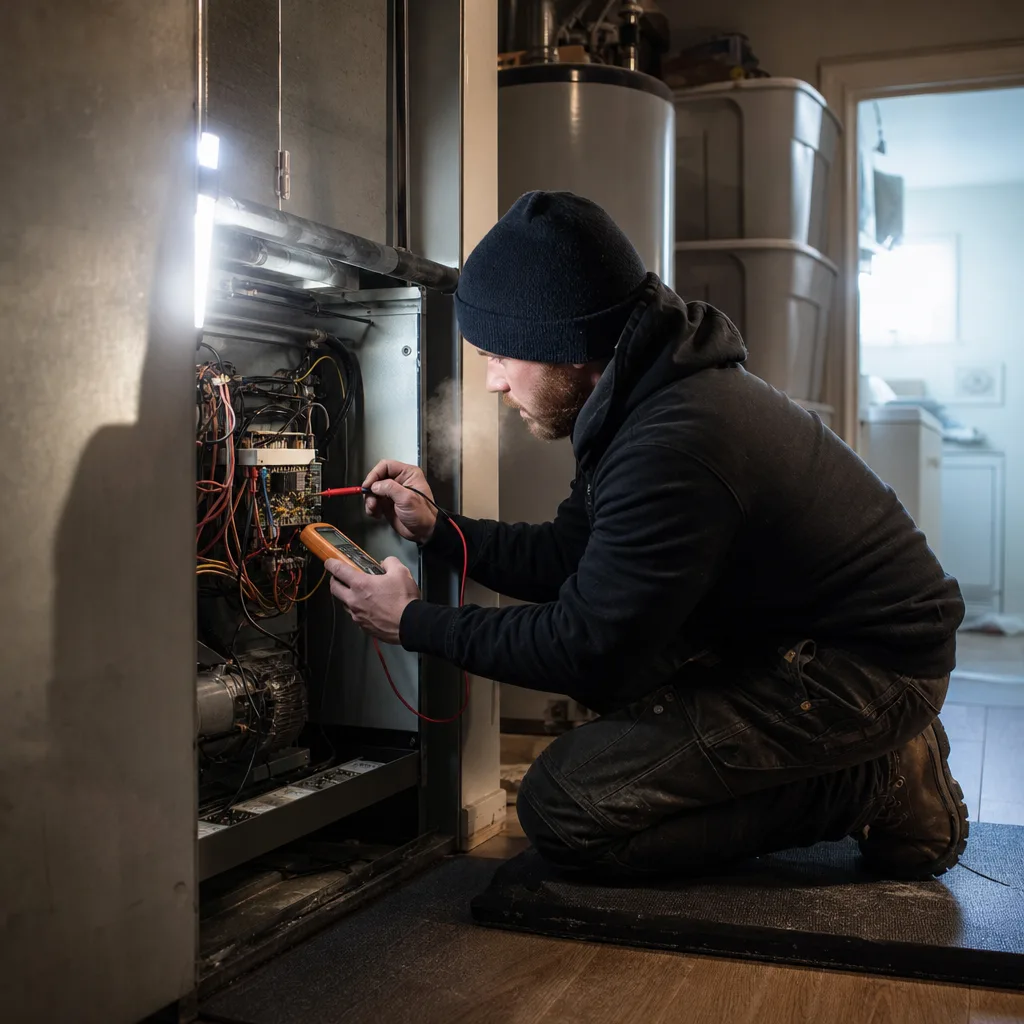
Our technician’s first job is to find the one part that stopped your heat. The goal is to know what failed, not to guess. The notes you jotted down help here, especially the blink code and what you already checked.
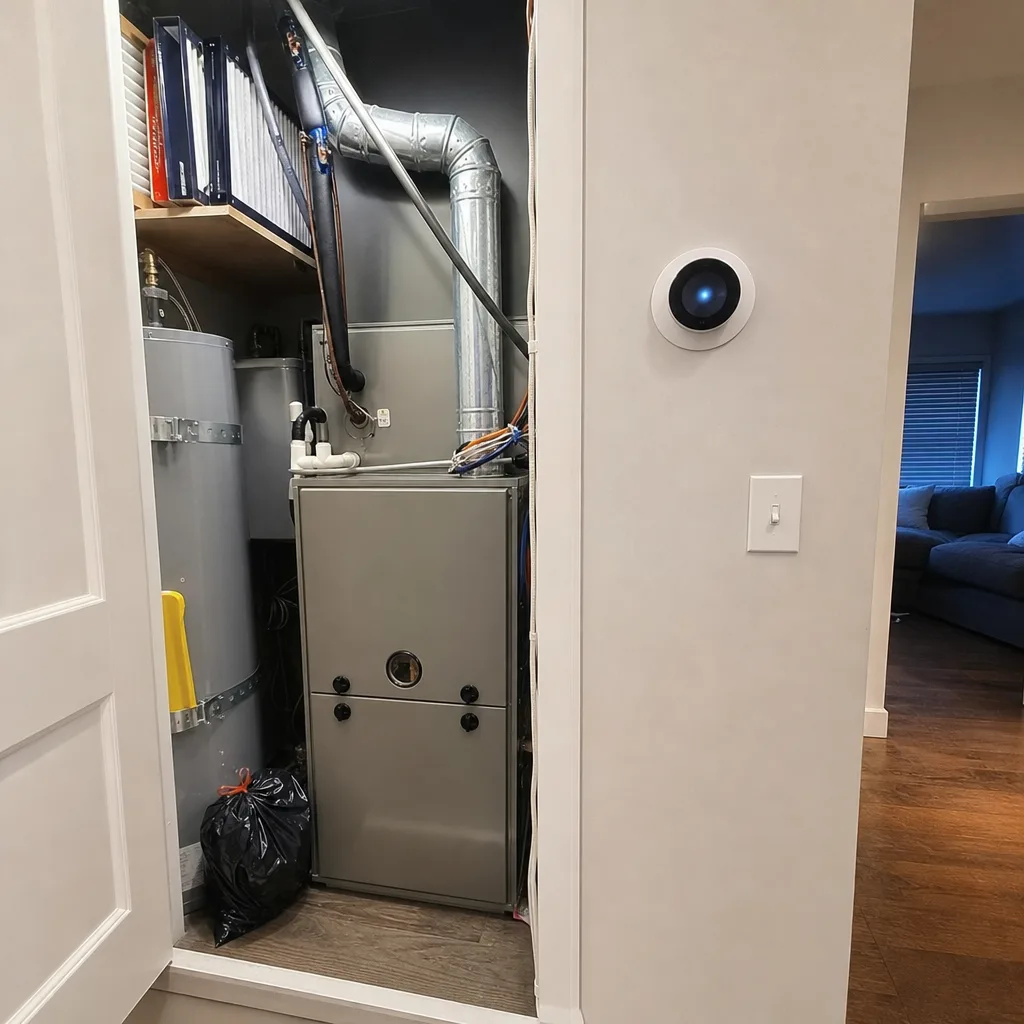
A gas furnace starts up in a set order, a little like a row of dominoes. The thermostat calls for heat. A small fan clears old air out of the vent pipe. A safety switch confirms that fan is working. The ignitor glows hot, the gas valve opens, and a flame sensor checks that the burners lit. Then the big blower pushes warm air through your vents. Watching where that chain stops points straight to the part that failed.
These are some of the parts that commonly stop a furnace partway through that chain:
- Ignitor: it cracks or wears out, so the burners never light.
- Flame sensor: a dirty sensor can’t tell the flame is on, so the furnace shuts the gas off after a few seconds. That’s the start-stop cycle described earlier.
- Pressure switch or vent fan motor: if the furnace can’t confirm it’s venting safely, it won’t light at all.
- Control board: this is the furnace’s brain. When it fails, nothing happens in the right order.
- Blower motor: the burners may light, but no warm air reaches your rooms.
Once we know what’s wrong, you get an upfront flat-rate price before any work starts. You approve it first, and there’s no meter running while we work. That price covers the diagnosis, the labor, and the standard replacement part, plus testing and cleanup. If we find that more than one part has failed, or that a major component needs work, we’ll quote that separately and you decide what to do. Code upgrades and permits are also quoted separately if a job needs them. If you go ahead with the repair, the service-call fee is credited toward it.
Most calls turn out to be a single common failure that’s fixed on the first visit. After the repair, we run the furnace through full heating cycles to make sure it starts, lights, stays lit, and shuts off the way it should. Before the technician leaves, you should feel steady warm air coming from your vents.
Sometimes the problem is bigger than one part, like an older furnace with several worn components failing at once. When that happens, you’ll get a straight explanation of what we found and what your options are, so you can choose without pressure. Financing isn’t typically offered for a smaller repair like this one, but it is available on larger repairs and replacements if you need it.
The person working in your home will be one of our licensed and insured technicians. Every one of our team members is background-checked and drug-tested. With our office on Riverside Drive in Irving, you’re dealing with a local team that’s close by. You’re not handing your home over to a stranger in the middle of a cold night.
Have questions? We’re happy to help.
Call Today, Get Service Today. Xtreme Air Services — Irving is ready to help.
What a No-Heat Repair Costs and What’s Included
Here are the real numbers. Our most common no-heat furnace repair costs $200-$525. That price covers finding the failed part, repairing or replacing it, and making sure your furnace runs correctly again. Since most calls come down to one failed part, that’s where most people’s bills land.
Across all of our no-heat repairs, the typical range is $200-$900. A few things decide where your repair falls in that range:
- How much failed. Cleaning a dirty flame sensor is a smaller job than replacing a control board, the furnace’s brain.
- Part cost and availability. Some parts are easy to get. A part for an older or less common furnace can cost more.
- Your furnace’s age and brand. These affect which parts fit and what they cost.
- More than one failed part. If a second part has quit too, it’s priced separately, as covered above, and you decide whether to go ahead.
- Time of day. This one doesn’t raise your price with us. We charge no extra for nights or weekends.
There’s also a $26-$99 service-call fee. If you go ahead with the repair, that fee is credited toward it, so it isn’t an extra charge stacked on top of your bill.
What if the price climbs toward the top of that range, or a major part like a heat exchanger is the problem? That’s a good moment to slow down. On an older furnace, putting a big repair into worn equipment may not make sense. A technician should lay out both choices plainly: repair it now, or look at replacing it. Then the decision is yours.
Whoever you call, ask a few questions before anyone starts work. The answers tell you how a company prices its jobs:
- Is there a service-call or trip fee? Is it credited toward the repair?
- Do you charge more for nights or weekends?
- Will I get a set price before work starts, or do you bill by the hour?
- What does the price include, and what would cost extra?
Hourly billing on an emergency call can leave you watching the clock while your house gets colder. A set price you approve first takes that worry off the table. You already know how we answer each of these questions. We’d rather you hear it now than be surprised by a bill later.
Call 469-200-2166
Watch Our Video
See How We Handle Emergency / no-heat furnace repair in Irving
Xtreme Air Services — Irving
Why Cold Snaps Hit Irving Furnaces Hard
If your furnace quit on the first really cold night of the year, you’re not unlucky. That’s when furnaces in Irving are most likely to fail, and the reason has a lot to do with how North Texas weather works.
Here, your air conditioner does the heavy lifting for most of the year. Your furnace may run only a few weeks each winter, and it might sit unused for months at a time. A worn ignitor, a dirty flame sensor, or a tired blower motor can get by on a mild 50-degree morning, when the furnace only kicks on now and then. You won’t notice anything is wrong.
Then a cold front rolls in. The temperature can drop fast, sometimes in a single afternoon. Your furnace goes from barely running to running almost nonstop, starting and stopping over and over through the night. Every start puts the ignitor, the flame sensor, and the control board to work again. A part that was already weak gets pushed past its limit. That’s why a cold-snap failure is usually one worn part giving out, not a sign that your whole system is done.
Where your furnace sits matters too. Many North Texas homes have the furnace in the attic. All summer long, that attic gets very hot, and that heat is hard on wiring, motors, and electronic parts over the years. In winter, the same attic gets nearly as cold as the outdoors. During a hard freeze, a furnace up there is working in the cold, and things like the condensate drain and vent pipes covered earlier are more likely to cause trouble.
Irving also has a mix of older, established homes and newer builds. An older furnace has more years of wear on every part. A newer high-efficiency furnace has more safety switches and sensors that can stop the heat if something isn’t right. Either one can let you down on a cold night, for different reasons.
One more thing happens during a cold snap. Lots of homes need heat at the same moment, so lots of weak furnaces fail on the same night. That’s a big reason it pays to find a problem before the weather turns.
You can do a lot of that yourself in a few minutes:
- Test your heat on a cool fall day, before you really need it. Set the thermostat a few degrees above room temperature and make sure warm air comes out within a few minutes.
- Listen while it starts. Clicking that repeats, a burner that lights and then shuts off, or new rattling are worth getting checked while it’s still mild out.
- Put in a fresh filter before the first cold front, not after.
- Look at the outside vent pipes and clear away leaves or nests you can reach from the ground.
- Test your carbon monoxide alarm and swap the batteries if it’s been a while.
If you’d rather have a technician look things over, a heating maintenance tune-up before winter lets someone clean the flame sensor, check the ignitor, and spot a worn part while it’s still a planned visit. If we find something during a furnace safety inspection or carbon monoxide testing, you’ll hear about it plainly, with a set price, so you can fix it on your schedule instead of the cold front’s.
Frequently Asked Questions
Common questions about Emergency / no-heat furnace repair
Do you charge extra for a furnace repair at night or on a weekend?
No, we charge the same price no matter when you call. A Saturday night repair costs the same as a Tuesday morning one, so you can decide based on how cold your house is getting, not what time it is.
Can a no-heat problem really be an emergency even if it’s not freezing outside?
Yes, if your furnace keeps starting and shutting off, that counts as an emergency no matter the temperature. A safety control is stopping it for a reason, and that usually points to a failed part that needs a technician soon.
What should I do if I smell gas near my furnace?
Get everyone outside right away, then call your gas company or 911 once you’re safely out of the house. This is a safety emergency, not something to troubleshoot yourself, and a repair visit should only happen after it’s confirmed safe to go back in.
Will one technician be able to fix my furnace in a single visit?
Most of the time, yes, since most no-heat calls come down to one failed part like an ignitor or flame sensor. If more than one part has failed, or a major component needs work, you’ll get a separate quote before any extra work starts.
Ready to Get Started?
Call (469) 200-2166 Today, Get Service Today.