


EV Charger Installation in Irving: What Decides Your Price
Level 2 home chargers wired on their own circuit, with your panel checked first so the charger runs at full speed.
What’s Covered on This Page
- Panel Capacity Decides Your EV Charger Installation Cost
- What a Professional EV Charger Installation Includes
- Permits and Code Requirements for a Dedicated EV Circuit
- When You Don’t Need a Dedicated EV Charger Circuit
- Licensed Electrical Work for Panel-Level Installations
- Do I need to supply my own charger, or can you provide one?
- Can I install an EV charger myself if I already have the unit?
- What if my electric utility needs to upgrade service to my house, not just my panel?
- Will a solar or battery backup system change how my EV charger gets installed?
Panel Capacity Decides Your EV Charger Installation Cost
Here’s the honest truth about EV charger cost. The charger and the mounting are the easy part. What really sets your price is whether your electrical panel has enough spare power to feed one more big circuit.
A Level 2 charger pulls a lot of power for hours at a time, often overnight. It needs its own dedicated circuit, run straight from your panel. Your panel can only safely carry so much at once. If your AC, electric dryer, water heater, and range already use most of it, adding a charger can push it past what it’s built for.
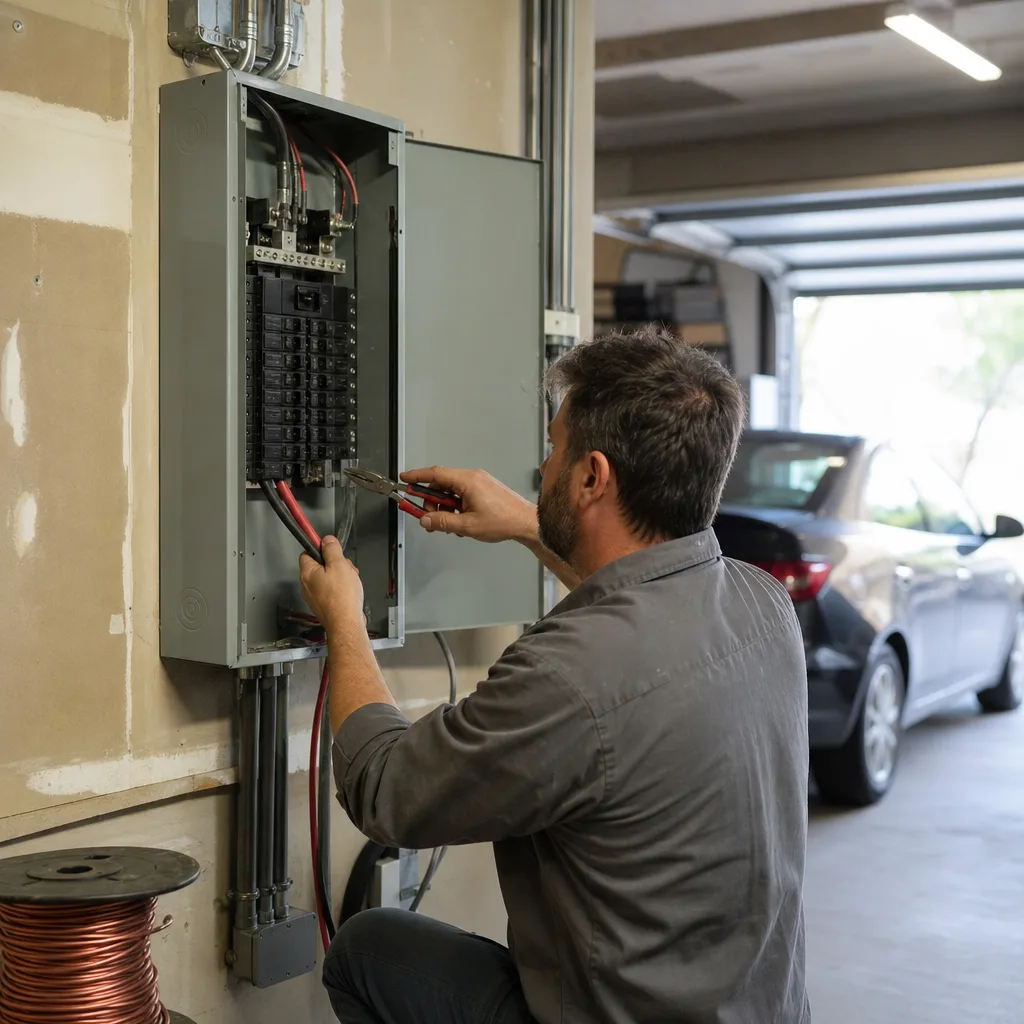
You can get a rough idea yourself in about two minutes. Open your panel door and look for these things:
- The main breaker size. It’s the big breaker at the top, marked with a number like 100, 150, or 200. That’s your panel’s total amps.
- Open slots. Look for empty spaces where a new breaker could go. A full panel makes the job harder.
- Big electric loads. Check for breakers labeled for an electric range, dryer, water heater, heat strips, a pool, or a hot tub.
- Warning signs. Breakers that trip often, a warm panel cover, or a buzzing sound mean the panel needs a look before anything gets added.
A higher main breaker with open slots usually means a simpler job. A smaller panel with few or no open slots and a lot of electric appliances means you’ll want a real load check first. That check tells you how much power your home already uses and how much is left over for the charger.
When the panel is tight, you still have options. Sometimes a lower charger amperage fits fine and still fully charges your car overnight. Other times, the right answer is an electrical panel upgrade or a subpanel installation. That way your charger, your AC, and everything else can run at the same time without tripping breakers.
Here’s how that shows up in your price. Our typical range for EV charger installation runs $500-$2,500. Our most common job installs a Level 2 home charger on a dedicated circuit from the panel, mounted, connected, and tested. That job runs $900-$1,700, and most finish the same day. It includes the dedicated circuit, professional installation, mounting, startup, and testing.
Some things aren’t included unless your quote says so. That means panel upgrades, trenching, code corrections, permits, and the charger itself if you don’t supply it. Distance from the panel, wall and conduit routing, and charger amperage can also move the price up or down. A garage right next to the panel costs less than a run across the house.
Our service-call fee is $26-$99, and it’s credited toward the work if you go ahead with us. If your panel needs an upgrade, flexible financing is available on qualifying installations and larger jobs, on approved credit. You’ll see the full price up front before any work starts, so you know exactly what your panel needs and what it costs.
What a Professional EV Charger Installation Includes
Once you know your panel can handle the load, the install itself is pretty straightforward. Our most common job covers the whole path from your panel to your parking spot. That includes the dedicated circuit, professional installation, mounting, and startup and testing. Most of these jobs finish the same day, so you can often charge your car that night.
Here’s what a good install covers, and why each step matters to you.
- Picking the right spot. The charger should go where your car’s charging port can reach it without the cord stretching across the floor. Think about which side of the car the port is on, and whether you’ll ever park a second EV there.
- Plug-in or hardwired. Some chargers plug into a heavy-duty 240-volt outlet. Others connect straight to the circuit. A plug-in setup lets you swap chargers later. A hardwired one often allows higher charging speeds. Either way, the circuit has to match the charger.
- Sizing the circuit. The breaker and wire need to be the right size for your charger’s amperage. A Level 2 charger runs hard for hours, so an undersized wire can run hot even if the car seems to charge fine at first.
- Routing the wire. The run from your panel to the charger goes through walls, along the garage, or in conduit outside. A clean, protected route keeps the wiring safe from bumps, sun, and moisture.
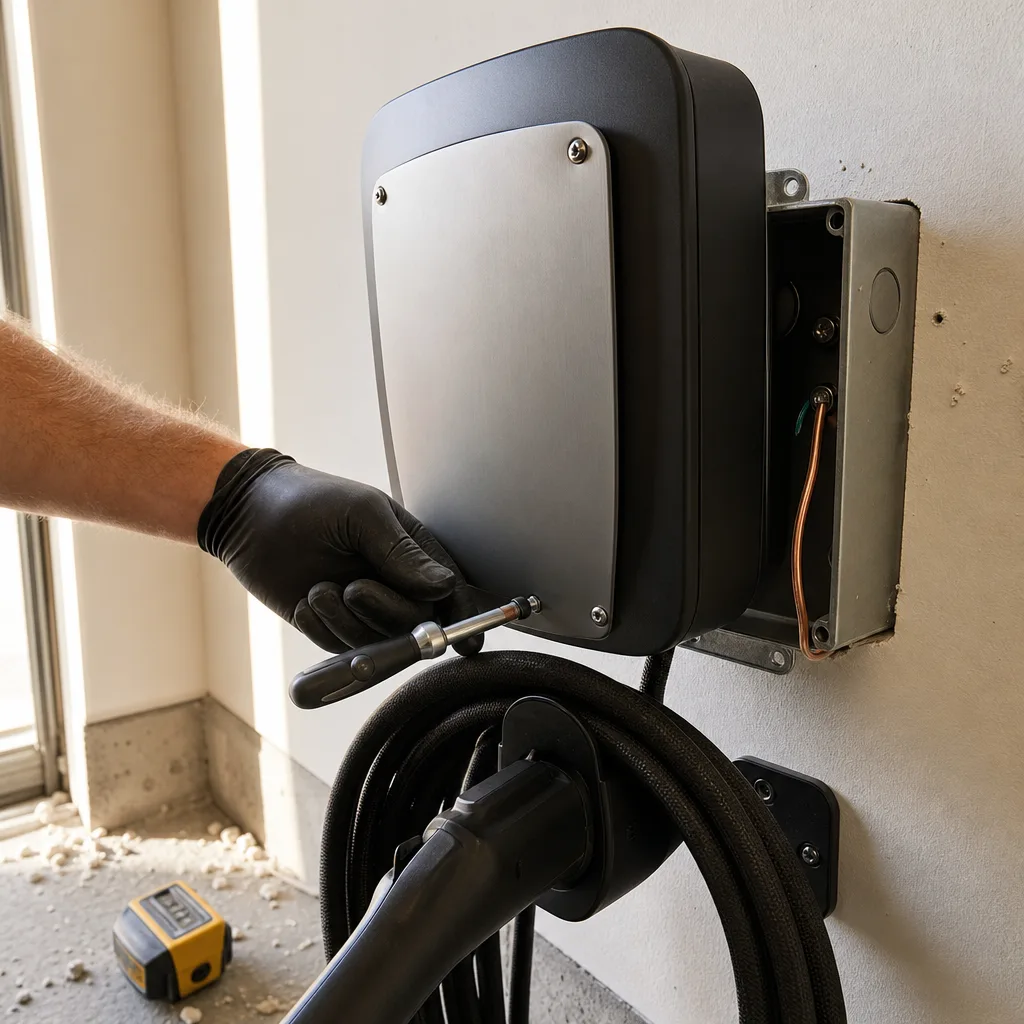
- Mounting the charger. It gets fastened solidly to the wall at a height that’s easy to use, with the cord hanging where you won’t trip over it or run it over.
- Startup and testing. The charger gets powered up, set to match the circuit, and checked while it’s charging your car.
If your charger will live outside, plan for North Texas weather. Summer heat, hard storms, and the odd winter freeze are tough on gear that sits outdoors all year. Use a charger and outlet rated for outdoor use, and keep the mounting spot out of standing water and away from where rain pours off the roof.
You don’t need to be an electrician to tell whether the job was done right. After the install, keep an eye out for a few things over the first couple of charges:
- Your car shows Level 2 charging speed, not the slow trickle you’d get from a regular wall outlet.
- The breaker doesn’t trip, even when your AC is running at the same time.
- The outlet, plug, and charger stay only mildly warm, never hot to the touch.
- There’s no buzzing, burning smell, or flickering lights when the car starts charging.
If any of those show up, stop charging and have the circuit checked. That’s not normal, and it’s not something to live with.
Before you book, it helps to have two answers ready. First, do you already have a charger, or do you need one supplied? Second, where do you want it, garage or driveway? With those, our licensed, background-checked technicians can give you an upfront price that matches your home. You’ll also know whether a permit or anything else outside the standard job is part of your quote.
Permits and Code Requirements for a Dedicated EV Circuit
Short answer: if you’re adding a new 240-volt circuit for a Level 2 charger, plan on an electrical permit and an inspection. If you’re only plugging a Level 1 cord into an outlet you already have, there’s no new wiring, so there’s usually nothing to permit.
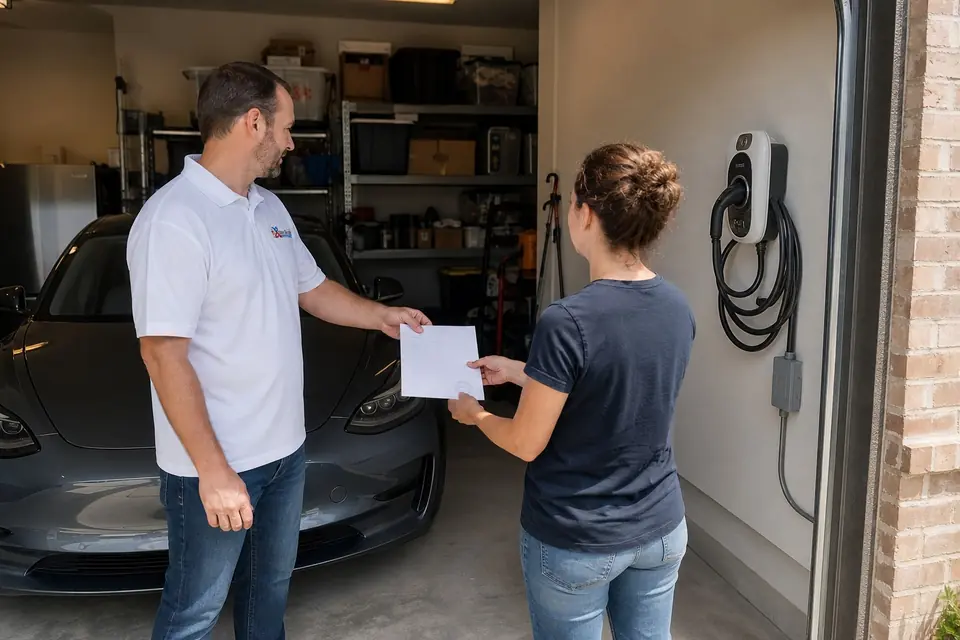
For homes inside Irving city limits, the City of Irving decides what needs a permit and sends out the inspector. Rules and fees can change, so the safe move is to confirm with the city for your address before work starts. As we mentioned earlier, permits aren’t part of the standard job unless your quote says so. You’ll know up front if it’s included.
A permit can feel like red tape. But it gets a second set of trained eyes on a circuit that will carry heavy power for hours at a time, usually while you’re asleep. Here’s what the code and the inspector care about:
- A circuit just for the charger. Nothing else shares it. No garage freezer, no shop lights.
- A breaker sized with room to spare. An EV charger counts as a long, steady load, so the breaker and wire are sized above the charger’s actual draw. That headroom keeps the wire from running hot night after night.
- Wire that matches the breaker. Thick enough for the amps, and the right type for where it runs, whether that’s inside a wall, along the garage, or outdoors.
- Solid grounding and tight connections. Loose connections are where heat and burning smells start.
- Ground-fault protection where the code calls for it. This trips power fast if current leaks somewhere it shouldn’t, which matters in a garage or driveway that can get wet.
- Proper outdoor gear. Outdoor chargers need covers, boxes, and conduit rated for the weather.
Who does the work matters too. In Texas, electricians are licensed through the Texas Department of Licensing and Regulation, also called TDLR. A licensed electrical contractor can pull the permit, and the inspector signs off on that work. When a handyman or a friend wires it, a permit often gets skipped, and nobody checks the job.
Skipping it can come back on you. An unpermitted circuit can raise questions when you sell your home, during a home inspection, or if you ever file an insurance claim after an electrical problem. If you already have a charger that was put in without a permit, it’s worth having the circuit checked. Code correction is a separate job from a new install.
One more piece. If your load check shows you need more power coming into the house, not just a bigger panel, the electric utility gets involved. In Irving, that utility is Oncor. That adds time, so it’s good to know early.
If you rent, or your home is part of an HOA, get written approval from your landlord or association before anyone drills or runs conduit outside.
Call 469-200-2166
Not sure what your EV charger installation project needs? Ask us.
Call Today, Get Service Today. Xtreme Air Services — Irving is ready to help.
When You Don’t Need a Dedicated EV Charger Circuit
Plenty of people don’t need a new circuit at all, at least not right away. Every EV comes with a cord that plugs into a regular 120-volt wall outlet. That’s called Level 1 charging. It’s slow, adding only a few miles of range for each hour it’s plugged in. But your car sits in the garage for 10 to 12 hours most nights, and a few miles an hour adds up while you sleep.
Here’s the real question: does what you add overnight cover what you drive the next day? If it does, a regular outlet may be all you need.
A regular outlet usually works fine if:
- You drive a short daily round trip and park at home every night.
- You have a plug-in hybrid. The battery is small, so a wall outlet can often fill it overnight, and the gas engine covers the rest.
- You can charge at work or at a public charger a few times a week.
- You work from home and your car sits most of the day.
- You plan to move soon. A new circuit stays with the house, not with you.
Picture this. You bought an EV last month. You drive to the office and back, run a few errands on the weekend, and plug in every night. Each morning the battery reads full or close to it. Nothing’s wrong, and you don’t need to spend money to fix it.
There’s one thing to check before you count on an existing outlet. That outlet will carry a steady load for hours, so it should be in good shape and not share its circuit with a big appliance like a garage freezer or a shop vac. If the breaker trips while you charge, or the plug or outlet gets hot, that outlet isn’t up to the job. It’s time to have it looked at.
You might also already have a 240-volt outlet in the garage from an old welder, shop tool, or past owner. It might work for a plug-in Level 2 charger. It might not. The outlet type, breaker size, and wire all have to match the charger, as we covered above. Have someone confirm it before you plug a charger into it.
So when does Level 2 make sense? It’s worth it when Level 1 can’t keep up. Maybe you have a long commute, two EVs sharing one garage, or you often wake up short on range. It also helps when you need a quick top-off between trips. If none of that sounds like your week, give the cord that came with your car a fair try first. You can always add a dedicated circuit later, once you know how you really drive.
Waiting doesn’t cost you anything. Your panel, your garage, and the install steps will all still be there when you’re ready.
Watch Our Video
See How We Handle EV charger installation in Irving
Xtreme Air Services — Irving
Licensed Electrical Work for Panel-Level Installations
If your charger install means working inside the panel, it’s a job for a licensed electrician. That includes adding a breaker, rearranging circuits, adding a subpanel, or replacing the panel. This is the part of the work you’ll never see once the cover goes back on. It’s also the part that has to be right for years of overnight charging.
Here’s a fact that surprises people. Flipping the main breaker off doesn’t make the whole panel safe. The big wires coming in from the utility, and the spots where they connect, stay live. Someone without the training can get badly hurt in seconds or leave behind a connection that slowly overheats.
Depending on what your load check shows, panel-level work can look like this:
- A new two-pole breaker for the charger, placed in an open slot.
- Moving or combining a few circuits to free up space. This is only done where your panel is built and labeled to allow it.
- A subpanel in the garage, fed from your main panel, so the charger and future garage circuits have their own home.
- A larger panel to replace one that’s full or too small.
- A service upgrade, which brings in Oncor, as covered above.
- A load management device that pauses or slows charging when the rest of your house is pulling a lot of power. In some homes, this can help you avoid a bigger upgrade.
Whoever you hire, ask these questions before anyone opens your panel:
- Are you a licensed electrician, and will you pull the permit?
- Did you check my home’s load, and can I see what you found?
- Does the quote list panel work, permits, and code corrections as separate lines, so I know what’s included?
- What charger amperage will this circuit support, and why?
A good electrician answers all four without hesitating. If the answers are vague, or the quote is one number with no details, keep looking.
In North Texas, your AC is usually the biggest power user in your home from late spring into fall. On a hot night it can still be running while your car charges in the garage. Because we’re one trusted team for HVAC, plumbing, electrical, and refrigeration, you can talk through your AC and your charger in the same conversation. If you’re also thinking about a standby generator, mention it on the call. That way the plan for your panel covers everything it will need to handle, not just the charger.
Our licensed and insured technicians are background-checked and drug-tested, and your neighbors have given us 4.8 stars across more than 2,900 reviews on Google, Angi, and HomeAdvisor. Same-day service is available, there’s no extra charge for nights or weekends, and you’ll get upfront flat-rate pricing before any work starts.
Call 469-200-2166
Frequently Asked Questions
Common questions about EV charger installation
Do I need to supply my own charger, or can you provide one?
You can do either one. Some homeowners already own a charger, like a Tesla unit, and just need it installed. Others want us to supply the charger as part of the job. Either way, let us know before you book so your quote matches what you need.
Can I install an EV charger myself if I already have the unit?
If it’s a Level 1 cord plugging into an outlet you already have, you can do that yourself. But a Level 2 charger needs a new dedicated 240-volt circuit run from your panel, which is electrical work for a licensed electrician. Panel work also needs a permit in most cases, and skipping that step can cause problems later if you sell your home or file an insurance claim.
What if my electric utility needs to upgrade service to my house, not just my panel?
If your load check shows your home needs more incoming power, not just a bigger panel, that involves Oncor, your electric utility. This adds extra time to the project, so it helps to find out early whether your situation needs this step before you commit to a timeline.
Will a solar or battery backup system change how my EV charger gets installed?
Yes, adding solar or a battery system can change your panel setup and may require extra permitting. If you’re planning solar panels or a battery backup alongside your charger, mention it when you call so the electrician can plan your panel work to handle everything at once instead of redoing it later.
Ready to Get Started?
Call (469) 200-2166 Today, Get Service Today.