


Electrical Panel Replacement / Upgrade in Plano
Panel upgrades for homes that have outgrown their power, done by licensed electricians with the permit pulled.
What’s Covered on This Page
- Signs Your Panel Needs Replacing, Not Just Repair
- Why Older Plano Homes Often Need a Capacity Upgrade
- When a Panel Upgrade Is Not What You Need
- What Happens During a Panel Upgrade
- What Drives the Cost of a Panel Upgrade
- Should a 50-year-old electrical panel be replaced?
- Is it worth upgrading to 200-amp service?
- What counts as an electrical service upgrade versus a simple panel swap?
Signs Your Panel Needs Replacing, Not Just Repair
Let’s start with the honest part. Not every panel problem means you need a new panel. If one breaker trips because one circuit is overloaded, or a single breaker has worn out, swapping that breaker or tightening a connection often fixes it for good. That’s electrical panel repair, and it costs a lot less than a replacement. We’d rather tell you that up front than sell you something you don’t need.
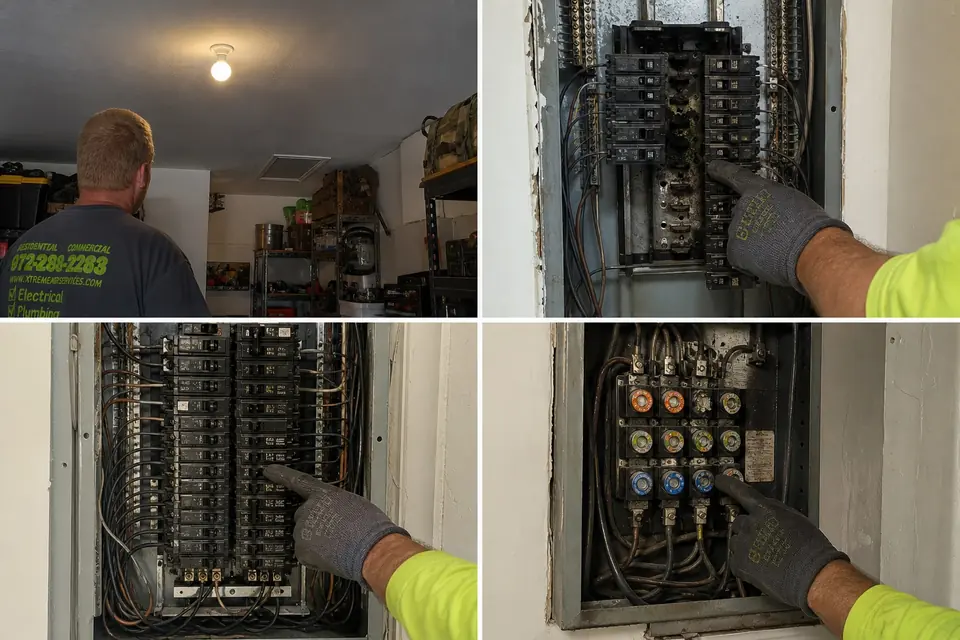
Replacement starts to make sense when the problem isn’t one part. It’s the whole panel. Here’s what that usually looks like:
- You still have a fuse box. Fuses did their job for decades, but most homes now run far more than those boxes were sized for.
- Breakers trip again and again, on different circuits, even after you’ve cut back on what’s plugged in.
- A breaker won’t stay reset, or it feels loose when you push it back into place.
- The panel cover feels warm, you notice a burning smell near it, or you see dark scorch marks around the breakers.
- You hear buzzing or crackling coming from inside the panel.
- There’s rust or water staining inside the box, which can point to moisture getting in over the years.
- Lights dim or flicker every time your AC, dryer, or another big appliance kicks on.
- Every slot is full, and you’re seeing two wires squeezed under one breaker or a pile of add-on breakers to make room.
- A home inspector or your insurance company flagged the panel during a sale or a policy review.
The flickering lights sign matters a lot here in Plano. Your air conditioner runs hard from late spring well into fall, and that’s often the biggest load your panel carries. If the lights dip every time the AC starts, the panel may be struggling to keep up on the hottest days, exactly when you need it most.
The other big reason to replace is simple: you’re adding something. An EV charger, a hot tub, pool equipment, a new heat pump, or a backup generator all need room and power. If your panel is already full or sized at a lower amperage, an upgrade, often to 200 amps, gives you space for what you have now and what’s coming next. Doing it before the new equipment goes in saves you from patching around a panel that was never going to fit.
Some signs, like heat, scorch marks, or buzzing, aren’t something to sit on for months. Others, like a full panel or an old fuse box that works fine, give you time to plan and budget. Either way, the first step is the same. A licensed electrician opens the panel, checks the breakers, wiring, and grounding, and tells you plainly whether a repair will hold or whether replacement is the smarter move for your home.
Why Older Plano Homes Often Need a Capacity Upgrade
Here’s the plain truth about a lot of older homes. The panel wasn’t built wrong. It was built for a different way of living. When many established Plano homes went up, a 100-amp panel, or an even smaller fuse box, was plenty for a family’s lights, a range, a washer, and a window unit or a modest central AC.
Think about what that same house runs today:
- A bigger central air system that runs for months straight in North Texas heat
- A kitchen remodel with a microwave, an induction cooktop, and more countertop gadgets
- A home office with computers, monitors, and a space heater under the desk
- Pool pumps, hot tubs, or a garage workshop added over the years
- Electric water heaters, dryers, and a second fridge in the garage
Each change made sense on its own. Together, they can ask the panel to carry far more than it was ever sized for. That’s why an older home can have no single “broken” part and still be short on power.
So how do you know for sure? A licensed electrician doesn’t guess, and you shouldn’t have to either. The right way is a load calculation. That’s a fancy name for adding up what your home uses: square footage, big appliances, heating and cooling, and anything you plan to add. The result shows whether your current panel has room to spare or is already running close to its limit. If someone tells you that you need 200 amps without doing that math, ask them to show you how they got there.
A capacity upgrade isn’t always just the panel, either. More amps usually means the wires coming into your house and the meter base have to handle more power too. That part of the system connects to Oncor, the utility that delivers power in Plano, so the job takes coordination to shut off power, make the connection, and turn it back on safely. Older homes may also need grounding brought up to today’s standards while the panel is open. It’s better to know about all of that before work starts than to find out halfway through.
That’s the honest test. If your home needs more power than it has, an upgrade fixes the real problem. If it doesn’t, you should hear that too, and keep your money for something that matters.
When a Panel Upgrade Is Not What You Need
A new panel is a big job, and plenty of problems that feel like panel trouble aren’t. Before you set money aside for an upgrade, check whether your situation is one of these. Some cost little or nothing to fix.
- One appliance keeps tripping its breaker. If the breaker trips only when the space heater, vacuum, or microwave runs, the appliance or that one circuit is the likely cause. Plug the appliance into an outlet on a different circuit. If it trips there too, the appliance is probably the problem, not your panel.
- An outlet went dead in the kitchen, a bathroom, the garage, or outside. Those outlets are often protected by a GFCI, the outlet with the test and reset buttons. Sometimes one GFCI controls outlets in another room. Press reset on the GFCI outlets nearby before you call anyone.
- One light or one room flickers. That points to a loose bulb, a worn switch, or a bad connection at the fixture. It’s a small repair, not a reason to replace the panel.
- Lights dim all over the house at once, even when nothing big is running. That can come from a loose connection at the meter or the line feeding your home, which is the utility’s side. Oncor handles that part. A licensed electrician can tell you which side the problem is on so you call the right people.
- The whole house lost power. Check whether your neighbors are out too. If they are, it’s an outage, not a failed panel.
- A home inspector flagged your panel. Read the exact wording. Items like a missing cover screw, an unlabeled panel, or one wrong breaker are often code corrections that don’t require a new panel. Ask for the specific problem in writing before anyone quotes a replacement.
- You want protection from storm surges. North Texas thunderstorms are hard on electronics, and a whole-house surge protector mounts at your existing panel. You don’t need a new panel to get one.
- You’re adding an EV charger and capacity is tight. A charger set to a lower amp level, or a load-management device that pauses charging when your AC and dryer are running, can sometimes avoid a full service upgrade. Ask whether that option fits your home and your driving.
Age by itself isn’t a reason to replace a panel either. If yours is sized right for your home, has room to spare, and shows none of the warning signs covered earlier, it’s fine to leave it alone. Upgrade when a real need shows up, not because the panel turned a certain age.
There’s also a fair case for waiting. Say you’re planning a kitchen remodel, a pool, or a heat pump in the next year or two, and your panel is working fine today. It can make sense to hold off and size the upgrade once, around what you’re adding, instead of paying for work twice.
Have questions? We’re happy to help.
Call Today, Get Service Today. Xtreme Air Services — West Plano is ready to help.
What Happens During a Panel Upgrade
A panel upgrade is a planned job, not a mystery. Once the load calculation shows what size panel your home needs, the work follows a clear order. Knowing that order helps you plan your day and spot anything that doesn’t add up in a quote.
- Scope and quote. The electrician looks at your current panel, the meter base, the grounding, and how many circuits you have. You should get the price before any work starts, so nothing changes once the power is off.
- Permit and scheduling. A panel replacement in Plano needs a city permit and an inspection. If the job needs a service disconnect, the date also has to work with Oncor, which was covered earlier.
- Power off. On work day, the power to your home is shut off at the source. Plan on being without power for a good part of the day.
- Old panel out. Each circuit is labeled so it lands in the right spot. Then the old panel or fuse box comes off the wall.
- New panel in. The new panel is mounted, the circuits are moved over, and new breakers go in. Grounding is brought up to today’s standards while everything is open.
- Startup and testing. Power comes back on, and each circuit is checked so your AC, kitchen, and outlets work the way they should.
- Inspection and cleanup. A city inspector signs off on the work, and the old panel is hauled away.
With Xtreme Air Services, the panel and materials, professional installation, breakers, grounding, startup and testing, and haul-away of the old panel are included. Service-entrance and meter work done by the utility, rewiring, code corrections, and permits are excluded unless your quote says otherwise. That’s worth reading closely in any quote you get. A low number that leaves out the permit isn’t really a low number.
Older panels sometimes hide problems that only show up once the cover comes off, like brittle wires, melted insulation, or a circuit that was never wired right. If that happens, you should hear exactly what was found and what it costs to fix before anyone touches it. That’s how upfront flat-rate pricing is supposed to work. You approve the price first, and the meter isn’t running while you decide.
A few things make the day go smoother:
- Clear a few feet of space in front of the panel and the outside meter. Move shelves, bins, and anything parked in the way.
- Shut down computers and TVs before the power goes off, and unplug them if you can.
- Keep the fridge and freezer closed so food stays cold.
- If someone in your home uses powered medical equipment, plan a backup or another place to stay for the day.
- Pick a day without big heat if you can. A house without AC warms up fast on a Plano summer afternoon, so a cooler-season date is easier on your family when you have the choice.
When the inspector signs off, you’re left with a labeled panel, room to grow, and a home that can run the AC, the dryer, and everything else without the lights dipping.
Watch Our Video
See How We Handle Electrical panel replacement / upgrade in Plano
Xtreme Air Services — West Plano
What Drives the Cost of a Panel Upgrade
Here are our real numbers. At Xtreme Air Services, an electrical panel replacement or upgrade typically runs $1,500 to $4,500. Our most common job is swapping an aging or undersized panel for a 200-amp panel with new breakers and proper grounding, inspected and tested. That job usually lands between $2,100 and $3,300.
Where your home falls in that range depends on what we find once we look at your setup. These are the things that move the price:
- Panel amperage. A larger panel costs more than a same-size swap. The load calculation tells you which size your home needs.
- Panel brand. Panels and their matching breakers vary in price by manufacturer.
- Meter and service condition. If the meter base or the wires coming into your home are worn or too small for the new panel, that work adds to the job.
- Grounding upgrades. Many older homes have grounding that doesn’t meet today’s standards. Bringing it up to code takes extra parts and labor.
- Circuit count. More circuits take more time to label, move, and connect, and they need more breakers.
- Ease of access. A panel on an open garage wall is quicker to replace than one tucked inside a finished closet or blocked by built-in cabinets.
- Utility coordination. Jobs that need Oncor to disconnect and reconnect service take more scheduling and more steps.
- Code upgrades. Problems found inside an older panel may need correcting before the new one can pass inspection.
- Permits. Plano requires a permit and an inspection for this work, and that cost is part of the total.
Most of these drivers trace back to two questions: how much power your home needs, and what shape the rest of your electrical system is in. A newer home with solid grounding and an easy-to-reach panel usually sits toward the lower end. An older home that needs a bigger service, grounding work, and code fixes tends to climb higher. Neither one is a bad sign. It just reflects the work that gets your home done right the first time.
To get to your price, we start with a service call. The fee is $26 to $99, and it’s credited toward the work if you go ahead with Xtreme Air Services. You get upfront flat-rate pricing that you approve before anything starts, so the bill doesn’t grow while the power is off.
If you’re comparing quotes, ask each company the same questions so you’re comparing fairly:
- Did you do a load calculation, and what size panel did it show?
- Does the price include the permit and the city inspection?
- Does it include grounding work, or is that extra?
- What happens to the price if you find a problem behind the panel cover?
- Is the price flat, or is it based on hours?
A panel upgrade is a real expense. You don’t have to cover it all at once. Flexible financing is available on qualifying installations and larger jobs, on approved credit.
Call 469-217-9095
Frequently Asked Questions
Common questions about Electrical panel replacement / upgrade
Should a 50-year-old electrical panel be replaced?
Not automatically, but age alone is a reason to get it checked. A panel that old often predates today’s power needs, and many older boxes are fuse-based or sized at 60-100 amps. If it’s a fuse box, shows rust, or trips often, replacement usually makes sense. If it’s been upgraded before and still handles your home’s load with no warning signs, it can keep running.
Is it worth upgrading to 200-amp service?
It’s worth it if your home needs more power than it currently has. A load calculation shows whether your panel is already near its limit or has room to spare. If you’re adding an EV charger, a pool, or a heat pump, 200 amps gives you space to grow instead of maxing out again soon after the work is done.
What counts as an electrical service upgrade versus a simple panel swap?
A service upgrade means increasing the amount of power coming into your home, not just replacing the panel box itself. That usually involves larger wires from the meter, a bigger meter base, and coordination with Oncor to disconnect and reconnect service safely. A straight panel swap at the same amperage is simpler and doesn’t require that utility coordination.
Ready to Get Started?
Call (469) 217-9095 Today, Get Service Today.