


EV Charger Installation in Plano: What It Costs and What’s Included
Level 2 home chargers wired on their own circuit, with your panel checked first so the charger runs at full speed.
What’s Covered on This Page
- What a Home EV Charger Installation Includes
- Panel Capacity Decides Whether You Need an Upgrade
- The Plano Electrical Permit Is Part of This Job
- When a Full Dedicated Circuit Install Isn’t Necessary
- What to Ask Before You Book an Installer
- How long does a home EV charger installation take?
- Can I install my own EV charger to save money?
- Does North Texas heat affect EV charger installation or performance?
What a Home EV Charger Installation Includes
When you buy an EV, the dealer hands you a car, not a plan for your garage. So here’s what you get when we install a Level 2 home charger. A Level 2 charger runs on 240 volts, the same kind of power your dryer or electric range uses. That’s why it can fill your battery overnight instead of over a couple of days on a regular wall outlet.
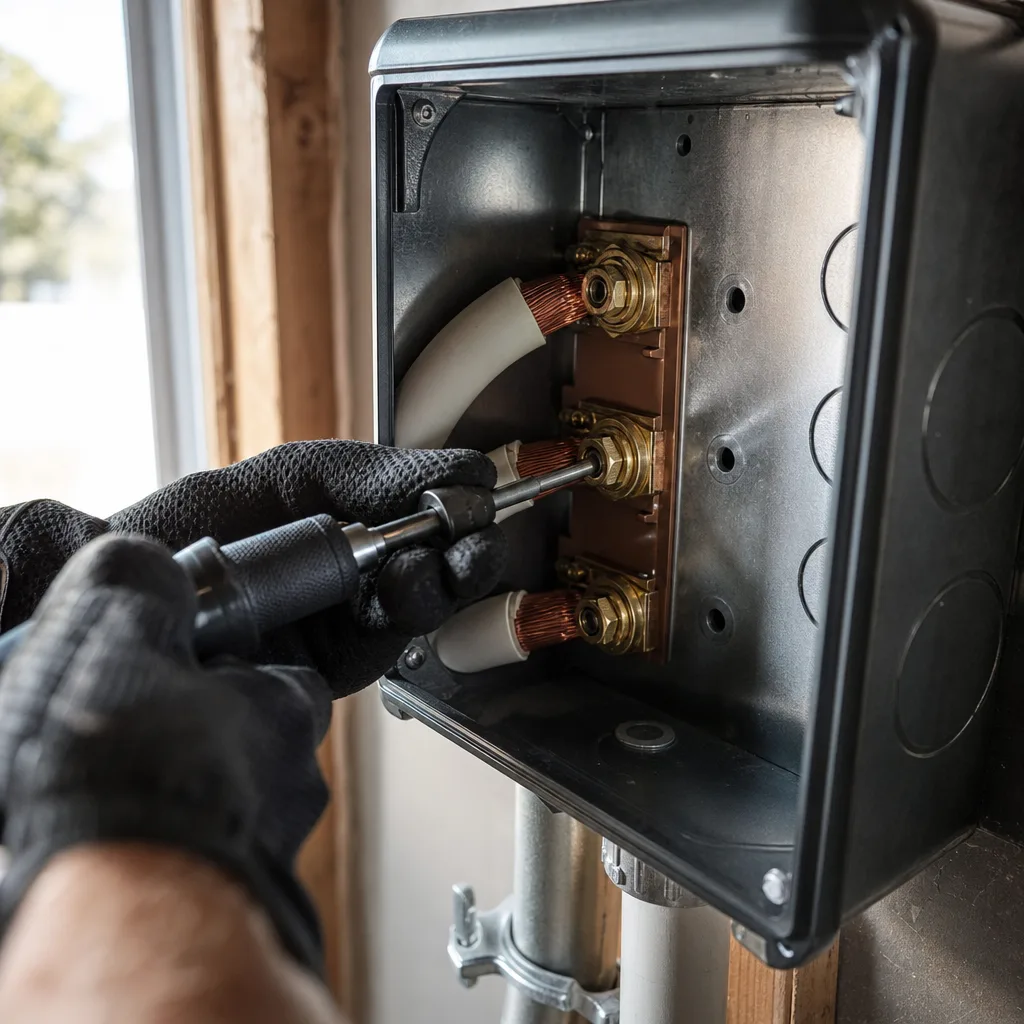
A standard installation includes:
- A dedicated circuit. This is a new line that runs from your electrical panel to the charger and serves nothing else, so your car isn’t sharing power with the freezer or the garage lights.
- Professional installation by our licensed and insured electrical team.
- Mounting the charger where you’ll use it.
- Startup and testing, so you know it charges before we pack up.
We want you to know what’s not in that standard price, too. You shouldn’t find out after the work is done. These items are excluded unless your quote states them:
- The charger itself, if you haven’t already bought one
- Panel upgrades
- Trenching, such as running a line underground to a detached garage or driveway post
- Code corrections to existing wiring
- Permits
Some homes need none of those extras. Others need one or two. If your panel is already full, for example, the charger can’t safely go in until there’s room. That’s a separate job. It’s not something we’d tuck into the install and hope you don’t notice. Panel upgrades have their own page if you want the full picture.
On price, our most common job, a Level 2 charger on a dedicated circuit, mounted, connected, and tested, runs $900-$1,700. Across all EV charger installations, our typical range is $500-$2,500. Where your home lands depends on things like how far the charger is from your panel, your panel’s capacity, the charger’s amperage, and how the wire has to be routed through walls or conduit.
There’s a $26-$99 service-call fee. If you go ahead with the work, that fee is credited toward the job. You’ll see upfront flat-rate pricing before anything starts, so there’s no meter running while we work.
If the job turns out bigger than a simple install, like a panel upgrade plus the charger, flexible financing is available on qualifying installations and larger jobs, on approved credit. That way you don’t have to put off charging at home just because the panel needs work first.
The point is simple. You should know what’s included, what isn’t, and why before you say yes. That’s how you end up with a charger that works the first night and a bill that matches what you were told.
Panel Capacity Decides Whether You Need an Upgrade
Your electrical panel is the one thing that decides whether your charger is a simple install or a bigger project. If it has the capacity and the room, the charger goes in on its own circuit and you’re done. If it doesn’t, something has to change first. That’s why we look at the panel before we talk about anything else.
Capacity comes down to two questions. First, how much power can your panel handle in total? Most homes have a 100, 150, or 200 amp panel, and the number is usually printed on the main breaker at the top. Second, how much of that power is your home already using? A Level 2 charger pulls a steady, heavy load for hours at a time. Electricians treat that kind of load differently than a toaster that runs for two minutes. So the circuit has to be sized with extra headroom, and your panel has to have that headroom to give.
Here’s what tends to push a home toward an upgrade:
- A smaller or older panel, especially 100 amps, in a home that’s added big appliances over the years
- No open slots left for a new breaker, so there’s physically nowhere to add the circuit
- Several large electric loads already sharing the panel, like an electric range, electric dryer, central AC, a pool pump, or a hot tub
- Signs the panel is already struggling, such as breakers that trip often or a panel that feels warm
Now the honest part. Plenty of homes don’t need an upgrade at all. If you have a 200 amp panel with open space and a gas range or gas dryer, there’s a good chance your charger fits just fine. And even when a panel is tight, a full upgrade isn’t the only answer.
- Turn the charger down. Most Level 2 chargers let you set a lower amperage. You’ll charge a little slower, but for most daily driving, a lower setting still refills your battery overnight.
- Use load sharing. Some chargers can watch your home’s power use and ease off when the AC and dryer are running at the same time.
- Add a subpanel. If your main panel has the capacity but no open slots, a subpanel can add space without replacing everything.
Think about how you drive. If you commute 30 miles a day and park in the garage every night, you probably don’t need the fastest charger on the market. A slower setting on your current panel may cover you completely. If you drive long distances daily or have two EVs, the math changes, and an upgrade may be worth it.
Either way, you shouldn’t have to guess. We’ll tell you plainly whether your panel can handle the charger you want, what your options are if it can’t, and what each one costs, with upfront flat-rate pricing before any work starts. If the answer is that you don’t need an upgrade, that’s what you’ll hear. If you do, the panel upgrade is quoted as its own line, not hidden inside the charger install.
The Plano Electrical Permit Is Part of This Job
A Level 2 charger isn’t like plugging in a lamp. You’re adding a new 240-volt circuit that will carry a heavy load for hours, often overnight while your family sleeps. In Plano, new circuit work like this generally needs an electrical permit from the city, and the finished work gets checked by a city inspector. The permit isn’t extra paperwork stacked on top of the job. It’s part of doing the job right.
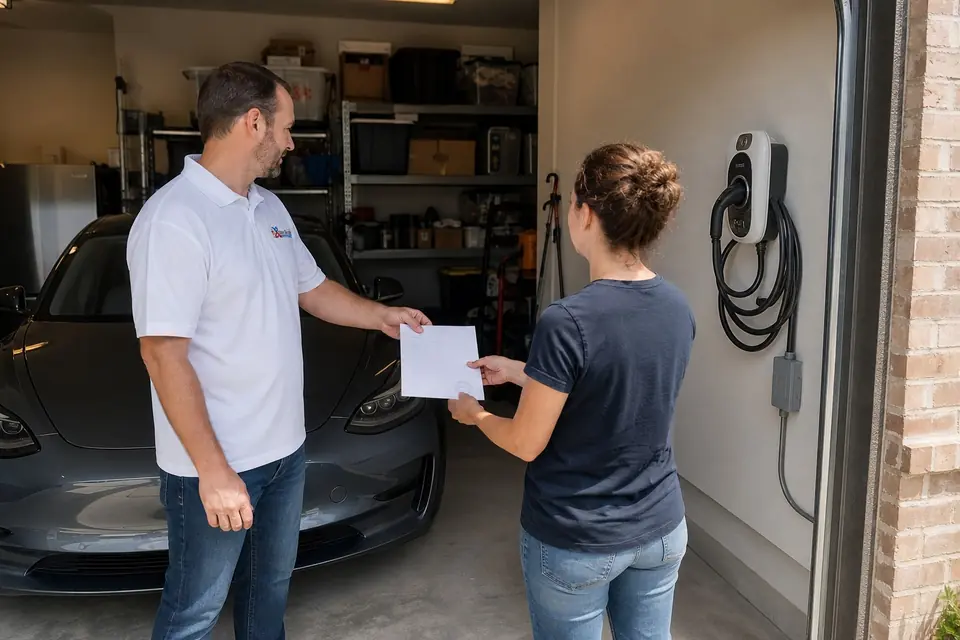
Here’s why it matters to you, not just to the city. The inspector is a second set of eyes that doesn’t work for your electrician. They check that the wire is the right size for the breaker and that the circuit is grounded and protected. They also make sure the charger is mounted and connected the way the rules and the maker call for. If something’s off, it gets fixed before you start charging, not after.
Skipping the permit can come back on you in ways that have nothing to do with how well the charger works:
- Selling your home. Buyers’ inspectors in Plano often spot a newer 240-volt circuit in the garage. Unpermitted work can slow a sale or force you to open walls so it can be inspected after the fact.
- Insurance questions. If there’s ever an electrical problem, your insurer may ask whether the work was permitted and inspected.
- Bigger jobs. If your charger needs a panel upgrade or a new service, the city and Oncor, the utility that delivers power in Plano, may both be involved. That step can’t be skipped.
As we covered above, permits aren’t part of our standard install price unless your quote says so. That’s on purpose. Permit needs can change with the scope of your job, so we’d rather show the permit as a clear line than guess and bury it. You’ll see it in your upfront flat-rate price before any work starts.
Whoever you hire, ask these questions before you say yes:
- Does this job need a permit, and is it in the price you just gave me?
- Who pulls the permit, you or me?
- Who meets the inspector, and what happens if the work doesn’t pass the first time?
- Is the person doing the work a licensed electrician? In Texas, electrical licenses come from the Texas Department of Licensing and Regulation, so you can look one up.
A good installer will answer all four without hedging. If someone tells you a permit is never needed for an EV charger, or offers a lower price to skip it, treat that as a warning sign. A low quote that skips the permit can turn into a bigger bill later.
One more Plano detail to think about: if you live in a neighborhood with a homeowners association and plan to mount the charger outside, like on an exterior wall or a driveway post, check your HOA rules too. The city permit covers the electrical work, but it doesn’t cover what your HOA allows on the outside of your home.
Not sure what your EV charger installation project needs? Ask us.
Call Today, Get Service Today. Xtreme Air Services — West Plano is ready to help.
When a Full Dedicated Circuit Install Isn’t Necessary
Not everyone who buys an EV needs a new circuit run to the garage. Sometimes the right answer is to wait, or to use what you already have. Here’s when that’s true.
You don’t drive very far each day. Your car almost certainly came with a cord that plugs into a regular 120-volt wall outlet. That’s called Level 1 charging. It’s slow and adds just a few miles of range for every hour it’s plugged in. But if your car sits in the garage for 10 to 12 hours a night and you only drive a short round trip to work, school, or the store, that slow trickle may refill what you used. A lot of people find out Level 1 is plenty once they track their real driving for a couple of weeks.
You drive a plug-in hybrid. Plug-in hybrids have much smaller batteries than full EVs, and the gas engine takes over when the battery runs low. Many hybrid owners charge on a standard outlet overnight and never feel held back. A Level 2 circuit would charge it faster, but faster may not change anything for you.
You already have a 240-volt outlet in the garage. Some homes have one for a dryer, a welder, a shop tool, or a past owner’s EV. Some newer homes come with one roughed in by the builder. If yours is close to where you park, a plug-in Level 2 charger may work without any new wiring. It’s still smart to have the outlet and its circuit checked before you count on it every night, since an outlet that was fine for a dryer running an hour isn’t always ready for a car pulling power for hours. That check is a lot smaller than a full install.
You rent, or you’re moving soon. If you’re renting, the wiring isn’t yours to change, and your landlord gets the final say. If you plan to sell in the next few months, a new circuit may not pay off for you. Level 1 can carry you until you’re settled in the home you’ll keep.
You charge somewhere else most days. If your workplace has chargers, or there’s a public station on your regular route, home charging may only need to top you off. Level 1 often covers that just fine.
Here’s a simple way to decide. Use the cord that came with your car for two or three weeks. If you wake up with enough range for your day, every day, you may not need anything more yet. If you’re coming up short, or you’ve got a second EV coming, or long drives on short notice are part of your life, that’s when a dedicated Level 2 circuit starts to earn its cost.
- Probably fine on Level 1: short daily drives, a plug-in hybrid, charging at work, or renting.
- Worth a closer look: an existing 240-volt garage outlet you’d like to use for a plug-in charger.
- Likely time for Level 2: long daily drives, two EVs, or mornings where you keep waking up short on range.
There’s no prize for buying more charger than your driving needs. The right setup is the one that gets you where you’re going without paying for speed you won’t use.
Watch Our Video
See How We Handle EV charger installation in Plano
Xtreme Air Services — West Plano
What to Ask Before You Book an Installer
By now you know what a charger install includes, how your panel affects it, and why the permit matters. The last step is picking who does the work. We’ve already covered the permit and license questions. These are the other questions that separate a good quote from one that leaves you guessing. Ask them of anyone you call, including us.
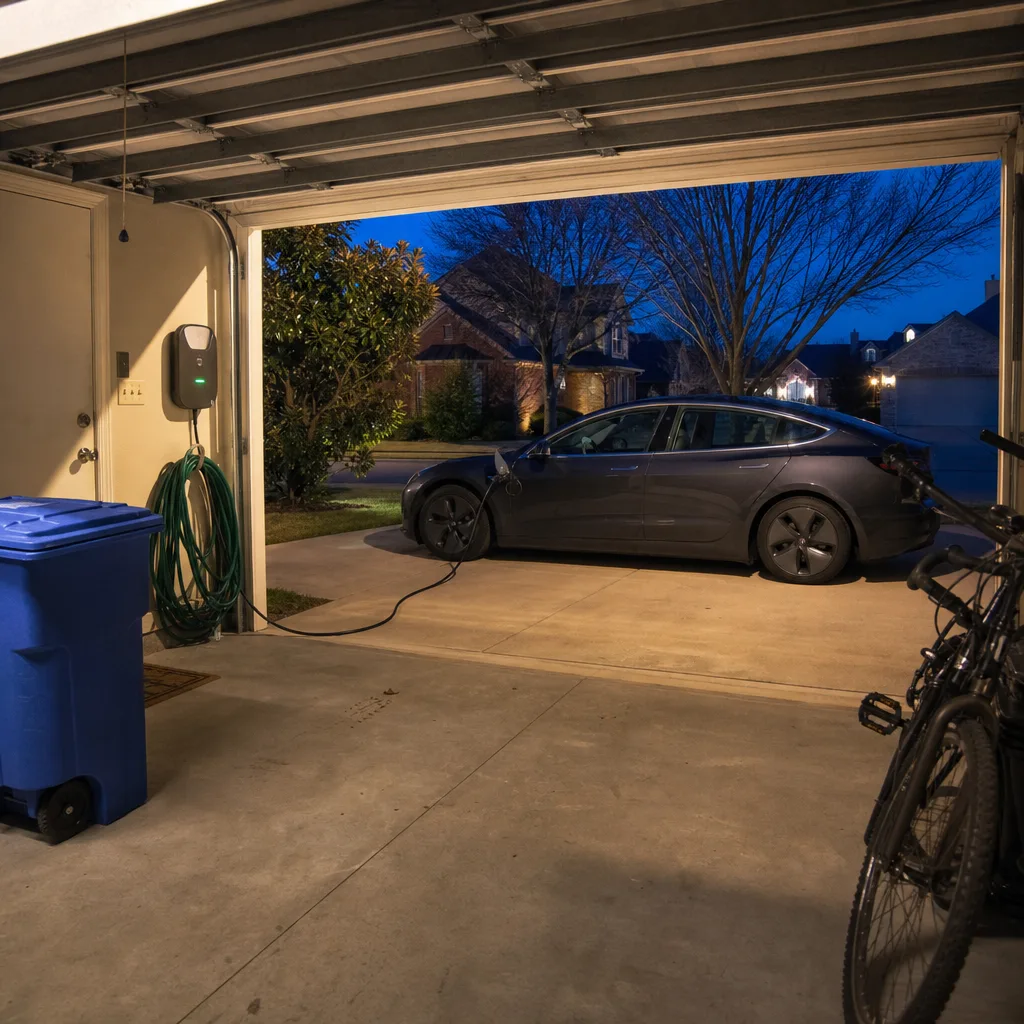
- Did you check my panel before you gave me a price? A quote given over the phone without anyone looking at your panel is a guess. Ask how they decided your panel has room, and what changes if it doesn’t.
- What size breaker and wire are you using, and what amperage will my charger run at? The breaker, the wire, and the charger setting all have to match. A good installer can explain that in one plain sentence.
- Is the charger supplied, and is it safety listed? If you’re buying your own, ask whether the installer will work with it. Either way, look for a charger tested and listed by a recognized safety lab, such as UL. Skip bargain units with no listing.
- Where will it mount, and how will the wire get there? Will the wire be hidden in the wall or run in conduit along the surface? Ask how much drywall gets opened and who patches it.
- Is this charger right for where it’s going? North Texas garages get very hot in summer. Ask whether the charger is rated for that heat. If it’s going outside on a wall or a driveway post, ask whether it’s rated for rain and the hail storms we get every spring.
- Hardwired or plug-in? Some chargers wire straight to the circuit. Others plug into a 240-volt outlet. Ask which one they recommend for your setup and why.
- What’s in the written price, and what isn’t? You want the charger, the panel work, the permit, and any trenching each listed as a separate line. Vague words like “standard install” leave room for surprises.
- Will you test it before you leave? Ask whether they’ll start it up and confirm it’s charging, so you’re not finding a problem at 10 p.m. with your car plugged in.
Listen to how they answer, not just what they say. A good installer will give you straight answers and won’t rush you. They won’t mind if you write things down. If someone gets vague about the panel or the price, or pushes you to decide on the spot, keep calling.
Here’s how we answer those questions. Our licensed and insured electrical team looks at your panel before we talk price. You’ll get upfront flat-rate pricing with each item listed, so you can see what’s included and what isn’t. Every standard install includes startup and testing, so you’ll know it works before we pack up. If your home doesn’t need a new circuit yet, we’ll tell you that too.
Call 469-217-9095
Frequently Asked Questions
Common questions about EV charger installation
How long does a home EV charger installation take?
Most Level 2 installations finish the same day. If your panel has room and the run from the panel to the garage is straightforward, the electrician can mount, wire, and test the charger in one visit. Jobs that need a panel upgrade or trenching for a detached garage take longer, since that work is scoped and scheduled separately.
Can I install my own EV charger to save money?
You shouldn’t, even though it may seem simple. A Level 2 charger needs a dedicated 240-volt circuit sized correctly for the breaker and wire, plus a permit and inspection through the City of Plano. A licensed electrician through TDLR knows how to size that circuit safely and get it signed off, which protects you if you ever sell the home or file an insurance claim.
Does North Texas heat affect EV charger installation or performance?
Yes, garage and attic temperatures in Plano summers can swing high enough to matter. A charger mounted in a hot, unventilated garage needs a listed unit rated for that heat, and the same goes for any charger mounted outside where it also faces spring hail and rain. Ask your installer whether the charger you’re buying is rated for both conditions before it goes in.
Ready to Get Started?
Call (469) 217-9095 Today, Get Service Today.