Minimum efficiency depends on your region: higher SEER2 values are required in southern and southwestern areas compared to northern regions for split systems under 45,000 Btu/h, while heat pumps have a nationwide minimum efficiency floor. Manufacturers, distributors, and installers all share responsibility for meeting these numbers, and the obligation shifts depending on whether a unit was built or installed before the compliance cutoff.
TL;DR:
- In southern and southwestern regions, split-system air conditioners under 45,000 Btu/h require a minimum of 13.4 SEER2, while northern areas have a lower threshold.
- All heat pumps nationwide must meet a minimum of 14.3 SEER2 for cooling and 7.2 HSPF2 for heating, regardless of region.
- SEER2 ratings are lower than the previous SEER due to updated testing procedures that better reflect real-world performance, especially under higher static pressure.
- Compliance depends on the manufacturing date, and non-compliant inventory cannot be installed once the deadline passes, unless recertified, which is rarely economical.
- Verifying equipment for standards and incentives requires cross-checking model numbers against AHRI, matching spec sheets to on-unit labels, and keeping documented proof for inspections and tax credits.
Table of Contents
- What Are the SEER2 Requirements for 2026?
- Why Did SEER Change to SEER2, and What Do EER2 and HSPF2 Measure?
- When Do 2026 Compliance Deadlines Apply, and Who’s on the Hook?
- How Do You Verify a Unit Meets SEER2 Requirements, and Does It Qualify for Tax Credits?
- Field Checklist: How Installers Keep Every Job Compliant
- Should You Buy the Minimum SEER2 or Pay for More?
- Get Your System Verified Before the Next Inspection
- Where to Verify SEER2 Ratings and Incentive Rules Directly
- Sources
- FAQ
What Are the SEER2 Requirements for 2026?
The country splits into three efficiency regions under the Department of Energy’s framework, and the region you’re in decides your minimum, not the calendar year alone. Split-system air conditioners under 45,000 Btu/h require region-specific minimum SEER2 values, with higher targets in southern regions. Larger split systems have corresponding EER2 minimums that vary by region based on testing protocols.
Split heat pumps carry one nationwide standard rather than a regional split: 14.3 SEER2 for cooling and 7.2 HSPF2 for heating, no matter which of the three DOE zones you’re installing in. That’s a meaningful design choice. Heating demand doesn’t track the same North/South lines that cooling demand does, so the Department of Energy (DOE) applies one floor everywhere.
In certain hot climate areas, an additional EER2 minimum complements the SEER2 requirement for larger equipment to better represent peak performance during extreme heat. If you’re quoting equipment for Arizona, Nevada, or similar territory, check both numbers, not just the SEER2 rating on the box, as FieldEdge’s regional breakdown lays out in more detail.
Why Did SEER Change to SEER2, and What Do EER2 and HSPF2 Measure?
SEER2 numbers run lower than the old SEER ratings for a comparable unit, and that’s by design, not a red flag. The DOE’s M1 test procedure increases external static pressure during testing to better simulate real ductwork resistance, resulting in lower SEER2 ratings that more accurately reflect field performance. Units previously rated at certain SEER values are rated lower under SEER2 due to revised testing procedures, despite unchanged hardware.
That gap matters when you’re comparing a pre-2023 spec sheet against a current one. A straight numeric comparison between legacy SEER and SEER2 is misleading. Treat them as related but distinct scales, and always confirm which testing standard produced the number you’re looking at.
SEER2 measures cooling efficiency across a season. EER2 measures efficiency at a single peak-demand condition, the kind of 95-degree, full-load afternoon that actually spikes your electric bill. HSPF2 does for heating what SEER2 does for cooling, averaging a heat pump’s output against the energy it consumes across a heating season. Contractors sizing equipment for Texas summers should weight EER2 more heavily than a national spec sheet might suggest, since peak-load performance is what determines whether a system keeps up during the hottest stretch of August.
When Do 2026 Compliance Deadlines Apply, and Who’s on the Hook?
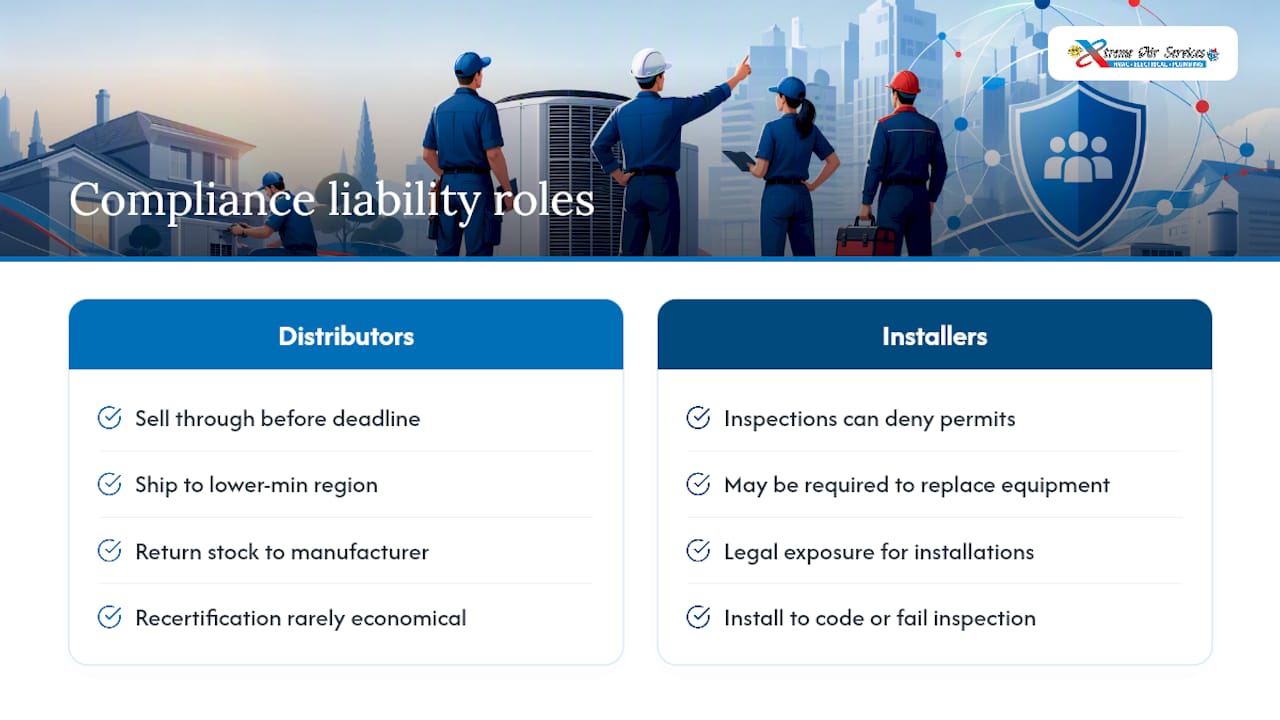
Compliance is determined by a unit’s date of manufacture rather than installation date, affecting how older inventory can be legally sold and installed. A unit built before its region’s compliance deadline can generally still be sold and installed under sell-through provisions, but once that manufacture cutoff passes, non-compliant stock can’t legally go into a new installation, regardless of when it arrived at the warehouse.
Distributors holding non-compliant inventory have three realistic paths: sell through what’s legally sellable before the deadline, ship remaining stock to a distributor in a region with a lower minimum where it still qualifies, or return it to the manufacturer. Manufacturer recertification is technically possible but rarely economical. Retesting and relabeling a unit costs more, in most cases, than simply eating the loss on old stock.
Installers bear significant liability for non-compliant equipment — inspections can deny permits and may require costly replacements at installer expense. HVACR industry guidance is blunt that installers, not just manufacturers, bear legal exposure for putting non-compliant equipment into service. Installing to code isn’t optional paperwork; it’s the difference between a passed inspection and a very expensive callback.
How Do You Verify a Unit Meets SEER2 Requirements, and Does It Qualify for Tax Credits?
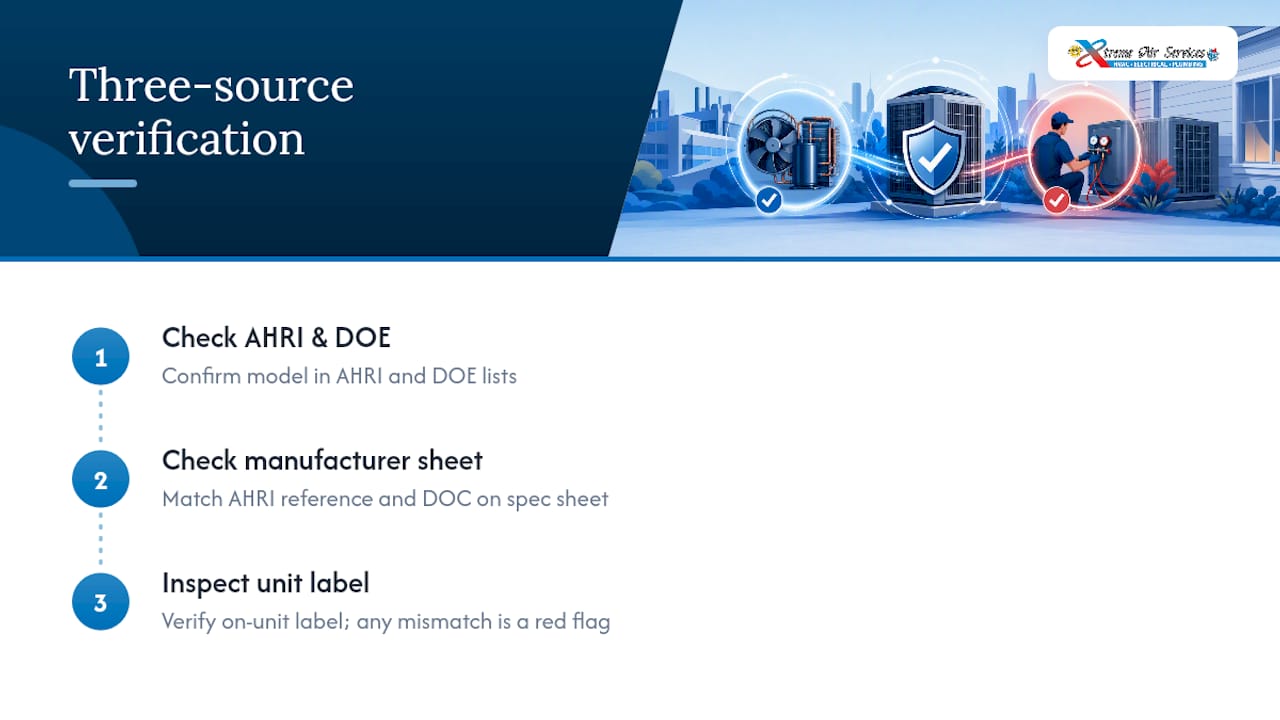
Verification takes three checks, in order. First, confirm the model number against the AHRI Directory and cross-reference it with the DOE’s Qualified Product List. Second, pull the manufacturer’s spec sheet and match the AHRI reference number and DOC (Direct-Vent Certification, where applicable) number printed on it. Third, physically inspect the on-unit label. A mismatch between any two of these three sources is a red flag worth chasing down before you close the job.
Homeowners chasing a federal tax credit need a specific paper trail: the manufacturer’s spec sheet showing SEER2 and HSPF2 ratings, the dated invoice with model and serial numbers, and, where required by local code, a Manual J load calculation showing the system was sized correctly rather than oversized to hit an efficiency number on paper. Skipping Manual J doesn’t just risk comfort problems. It can undercut an incentive claim if an auditor questions whether the installed capacity matches the home’s actual load.
Federal incentives for heat pumps under current legislation require meeting both SEER2 and HSPF2 efficiency minimums simultaneously for eligibility. Before quoting a customer on expected savings, verify current thresholds directly through IRS guidance, since credit amounts and qualifying efficiency levels get revisited periodically. A system that qualified last year isn’t guaranteed to clear the bar this year.
Field Checklist: How Installers Keep Every Job Compliant
Getting SEER2 right on paper doesn’t help if the label on the actual unit disagrees with the invoice. A short pre-installation routine catches most problems before they become a failed inspection or a denied credit claim.
- Confirm AHRI and DOC listings for the exact model before it leaves the warehouse, not after it’s already on the truck.
- Match the spec sheet’s SEER2, EER2, and HSPF2 figures against the physical label once the unit is on site.
- Tag and physically segregate any pre-2023 or otherwise non-compliant inventory so it never accidentally ships on a compliant job.
- Weigh recertification only when a manufacturer offers it directly. In most cases, returning the unit costs less than the retest.
- Hand homeowners a complete packet at job close: Manual J/S documentation, commissioning notes, the AHRI certificate, and the itemized invoice they’ll need for any incentive claim.
Pro Tip: Screenshot the DOE Qualified Product List lookup for every install, date it, and keep it in the job file alongside the invoice. If an auditor or permit office questions the equipment months later, you have dated proof it was compliant at time of purchase, not just a claim you’re making after the fact.
Should You Buy the Minimum SEER2 or Pay for More?
Jumping from a legacy 14 SEER unit to 16 SEER2 typically pays back within a handful of cooling seasons in hot, long-runtime climates, faster where incentives offset the upfront gap, according to EIA analysis on efficiency and energy use. In North Texas, where the AC runs most of the day for five months straight, that math tends to favor spending above the minimum. If your climate is milder or your system runs only a few weeks a year, the minimum-compliant unit is often the more rational buy.
Get Your System Verified Before the Next Inspection
Professional HVAC service providers handle the parts of SEER2 compliance that trip up both homeowners and other contractors: confirming a model actually clears its AHRI listing, running Manual J/S load calculations so equipment is sized correctly instead of guessed at, and handling the installation and commissioning paperwork you’ll need if you’re claiming a federal incentive.

If your current system is aging out, or you’re not sure whether a quote you received actually meets your region’s SEER2 floor, a maintenance and compliance inspection settles the question before you sign anything. We’ll check the label against the paperwork, confirm what your home actually qualifies for, and put it in writing. Homeowners weighing a full system swap can also compare the tradeoffs on our repair versus replace guide before scheduling. Book an inspection and get a straight answer on where your system stands.
Where to Verify SEER2 Ratings and Incentive Rules Directly
Check model compliance against the DOE’s efficiency standards and the AHRI Directory. Confirm current credit eligibility through IRS guidance, and review sizing standards through ACCA’s resources before finalizing any installation.
Sources
- U.S. Department of Energy (DOE)
- HVACR Business — All you need to know about 2023 HVAC regulation changes
- FieldEdge — Energy efficiency minimum SEER rating (2023)
- IRS — Federal tax guidance
FAQ
What is the minimum SEER2 rating for 2026?
Split-system air conditioners under 45,000 Btu/h need at least 13.4 SEER2 in northern states and 14.3 SEER2 across southern and southwest states, with larger units measured in EER2 instead.
What is the minimum SEER2 rating required for heat pumps in the United States?
Split heat pumps must meet 14.3 SEER2 for cooling and 7.2 HSPF2 for heating nationwide, with no regional variation the way air conditioners have.
What SEER2 rating qualifies for tax credit?
Federal incentive eligibility depends on current IRS thresholds, which typically require both SEER2 and HSPF2 minimums above the baseline compliance floor, so always confirm the current year’s specific numbers before quoting a customer.
Are 14 SEER AC units being phased out?
Legacy 14 SEER units aren’t banned outright, but new production must meet SEER2 minimums under the current testing method, and any leftover pre-2023 inventory is restricted by sell-through and regional shipping rules rather than a blanket phase-out date.