

A ductwork system is defined as the network of channels that transports conditioned air from your HVAC unit to every room in a building and back again. Think of it as the circulatory system of your home: when it works well, every space gets the right temperature at the right time. When it fails, up to 30% of conditioned air escapes before reaching living spaces. That single fact explains why ductwork quality determines whether your HVAC investment pays off or quietly drains your energy budget every month.
What is a ductwork system and why does it matter?
A ductwork system is the complete assembly of ducts, fittings, registers, and dampers that moves air between your HVAC equipment and the occupied spaces in a building. The industry term for this assembly is the “air distribution system,” though most homeowners and facility managers simply call it ductwork. Both terms refer to the same thing.
The system performs two jobs simultaneously. Supply ducts deliver conditioned air through registers into each room, while return ducts pull stale indoor air back to the HVAC unit to be filtered and reconditioned. Without both sides working together, pressure imbalances develop and rooms become either stuffy or drafty.
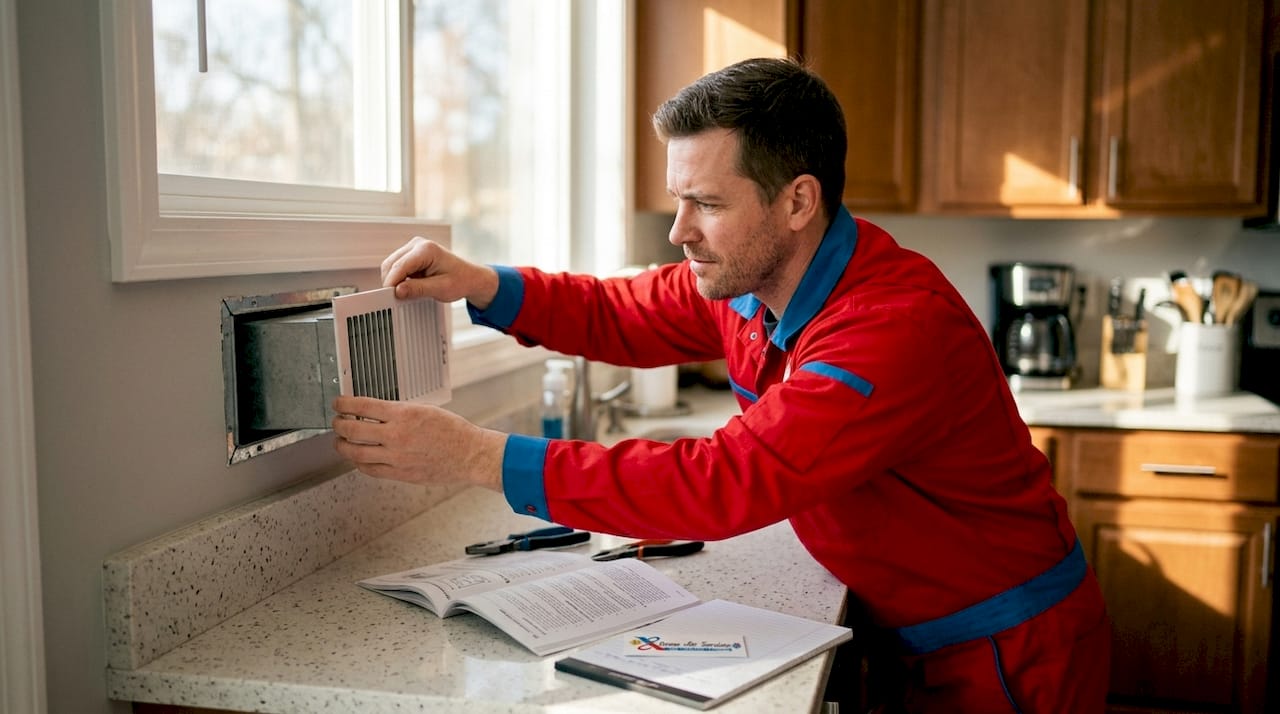
Ductwork also has a direct impact on indoor air quality. Leaky or dirty ducts pull in dust, mold spores, and outdoor pollutants from attics, crawl spaces, and wall cavities. Those contaminants then circulate through every room. Homeowners who notice persistent dust buildup or allergy symptoms often trace the problem back to compromised duct systems rather than the HVAC unit itself. You can read more about this connection in Xtreme Air Services’ guide on improving home air quality.
Even perfectly sized HVAC equipment underperforms when paired with an inefficient duct system. That means a brand-new furnace or air conditioner can still leave you uncomfortable and overpaying on utility bills if the ducts are leaky, undersized, or poorly routed.
How does a ductwork system work within a home or building?
The process starts at the air handler or furnace. The HVAC unit conditions the air, and the blower fan pushes it into the supply trunk, which is the main large duct running through the center of the system. From there, smaller branch ducts split off and carry air to individual rooms through registers or diffusers in the floor, wall, or ceiling.
Simultaneously, return air grilles in hallways and common areas pull room air back through return ducts to the air handler. The air handler filters it, heats or cools it again, and the cycle repeats. This continuous loop is what maintains a steady indoor temperature.
The most common layout in residential buildings is the trunk-and-branch system. A large central trunk runs the length of the home, with smaller branches extending to each room. Commercial buildings often use more complex layouts, including radial systems and plenum-based designs, to serve larger floor areas. The differences between residential and commercial ductwork design are significant enough that they require separate engineering approaches.
Proper airflow balancing is what separates a comfortable home from one with hot and cold spots. Key factors that affect balance include:
- Duct sizing: Undersized ducts restrict airflow and force the blower to work harder.
- Branch length: Longer runs lose more pressure, so they need larger duct diameters.
- Number of bends: Every elbow or turn reduces airflow velocity.
- Register placement: Registers positioned near windows offset heat gain and loss more effectively.
- Damper settings: Manual or motorized dampers fine-tune airflow to individual rooms.
Pressure testing, using a device called a duct blaster, measures how much air leaks from the system under controlled conditions. This test gives a precise picture of duct tightness and helps technicians locate problem areas before they become expensive failures.
What are the common types of ductwork materials and systems?
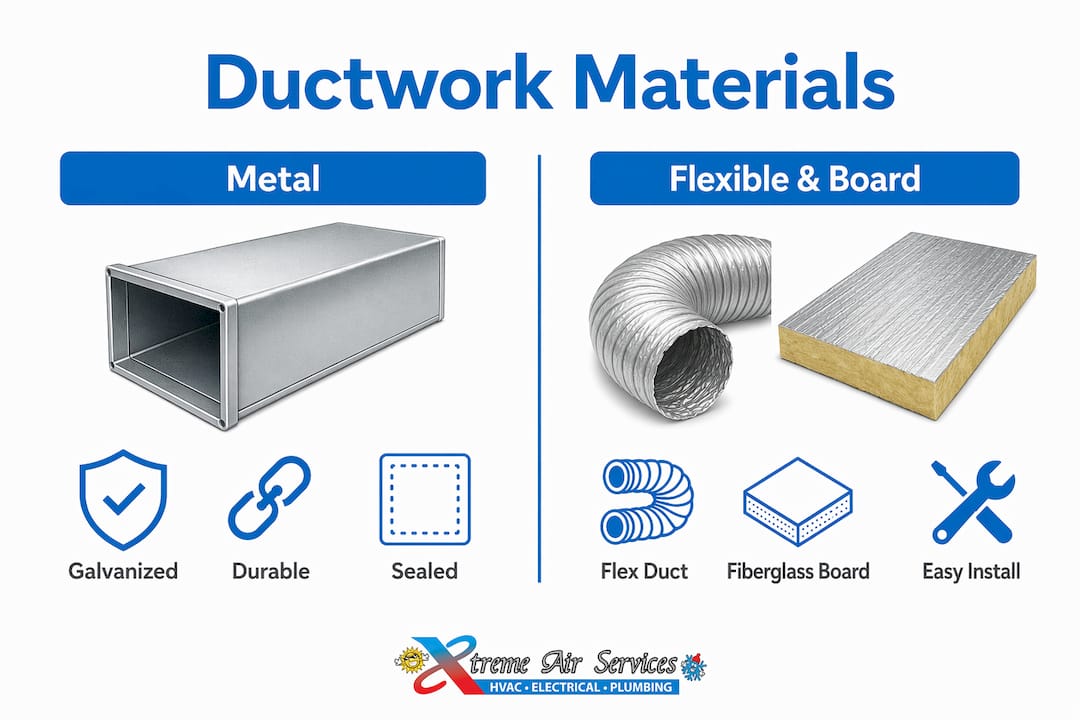
The material your ducts are made from affects durability, cost, airflow efficiency, and how long the system lasts. Each material has a specific set of applications where it performs best.
| Material | Durability | Cost | Best Use | Key Weakness |
|---|---|---|---|---|
| Galvanized sheet metal | Very high | Moderate to high | Main trunks, long runs | Requires skilled fabrication |
| Aluminum | High | Moderate | Flexible connections, exposed runs | Dents more easily than steel |
| Fiberglass duct board | Moderate | Moderate | Residential supply plenums | Fiber release if damaged |
| Flex duct | Low to moderate | Low | Short branch runs | Prone to kinking and sagging |
| Fabric (textile) duct | Moderate | Moderate to high | Commercial spaces, gyms | Requires regular cleaning |
Galvanized sheet metal is the gold standard for main trunk lines. It is airtight when properly sealed, resists mold, and lasts decades. The tradeoff is that fabrication requires skilled sheet metal workers and costs more upfront.
Flex duct is more prone to kinking and faster degradation compared to rigid metal ducts. That kinking restricts airflow and can cut a duct’s effective lifespan significantly, especially in hot attics. Flex duct works well for short final connections between a rigid trunk and a register, but using it for long runs is a common installation mistake.
Fiberglass duct board is cut and assembled on-site, which makes it faster to install in tight spaces. The inner surface provides some insulation value, but damaged sections can release fibers into the airstream. Fabric ducts are popular in commercial gyms and open-plan offices because they distribute air evenly across a large area without cold spots.
Pro Tip: If your home uses flex duct for runs longer than 6 feet, ask your HVAC technician to check for sags and kinks during the next service visit. A single sharp bend can reduce airflow by a measurable amount and force your system to run longer cycles.
What are the best practices for ductwork installation and sealing?
Installation quality determines how well a duct system performs for its entire lifespan. Poor joints, wrong materials, and skipped insulation steps create problems that compound over years.
Sealing: the right materials matter
Mastic sealant and UL 181-rated foil tape are the two industry-standard options for sealing duct joints. Standard silver duct tape, the kind sold at hardware stores, dries out and cracks within a few years. Once it fails, joints open up and conditioned air leaks into unconditioned spaces like attics and crawl spaces.
Mastic is a paste-like compound brushed onto joints and seams. It stays flexible as the duct expands and contracts with temperature changes. UL 181-rated foil tape is pressure-sensitive and designed specifically for HVAC applications. Using either of these materials correctly at every joint is the single most effective step in a ductwork installation guide.
Insulation requirements
The 2024 IECC requires R-6 to R-8 insulation on supply ducts running through unconditioned spaces. An uninsulated duct in a hot attic can lose a significant portion of its cooling capacity before the air even reaches the register. R-6 is the minimum in most climate zones, while hotter or colder regions require R-8 or higher.
Insulation wraps around the outside of the duct and must be installed without gaps or compression. Compressed insulation loses R-value quickly. This is a detail that rushed installation crews frequently skip.
Sizing and design
Proper sizing follows ACCA Manual D, the industry standard for residential duct design. Manual D uses the results of a Manual J load calculation to determine the correct duct diameter and layout for each room. Skipping this step and guessing at duct sizes is a leading cause of uneven heating and cooling.
Key installation steps that affect long-term performance:
- Seal every joint with mastic or UL 181-rated foil tape before insulating.
- Support flex duct every 4 feet to prevent sagging that restricts airflow.
- Minimize bends and keep radius turns as wide as possible.
- Insulate all ducts in unconditioned spaces to the required R-value.
- Test after installation with a duct blaster to confirm tightness before closing walls.
What does ductwork installation cost?
Residential ductwork installation costs generally range between $2,000 and $8,000, depending on home size, material choice, and accessibility. Commercial installations are a different category entirely, often exceeding $50,000 for complex buildings. Those numbers reflect why getting the design and installation right the first time matters. Redoing ductwork after walls are closed is far more expensive than doing it correctly upfront.
Pro Tip: Get a Manual J and Manual D calculation from your contractor before any new duct installation. If a contractor quotes a job without mentioning these calculations, that is a red flag.
How to maintain ductwork systems for optimal HVAC performance and air quality?
Ductwork maintenance is the most overlooked part of HVAC ownership. Most homeowners replace filters and schedule annual tune-ups, but the ducts themselves go uninspected for years.
Here is a practical maintenance sequence to follow:
- Schedule professional duct cleaning every 5–7 years. Professional cleaning at 5–7 year intervals removes accumulated dust, debris, and biological growth that degrade air quality and restrict airflow.
- Inspect accessible ducts annually. Check visible sections in basements, attics, and crawl spaces for disconnected joints, torn insulation, or visible gaps.
- Watch for warning signs. Uneven temperatures between rooms, rising energy bills, and increased dust on surfaces all point to duct problems. The Xtreme Air Services guide on HVAC repair signs covers these symptoms in detail.
- Seal leaks promptly. Small leaks grow over time as ducts expand and contract. Catching them early with mastic or UL 181-rated tape prevents larger failures.
- Replace damaged insulation. Insulation that has been compressed, torn, or saturated with moisture loses its R-value and can harbor mold.
Leaks and blockages do more than waste energy. They create negative pressure in parts of the home, which pulls air in from wherever it can find a path. That includes gaps around pipes, electrical penetrations, and foundation cracks. The result is poor indoor air quality and, in some cases, backdrafting of combustion gases from water heaters or furnaces.
Facility managers overseeing commercial properties face the same issues at a larger scale. Rooftop units, longer duct runs, and more complex zoning systems mean that a single undetected leak can affect an entire floor. Proactive inspection schedules, documented in a maintenance log, are the most reliable way to catch problems before they affect tenants or trigger equipment failures.
Pro Tip: Hold a piece of tissue near supply registers while the system runs. If the tissue barely moves, you likely have a restriction or leak somewhere in that branch run. That simple test costs nothing and takes two minutes.
Detecting hidden leaks in building systems is a skill that applies across multiple trades. The same diagnostic mindset used to detect sewer leaks early applies directly to duct systems: small, invisible failures cause the most expensive damage over time.
Key Takeaways
A properly sealed, insulated, and maintained ductwork system is the single most important factor in whether your HVAC equipment delivers comfort and efficiency or wastes energy and money.
| Point | Details |
|---|---|
| Ductwork defines HVAC performance | Leaky ducts waste up to 30% of conditioned air, regardless of equipment quality. |
| Two-part airflow system | Supply ducts deliver conditioned air; return ducts pull stale air back for reconditioning. |
| Material choice affects lifespan | Galvanized sheet metal lasts longest; flex duct works only for short final connections. |
| Seal with the right products | Use mastic sealant or UL 181-rated foil tape. Standard duct tape fails within a few years. |
| Maintain on a schedule | Professional duct cleaning every 5–7 years protects air quality and extends system life. |
What I’ve learned from years of ductwork inspections
Homeowners consistently underestimate how much their ductwork affects their comfort and utility bills. The most common scenario I see is a homeowner who has replaced their HVAC unit twice in ten years, still has rooms that never get comfortable, and has never once had their ducts inspected. The equipment was never the problem.
The second thing I’ve noticed is that people trust silver duct tape because it looks industrial and official. It is not. I have pulled apart duct connections sealed with standard tape that were installed fifteen years ago, and the tape crumbles in your hand. Meanwhile, a properly mastic-sealed joint from the same era is still airtight. That difference in materials is the difference between a system that works and one that silently wastes money every single day.
My honest advice: before you spend money on a new thermostat, a smart HVAC system, or any other upgrade, pay for a duct inspection and a blower door test. Those two tests will tell you more about your home’s energy performance than any equipment specification sheet. If your ducts are leaking, fix them first. Everything else is secondary.
Facility managers should treat duct inspection as a line item in the annual maintenance budget, not an optional add-on. A single floor with leaking ducts can add meaningfully to a building’s energy costs over a year. The return on a professional inspection and sealing job is almost always faster than people expect.
— Xtreme
Xtreme Air Services is ready to help with your ductwork
Ductwork problems rarely announce themselves loudly. They show up as higher utility bills, rooms that never reach the right temperature, and air that feels stale no matter how often you change the filter.

Xtreme Air Services provides professional duct inspection, sealing, and cleaning services for both residential and commercial properties. The team uses pressure testing to locate leaks precisely, applies industry-standard mastic and UL 181-rated tape, and installs insulation to current code requirements. For ongoing protection, HVAC maintenance plans include scheduled duct checks that catch small problems before they become expensive repairs. If your home or facility has not had a duct inspection in the last five years, now is the right time to schedule one.
FAQ
What is a ductwork system in simple terms?
A ductwork system is the network of channels that carries heated or cooled air from your HVAC unit to each room and returns stale air back for reconditioning. It is the delivery system that makes your heating and cooling equipment actually work.
How much does ductwork installation cost?
Residential ductwork installation typically costs between $2,000 and $8,000, while commercial projects can exceed $50,000 depending on building size and system complexity.
How often should ductwork be cleaned?
Professional duct cleaning should be performed every 5–7 years to maintain air quality and system efficiency, though homes with pets, heavy dust, or recent renovations may need more frequent service.
Why is standard duct tape not recommended for sealing ducts?
Standard silver duct tape dries out and cracks over time, causing sealed joints to open up and leak conditioned air. Mastic sealant and UL 181-rated foil tape are the industry-approved alternatives that maintain an airtight seal long-term.
What are the signs that my ductwork needs repair?
Uneven temperatures between rooms, unexplained increases in energy bills, and excessive dust on surfaces are the most common indicators that your duct system has leaks, blockages, or insulation failures that need professional attention.