

What are the main types of commercial plumbing fixtures?
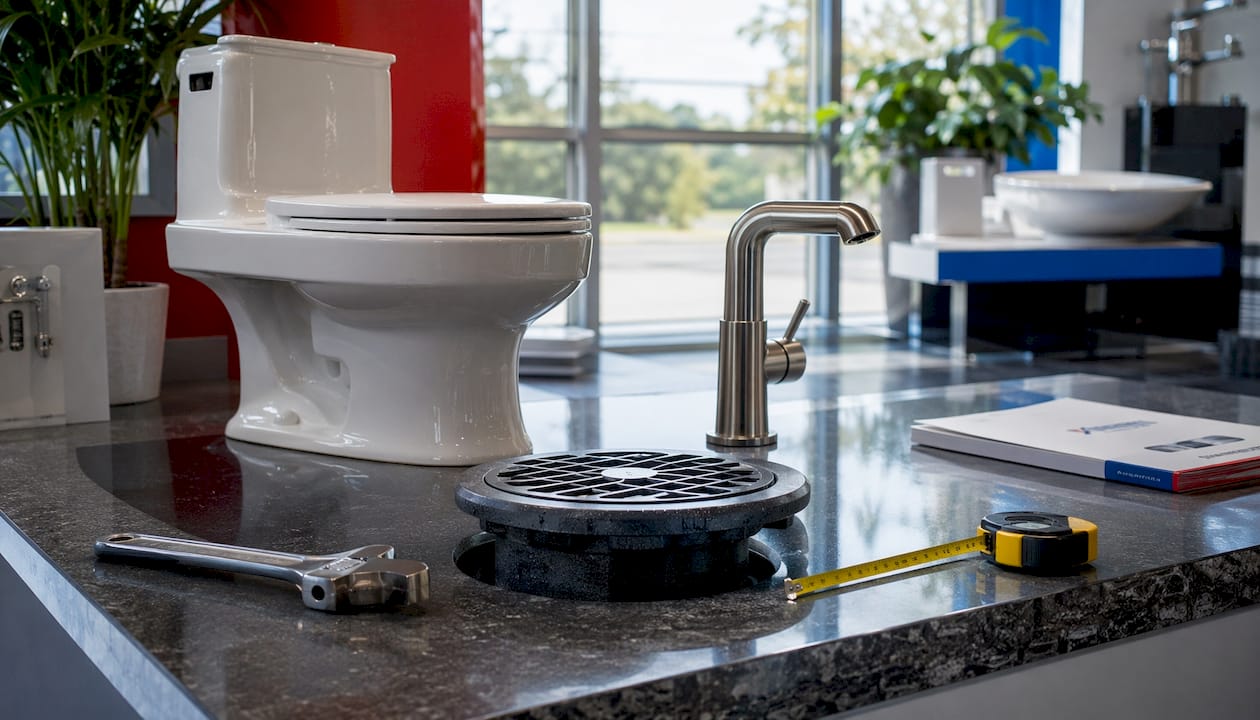
Commercial plumbing fixtures fall into five core categories: toilets, faucets, sinks, urinals, and specialty fixtures such as mop sinks, emergency eyewash stations, and floor drains. Each category serves a distinct function in high-traffic environments where durability, hygiene, and code compliance are non-negotiable.
Here is a quick reference for what each category covers:
- Toilets: Wall-hung and floor-mounted water closets, flushometer-valve models rated for continuous heavy use
- Faucets: Manual, sensor-activated, and hybrid-power units designed for hundreds of daily activations
- Sinks: Multi-compartment warewashing sinks, dedicated handwashing sinks, prep sinks, and mop sinks
- Urinals: Wall-hung and waterless models with integrated flush valves or sensor controls
- Specialty fixtures: Floor drains, emergency eyewash stations, utility sinks, and grease interceptors
Most commercial fixtures are built from 304 or 316 stainless steel, vitreous china, or cast iron with acid-resistant enamel. Polished chrome and brushed nickel finishes dominate restroom applications because they resist fingerprints and tolerate commercial-grade cleaning agents. The International Plumbing Code (IPC) governs minimum fixture counts and performance standards across most U.S. jurisdictions, so every selection decision starts there.
Table of Contents
- How each commercial fixture type works and what sets them apart
- How commercial fixtures differ from residential ones
- How to choose plumbing fixtures for a commercial building
- What plumbing systems are common in commercial buildings?
- Why qualified commercial plumbing professionals matter
- Modern fixture technologies worth knowing about
- Xtremeairservices handles commercial plumbing so you don’t have to
- Key Takeaways
- FAQ
How each commercial fixture type works and what sets them apart
Toilets
Commercial toilets use flushometer valves rather than tank-fill mechanisms. A flushometer delivers a metered, high-pressure flush directly from the supply line, then resets in seconds. That cycle time matters in a busy office building or stadium where a tank-style toilet would create a queue. Wall-hung models are the preferred spec in new commercial construction because the concealed carrier allows the bowl height to be set for ADA compliance and simplifies floor cleaning underneath.
Faucets
Commercial faucets split into three functional types based on activation method and power source:
- Manual faucets: Single or dual-handle, wrist-blade, or metering designs; wrist-blade handles are common in healthcare because staff can operate them with forearms
- Sensor-activated faucets: Infrared proximity sensors trigger flow without contact, reducing cross-contamination
- Hybrid-power faucets: Combine AC hardwiring with battery backup, supporting 500+ daily activations in airports, hospitals, and transit hubs
Metering faucets, which shut off automatically after a preset flow duration, are worth specifying in public restrooms where water waste is a concern.
Sinks
Commercial kitchen sinks are categorized by function: three-compartment warewashing sinks (the health-code standard for manual dishwashing), dedicated handwashing sinks, prep sinks, and floor-mounted mop sinks. Three-compartment sinks are the industry baseline in food service because health codes require separate wash, rinse, and sanitize stations.
Restroom sinks in commercial buildings run from single-bowl wall-hung units to multi-user wash fountains. Undermount and drop-in configurations suit countertop installations in office restrooms, while wall-hung models work well in high-traffic public facilities.
Urinals
Wall-hung urinals dominate commercial restrooms because they simplify floor cleaning and allow ADA-compliant height adjustment. Waterless urinals use a liquid-seal cartridge to block sewer gas without any flush water, cutting water consumption to zero per use. Sensor-flush urinals split the difference: they use water but eliminate manual contact with the flush valve.
Specialty fixtures
Floor drains, grease interceptors, emergency eyewash stations, and utility mop sinks round out the commercial fixture picture. Emergency eyewash stations are mandatory under OSHA 29 CFR 1910.151 in facilities handling hazardous chemicals. Grease interceptors are required by most municipal codes in food service operations to prevent fats, oils, and grease from entering the sewer system.
Fixture type comparison
| Fixture Type | Typical Material | Key Durability Factor | Maintenance Note |
|---|---|---|---|
| Flushometer toilet | Vitreous china / stainless valve | Valve rated for 500,000+ cycles | Rebuild valve diaphragm annually |
| Sensor faucet | Chrome-plated brass body | Hybrid power for 500+ daily uses | Replace sensor module; check battery backup |
| three-compartment sink | 16-gauge stainless steel | Gauge thickness resists denting | Inspect drain baskets and leg levelers |
| Wall-hung urinal | Vitreous china | Concealed carrier supports weight | Clean trap seal cartridge quarterly |
| Mop sink | 12-gauge stainless or molded stone | Heavy-gauge floor resists impact | Check drain strainer weekly |
| Emergency eyewash | Stainless steel / ABS plastic | Corrosion-resistant materials | Activate and flush weekly per ANSI standards |
How commercial fixtures differ from residential ones
The gap between commercial and residential plumbing fixtures is wider than most people expect. It is not just about size.
- Construction weight and material grade: Commercial toilets use heavier vitreous china with thicker walls; commercial faucet bodies are solid brass rather than zinc alloy
- Usage cycle ratings: A residential faucet might be tested to 50,000 cycles; a commercial unit is rated for 500,000 or more
- Flush valve design: Residential toilets use gravity-tank mechanisms; commercial models use flushometer valves that reset in under 10 seconds
- Code compliance scope: Commercial fixtures must meet IPC or UPC fixture-count tables, ADA Standards for Accessible Design, and often ASHRAE 90.1 water-efficiency targets; residential codes are far less prescriptive
- Parts ecosystem: Commercial fixtures from established manufacturers carry deep parts catalogs; a residential fixture discontinued after three years may leave you hunting for a cartridge that no longer exists
The difference between commercial and residential building systems extends well beyond plumbing. Facility managers who have only managed residential properties often underestimate how quickly a single failed commercial fixture affects dozens of users and triggers a code inspection.
How to choose plumbing fixtures for a commercial building
Selecting the right fixtures comes down to four factors: total cost of ownership, water efficiency, code compliance, and maintenance accessibility.
Total cost of ownership
Purchase price is the smallest part of the equation. Labor to service a fixture, downtime during repairs, and part availability over a 10–15 year lifecycle matter far more. Experts warn that proprietary fixtures with hard-to-source parts create maintenance backlogs in high-use public restrooms. Standardizing on a single manufacturer’s platform across a facility cuts parts inventory and training time.
Water efficiency
EPA WaterSense-certified fixtures meet performance standards at least 20% more water-efficient than the federal baseline. For toilets, that means 1.28 gallons per flush or less. For faucets, 0.5 gallons per minute in public restrooms. Many states and municipalities offer rebates for WaterSense fixtures in commercial applications, so the payback period on higher-efficiency models is often shorter than the sticker price suggests.
ADA and code compliance
Sensor-activated fixtures improve hygiene and ADA accessibility simultaneously. Touchless faucets eliminate the need to grip or twist, which directly serves users with limited hand mobility. ADA requires water closets to be mounted with the seat between 17 and 19 inches from the finished floor, grab bars at specified heights, and clear floor space for wheelchair approach. Getting these dimensions wrong on a new build triggers costly retrofits. For a deeper look at plumbing code requirements, the IPC Chapter 4 is the authoritative starting point.
Fixture counts
IPC jurisdictions generally require more female water closets than UPC for the same occupancy load. Undercounting fixtures leads to failed inspections and expensive retrofits after walls are closed. Run fixture counts against both the applicable code and the actual occupancy load before finalizing a specification.
Pro Tip: Avoid specifying fixtures with proprietary cartridges or sensor modules that are only available through the original manufacturer. When that product line is discontinued, you are looking at full fixture replacement rather than a simple part swap.
What plumbing systems are common in commercial buildings?
Commercial buildings use one of four primary distribution and drainage configurations, and the system type directly shapes which fixtures you can specify and where.
- Two-pipe system: Separate supply and drainage stacks for hot and cold water; the most common configuration in mid-rise and high-rise commercial construction; supports the widest range of fixture types and locations
- One-pipe system: A single pipe handles both supply and return; less common in the U.S. but found in older institutional buildings; limits fixture placement flexibility
- Single-stack system: Combines soil, waste, and vent functions in one vertical stack; used in some European-influenced designs and compact commercial builds; requires careful fixture grouping to maintain trap seal integrity
- Single-stack with partial ventilation: Adds air admittance valves or partial vent branches to a single-stack layout; a practical compromise for mid-rise buildings where full vent stacks would consume significant floor space
The system you are working with determines fixture grouping, drain sizing, and vent requirements. A multi-story building’s plumbing layout adds pressure zone management to the equation, since fixtures above the seventh or eighth floor typically require pressure-reducing valves to stay within the operating range that commercial faucets and flush valves are rated for.
Fixture counts must comply with jurisdictional plumbing codes; underestimating leads to failed inspections and costly retrofits after construction is complete.
Why qualified commercial plumbing professionals matter
Commercial plumbing is not a category where cutting corners on labor pays off. The consequences of improper installation show up fast and expensively.
- Code navigation: A licensed commercial plumber reads IPC or UPC fixture-count tables, interprets ADA dimensional requirements, and coordinates with the authority having jurisdiction (AHJ) on inspections. An unqualified installer typically does none of that.
- Structural considerations: Wall-mounted fixtures require reinforced wall backing to support continuous commercial use. Missing that backing causes fixture failure and potential wall damage within months.
- System integration: Commercial fixtures connect to larger supply, drainage, and vent systems with specific pressure and flow requirements. A sensor faucet installed on a supply line with inadequate pressure will never activate reliably.
- Liability and warranty: Most commercial fixture manufacturers void warranties when installation is not performed by a licensed plumber. Beyond warranty, improper installation that causes water damage in a commercial building creates significant liability exposure.
- Ongoing maintenance: Preventive maintenance schedules for commercial plumbing, similar to commercial HVAC preventive maintenance, extend fixture life and catch problems before they become shutdowns.
The short version: a licensed commercial plumber pays for itself in avoided rework, passed inspections, and fixtures that actually last their rated lifecycle.
Modern fixture technologies worth knowing about
The technology gap between a fixture installed in 2010 and one specified today is significant, particularly in sensor systems and materials.
Hybrid power and high-cycle faucets
Battery-only sensor faucets work fine under 100 activations per day. Push past 250 daily cycles and battery drain becomes a maintenance burden. AC plus battery hybrid systems from manufacturers like Moen M-Power and Sloan Optima handle 500+ daily cycles without reliability issues, making them the correct spec for airports, hospitals, and high-traffic transit facilities.
Stainless steel gauge in commercial sinks
Lower gauge numbers mean thicker steel. A 16-gauge sink withstands the daily punishment of a commercial kitchen far better than an 18-gauge unit. Thinner steel in industrial sinks fails faster under heavy use, driving up long-term replacement costs despite the lower upfront price. For mop sinks and utility applications, 12-gauge or molded stone resin are the practical choices.
Touchscreen and hygienic innovations
Some manufacturers now offer faucets with touchscreen temperature controls on the spout body, eliminating the handle entirely. Antimicrobial surface coatings, particularly silver-ion treatments on sensor housings, reduce bacterial growth between cleaning cycles. These features matter most in healthcare and food-processing environments where surface contamination is a documented risk.
Pro Tip: Sensor faucets reduce cross-contamination, but they require more frequent electronic maintenance than manual units. Before specifying touchless fixtures throughout a facility, confirm that your maintenance team has the diagnostic tools and training to service the sensor modules.
Xtremeairservices handles commercial plumbing so you don’t have to
Specifying the right fixtures is half the job. Getting them installed correctly, maintained on schedule, and kept in code compliance is the other half. That is where most facility managers and contractors hit a wall.
Xtremeairservices provides full-service plumbing for commercial properties, from fixture specification and installation through ongoing maintenance. The team works across HVAC, electrical, and plumbing, which means a single point of contact for the building systems that interact most. No chasing three separate contractors when a sensor faucet’s power supply ties into the electrical panel. For facility managers who need plumbing code compliance handled correctly the first time, Xtremeairservices brings licensed expertise and a parts-stocked service fleet. Get in touch with Xtremeairservices to schedule a commercial plumbing assessment for your property.
Key Takeaways
Choosing the right commercial plumbing fixtures requires matching fixture type, material grade, and power system to your building’s occupancy load, applicable code, and long-term maintenance capacity.
| Point | Details |
|---|---|
| Fixture categories | Toilets, faucets, sinks, urinals, and specialty fixtures each serve distinct functions in commercial settings. |
| High-cycle power | Hybrid AC plus battery faucets support 500+ daily activations, suitable for airports and hospitals. |
| Code compliance | IPC jurisdictions require more female water closets than UPC for the same occupancy load. |
| Material grade | Lower-gauge stainless steel (16-gauge or thicker) resists denting and reduces long-term replacement costs. |
| Xtremeairservices | Provides licensed commercial plumbing installation and maintenance, covering fixture selection through code-compliant service. |
FAQ
What are the different types of plumbing fixtures?
Commercial plumbing fixtures include toilets, faucets, sinks, urinals, and specialty fixtures such as floor drains, mop sinks, and emergency eyewash stations. Each type is rated for specific usage cycles and must meet applicable IPC or UPC standards.
What are the 4 types of faucets used in commercial settings?
The four main faucet types are manual (single or dual-handle), metering (auto-shutoff after a preset flow), sensor-activated (infrared proximity), and hybrid-power (AC hardwired with battery backup). Hybrid models handle 500+ daily activations, making them the right choice for high-traffic facilities.
What types of plumbing are common in commercial jobs?
Commercial buildings most commonly use two-pipe systems with separate supply and drainage stacks, though single-stack and single-stack with partial ventilation configurations appear in compact or older institutional buildings. System type determines fixture placement, drain sizing, and vent requirements.
What are the 4 types of plumbing systems?
The four systems are two-pipe, one-pipe, single-stack, and single-stack with partial ventilation. Two-pipe is the U.S. standard for new commercial construction because it supports the widest range of fixture types and locations.
How do I choose the right commercial plumbing fixtures?
Prioritize total cost of ownership, WaterSense water-efficiency certification, ADA compliance, and parts availability over initial price. Avoid proprietary fixtures with hard-to-source components, and run fixture counts against the applicable IPC or UPC tables before finalizing any specification.