

A commercial backflow preventer is a testable plumbing assembly that physically stops contaminated water from reversing direction and entering a building’s potable supply. Every commercial property with a cross-connection between its plumbing and a non-potable source is required to have one. Without it, chemicals, sewage, or industrial fluids can flow backward into the same pipes that supply drinking water, sinks, and ice machines.
The bottom line: backflow prevention assemblies are not optional on commercial sites, and installation alone does not satisfy compliance. Most jurisdictions require annual testing by a certified technician and documented reporting to the local water authority.
Here is what you should do right now:
- Identify every cross-connection on your property (irrigation, fire suppression, boilers, cooling towers, lab lines).
- Confirm a compliant backflow assembly is installed at each connection point.
- Schedule testing with a certified cross-connection control technician before your utility’s deadline.
Table of Contents
- How does backflow actually happen in a commercial building?
- What types of backflow preventers are used in commercial settings?
- Where are commercial backflow preventers typically installed?
- What are the U.S. compliance and testing requirements?
- What do inspectors check, and what are the signs of a failing device?
- How much does a commercial backflow preventer installation cost?
- How do you visually identify a commercial backflow preventer on-site?
- Why backflow prevention is a public-health responsibility, not just a checkbox
- Key Takeaways
- The part most property managers get wrong
- Xtreme Air Services can handle your commercial backflow needs
- Useful sources for verifying local rules and finding certified testers
- FAQ
How does backflow actually happen in a commercial building?
Two hydraulic conditions cause backflow, and both are common in commercial systems.
Backpressure occurs when downstream pressure exceeds the supply pressure. A boiler system, a pressurized chemical feed line, or a pump on an irrigation system can all push water backward against the normal flow direction. Backsiphonage is the opposite mechanism: a sudden drop in supply pressure, caused by a main break or heavy upstream demand, creates a siphon effect that pulls water backward from the building’s connected systems.
Inside a backflow preventer, one or two spring-loaded check valves act as one-way gates. When water flows in the correct direction, the valves open. The moment pressure tries to reverse, the springs force the valves shut. A reduced-pressure assembly adds a relief valve between the two checks; if either check leaks, the relief valve opens and discharges water rather than allowing contamination to pass through.
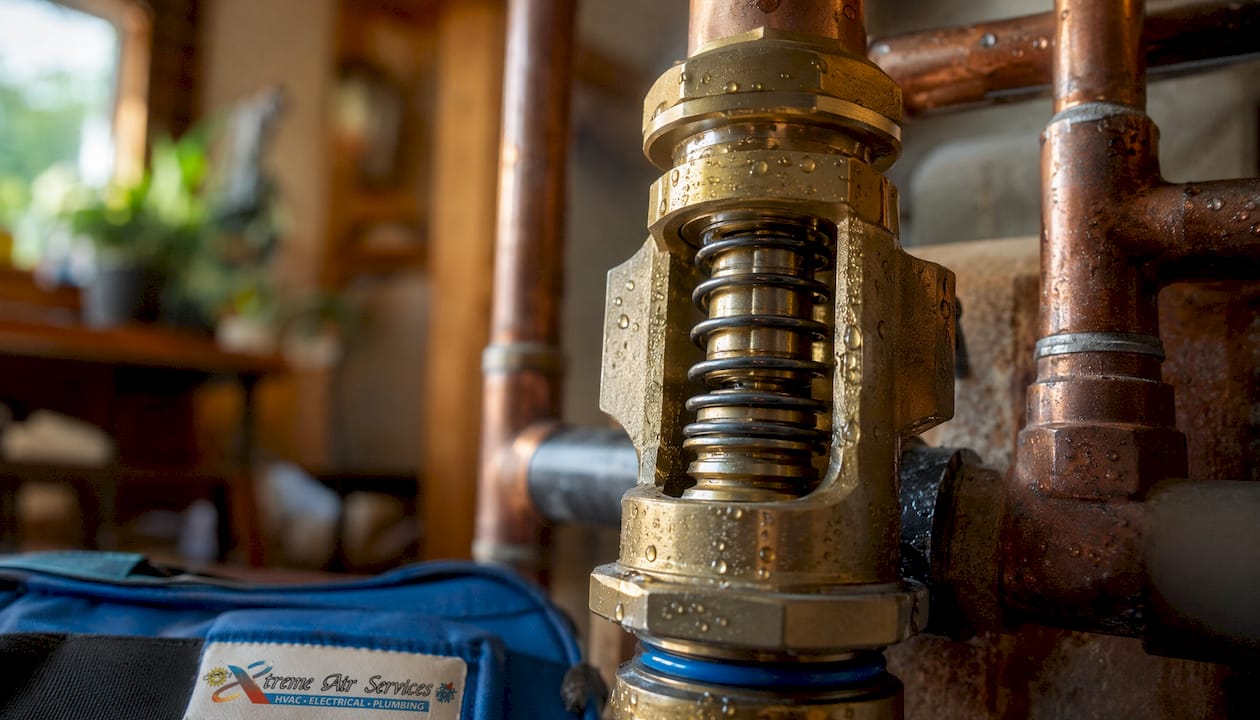
An air gap is the simplest backflow prevention method: a physical break between the water supply outlet and the flood rim of a receiving vessel. No mechanical parts, no maintenance, but it also cannot be used under continuous pressure.
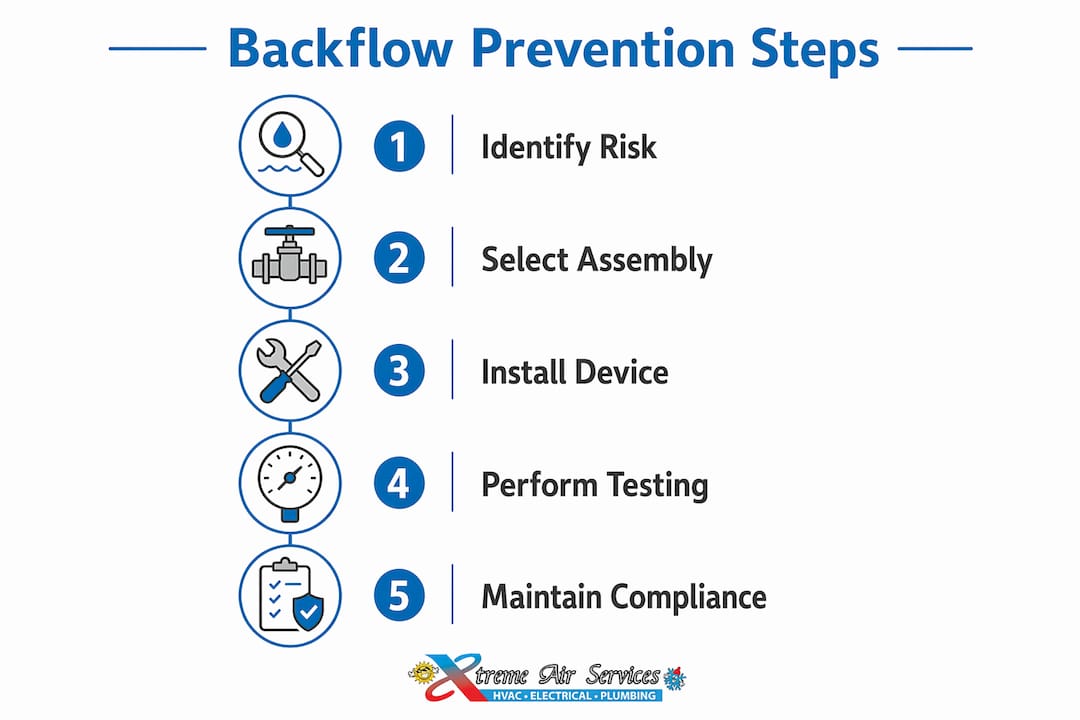
Pro Tip: The most common sources of backpressure in commercial buildings are boiler feed pumps, chemical injection systems, and rooftop cooling towers. If your facility has any of these, assume a high-hazard cross-connection exists until a licensed plumber confirms otherwise.
What types of backflow preventers are used in commercial settings?
The device required at any given connection depends on the hazard level and whether the system needs to stay under continuous pressure. Here is how the main assemblies compare:
| Assembly Type | Hazard Level | Continuous Pressure | Testable | Typical Use Case |
|---|---|---|---|---|
| Reduced Pressure Zone (RPZ) | High health hazard | Yes | Yes | Irrigation, boilers, chemical lines, labs |
| Double Check Valve Assembly (DCVA) | Non-health hazard | Yes | Yes | Fire suppression, HVAC, general commercial |
| Pressure Vacuum Breaker (PVB) | High health hazard | Intermittent only | Yes | Irrigation (above grade, seasonal) |
| Atmospheric Vacuum Breaker (AVB) | High health hazard | No | No | Hose bibs, individual fixture protection |
| Air Gap | High health hazard | No | No | Sinks, lab drain connections, tank inlets |
Reduced Pressure Zone (RPZ) assembly is the workhorse of commercial high-hazard protection. It contains two independently operating check valves and a differential pressure relief valve between them. If either check fails, the relief valve opens and discharges water to atmosphere rather than letting contaminated water pass. The RPZ assembly is the most specified device for potable water protection at high-hazard connections.
Double Check Valve Assembly (DCVA) uses two check valves in series but no relief valve. It is rated for non-health hazard applications, which is why it is widely used on fire sprinkler connections where the water is treated but not considered a direct health threat. Both checks must be independently testable.
Pressure Vacuum Breaker (PVB) protects against backsiphonage only, not backpressure. It must be installed at least 12 inches above the highest downstream outlet and cannot remain under continuous pressure. Most jurisdictions allow it for seasonal irrigation above grade.
Atmospheric Vacuum Breaker (AVB) is the simplest mechanical device, used on individual hose connections and low-risk fixtures. It cannot be tested in the traditional sense and offers no protection against backpressure.
When to specify each type:
- RPZ: anywhere the downstream fluid poses a direct health risk (chemicals, fertilizers, boiler treatment compounds, lab reagents).
- DCVA: fire suppression tie-ins, HVAC makeup water, general commercial connections with low contamination risk.
- PVB: above-grade seasonal irrigation where backpressure is not a concern.
- AVB: individual hose bibs, laundry connections, single-fixture protection.
- Air gap: tank inlets, lab sinks, any location where continuous pressure is not required.
Before purchasing, verify the assembly carries NSF/ANSI, ASSE, or AWWA certifications listed on the manufacturer’s specification sheet. Code compliance depends on it.
Where are commercial backflow preventers typically installed?
Backflow protection is required wherever a commercial plumbing system connects to a non-potable source or a system that could introduce contamination. During a site walk, these are the locations to check first:
- Irrigation systems: Fertilizers, pesticides, and soil bacteria make landscape irrigation one of the highest-hazard cross-connections on any commercial property. An RPZ or PVB is typically required at the meter connection.
- Fire sprinkler tie-ins: The water in a fire suppression system sits stagnant for long periods and is often treated with corrosion inhibitors. A DCVA is the standard protection at the fire suppression connection.
An RPZ may be required if antifreeze or other additives are present. - Cooling towers and rooftop HVAC: Cooling tower water carries Legionella risk and high concentrations of treatment chemicals. An RPZ is almost always specified at the makeup water connection.
- Boilers and hydronic heating systems: Boiler water contains oxygen scavengers and pH-adjustment chemicals. Any boiler feed connection to the potable supply requires a high-hazard assembly.
- Laboratories and medical facilities: Chemical reagents, biological agents, and process water create extreme contamination risk. RPZ assemblies are standard, and some jurisdictions require air gaps at the most critical points.
- Commercial kitchens: Dishwashers, pre-rinse spray valves, and carbonated beverage lines all create cross-connection risk. Atmospheric vacuum breakers or dedicated check valves are required at most fixture connections.
- Manufacturing and process lines: Any point where process water, cleaning chemicals, or industrial fluids connect to the potable supply needs a device rated for the specific contaminant.
During a site walk, look for any hose bib, threaded connection, or submerged inlet where a non-potable fluid could contact the water supply. Understanding cross-connection risks at each of these points is the first step toward a complete protection plan.
What are the U.S. compliance and testing requirements?
The federal framework comes from the Safe Drinking Water Act, which directs the EPA to set standards for cross-connection control. In practice, local water utilities and state plumbing codes carry out enforcement through cross-connection control programs. The federal law sets the floor; your local utility sets the actual deadlines and procedures.
Standard requirements across most U.S. jurisdictions:
- Testing at installation: Every new assembly must be tested before the system goes into service.
- Testing after repair or relocation: Any time an assembly is rebuilt, replaced, or moved, a new test is required before the connection is restored.
- Annual testing at minimum: Most commercial properties must have assemblies tested at least once per year. High-hazard sites may face more frequent requirements.
- Certified testers only: Testing must be performed by a technician certified in cross-connection control. Some jurisdictions also require that installation and repair be performed under a licensed master plumber.
- Mandatory reporting: After testing, the certified tester must submit results to the local water authority. Many utilities require electronic submission of test reports within a set window after test completion.
Consequences of noncompliance are real. Utilities prioritize commercial sites with the highest hazard potential, which means enforcement is faster and less forgiving than on residential properties. Penalties range from written notices and fines to water service restrictions and shutoffs. Missing a reporting deadline can trigger automatic fines even when the assembly itself passed the test.
Compliance is ongoing. Submitting a test report late, even by a few days, can result in fines at some utilities. Keep the submission date on your maintenance calendar, not just the test date.
What do inspectors check, and what are the signs of a failing device?
A certified tester arrives with a differential pressure gauge kit and works through a standard procedure for each assembly type.
- Isolate the assembly by closing the downstream shutoff valve.
- Attach test gauges to the test cocks on the assembly body.
- Check the first check valve by measuring the pressure differential across it. A passing first check holds a minimum differential (typically 5 psi or more, depending on the assembly type and local standard).
- Check the second check valve using the same differential pressure method.
- Test the relief valve (RPZ only) by slowly opening the test cock between the two checks and verifying the relief valve opens at the correct differential.
- Record results on the official test form, attach a new tag to the assembly, and submit the report to the utility.
Routine maintenance beyond the annual test includes cleaning debris from test cocks, inspecting shutoff valve handles for corrosion or damage, and checking the relief valve discharge port for blockages. Some assemblies require a rebuild every five years or when they fail a test; manufacturers and local codes specify the interval.
Signs that something is wrong:
- Discolored or foul-smelling water at fixtures downstream of the assembly.
- Unexplained pressure drops in the potable supply.
- Water discharging continuously from the relief valve port (a sign the first check has failed).
- A failed annual test result.
- A missing or expired inspection tag.
Pro Tip: If you see water dripping or flowing steadily from the relief valve discharge port on an RPZ, do not ignore it. That is the assembly doing its job, but it also means a check valve has failed and the device needs immediate repair before the relief valve itself wears out.
Adding backflow testing to your plumbing maintenance checklist is the simplest way to avoid missed deadlines.
How much does a commercial backflow preventer installation cost?
Cost varies more than most property managers expect, and the device itself is often the smaller part of the total bill.
Key factors that drive price:
- Device type and size: A 3/4-inch DCVA for a small irrigation connection costs far less than a 2-inch RPZ for a cooling tower makeup line. Larger assemblies with more complex internals carry higher material costs.
- Above-ground vs. below-grade installation: Underground vaults require excavation, concrete work, and often a separate permit. Above-ground installations in a mechanical room are significantly less expensive.
- Permit and inspection fees: Most jurisdictions require a plumbing permit for new installations. Fees vary by municipality.
- Site access and retrofit complexity: Installing a device in an existing mechanical room with limited clearance, or retrofitting a connection that was never designed for a backflow assembly, adds labor hours.
- Annual testing and rebuild costs: Budget for annual certified testing on top of the installation cost. Assemblies that fail a test may need a rebuild, which adds parts and labor.
Residential installations in some regions run $1,000–$1,500. Commercial assemblies and complex installs often exceed $2,000, and large-diameter devices on high-hazard connections can run considerably higher. Get itemized quotes that separate device cost, labor, permit fees, and testing.
A typical installation timeline runs from permit application through final test and report submission. Simple above-ground installations can be completed in a day once the permit is issued. Underground or retrofit work may take several days, plus the permit processing window, which varies by jurisdiction.
How do you visually identify a commercial backflow preventer on-site?
Most commercial assemblies are immediately recognizable once you know what to look for. They are not subtle.
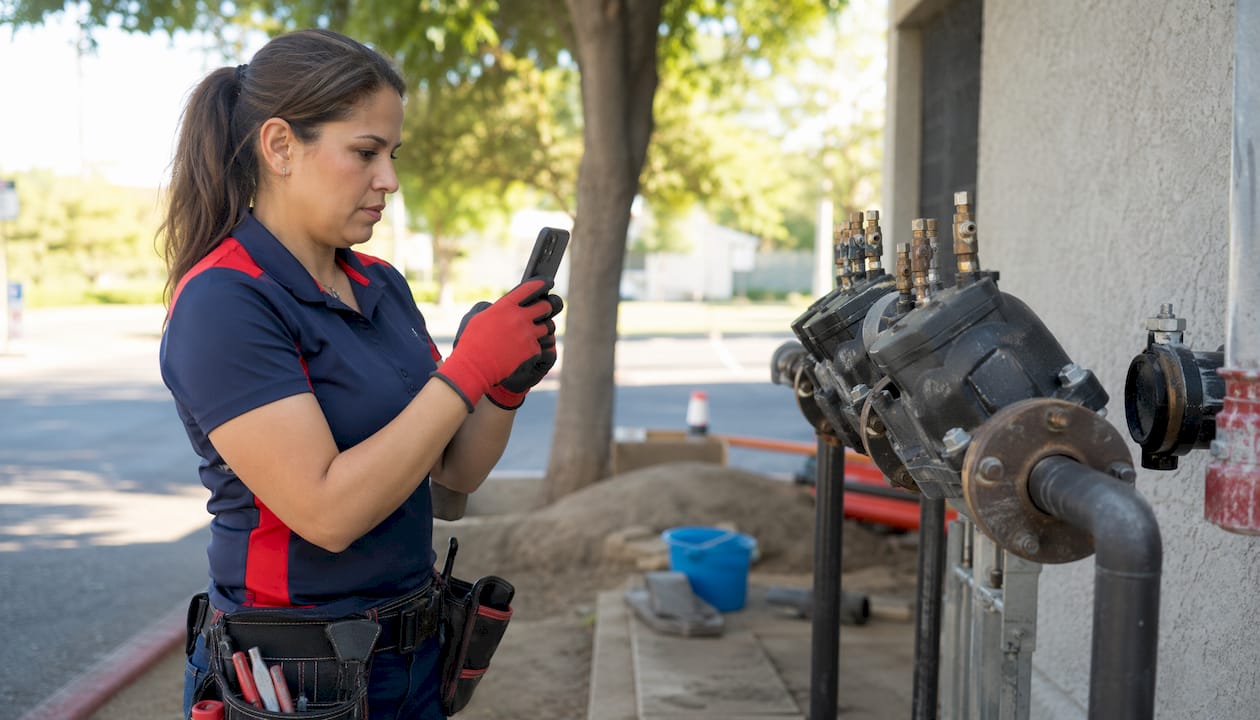
Physical appearance: A commercial backflow preventer is typically a brass, bronze, or cast-iron assembly mounted horizontally in a pipe run. It looks like a short, chunky section of pipe with extra hardware attached. Larger assemblies can be 12–24 inches long or more. Above-ground assemblies are often housed in a green or black insulated enclosure in a mechanical room or mounted on an exterior wall. Below-grade assemblies sit in a concrete or fiberglass vault with a metal lid at grade level.
Key external components to recognize:
- Test cocks: Small threaded ports (usually 4 on an RPZ, 2 on a DCVA) where a tester attaches gauge fittings. They look like small brass nipples with a slotted or square-drive plug.
- Shutoff valves: Full-port ball valves or gate valves on each end of the assembly. They are used to isolate the device for testing and repair.
- Relief valve discharge port (RPZ only): A downward-facing port or pipe stub between the two check valve bodies. If water is draining from it, the assembly needs attention.
- Inspection tag: A metal or plastic tag wired to the assembly body listing the last test date, tester name, and certification number. An expired or missing tag is a compliance flag.
- Assembly body markings: The manufacturer name, model number, size, and flow direction arrow are cast or stamped into the body.
When photographing an assembly for a technician or for records, capture the full assembly from the side (showing all test cocks and shutoff valves), a close-up of the inspection tag, and the body markings showing the model and size.
Why backflow prevention is a public-health responsibility, not just a checkbox
Property owners who treat annual testing as a paperwork exercise are missing the point. A failed or untested assembly is a direct pathway for contaminants to reach the municipal distribution system, not just the building’s own fixtures. Fertilizers, boiler chemicals, and industrial solvents have all been documented in backflow incidents that affected neighboring properties and public mains.
Utilities prioritize commercial sites with the highest hazard potential when allocating inspection resources, which is why commercial properties face faster follow-up after failed tests than residential accounts. A failed test at a chemical plant or hospital gets a utility response measured in hours, not weeks.
Certified testers do more than record a pass/fail. They document tag placement, capture serial and installation details, and submit reports that create an official compliance trail for the property. That trail matters when a utility audits your account, when you sell the building, or when an incident investigation asks for documentation.
Key professional practice points:
- Keep copies of every test report and tag record, organized by assembly location and date.
- Verify your tester’s certification is current and recognized by your local water authority before scheduling a test.
- Confirm the tester submits the report to the utility directly; do not assume it was filed.
- Schedule rebuilds proactively when an assembly approaches its manufacturer-specified service interval.
Key Takeaways
A commercial backflow preventer is a testable assembly that protects potable water from contamination at cross-connections, and U.S. law requires annual testing by a certified technician with mandatory reporting to the local water authority.
| Point | Details |
|---|---|
| Annual testing is mandatory | Most commercial properties must test at installation, after any repair, and at least once per year. |
| Only certified testers qualify | Testing must be performed by a certified cross-connection control technician; some jurisdictions also require a licensed master plumber for installation. |
| RPZ for high-hazard connections | Reduced Pressure Zone assemblies are required wherever downstream fluids pose a direct health risk, such as irrigation, boilers, and labs. |
| Late reports trigger fines | Many utilities require test reports submitted within 30 days; missing that window can result in fines even when the assembly passed. |
| Xtreme Air Services handles it | Xtreme Air Services coordinates commercial backflow testing, repairs, and utility reporting for properties in the Dallas area. |
The part most property managers get wrong
Most backflow compliance failures are not about the device. The assembly is usually there, it usually passes, and the technician usually shows up. The failure happens in the 30 days after the test, when the report never gets submitted, or the wrong form goes to the wrong utility contact, or the property manager assumes the tester handled the filing.
Utilities do not chase you down to collect your test results. The burden is on the property owner to confirm that a certified tester submitted the report within the required window. One missed submission, even after a clean pass, can generate a fine and a compliance notice that follows the property’s account for years.
The other thing worth saying: the annual test is the minimum. A device that passes in January can fail by August if a check valve spring fatigues or debris lodges in a seat. If your building has a high-hazard connection, treating the annual test as the only checkpoint is a risk. A quick visual inspection every quarter, looking specifically at the relief valve discharge port and the condition of the test cocks, takes five minutes and catches obvious failures before they become incidents.
Xtreme Air Services can handle your commercial backflow needs
Commercial backflow compliance involves more moving parts than most property managers expect: the right device for each hazard level, a certified tester who files with your specific utility, and documentation that holds up to an audit. Xtreme Air Services provides commercial plumbing services in the Dallas area, including backflow assembly identification, testing coordination, repair, and utility report submission.
Whether you need a new installation, a replacement for a failed assembly, or a first-time compliance review of your property’s cross-connections, the process starts with a site assessment. Have your last test report and any existing assembly tags ready when you call. If you do not have those documents, that is fine too. Xtreme Air Services can locate and document every assembly on-site as part of the initial visit.
Contact Xtreme Air Services to schedule a commercial plumbing inspection and get your backflow testing on the calendar before your utility’s deadline.
Useful sources for verifying local rules and finding certified testers
Local requirements vary more than most guides acknowledge. The sources below are the most reliable starting points for confirming what your specific jurisdiction requires.
- EPA Cross-Connection Control guidance: The EPA’s cross-connection control fact sheet explains the federal framework under the Safe Drinking Water Act and describes how utilities are expected to implement control programs. Use it to understand the baseline federal requirements before checking your local utility’s rules.
- Your local water utility’s cross-connection control program page: Most utilities publish their specific testing windows, approved tester lists, and required reporting formats online. Search your utility’s name plus “cross-connection control” or “backflow prevention program.” WSSC Water’s cross-connection control page is a good example of what a well-documented utility program looks like.
- IAPMO BPI (Backflow Prevention Institute): IAPMO BPI maintains guidance on why testing and maintenance are required and publishes resources for both property owners and certified testers. Use it to verify industry standards and find information on tester certification programs.
- State plumbing board or contractor licensing board: Your state’s licensing board can confirm which certifications are recognized for backflow testing and whether installation must be performed under a licensed master plumber.
Documents to collect before an inspection:
- The most recent test report for each assembly (date, tester name, pass/fail result, utility submission confirmation).
- The inspection tag currently attached to each assembly (photograph it if you cannot remove it).
- The original installation permit, if available.
- The assembly manufacturer and model number (found on the body markings or the original permit).
For commercial properties with multiple assemblies, maintain a simple log that tracks each device’s location, size, type, last test date, and next due date. That log is what a utility auditor will ask for first.
FAQ
How does a commercial backflow preventer work?
A commercial backflow preventer uses one or two spring-loaded check valves to allow water to flow in only one direction. When downstream pressure exceeds supply pressure, or supply pressure drops suddenly, the check valves close and block reverse flow. Reduced-pressure assemblies add a relief valve that discharges water to atmosphere if either check valve fails.
How much does it cost to install a commercial backflow preventer?
Residential installations in some regions run $1,000–$1,500; commercial assemblies and complex installs often exceed $2,000, with large-diameter or high-hazard devices running higher. Final cost depends on device type and size, above-ground versus underground installation, permit fees, and site access complexity.
What does a commercial backflow preventer look like?
It is a brass, bronze, or cast-iron assembly mounted in a pipe run, typically 12–24 inches long with test cocks, shutoff valves on each end, and an inspection tag wired to the body. Above-ground units are often housed in an insulated enclosure; below-grade units sit in a concrete or fiberglass vault with a metal lid at grade level.
What are the four main types of backflow preventers?
The four types most commonly specified on commercial sites are the Reduced Pressure Zone assembly (RPZ), the Double Check Valve Assembly (DCVA), the Pressure Vacuum Breaker (PVB), and the Atmospheric Vacuum Breaker (AVB). A fifth method, the air gap, is a physical separation rather than a mechanical device and is used where continuous pressure is not required.
Who is allowed to test a commercial backflow preventer?
Testing must be performed by a technician certified in cross-connection control and recognized by the local water authority. Some jurisdictions additionally require that installation and repair work be performed under a licensed master plumber. Always verify your tester’s credentials with your utility before scheduling a test.