

Backflow testing is required in Texas. If you have a testable backflow prevention assembly protecting against a health hazard, state law under 30 TAC Chapter 290 requires testing at installation and at least once every 12 months. The governing authority is the Texas Commission on Environmental Quality (TCEQ), and the official document you’ll deal with is the TCEQ-20700 Backflow Prevention Assembly Test and Maintenance Report. Your immediate next step: identify whether you have a testable assembly (RP, DCVA, PVB, or SVB), then schedule a TCEQ-licensed Backflow Prevention Assembly Tester (BPAT) if you haven’t had a passing test within the last year.
Here’s what to do right now:
- Identify your device. Is it a Reduced Pressure Principle Assembly (RP/RPBA), Double Check Valve Assembly (DCVA), Pressure Vacuum Breaker (PVB), or Spill-Resistant PVB (SVB)? Those are testable. Single-check valves and atmospheric vacuum breakers are not.
- Check your last test date. If you can’t locate a signed TCEQ-20700 form with a date within the past 12 months, you’re likely overdue.
- Find a licensed BPAT. Verify their current TCEQ license number before scheduling.
- Confirm gauge calibration. Your tester’s differential pressure gauges must be verified for accuracy at least annually.
- Submit the T&M form. The signed original goes to your Public Water System (PWS). Keep a copy for your records.
Pro Tip: Before the tester leaves, ask for a copy of the signed TCEQ-20700 form and confirm they’ve submitted or will submit the original to your PWS. Don’t assume it gets filed automatically.
Key Takeaways
Texas backflow testing requirements under 30 TAC Chapter 290 mandate testing at installation and at least annually for health-hazard assemblies, using a TCEQ-licensed BPAT and the TCEQ-20700 form, with records retained for at least three years.
| Point | Details |
|---|---|
| Testing triggers | Test at installation, repair, replacement, or relocation, and at least annually for health-hazard assemblies. |
| Who can test | Only a TCEQ-licensed BPAT may test; fire-line testers must be employed by a registered fire sprinkler contractor. |
| Official form | The TCEQ-20700 must be completed on-site, signed, and the original submitted to your PWS. |
| Record retention | PWSs must keep signed T&M forms for at least three years; keep your own copy for the same period. |
| Xtremeairservices | Xtremeairservices coordinates backflow testing and documentation for Dallas-area residential and commercial properties. |
Table of Contents
- What Texas law actually requires for backflow testing
- Which assemblies are testable and how often you need to test
- Who can legally test a backflow device in Texas
- Customer service inspections versus backflow assembly testing
- How an official backflow test works and what gets documented
- How local water-supplier rules often differ from state minimums
- Step-by-step compliance checklist for property managers
- What happens when you don’t comply
- Why backflow testing is about more than checking a box
- Xtremeairservices handles backflow compliance for Dallas-area properties
- Sources
- FAQ
What Texas law actually requires for backflow testing
The legal foundation for backflow testing requirements in Texas is 30 TAC Chapter 290, administered by TCEQ. Sections 290.44 and 290.46 set the minimum standards for cross-connection control and backflow prevention across public water systems statewide.
The state minimums are clear: all backflow prevention assemblies must be tested upon installation, repair, replacement, or relocation. For assemblies protecting against a health hazard, TCEQ’s GI-411 guidance confirms annual testing is required at minimum. These aren’t suggestions. They’re conditions of maintaining continuous water service.
Your PWS, however, can go further. Many municipalities require annual testing for all assemblies, not just those at health-hazard connections. Some require specific approved assembly models or mandate shorter testing intervals. The state minimum sets a baseline standard.
On recordkeeping: RG-478 requires PWSs to retain signed T&M forms for a multi-year period. That obligation runs to the water supplier, but you should keep your own copies for the same period.
| Requirement | State minimum (30 TAC Ch. 290) | Local PWS rules |
|---|---|---|
| Testing trigger | Installation, repair, replacement, relocation | Same, plus any additional triggers the PWS sets |
| Annual testing | Required for health-hazard assemblies | May apply to all assemblies |
| Form used | TCEQ-20700 | Same form; some PWSs add their own reporting |
| Record retention | Several years (PWS obligation) | May require owner copies as well |
Which assemblies are testable and how often you need to test
Not every backflow device on your property requires a licensed tester with differential gauges. The distinction matters because installing the wrong device at the wrong connection is one of the most common compliance mistakes.
Testable assemblies (require periodic testing by a BPAT):
- Reduced Pressure Principle Assembly (RP / RPBA)
- RPBA-Detector (RP-D)
- Double Check Valve Assembly (DCVA)
- DCVA-Detector (DCVA-D)
- Pressure Vacuum Breaker (PVB)
- Spill-Resistant Pressure Vacuum Breaker (SVB)
Non-testable or inspection-only devices:
- Atmospheric Vacuum Breaker (AVB): inspectable but not testable with gauges; not suitable for health-hazard protection
- Single-check and dual-check valves: not testable; not approved for health-hazard connections
Per GI-411, licensed professionals and your PWS determine the appropriate assembly based on hazard degree. If you’re protecting a health-hazard connection with a single-check valve, that’s a compliance problem regardless of how long it’s been there.
Testing frequency follows the same rule across all testable types: upon installation, repair, replacement, or relocation, and at least annually when protecting a health hazard. Your local PWS may require annual testing for all testable assemblies regardless of hazard level.
Who can legally test a backflow device in Texas
Only a professional holding a current BPAT license issued by TCEQ may test or repair backflow assemblies on domestic, commercial, industrial, or irrigation connections. That’s the rule, with one significant exception for fire protection systems.
For fire-line backflow devices, the tester must be permanently employed by a fire sprinkler contractor registered with the Texas State Fire Marshal’s Office. A freelance BPAT who tests residential and commercial irrigation lines cannot legally test your fire suppression system’s backflow assembly unless they meet that employment requirement. RG-345 spells out these employment and registration rules in detail.
What to verify before hiring a BPAT:
- Current TCEQ BPAT license number (searchable on the TCEQ licensing portal)
- Gauge calibration date and serial number (gauges must be verified at purchase and at least annually)
- If testing a fire line: confirmation of permanent employment with a State Fire Marshal-registered fire sprinkler contractor
- Proof of liability insurance and company registration where applicable
The BPAT licensing requirements include completing a 40-hour BPAT course with hands-on practical testing components, passing written and practical exams, and submitting an application with the required fee. After licensing, BPATs must complete 24 hours of continuing education, including at least 8 hours of hands-on training, before each three-year renewal.
Pro Tip: Ask for the tester’s BPAT license card and gauge calibration sticker before the test starts. A tester who hesitates to show either one is a red flag.
Customer service inspections versus backflow assembly testing
These two obligations get confused constantly, and mixing them up can leave a property out of compliance on both fronts.
A Customer Service Inspection (CSI) is an inspection of private plumbing to identify cross-connections and potential contamination risks. It’s performed by the PWS or an authorized inspector, not by a BPAT. TCEQ’s cross-connection control guidance identifies the triggers: new construction, major plumbing modifications, suspected hazards, and certain connection types before continuous service begins.
Backflow assembly testing is a physical performance test of an installed assembly, performed by a licensed BPAT using calibrated differential pressure gauges and documented on the TCEQ-20700 form.
| Feature | Customer Service Inspection (CSI) | Backflow Assembly Test |
|---|---|---|
| Who performs it | PWS or authorized inspector | TCEQ-licensed BPAT |
| What it checks | Private plumbing for cross-connections | Assembly mechanical performance |
| Form used | PWS inspection report | TCEQ-20700 |
| Trigger | New construction, modification, suspected hazard | Installation, repair, annual cycle |
| Result | Recommendation to install/upgrade assembly | Pass or fail; repair and retest if fail |
One nuance worth understanding: when a PWS relies on an internal cross-connection control program rather than premises isolation at the meter, RG-478 explains that adequacy is determined through required CSIs and periodic verification. In practice, this means a robust internal program can sometimes eliminate the need for a meter-level assembly, but the PWS makes that determination, not the property owner.
When a CSI recommends installing or upgrading an assembly, the next step is arranging a BPAT test and submitting the TCEQ-20700 to the PWS. The CSI and the test are sequential, not interchangeable.
How an official backflow test works and what gets documented
The USC Foundation for Cross-Connection Control and Hydraulic Research testing procedures are the industry standard TCEQ references for BPAT methodology. Your tester follows those procedures on-site, and every result lands on the TCEQ-20700.
Step-by-step on-site process:
- Tester identifies assembly type, serial number, and location.
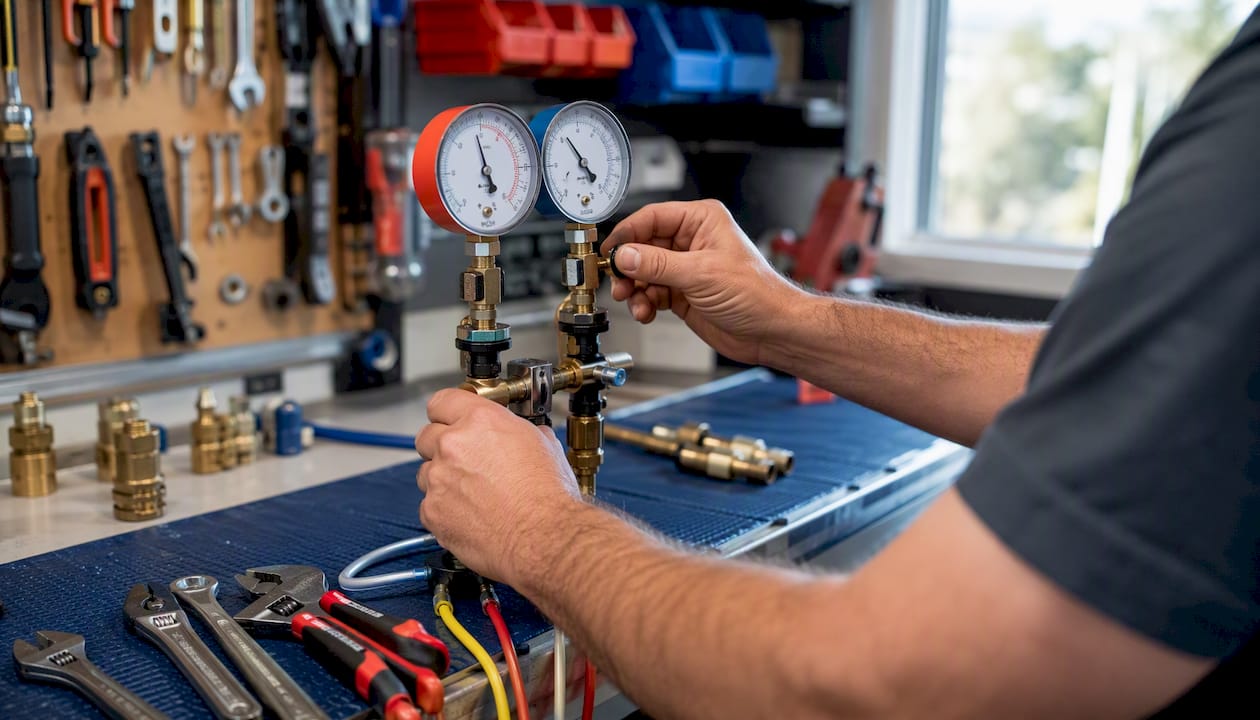
- Tester connects calibrated differential pressure gauges to the test cocks.
- Initial test is performed per USC manual procedures; readings are recorded.
- If the assembly passes, the TCEQ-20700 is completed and signed on-site.
- If the assembly fails, the tester documents the failure, performs or arranges repairs, and retests. Repairs and retests are documented on separate T&M forms if a different tester performs the follow-up.
- Signed original TCEQ-20700 is submitted to the PWS. Tester and owner each retain a copy.
The TCEQ-20700 form captures: PWS name and ID, service address, assembly type and serial number, initial test readings, any repairs and materials used, tester name, BPAT license number and expiration date, and the gauge make, model, serial number, and last calibration date.
Gauge calibration is where many tests quietly fail compliance. RG-478 requires gauges to be checked for accuracy upon purchase and at least annually. A test performed with an out-of-calibration gauge can be invalidated, meaning you’d need to retest at your expense.
Pro Tip: Ask the tester to show the calibration sticker on the gauge before they connect it. The sticker should show the calibration date and the next due date. If it’s expired, the test results won’t hold up.
How local water-supplier rules often differ from state minimums
State law sets the floor. Your local PWS can raise it, and many do. This is where property owners get surprised.
Common local variations include:
- Annual testing required for all testable assemblies, not just health-hazard connections
- Specific approved assembly lists (your assembly must appear on the PWS’s approved products list)
- Shorter testing intervals for high-risk connections (some PWSs require semi-annual testing)
- Mandatory submission deadlines (e.g., test results due within 30 days of the anniversary date)
- Required use of PWS-approved testers or contractors
| Rule area | TCEQ state minimum | Common local PWS addition |
|---|---|---|
| Annual testing scope | Health-hazard assemblies only | All testable assemblies |
| Approved assemblies | Testable types per TCEQ | PWS-specific approved product list |
| Submission deadline | Not specified at state level | Often 30 days from test date or anniversary |
| Tester approval | Any current BPAT | PWS-approved tester list in some jurisdictions |
Steps to confirm your local requirements:
- Visit your PWS’s website and search for “cross-connection control” or “backflow prevention.”
- Review your local plumbing ordinance, often available through the city or county clerk’s office.
- Call the utility’s cross-connection control coordinator directly and ask for written instructions.
- Request a copy of the PWS’s approved assembly list and any local testing deadlines.
Before you call, gather: service address, PWS ID (on your water bill), assembly serial number and model, last test date, and copies of any past T&M forms.
Step-by-step compliance checklist for property managers
Running backflow compliance without a system means something gets missed. Here’s an ordered process you can copy into your maintenance software or compliance folder.
- Identify the assembly. Locate the physical device, record the type, manufacturer, model, and serial number.
- Determine hazard level. Confirm with your PWS whether the connection is classified as a health hazard. This sets your testing interval.
- Confirm your testing interval. State minimum is annual for health-hazard assemblies; check local PWS rules for stricter requirements.
- Schedule a licensed BPAT. Verify their current TCEQ license and gauge calibration before confirming the appointment.
- Receive the signed TCEQ-20700. Get your copy before the tester leaves.
- Confirm PWS receipt. Follow up with your PWS to verify they received the signed original.
- File copies and set your next reminder. Store the T&M form in a dedicated compliance folder and schedule the next test date.
Calendar reminder template fields to track:
- Service address and meter number
- Assembly type, model, and serial number
- Last test date and result (pass/fail)
- BPAT company name and license number
- Next test due date
- PWS name and cross-connection contact
- Notes (repairs made, gauge calibration date on file)
For facilities teams managing multiple properties, centralizing T&M forms in one shared compliance folder and exporting next-due dates to your maintenance management software cuts the risk of a missed cycle. A commercial plumbing inspection checklist integrated with your backflow schedule keeps everything in one place.
What happens when you don’t comply
Non-compliance with backflow testing requirements in Texas follows a predictable escalation path. The consequences get more disruptive the longer a violation goes unaddressed.
Typical enforcement sequence:
- Written notice of violation from the PWS, with a deadline to schedule testing
- Follow-up inspection if the deadline passes without action
- Administrative penalties or fines
- Mandatory remediation with a compliance timeline
- In persistent or high-risk cases: temporary service suspension or meter lock
| Enforcement stage | Trigger | Typical outcome |
|---|---|---|
| Notice of violation | Missed testing deadline | Written notice with cure period |
| Follow-up inspection | No response to notice | PWS site visit, extended deadline |
| Administrative penalty | Continued non-compliance | Fines; amount varies by PWS and severity |
| Service suspension | Unresolved health hazard | Meter lock until assembly is tested and compliant |
Having signed T&M forms and proof of submission on file is your best defense. If a PWS inspector shows up and you can produce a current, signed TCEQ-20700 with a submission confirmation, the conversation is short. Without it, you’re starting from scratch.
Why backflow testing is about more than checking a box
Backflow devices are mechanical. They have springs, seals, and moving parts that degrade over time, sometimes quickly. A device that passed its test 13 months ago may not perform the same way today, and there’s no visual indicator that tells you it’s failing. That’s the whole point of the test.
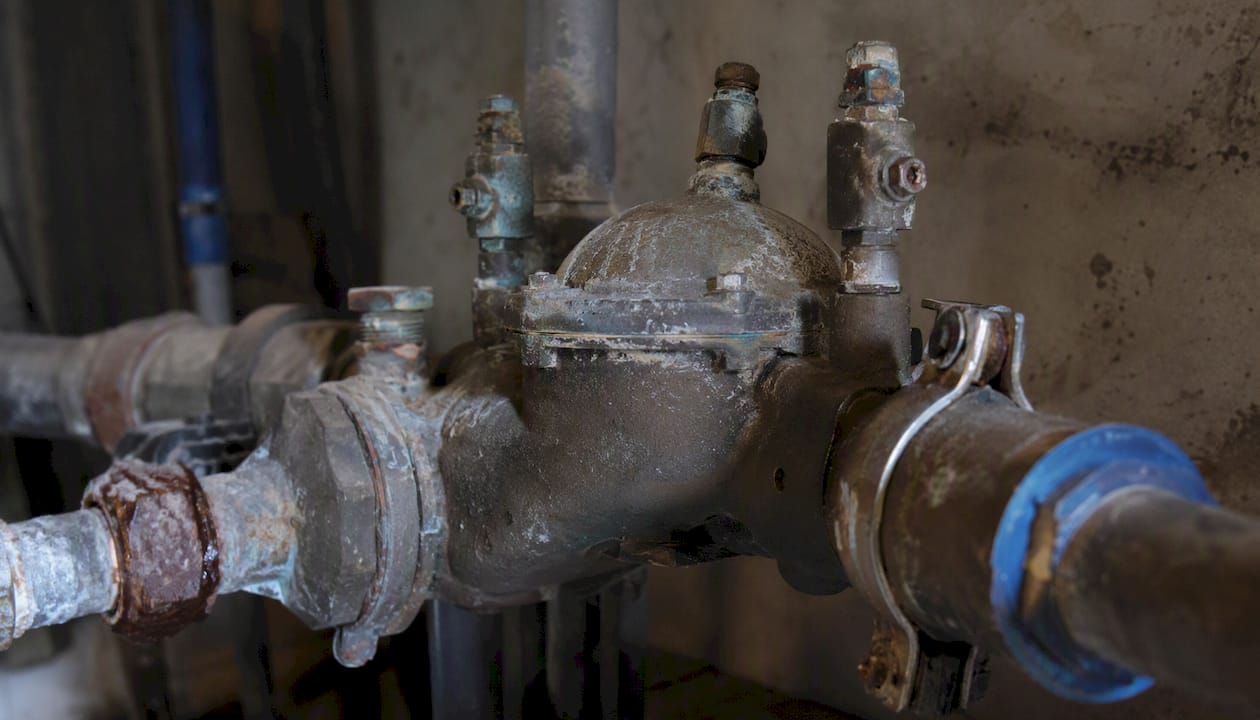
The most common mistakes property owners make aren’t about ignoring the rules. They’re about misunderstanding them. Installing a non-testable check valve at the meter because it was cheaper is a real problem: single-check valves can create a closed system that causes pressure issues and don’t meet the health-hazard protection standard. Not verifying the tester’s gauge calibration before the test is another. A test performed with an expired gauge is essentially worthless from a compliance standpoint, and you won’t know until the PWS flags it.
The third mistake is the most avoidable: failing to keep the signed T&M original. If your tester submits the form but you don’t have a copy, and the PWS’s records are incomplete, you have no proof of compliance. That’s a fixable problem, but it’s one that costs time and sometimes money to resolve.
Integrating backflow test scheduling into your annual facility maintenance calendar, alongside HVAC servicing and plumbing code compliance reviews, is the simplest way to avoid all three mistakes. Keep the tester’s license number and company contact in the same file as the T&M form.
Xtremeairservices handles backflow compliance for Dallas-area properties
Staying current on backflow testing requirements in Texas means coordinating the right licensed tester, managing paperwork, and confirming your PWS received the signed form. Xtremeairservices handles the plumbing side of that process for residential and commercial properties across the Dallas area, including on-site testing coordination, documentation handling, and follow-up with your water supplier.

When you reach out, have the following ready: your service address, assembly type and serial number, last test date, PWS name and contact, and site access instructions. That information lets the team confirm what’s needed and schedule efficiently. Whether you need a first-time compliance check or want to fold backflow testing into a recurring maintenance plan that covers plumbing, HVAC, and electrical, Xtremeairservices can put together a schedule that keeps your property compliant year over year. Contact Xtremeairservices to request a compliance check or schedule your next backflow test.
Sources
The primary TCEQ documents and the USC testing manual are the authoritative references for Texas backflow compliance. Each covers a distinct part of the regulatory picture.
- TCEQ Form 20700 – BACKFLOW PREVENTION ASSEMBLY TEST AND MAINTENANCE REPORT
This article is general information, not a substitute for advice from a qualified lawyer. Consult a qualified legal professional about your own circumstances before acting on anything here.
FAQ
Is backflow testing mandatory in Texas?
Yes. Texas law under 30 TAC Chapter 290 requires testing at installation and at least annually for backflow prevention assemblies protecting against health hazards, with results documented on the TCEQ-20700 form.
How often does a backflow assembly need to be tested?
At minimum, upon installation, repair, replacement, or relocation, and at least once every 12 months for assemblies at health-hazard connections. Your local PWS may require annual testing for all testable assemblies.
Who can test a backflow device in Texas?
Only a TCEQ-licensed Backflow Prevention Assembly Tester (BPAT) may perform tests on standard potable connections. For fire protection systems, the tester must also be permanently employed by a State Fire Marshal-registered fire sprinkler contractor.
How do you become a certified backflow tester in Texas?
Applicants must complete a 40-hour BPAT course with hands-on practical testing, pass written and practical exams, and submit a TCEQ application with the required fee. License renewal requires 24 hours of continuing education, including at least 8 hours of hands-on training, every three years.