


BTU, or British Thermal Unit, is the standard measurement used to quantify heating capacity in commercial HVAC systems. Understanding BTU in commercial heating is the first step every facility manager and business owner needs before selecting, sizing, or evaluating heating equipment.
One BTU represents the energy required to raise the temperature of one pound of water by one degree Fahrenheit. That equals approximately 1,055 joules.
In practice, commercial HVAC equipment is rated in BTU per hour, written as BTU/hr or BTUH. What matters operationally is how much heat a system can move every hour. Get this number wrong, and you pay for it in energy waste, comfort complaints, and premature equipment failure.
How is BTU measured in commercial HVAC systems?
BTU measures a single quantity of energy, while BTU/hr measures the rate at which that energy is transferred. The distinction matters enormously when you read equipment specifications.
Think of it this way: a BTU is like a gallon of water, and BTU/hr is the flow rate from a faucet.
A commercial building does not need a fixed amount of heat delivered once. It needs heat delivered continuously at a specific rate to maintain temperature. That rate is what equipment manufacturers publish, and it is what you compare when choosing between units.

How equipment ratings are expressed
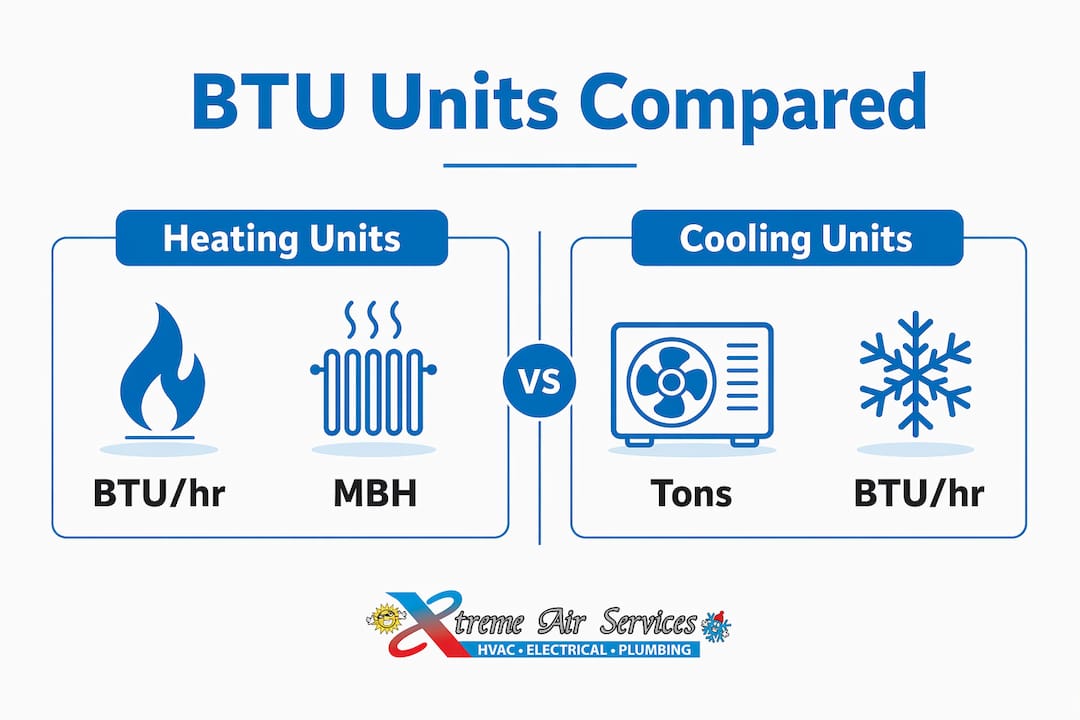
Commercial HVAC manufacturers express capacity in three common formats: BTU/hr, MBH, and tons. Each format is used in specific contexts, and misreading them leads to costly specification errors.
| Unit | Full Name | Equivalent | Typical Use |
|---|---|---|---|
| BTU/hr | British Thermal Units per Hour | Base unit | All HVAC equipment |
| MBH | Thousands of BTU/hr | 1 MBH = 1,000 BTU/hr | Commercial heating specs |
| Ton | Ton of Refrigeration | 1 ton = 12,000 BTU/hr | Cooling capacity ratings |
| Watt | Electrical power unit | 1 BTU/hr ≈ 0.293 watts | Energy comparisons |
MBH is the unit most commonly used for commercial heating equipment. A boiler rated at 500 MBH delivers 500,000 BTU/hr of heat output.
Tons are the standard for cooling capacity. That is why your rooftop unit spec sheet might list both a tonnage figure for cooling and an MBH figure for heating.
Commercial rooftop units often exceed 5 tons of cooling capacity. A 10-ton unit delivers 120,000 BTU/hr of cooling capacity. That scale shows how far commercial applications outsize residential systems.
Pro Tip: When reviewing a commercial HVAC proposal, always ask the contractor to express all capacities in BTU/hr. Converting everything to the same unit prevents apples-to-oranges comparisons between competing bids.
BTU vs. tons vs. MBH: which unit should you use?
Use tons for cooling capacity, MBH for heating capacity, and BTU/hr when you need to compare the two on the same scale. Facility managers encounter all three units regularly, and each one dominates a different part of the industry conversation.
Tons are the default language for cooling. The term comes from the era when ice was used to cool buildings. One ton of refrigeration equals the heat absorbed by melting one ton of ice in 24 hours, which works out to 12,000 BTU/hr.
That conversion is fixed and universal. A 20-ton rooftop unit removes 240,000 BTU/hr of heat from a building.
MBH dominates heating specifications. A gas furnace, boiler, or heat pump in heating mode typically carries an MBH rating on its nameplate. The “M” comes from the Roman numeral for 1,000, so 120 MBH equals 120,000 BTU/hr.
This unit gives engineers and contractors a cleaner number to work with when specifying large commercial heating systems.
Quick conversion reference
This table converts the same capacity across BTU/hr, MBH, and tons so you can line up competing specs at a glance.
| Capacity | BTU/hr | MBH | Tons |
|---|---|---|---|
| Small commercial unit | 60,000 | 60 MBH | 5 tons |
| Mid-size rooftop unit | 120,000 | 120 MBH | 10 tons |
| Large commercial system | 240,000 | 240 MBH | 20 tons |
| Industrial-scale system | 600,000 | 600 MBH | 50 tons |
Heating and cooling loads for the same building rarely match. A Dallas office building needs far more cooling capacity than heating capacity, while a Minneapolis warehouse flips that equation.
This asymmetry means you cannot simply size a heat pump to one load and assume it covers both. Climate zone drives which load dominates, and that determines how you size the system.
For facility managers overseeing buildings in multiple regions, this distinction is critical. The types of commercial HVAC systems you select should reflect the dominant load in each climate, not a one-size-fits-all BTU figure.
Why BTU in commercial heating determines efficiency, comfort, and cost
Proper BTU sizing is not a technical formality. It is the single most consequential decision in commercial HVAC system design, and getting it wrong in either direction creates problems.
The cost of undersizing
An undersized system runs continuously without ever reaching the target temperature. The consequences compound quickly:
- Occupants stay uncomfortable and complaints pile up.
- The equipment wears out faster because it never cycles off.
- Energy bills climb because the system operates at full load for extended periods without achieving the desired result.
Choosing properly sized, ENERGY STAR-certified equipment helps avoid this outcome from the start.
The cost of oversizing
Oversizing is the more common and less obvious mistake. A unit with too many BTU/hr heats the space quickly, then shuts off before completing a full cycle. This is called short cycling.
Short cycling wastes energy and accelerates mechanical wear on compressors, heat exchangers, and controls. The equipment costs more upfront, costs more to run, and fails sooner.
The importance of BTUs in HVAC goes beyond the nameplate number. Load matching is the practice of selecting equipment whose BTU/hr output aligns with the building’s actual calculated heat loss or gain.
Successful HVAC systems account for fluctuating building factors to maintain efficiency during part-load conditions. In a real commercial building, part-load is most of the time.
Key building factors that affect your BTU load include:
- Square footage and ceiling height: More volume requires more BTU/hr to condition.
- Insulation quality: Poor insulation dramatically increases heat loss in winter and heat gain in summer.
- Occupancy levels: Each person contributes roughly 400 BTU/hr in heat load. A 200-person call center generates 80,000 BTU/hr from occupants alone.
- Equipment and lighting heat output: Servers, industrial machinery, and commercial kitchen equipment all add to the internal heat load.
- Solar gain: South-facing glass in a sunny climate adds significant cooling load that must be accounted for in BTU calculations.
- Climate zone: A building in Phoenix and the same building in Chicago require completely different BTU/hr capacities for both heating and cooling.
Pro Tip: BTU ratings directly impact equipment longevity and occupant comfort. If your current system is short cycling or running continuously, request a load calculation before replacing it. You may be replacing a correctly sized unit with another incorrectly sized one.
How to calculate BTU requirements for commercial spaces
Estimating the BTU load for a commercial facility starts with a few key inputs. The accuracy of the result depends entirely on how thoroughly those inputs are gathered.
The industry standard for precise load calculations is ACCA Manual N, the commercial equivalent of the residential Manual J. Manual N accounts for every variable that affects heat transfer through the building envelope.
For most facility managers, the practical approach is to understand the major inputs, then commission a professional calculation.
Here is the sequence a qualified HVAC engineer follows:
- Measure the conditioned space. Total square footage and ceiling height establish the volume that must be heated or cooled.
- Assess the building envelope. Wall, roof, and floor insulation values (R-values) determine how fast heat escapes in winter or enters in summer.
- Identify the climate zone. The Department of Energy divides the U.S. into eight climate zones. Each zone has design temperatures that drive the worst-case BTU load scenario.
- Count occupants and equipment. Each person adds approximately 400 BTU/hr to the cooling load. Servers, ovens, and motors add their rated wattage converted to BTU/hr (1 watt equals approximately 3.41 BTU/hr).
- Calculate solar gain. Window area, orientation, and shading devices all affect how much solar energy enters the building.
- Apply the BTU per square foot estimate. Heating requirements vary from 30 to 60 BTU per square foot depending on climate and insulation quality. A well-insulated building in a mild climate sits near 30. A poorly insulated building in a cold northern climate approaches 60.
- Select equipment to match the calculated load. The target is a unit whose rated BTU/hr output falls within 15% of the calculated load, not the largest unit that fits the mechanical room.
A 10,000-square-foot office building in Dallas with good insulation might require 350,000 BTU/hr of cooling capacity and 200,000 BTU/hr of heating capacity. The same building in Minneapolis might need 250,000 BTU/hr of cooling and 400,000 BTU/hr of heating. Same square footage, completely different equipment.
Professional load calculations are the only reliable path to accurate BTU sizing. Rules of thumb based on square footage alone produce systems that are routinely 20–40% over or undersized.
Common misconceptions about btus in commercial HVAC
Several persistent misunderstandings about BTU measurement lead facility managers to make poor equipment decisions. Addressing them directly saves money and frustration.
-
BTUs measure temperature output, not heat transfer rate. A system with a higher BTU/hr rating does not produce hotter air. It moves more heat energy per hour. A 200,000 BTU/hr furnace and a 100,000 BTU/hr furnace can both produce 140°F supply air. The larger unit simply heats a larger space in the same amount of time.
-
Heating and cooling loads are not symmetrical. Many facility managers assume that a system sized for cooling will handle heating automatically. Loads for the same building rarely match, and heat pumps in particular must be sized to the dominant load for the climate zone.
-
High occupancy spaces need more cooling, not more heating. Each person generates approximately 400 BTU/hr of sensible heat. A packed conference room or retail floor can shift from a heating load to a cooling load mid-winter simply because of body heat and lighting.
-
Better insulation reduces BTU requirements significantly. Improving building insulation and sealing can reduce heating load by 30–50%. This means a facility that upgrades its envelope before replacing HVAC equipment can install a smaller, less expensive system and still achieve better comfort.
-
Bigger is not safer. The instinct to oversize “just in case” is the most expensive mistake in commercial HVAC. Oversized equipment costs more to purchase, more to operate, and fails faster due to short cycling.
Understanding BTU measurement for commercial use means recognizing that the number on the nameplate is only as useful as the load calculation behind it.
Key takeaways
Proper BTU sizing is the foundation of every efficient, cost-effective commercial heating system, and no rule of thumb replaces a professional load calculation.
| Point | Details |
|---|---|
| BTU/hr is the operative unit | Equipment capacity is always expressed as a rate per hour, not a fixed energy quantity. |
| 1 ton equals 12,000 BTU/hr | Use this conversion to compare cooling specs expressed in tons with heating specs in MBH. |
| Load matching beats oversizing | Short cycling from oversized equipment wastes energy and accelerates mechanical failure. |
| Occupancy adds significant load | Each person contributes roughly 400 BTU/hr, which shifts the load balance in high-traffic spaces. |
| Insulation cuts BTU demand | Upgrading building insulation can reduce heating load by 30–50%, enabling smaller equipment. |
What 15 years of BTU conversations have taught me
After working with facility managers across commercial properties of every size, I see one pattern most often: the BTU number gets all the attention, and the load calculation gets skipped.
A contractor quotes a 20-ton unit because the old one was 20 tons. Nobody asks whether the old one was correctly sized in the first place.
The facilities I have seen run most efficiently share one habit: the manager treated the load calculation as a non-negotiable first step, not an optional add-on. They commissioned Manual N calculations before issuing RFPs and asked contractors to justify every BTU on paper.
That discipline paid off. Equipment lasted longer, energy bills came in lower, and tenants stopped filing comfort complaints.
I have also learned that the building envelope conversation almost never happens during HVAC replacement discussions. If your roof insulation is degraded or your windows are single-pane, you are paying for BTUs that walk straight out of the building.
Fixing the envelope before replacing the equipment is the highest-return investment most commercial facilities never make.
My honest recommendation: treat BTU sizing as a financial decision, not a technical one. The right number saves you money every month for the life of the equipment. The wrong number costs you from day one.
— Xtreme
Get the right BTU capacity for your commercial building
Knowing BTU in commercial heating is only half the equation. The other half is having a qualified team verify that your current or planned system matches your actual building load.

Xtremeairservices provides commercial HVAC assessments, load calculations, and system sizing for facilities across Dallas, Plano, Irving, and Sunnyvale, TX. Whether you are replacing aging equipment or evaluating a new installation, the team identifies the correct BTU/hr capacity for your specific building conditions.
Xtremeairservices also offers HVAC maintenance plans that keep your heating and cooling systems operating at their rated capacity year-round, protecting your investment and your occupants’ comfort.
Contact Xtremeairservices to schedule a commercial HVAC assessment and get BTU sizing done right the first time.
FAQ
What does btu/hr mean on a commercial heater?
BTU/hr, or British Thermal Units per hour, is the rate at which a heating system transfers heat energy. It is the standard capacity rating on all commercial HVAC equipment and tells you how much heat the unit can deliver in one hour of operation.
How many btus does a commercial building need per square foot?
Commercial heating requirements range from 30 to 60 BTU per square foot depending on insulation quality, climate zone, and occupancy. A well-insulated building in a mild climate needs fewer BTUs than a poorly insulated building in a cold northern region.
What is the difference between BTU and tons in HVAC?
One ton of cooling capacity equals 12,000 BTU/hr. Tons are the standard unit for expressing cooling capacity, while MBH (thousands of BTU/hr) is more commonly used for commercial heating specifications.
Why does BTU sizing matter for commercial HVAC efficiency?
An oversized unit short cycles, wasting energy and accelerating wear. An undersized unit runs continuously without reaching the target temperature. Matching BTU/hr output to the calculated building load is the only way to achieve reliable efficiency and equipment longevity.
Can improving insulation reduce my commercial building’s BTU requirements?
Upgrading building insulation and sealing air leaks can reduce heating load by 30–50%. This reduction allows facility managers to install smaller, less expensive HVAC equipment while achieving better comfort and lower operating costs.