

A facility maintenance plan setup is the process of organizing maintenance tasks, schedules, and priorities so facility assets run reliably and cost-effectively. It turns scattered repairs into a structured program.
The stakes are high. Without a structured plan, facilities spend 3–5 times more on reactive repairs. They also face 15–40% higher downtime than facilities with formal programs. That gap is real money: unplanned downtime can cost $50,000 per hour in some operations.
The industry standard for this discipline is a Computerized Maintenance Management System (CMMS)-backed maintenance strategy. It aligns with frameworks like ISO 55001 for asset management.
Facility managers who treat plan setup as a foundational investment consistently outperform those who react to failures after the fact.
What do you need before setting up a facility maintenance plan?
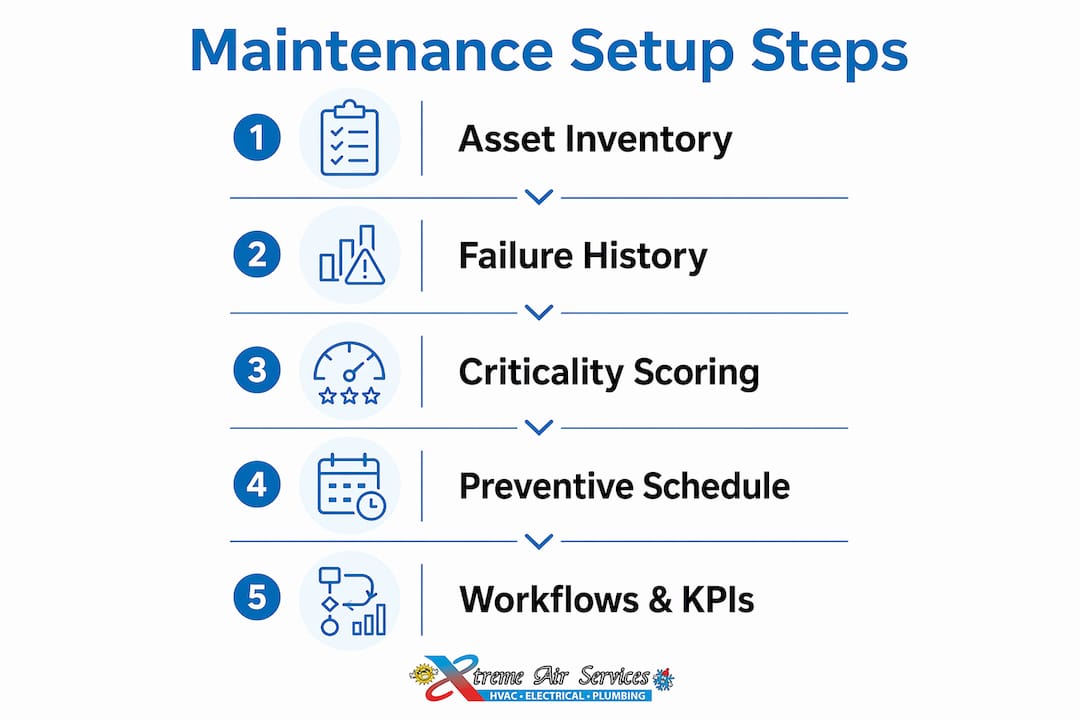
Before you build a schedule, you need five things: a complete asset inventory, 12–24 months of work order history, OEM service specifications, alignment with business goals, and the right tracking tool.
The first step in any maintenance strategy development is knowing exactly what you are maintaining. A complete facility asset inventory is non-negotiable.
For each asset, record:
- Location
- Age
- Manufacturer specifications
- Original equipment manufacturer (OEM) service requirements
Without this baseline, any schedule you build is guesswork dressed up as planning.

Gather failure and work order history
Pull at least 12–24 months of work order records before writing a single maintenance task. This history reveals three things:
- Which assets fail most often
- What those failures cost
- How long repairs take
Patterns in that data tell you where to focus your preventive maintenance schedule first.
Choose the right tracking system
Your tracking system will be either a spreadsheet or a CMMS platform. The right choice depends on your asset count, team size, and budget. This tool shapes how well your plan holds together over time.
Two main options exist:
- Spreadsheet systems: Low cost and fast to set up. Best for facilities with fewer than 50 assets or teams just starting out. The downside is manual data entry, version control problems, and no automated scheduling.
- CMMS platforms: Purpose-built software that automates work orders, tracks parts inventory, and generates compliance reports. Facilities with complex asset portfolios or multiple shifts benefit most from this approach.
A small commercial property might run well on a structured spreadsheet. A multi-building campus needs a CMMS.
Align maintenance objectives with business goals
Align maintenance objectives with business goals by translating each priority into task frequency and resource allocation. A maintenance strategy should act as the bridge between business goals and daily work rules, not merely a policy document.
Maintenance strategy development fails when it operates in isolation from business priorities. If your business goal is 99% uptime for production equipment, your plan must reflect that priority in every task.
Write down your top three operational objectives before building any schedule.
Pro Tip: Create a one-page asset register template with columns for asset ID, location, age, OEM service interval, and last service date. Fill this in before touching any scheduling tool. It takes two hours and saves weeks of rework later.
The table below shows the key prerequisites and what each one delivers:
| Prerequisite | What it delivers |
|---|---|
| Asset inventory | Accurate scope of what needs maintenance |
| Work order history | Data-driven task prioritization |
| OEM specifications | Correct service intervals and parts lists |
| Business objective alignment | Justification for resource allocation |
| Tool selection (spreadsheet or CMMS) | Consistent tracking and scheduling |
How do you prioritize maintenance tasks using asset criticality?
You prioritize maintenance tasks with asset criticality scoring. This method decides which assets get the most attention and which can tolerate a run-to-failure approach.
Experts recommend scoring each asset on a scale of 1–25. The score combines three factors: safety impact, production dependency, and repair cost. That number then drives the maintenance strategy for each asset.
Understanding the criticality scoring scale
The 1–25 scale breaks into three bands, each mapped to a different maintenance approach:
- Scores 5–10 (low criticality): Run-to-failure is acceptable. These assets are cheap to replace, have redundant backups, or pose no safety risk. A spare office ceiling fan fits here.
- Scores 11–17 (medium criticality): Preventive maintenance applies. These assets affect operations if they fail but are not immediately dangerous. HVAC units in secondary zones often fall in this range.
- Scores 18–25 (high criticality): Predictive monitoring plus preventive maintenance backup. These assets are mission-critical. Main electrical panels, primary HVAC chillers, and fire suppression systems belong here.
Building a criticality matrix
A criticality matrix links each asset’s score to a specific maintenance treatment. It prevents the most common mistake in facility upkeep: applying the same maintenance frequency to every asset regardless of its actual risk level.
Mismatches between risk appetite and floor-level work orders are a documented cause of improper maintenance priorities.
To build the matrix, follow four steps:
- List every asset.
- Assign its criticality score.
- Map it to one of three maintenance approaches: run-to-failure, time-based preventive maintenance, or condition-based monitoring.
- Assign a responsible technician and a review date to each row.
Pro Tip: Many facilities inherit PM catalogs from previous management teams. Before accepting any inherited schedule, check whether each task’s frequency matches the current criticality score. Outdated catalogs are one of the most common sources of wasted labor in facility maintenance.
The table below compares the three maintenance approaches by criticality band:
| Criticality band | Score range | Maintenance approach | Monitoring method |
|---|---|---|---|
| Low | 5–10 | Run-to-failure | Visual inspection only |
| Medium | 11–17 | Preventive maintenance | Scheduled inspections |
| High | 18–25 | Predictive + PM backup | Sensors, vibration analysis |
A criticality matrix only works when it produces actionable maintenance objectives that eliminate specific failure causes. If your matrix does not change what a technician does on Tuesday morning, it is decoration, not strategy.
How do you design a preventive maintenance schedule for your facility?
Design a preventive maintenance schedule around multi-trigger logic, not calendar dates alone. This schedule is the operational core of any facility maintenance plan.
Multi-trigger scheduling combines time-based, usage-based, and condition-based triggers to maintain 90%+ PM compliance rates. Calendar-only scheduling misses failures that happen between fixed dates.
The three trigger types explained
The three trigger types are time-based, usage-based, and condition-based. Each fires a task under different conditions:
-
Time-based triggers: Tasks fire on a fixed interval regardless of use. Monthly HVAC filter checks and annual roof inspections are classic examples. Time-based triggers work well for assets with predictable wear patterns.
-
Usage-based triggers: Tasks fire after a set number of operating hours, cycles, or miles. A commercial air handler might require bearing lubrication every 2,000 operating hours. This approach prevents both over-maintenance and under-maintenance by tying service to actual wear.
-
Condition-based triggers: Tasks fire when a sensor reading or inspection result crosses a threshold. Vibration levels on a pump motor, refrigerant pressure in an HVAC system, or voltage readings on electrical panels all qualify. Condition-based triggers are the most efficient but require monitoring infrastructure.
Building task details into the schedule
Each scheduled task needs five pieces of information to be executable:
- Task description: What the technician does, step by step.
- Trigger type and frequency: Time, usage, or condition, and the specific interval.
- Estimated labor hours: How long the task takes so you can balance workloads.
- Parts and materials required: What needs to be on hand before the work starts.
- Assigned role or technician: Who owns the task and who covers it during absences.
Skipping any of these fields creates ambiguity. Ambiguity creates skipped tasks. Skipped tasks create failures.
Avoiding over-maintenance and under-maintenance
Over-maintenance wastes labor and parts. Under-maintenance causes failures. Both are expensive.
High-performing facilities achieve PM compliance above 90% and reduce unplanned failures by 30–40% after implementing structured scheduling. The path to that result is calibrating trigger types to actual asset behavior, not copying a generic template.
For HVAC systems specifically, a commercial preventive maintenance approach that combines seasonal inspections with usage-based filter changes consistently outperforms calendar-only programs.
Seasonal triggers also matter. A winter preparation checklist for heating systems prevents the most common cold-weather failures before they happen.
Pro Tip: Run a 90-day pilot on your new schedule before locking it in. Track which tasks get completed on time, which get deferred, and why. That data tells you where your schedule is unrealistic and where it is too loose.
How do you implement workflows and monitor your maintenance plan’s performance?
Implement workflows by defining who does what, in what order, and what happens when something goes wrong. Then monitor performance with a small set of KPIs.
A maintenance plan without a workflow is a list of good intentions. Standard operating procedures (SOPs) for each task type are the foundation.
Setting up workflows and assigning roles
Every maintenance task needs a clear owner. Assign tasks by role, not by name, so coverage survives staff turnover.
Define escalation paths in advance. If a technician finds a problem outside the task scope, they need to know who to call and how fast. Document these paths in writing and attach them to the relevant work orders.
Balancing workload across shifts prevents burnout and task backlogs. Use your estimated labor hours from the scheduling phase to calculate weekly capacity per technician.
If your schedule demands 60 hours of labor from a 40-hour team, something has to give. Either add resources or reduce task frequency on lower-criticality assets.
Tracking performance with KPIs
Track performance with measurable outcomes, not gut feel. Monitor these five core KPIs from day one:
- PM compliance rate: The percentage of scheduled tasks completed on time. Target 90% or above.
- Mean time between failures (MTBF): How long assets run between unplanned failures. Rising MTBF means your plan is working.
- Mean time to repair (MTTR): How long repairs take. Falling MTTR means your team is getting faster and better stocked.
- Reactive vs. planned work ratio: The share of total labor hours spent on unplanned repairs. A healthy ratio is below 20% reactive.
- Cost per work order: Total maintenance spend divided by completed work orders. Tracks efficiency over time.
Review these numbers monthly for the first six months, then quarterly once the plan stabilizes.
Planning for continuous improvement
A maintenance strategy is a living system. It requires continuous review and real data to stay operationally relevant, so schedule a formal plan review every six months.
At each review, check three things:
- Whether asset criticality scores have changed
- Whether new equipment has been added
- Whether KPI trends point to any systemic problems
Adjust task frequencies, triggers, and assignments based on what the data shows.
For facilities with complex HVAC infrastructure, reviewing your HVAC filter replacement schedule annually against actual usage data is a practical example of this continuous improvement cycle.
What are the most common mistakes in facility maintenance plan setup?
The most common mistakes are treating the plan as static, ignoring criticality, misaligning schedules, accepting poor data quality, and losing stakeholder buy-in. These errors are predictable and avoidable.
Most facility maintenance plans fail not because of bad intentions but because of these errors. Knowing them in advance lets you design around them.
The most frequent setup errors
Five setup errors account for most plan failures:
- Treating the plan as static: A plan written once and never updated becomes obsolete within months as equipment ages and operations change. Maintenance programs must continuously update as failure modes evolve.
- Ignoring criticality: Applying the same maintenance frequency to a critical chiller and a storage room exhaust fan wastes resources on the fan and under-serves the chiller.
- Misaligned schedules: Scheduling tasks during peak production hours or understaffed shifts guarantees low compliance rates.
- Poor data quality: Work orders with missing asset IDs, vague descriptions, or no completion timestamps make performance tracking impossible.
- Stakeholder misalignment: Maintenance plans that operations teams do not understand or support get ignored at the floor level.
How to maintain data quality and stakeholder buy-in
Data quality starts at the work order level. Require technicians to log completion time, parts used, and any observations on every task. This takes 90 seconds per work order and produces months of useful trend data.
Stakeholder alignment requires translating maintenance priorities into business language. A facility manager who tells the CFO “we need to service the chiller” gets a different response than one who says “a $500 quarterly service prevents a $15,000 emergency repair and two days of downtime.”
Connect every major maintenance investment to an operational or financial outcome.
“Many asset maintenance failures stem from inherited PM catalogs not aligned with current criticality. The fix is not a new tool. It is a controlled remapping of priorities against what the facility actually needs today.” Aligning criticality and PM catalogs is the single highest-leverage action most facilities can take in their first 90 days.
For practical examples of how planned maintenance looks across different property types, planned maintenance examples from property management professionals offer useful reference points. Pairing those examples with effective maintenance scheduling principles helps facility managers adapt templates to their specific asset mix.
Key Takeaways
A structured facility maintenance plan built on criticality scoring, multi-trigger scheduling, and continuous KPI review is the most reliable path to lower repair costs and higher uptime.
| Point | Details |
|---|---|
| Start with a full asset inventory | Record location, age, OEM specs, and work order history before building any schedule. |
| Score every asset for criticality | Use a 1–25 scale to assign the right maintenance approach to each asset. |
| Use multi-trigger scheduling | Combine time, usage, and condition triggers to hit 90%+ PM compliance rates. |
| Track KPIs from day one | Monitor PM compliance, MTBF, MTTR, and reactive work ratio monthly. |
| Treat the plan as a living system | Review and update task frequencies every six months as equipment and operations change. |
What I have learned from building maintenance plans that actually hold up
The hardest part of facility maintenance plan setup is not the scheduling. It is getting people to treat the plan as a real operational tool rather than a document that lives in a folder.
I have seen well-designed plans collapse within three months. No one owned the review cycle, and no one connected the KPIs to anything the leadership team cared about.
The shift that changes everything is linking every maintenance decision to a business outcome. When a technician understands that an on-time quarterly HVAC inspection directly protects production capacity, the task gets done. When it feels like bureaucracy, it gets skipped.
Digital tools matter, but they are not the answer on their own. A CMMS loaded with bad data produces bad reports faster than a spreadsheet does.
The investment in data quality at the work order level pays off more than any software upgrade. Get the discipline right first, then let the tool amplify it.
One more lesson I keep coming back to: criticality scoring is not a one-time exercise. Equipment ages and operations change. A chiller that was medium-criticality three years ago may now be the only unit serving a newly expanded wing.
Remapping criticality annually is not extra work. It is the work.
— Xtreme
How Xtreme Air Services supports your facility maintenance needs
Xtreme Air Services builds and executes preventive maintenance programs for HVAC, electrical, and plumbing systems. We work with facility managers and business owners across Dallas, Plano, Irving, and Sunnyvale, TX.

Our HVAC maintenance plans are designed around the same criticality-based scheduling principles covered in this guide. We handle the inspection, documentation, and compliance tracking so your team can focus on operations.
Whether you manage a single commercial building or a multi-property portfolio, Xtreme Air Services delivers scheduled service that keeps systems running and repair costs predictable. Contact us to schedule a facility assessment and get a maintenance plan built around your actual asset mix.
FAQ
What is a facility maintenance plan?
A facility maintenance plan is a documented system that organizes maintenance tasks, schedules, and responsibilities for all assets in a building or property. It covers preventive, corrective, and condition-based maintenance activities.
How often should a facility maintenance plan be reviewed?
Review your plan every six months for the first year, then annually once KPIs stabilize. Update task frequencies whenever new equipment is added or criticality scores change.
What is PM compliance and why does it matter?
PM compliance is the percentage of scheduled maintenance tasks completed on time. High-performing facilities target 90% or above, which correlates with a 30–40% reduction in unplanned failures.
What is asset criticality scoring?
Asset criticality scoring assigns each asset a number from 1–25 based on its safety impact, production dependency, and repair cost. Scores of 18–25 indicate high-criticality assets requiring predictive monitoring plus preventive maintenance backup.
Do I need a CMMS to run an effective maintenance plan?
A CMMS helps but is not required for smaller facilities. Facilities with fewer than 50 assets can start with a structured spreadsheet. As asset count and team size grow, a CMMS pays for itself through automated scheduling and compliance reporting.