


Cooling Tower Installation in Fort Worth
Cooling tower installs for commercial chilled-water plants, with the permit and mechanical code requirements explained.
What’s Covered on This Page
- Cooling Tower Installation Covers Your Full Chilled-Water Plant
- Signs Your Building Needs a New Cooling Tower
- Repair or Replace: Know Which One You Need
- What a Cooling Tower Installation Project Includes
- What Drives Cooling Tower Installation Cost
- Can my building run without cooling while the new tower goes in?
- Do I need a crane to install a cooling tower?
- Will my old condenser water pumps and piping work with a new tower?
Cooling Tower Installation Covers Your Full Chilled-Water Plant
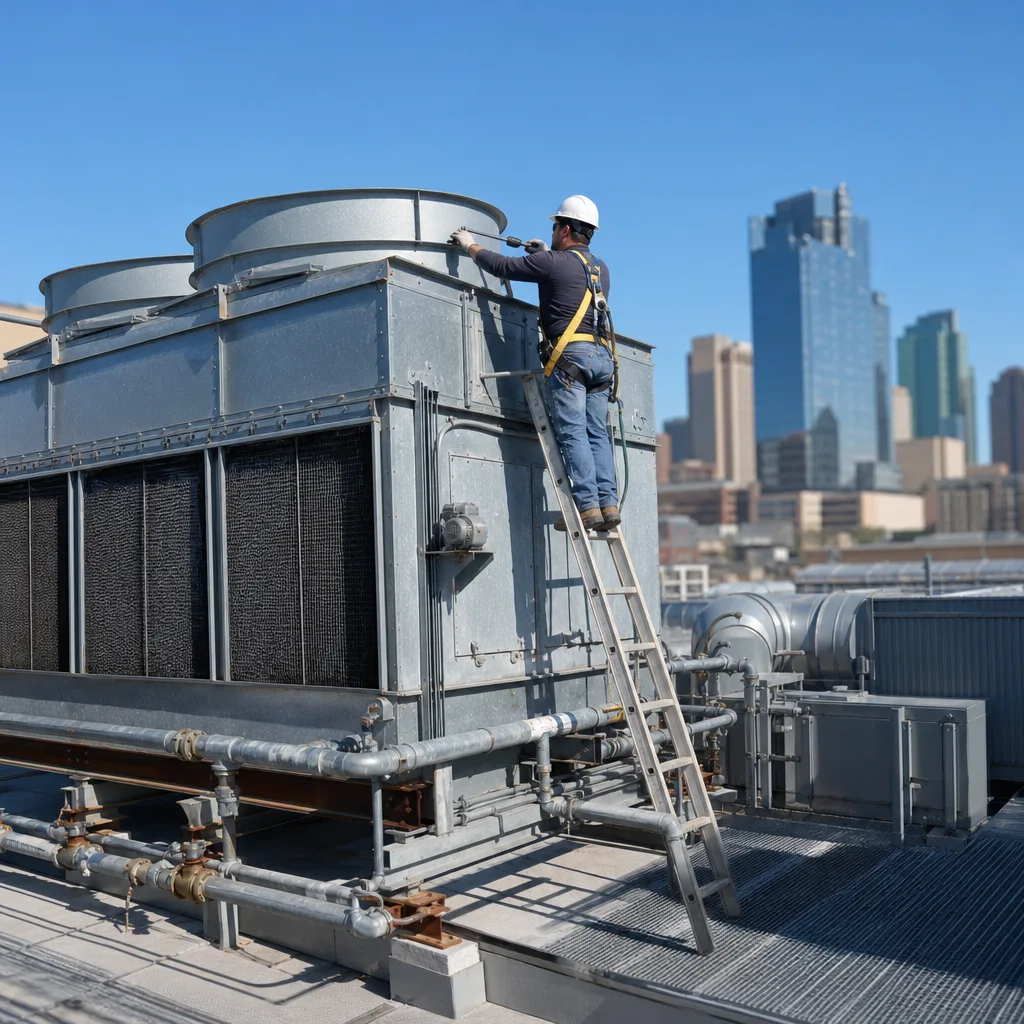
Here’s the thing most people don’t hear up front. Your cooling tower doesn’t cool your building by itself. It takes the heat your chiller pulls out of the building and dumps it outside. If one piece of that loop is sized wrong or hooked up poorly, the new tower can’t do its job.
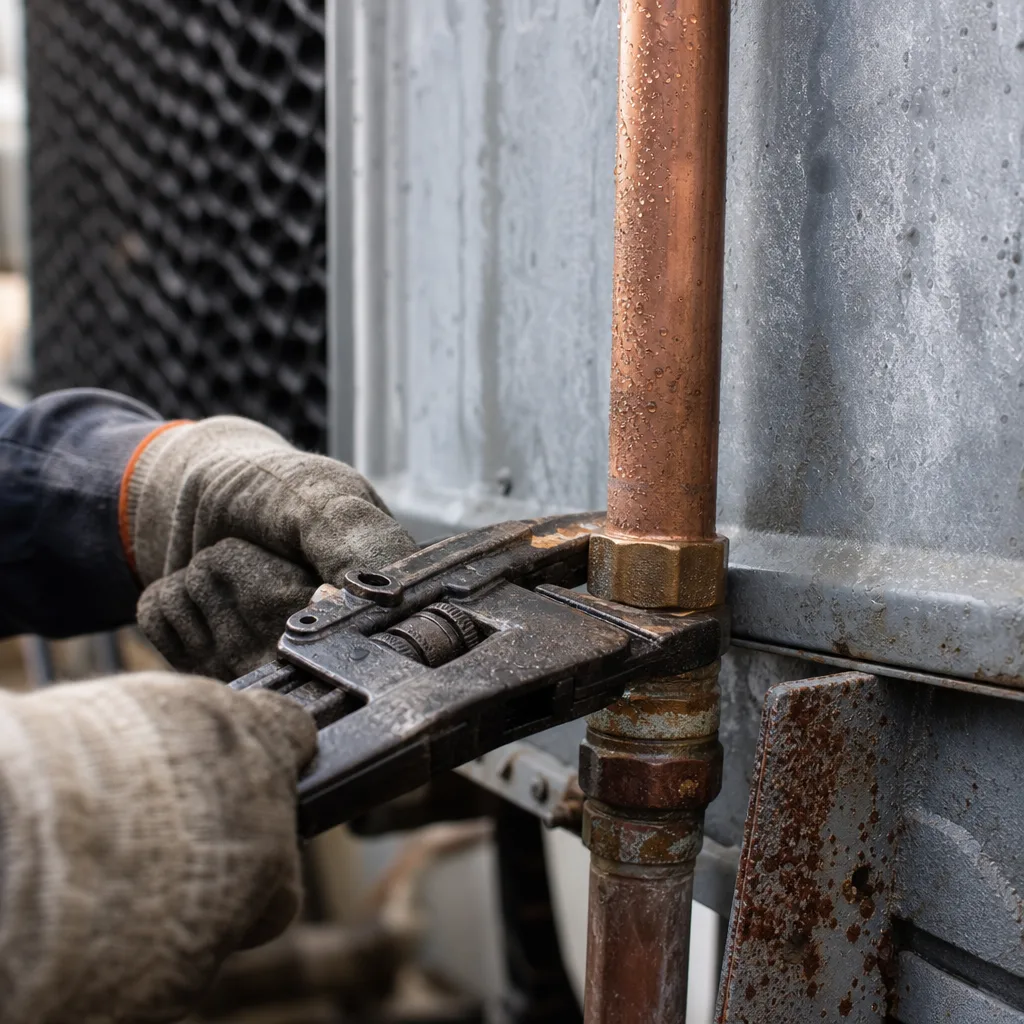
So when you replace or add a tower, you’re really working on your whole chilled-water plant. These are the pieces that have to line up:
- The tower itself, sized to match your chiller’s heat load and set on a base that can carry its weight when full of water.
- Condenser water piping that runs between the tower and the chiller, with the right pipe size so water moves at the flow the chiller needs.
- Condenser water pumps that push that water around the loop. An old pump can starve a new tower.
- The chiller tie-in, so the chiller and tower trade heat the way the design calls for.
- Electrical power for the fan motors and pumps, plus any upgrades the new equipment needs.
- Controls that turn fans and pumps on and off, ideally linked to your building automation system so you can see what the plant is doing.
- Startup and testing, where the system runs under real load and gets checked before anyone calls it done.
Fort Worth makes this matter more. Your tower works hardest in the middle of a North Texas summer, which is exactly when your building needs the most cooling. A plant that’s barely keeping up in May can fall behind in August. Hard water adds another layer. Cooling towers lose water to evaporation and leave minerals behind, so scale can build up on the fill and inside the chiller’s condenser tubes if the water side isn’t planned for from day one.
That’s why the scope on your quote matters as much as the bottom line. Our most common job is a standard like-for-like cooling tower installation using existing connections with no major modifications. It covers equipment and materials plus professional installation, startup, and testing.
To be clear about what that means for you: included are equipment and materials, professional installation, standard connections, startup and testing, and haul-away of the old unit. Excluded are duct, electrical, and plumbing modifications, code corrections, and permits unless stated. If your piping, pumps, or electrical need changes to fit the new tower, that’s separate work, and you should see it written down before anything starts.
This is where having one team helps. Xtreme Air Services handles HVAC, plumbing, and electrical under one roof, and we’re licensed and insured (HVAC License #TACLA29023C). We also cover the work around the tower, like chiller installation, pump installation and repair, piping installation, and building automation. That means the people working on your tower aren’t waiting on another company to finish the parts that tie into it. You get one accountable team for the whole plant.
Signs Your Building Needs a New Cooling Tower
Your cooling tower usually tells you it’s wearing out long before it quits. The trouble is that the signs show up in different places. Some are on the tower, some are on the chiller, and some are on your water bill. If you’re seeing several of these at once, it’s time to talk about replacement instead of another repair.
Start with how the building feels on the hottest afternoons. Say your chiller runs fine in the morning but trips offline around 4 p.m. in August, or the upper floors get warm while the lower floors stay cool. That often means the tower can’t shed enough heat when the load peaks. The chiller sees hot condenser water coming back, its pressure climbs, and it shuts itself down to stay safe. In a Fort Worth summer, that’s the exact moment your tenants, customers, or staff notice.
Then walk out and look at the tower itself. These are the signs worth writing down:
- Rust, flaking, or holes in the casing or the cold water basin, especially where water sits all day.
- Leaks around the basin, the seams, or the piping connections that come back after they’re patched.
- Fill that’s sagging, cracked, crushed, or caked with scale. Fill is the honeycomb material water trickles over, and it does most of the cooling. Damaged fill means less cooling surface.
- A fan or gearbox that shakes, grinds, or squeals. Heavy vibration can loosen bolts and wear out the structure around it.
- Supports, framing, or the deck that look bent, rotted, or corroded. That’s a safety issue, not just a performance one.
- Water spraying or misting off the tower more than it used to, or puddles and white mineral spots around the base.
Your numbers can tell the same story. Watch for makeup water use that keeps climbing, since that’s the fresh water the tower pulls in to replace what it loses. Watch for chiller energy use creeping up month over month with no change in how the building is used. And keep an eye on how often the same tower parts get fixed. When repair invoices start stacking up on equipment that’s already worn, you’re paying to keep an old tower limping along.
Scale deserves its own mention. With the hard water we covered above, minerals can build up on the fill and inside the chiller’s condenser tubes. A little scale can be cleaned. Fill that’s packed solid, or a basin and casing eaten away underneath the buildup, usually can’t be brought back to like-new shape.
One more sign has nothing to do with wear. If you’ve added floors, tenants, equipment, or a bigger chiller since the tower went in, the tower may simply be too small now. A tower that was sized right ten years ago can be undersized today, even if it looks fine.
None of these signs means you have to replace the tower tomorrow. A single bad fan motor or one worn pump is often a repair. What points toward a new tower is a pattern: structural wear plus falling performance plus rising repair costs, all on the same unit. When you see that pattern, getting a replacement planned before the next peak season beats losing the plant on the hottest day of the year.
Repair or Replace: Know Which One You Need
Not every tower problem means you need a new tower. The real question is whether the frame and basin are still sound. If the bones of the tower are good, you can usually fix the parts that wear out. If the bones are failing, new parts won’t save it.
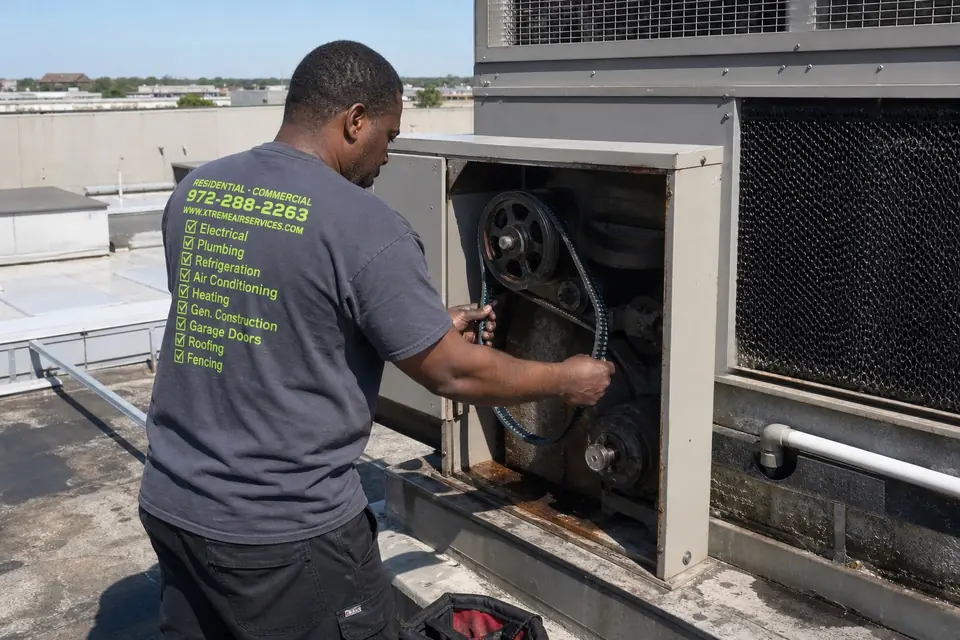
A repair usually makes sense when the trouble is limited to one moving part or one worn piece on a tower that’s otherwise in good shape. For example:
- A fan motor that burned out, while the fan, shaft, and gearbox are still fine.
- A gearbox or belt drive that’s noisy, on a tower with solid supports.
- A condenser water pump that’s worn and isn’t moving enough water.
- Clogged spray nozzles, or a float valve that won’t control the water level.
- A single leak at a pipe connection that hasn’t come back after a proper fix.
There’s also a middle option people don’t always hear about. If the casing and basin are solid but the fill is scaled up or crushed, you can often replace the fill and other worn parts inside. This kind of partial rebuild can bring back a lot of cooling without the cost of a whole new tower. It only works if the structure around those parts will last as long as the new parts do.
Replacement makes more sense when the problem is the tower itself, not one part on it:
- The basin, casing, or frame is corroded through, and patches keep failing.
- The tower is too small for the load your building carries now.
- Several major parts are wearing out at the same time.
- A repair would cost a big share of a new tower, on a unit that’s already near the end of its life.
- Your chiller is being replaced, and the old tower doesn’t match the new chiller’s heat load.
Here’s the honest part. If your tower has one bad motor and a solid frame, you don’t need a new tower, and no one should sell you one. Fix the motor and keep running. The same goes for a worn pump or a few clogged nozzles. Those are normal upkeep, not a sign the whole tower is done.
Timing matters too. In Fort Worth, your tower carries its heaviest load in the summer. If you know replacement is coming, plan it for the cooler months when your building can get by with less cooling. Doing it in an emergency in August means less choice on equipment, longer downtime, and more stress on your tenants or staff.
Before you agree to either path, ask these questions:
- Is the basin and frame sound enough to last another several years?
- What’s failing, and can you show me?
- If I repair it now, what’s likely to fail next?
- Is the tower still sized right for my building and my chiller?
A good contractor will answer all four in plain English and put the reasons in writing. Our team handles mechanical system troubleshooting, so we can look at the tower, the pumps, and the chiller together. That way you’re making the call based on the whole plant, not one part.
Have questions? We’re happy to help.
Call Today, Get Service Today. Xtreme Air Services — Fort Worth is ready to help.
What a Cooling Tower Installation Project Includes
A cooling tower installation is a planned project, not a one-day swap. Most of the work that decides whether your new tower runs well happens before the old one comes down and after the new one is set. Here’s what a complete project should cover, in the order it usually happens.
- Load and sizing check. Someone confirms how much heat your chiller needs to reject today, not when the old tower went in. This is where an undersized tower gets caught.
- Site and structure review. A full tower holds a lot of water and gets very heavy. The roof, deck, or pad has to carry that weight, and there has to be a clear way to lift equipment in and out.
- Shutdown planning. Your plant has to go offline for the swap. A good plan picks the timing and spells out how long the building will run with less cooling or none.
- Removal of the old tower. This includes draining it, disconnecting it, lifting it out, and hauling it away.
- Setting the new tower. It gets lifted into place, leveled, and anchored so it can handle wind and vibration.
- Piping and electrical tie-in. Condenser water lines connect to the new tower. Power runs to the fan motors and pumps.
- Controls hookup. Fans and pumps get wired to the controls, and to your building automation system if you have one.
- Water-side setup. The tower gets filled and the basin checked. With North Texas hard water, the plan for keeping scale off the fill and chiller tubes should be part of this step, not an afterthought.
- Startup and testing. The system runs under load. Flow, temperatures, fan operation, and water levels get checked before anyone calls it finished.
If a quote skips any of these stages, ask why. Missing the sizing check or the structural review can turn a smooth job into a costly surprise halfway through.
Price follows the size and difficulty of the job. Our typical price range for cooling tower installation is $10,000-$100,000. Our most common job is a standard like-for-like installation using existing connections with no major modifications, and that runs $28,000-$64,000.
What moves your number up or down:
- Equipment size, capacity, and efficiency
- Brand and model
- How easy it is to reach the tower site
- The condition of your existing wiring and plumbing
- Code upgrades and permits
- Any custom fabrication, such as new supports or piping changes
Access is the one owners most often underestimate. A rooftop tower that needs a large crane on a busy street is a different job from a ground-level tower with open space around it. The same goes for a tower whose piping or electrical has to change to fit the new unit. Those changes fall outside the standard scope we covered above, so they should show up as separate line items on your quote before work starts.
A project this size is a big expense to take on all at once. Flexible financing is available on qualifying installations and larger jobs, on approved credit. That can help you replace a failing tower on your schedule instead of waiting until it quits in the middle of summer.
Watch Our Video
See How We Handle Cooling tower installation in Fort Worth
Xtreme Air Services — Fort Worth
What Drives Cooling Tower Installation Cost
The price ranges we shared above give you the ballpark. Where your project lands inside them comes down to choices and site conditions you can see on a quote. That’s why two bids for what looks like the same tower can come back far apart. Usually one includes more of the plant than the other.
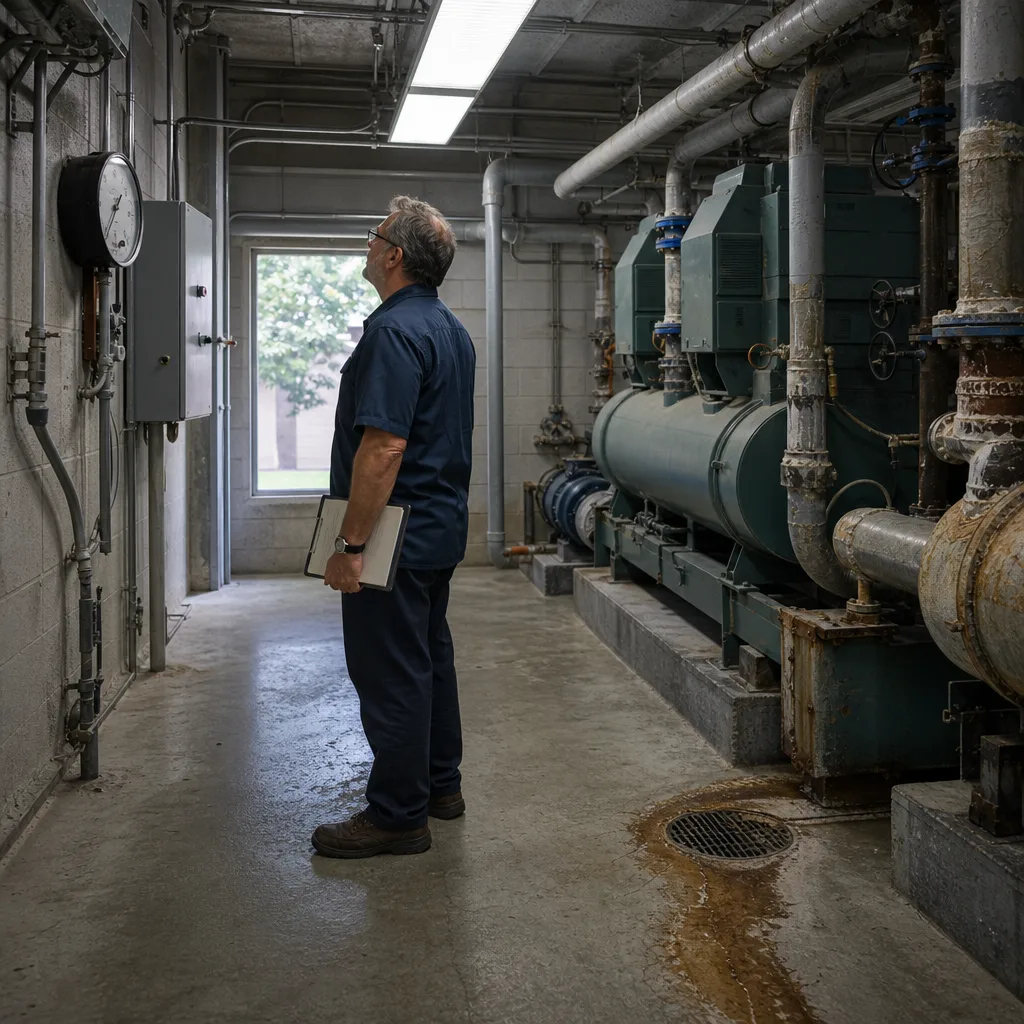
These are the choices that move the number the most.
- Tower type. Most buildings use a factory-built tower that arrives in one or a few pieces. Very large plants may need a tower built on site, which takes more labor and time. A closed-circuit tower keeps your loop water sealed inside a coil. It costs more up front but keeps dirt and minerals away from your chiller.
- Materials. Galvanized steel, stainless steel, and fiberglass all hold up differently. With hard water and heavy summer evaporation, a basin that resists corrosion can be worth paying more for.
- Fan drive. A variable frequency drive, or VFD, lets the fan slow down when the building needs less cooling instead of running full blast. It adds cost now and can trim energy use through the mild spring and fall months.
- Shutdown plan. If your building can’t go without cooling, you may need temporary cooling equipment during the swap. Scheduling the job in cooler months can shrink or skip that cost.
- Water treatment setup. Chemical feed, blowdown controls, and filtration protect the fill and chiller tubes from scale. Leaving them out lowers the quote but can raise your costs later.
A low price and a low cost aren’t the same thing. A bid that skips the pump check, the controls hookup, or startup under real load can look like a bargain. Then the missing work shows up as a change order halfway through, or as a new tower that can’t keep up in August. When you line quotes up, compare what each one connects, tests, and leaves out.
Ask every contractor these questions before you sign:
- What’s excluded, and what would those items cost if my building needs them?
- Who pulls the permit, and is it in this price?
- Are the crane and rigging included?
- Does the price cover startup and testing under load, not just a quick power-on?
- How long will my plant be down, and what’s the plan for cooling during that time?
- Are my condenser pumps and piping right for the new tower, or will they need work?
A contractor who’s confident in the price will answer all six in plain English and put it in writing. That’s how we work. You get upfront pricing approved before work starts, with no surprises. Our licensed and insured team covers HVAC, plumbing, and electrical, so the pieces that tie into your tower are part of one plan, not someone else’s problem.
Frequently Asked Questions
Common questions about Cooling tower installation
Can my building run without cooling while the new tower goes in?
Usually your plant has to go offline for part of the swap, so shutdown planning is a key step before work starts. We walk through the timing with you and spell out how long you’ll run with less cooling or none. If your building can’t go without it, temporary cooling equipment can cover the gap. Scheduling the job in cooler months, instead of mid-summer, often shrinks or skips that need altogether.
Do I need a crane to install a cooling tower?
It depends on where your tower sits and how heavy it is once full of water. A rooftop tower on a busy street often needs a large crane, while a ground-level tower with open space around it is a much simpler lift. Crane and rigging costs should be spelled out on your quote before work starts, not added as a surprise later.
Will my old condenser water pumps and piping work with a new tower?
Not always, and it’s worth checking before you commit to a price. An old pump can starve a new tower of the flow it needs, and piping sized for the old unit may not match the new one. That’s why a load and sizing check, plus a look at your existing pumps and piping, should happen before the new tower goes in, not after.
Ready to Get Started?
Call (817) 677-1907 Today, Get Service Today.