


Commercial Refrigeration in Plano: Repair Before You Lose Inventory
Walk-in coolers, freezers and ice machines repaired by licensed refrigeration technicians – usually one part, not a whole new system.
What’s Covered on This Page
- What a Commercial Refrigeration Repair Visit Covers
- Common Reasons a Walk-In Cooler, Freezer, or Ice Machine Fails
- Signs You Need Refrigeration Service Now vs. Scheduled Maintenance
- Why Licensing Matters When Hiring a Refrigeration Contractor in Texas
- What Drives Repair Cost Up or Down
- What makes a commercial refrigerator different from the one in my kitchen at home?
- What is a cold storage refrigeration unit, and is that the same as a walk-in cooler?
What a Commercial Refrigeration Repair Visit Covers
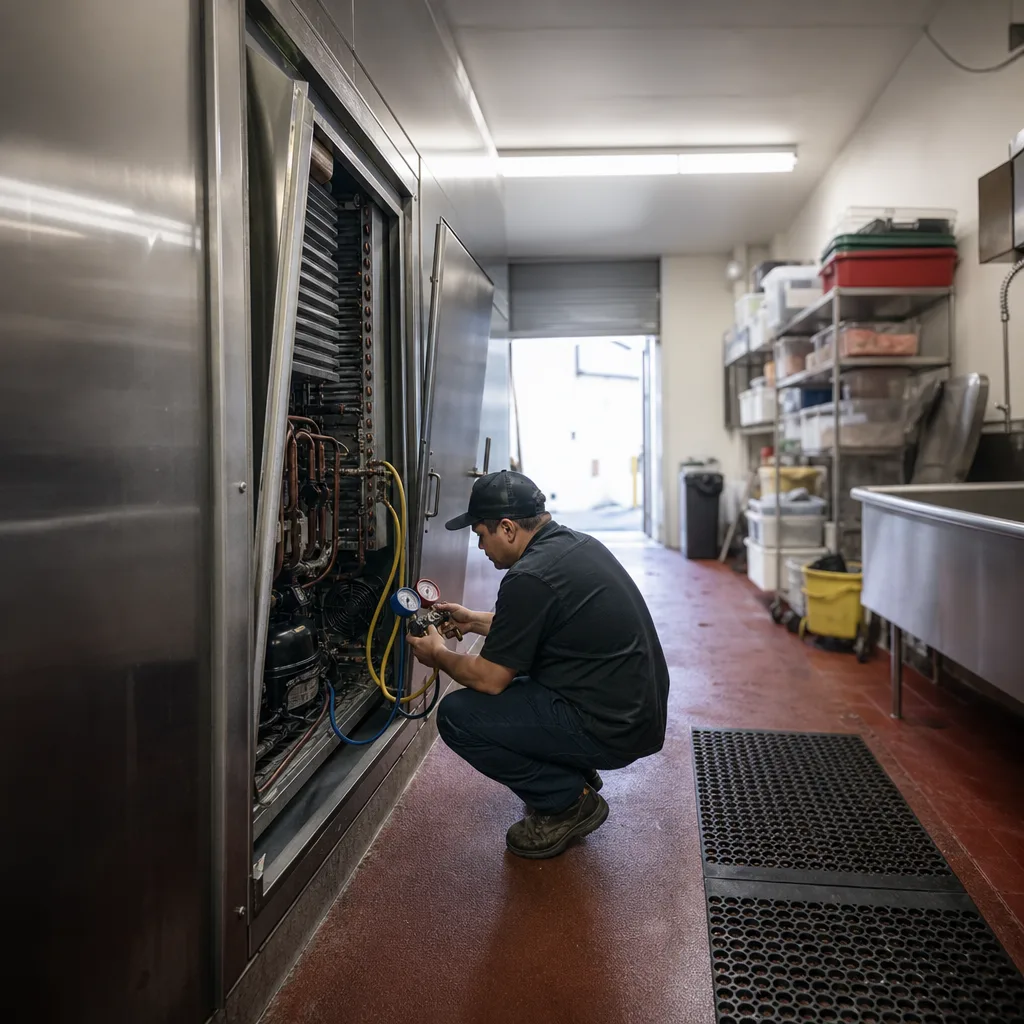
When your walk-in cooler is creeping up past safe temperatures or your reach-in freezer is sweating, you want two answers fast: what broke, and what it’ll cost to fix. Here’s what you’re paying for on a commercial refrigeration repair visit.
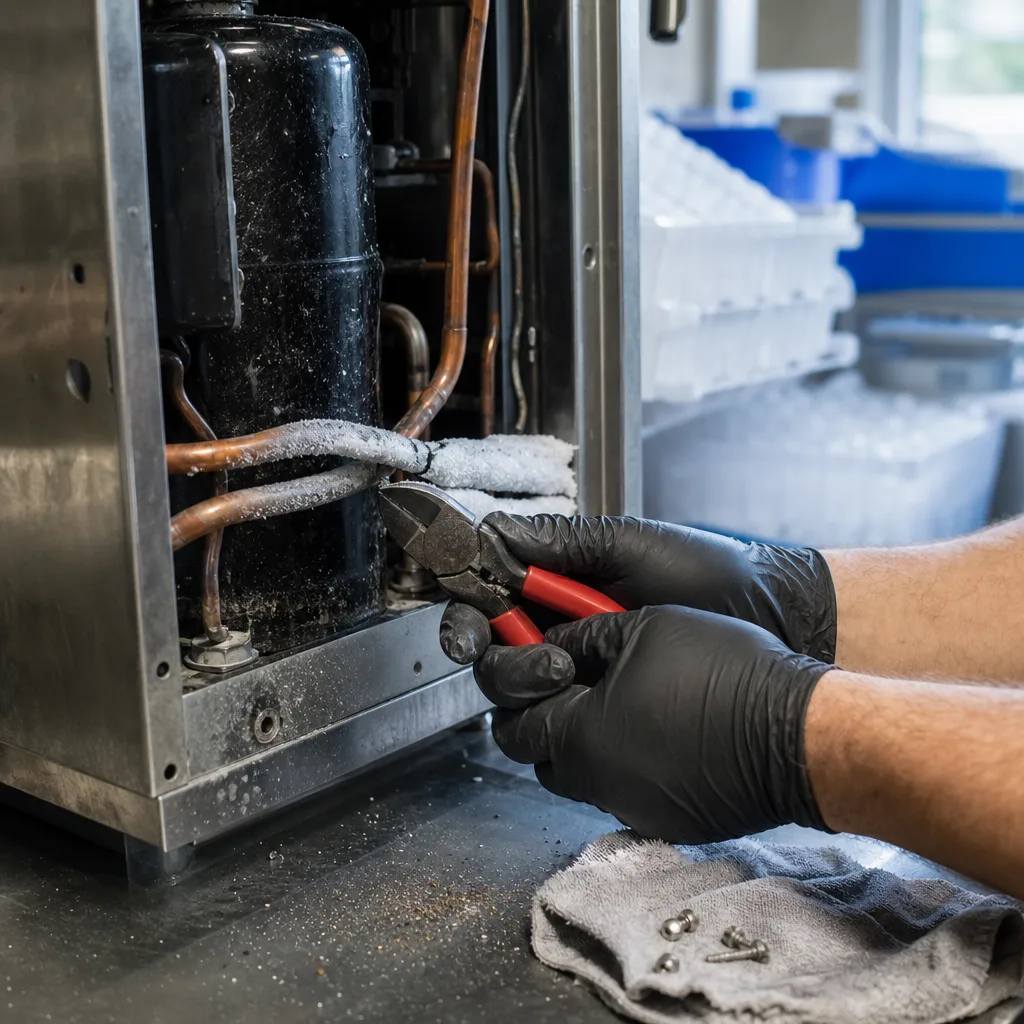
The job is simple to describe. We locate the failed part, repair or replace it, and verify the system runs correctly before we leave. Most calls come down to a single common failure that gets fixed on the first visit. That matters when you’ve got product sitting in a cooler that isn’t holding temperature.
Common culprits in commercial units include a condenser fan motor that’s quit, a dirty or blocked condenser coil, a failed start component on the compressor, a defrost problem that ices up the evaporator, or a worn door gasket letting warm air in. In Plano’s long summers, condensers parked on rooftops or behind restaurants work harder than they do most of the year, and that’s often when a weak part finally gives out.
- Included: diagnosis, labor, and the standard replacement part, plus testing and cleanup.
- Not included unless quoted separately: additional failed parts, major components, code upgrades, or permits.
- Service-call fee: $26-$99, credited toward the repair if you proceed with Xtreme Air Services.
Your price is upfront and flat-rate, and you approve it before work starts. No meter running while you wonder what the final bill will look like. If we find a second failed part or a major component like a compressor that needs replacing, that’s quoted to you separately so you can decide.
On cost, the most common job runs $300-$2,400. Across all commercial refrigeration work, the typical range is $300-$5,000. Where your repair lands depends on a few things:
- How extensive the failure is
- Part cost and availability
- Your equipment’s age and brand
- Whether more than one component has failed
After-hours timing can push prices up with a lot of companies. Not here. Xtreme Air Services charges no extra for nights or weekends, so a cooler that quits during Saturday dinner service costs the same to fix as one that quits on a Tuesday morning.
If the repair turns into a bigger job or a replacement, flexible financing is available on qualifying installations and larger jobs, on approved credit. That way a major failure doesn’t have to wreck your cash flow for the month.
Common Reasons a Walk-In Cooler, Freezer, or Ice Machine Fails
Most refrigeration breakdowns start small. A part wears out, a line clogs, or a fitting starts to leak. The box slowly loses ground until your product isn’t safe. Beyond the condenser, compressor, and gasket problems covered above, here’s what tends to take down each type of equipment and what you’ll notice first.
Walk-in coolers:
- Evaporator fan motor quits. The coil inside still gets cold, but no air moves across it. You’ll feel cold near the coil and warm spots everywhere else.
- Refrigerant leak. A slow leak at a fitting or coil makes the system run longer and longer until it can’t catch up. A unit that never shuts off, or frost on the copper line coming out of the box, are common clues. Finding and fixing the leak matters more than just adding refrigerant.
- Controller or thermostat failure. The display says 36 degrees, but your own thermometer says 45. The system is shutting off too early or not turning on when it should.
- Clogged drain line. Water pools on the floor or drips onto product. In a cooler, it’s a mess and a slip hazard.
Walk-in freezers:
- Frozen drain line. Freezers use a small heater to keep the drain open during defrost. When it fails, meltwater refreezes in the pan and builds into a block of ice under the coil.
- Door frame heater failure. The door freezes to the frame or won’t seal, and you’ll see ice building up around the edges.
- Expansion valve trouble. This valve meters refrigerant into the coil. When it sticks, the coil either starves or floods, and the freezer can’t hold temperature.
Ice machines:
- Scale buildup. The hard water common across North Texas leaves minerals on the freezing plate and water parts. Ice comes out thin, cloudy, or slow, or the machine stalls when it tries to drop a batch.
- Clogged water filter or failed water inlet valve. If no water gets in, no ice comes out.
- Ice sticking to the plate. When the harvest cycle can’t release the ice, production drops off fast.
- Overheating in a hot kitchen. An ice machine tucked into a tight, greasy spot with poor airflow struggles all summer.
Before you call anyone, check these. They take five minutes and sometimes solve the problem:
- Is the breaker on and the unit’s power switch flipped on?
- Does the door close and latch all the way? Are strip curtains hanging in place?
- Is product stacked against the evaporator fan or blocking the airflow inside the box?
- Does a separate thermometer agree with the display?
If all of that checks out and the temperature is still climbing, a part has failed. Early warning signs include a cooler that runs nonstop, frost where it doesn’t belong, or an ice machine making less ice than it used to. Catching the problem at that stage can mean fixing one part instead of several, and that’s one of the biggest factors in what your repair costs.
Signs You Need Refrigeration Service Now vs. Scheduled Maintenance
The real question isn’t whether something is wrong. It’s whether it can wait. Here’s how to sort it out once you’ve done the quick checks above.
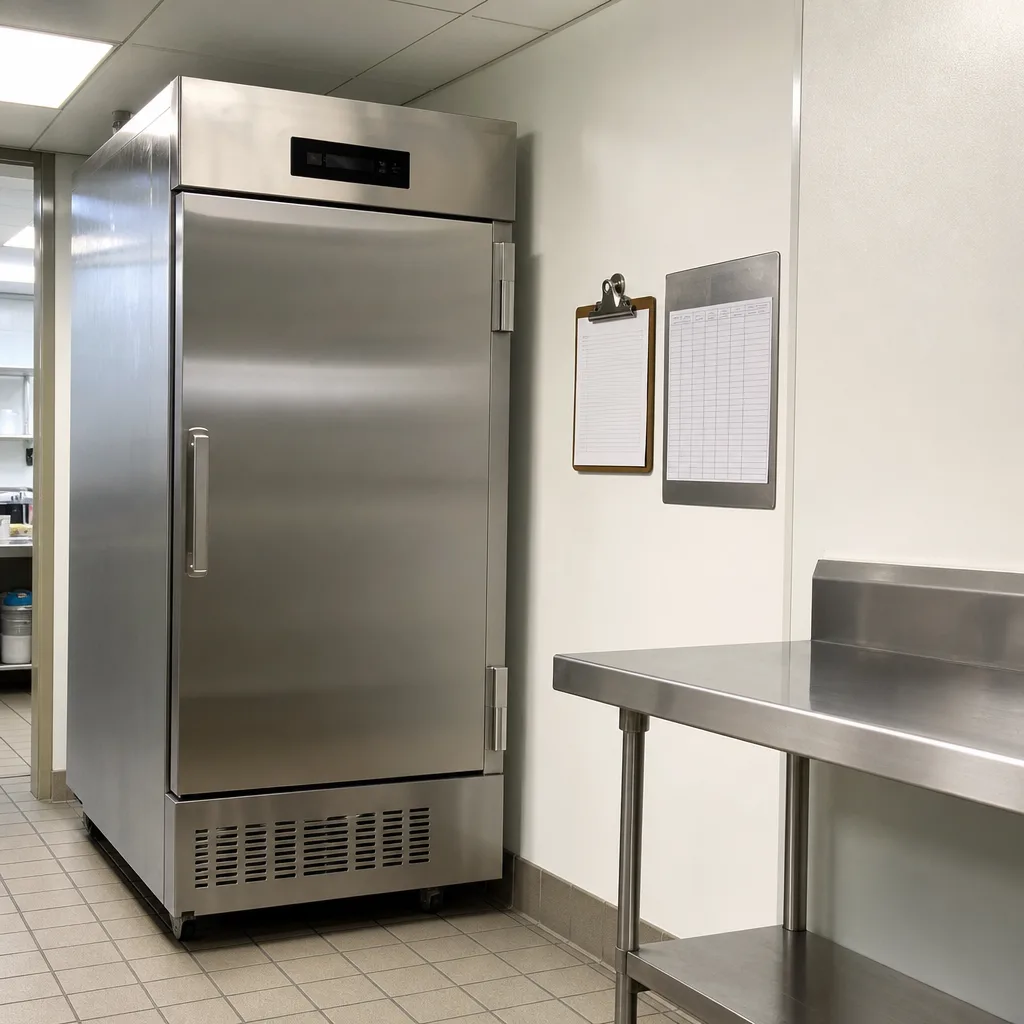
Call today if you see any of these:
- The temperature keeps climbing and won’t come back down, even with the door shut and the airflow clear. Your product is now on the clock.
- The breaker trips again after you reset it. Don’t keep flipping it back on. Something is drawing too much power, and that’s a safety issue as much as a cooling one.
- You smell something burning or hot near the condensing unit or the controls.
- The unit makes a loud grinding, banging, or buzzing sound and then shuts off.
- Water is spreading across the floor of a walk-in or pouring out from under an ice machine. It’s a slip hazard for your staff tonight, not next week.
- You hear a hiss near the copper lines or see oily spots on fittings. Those are common signs of a refrigerant leak.
Waiting on any of these usually turns one failed part into two, and it can cost you a full box of product. Price isn’t a reason to hold off either, since there’s no extra charge for nights or weekends.
Book a visit in the next few days if the unit is still holding temperature but something has changed:
- It runs longer between cycles than it used to.
- A light layer of frost keeps coming back on the coil or the door frame.
- Your ice machine is making less ice, or the cubes look thinner.
- A door gasket is torn or flattened in one spot.
- The display and your own thermometer disagree by a few degrees.
These are early warnings. The system is working harder to keep up. Getting it looked at now is usually a smaller, simpler fix than waiting for it to quit on a busy Friday.
Some things don’t need a repair call at all. If your cooler holds steady, cycles on and off normally, and keeps product where it should be, you don’t need an emergency visit. Don’t pay for urgency you don’t need. What you do need is routine care: cleaning condenser coils, descaling ice machines, clearing drain lines, and checking gaskets and door heaters before they fail.
Timing matters in Plano. Rooftop and back-lot condensers take a beating through the long summer, so late winter and early spring are a smart time to book maintenance. Then your equipment heads into peak heat clean and checked, not already struggling. Xtreme Air Services offers commercial preventive maintenance, so routine care can be lined up ahead of time instead of squeezed in after a breakdown.
If you’re waiting on a technician for an urgent problem, keep the door closed and move your most valuable product to a unit that’s holding temperature. Write down readings from your own thermometer every so often. That log helps you decide what to keep, and it helps us find the problem faster.
Call now
Not sure what your Commercial refrigeration project needs? Ask us.
Call Today, Get Service Today. Xtreme Air Services — West Plano is ready to help.
Why Licensing Matters When Hiring a Refrigeration Contractor in Texas
When your walk-in is warming up, it’s tempting to call whoever can show up first. But the person working on your system is handling high-voltage wiring, pressurized refrigerant lines, and equipment that keeps thousands of dollars of product safe. A license is your quickest way to know they’re trained and accountable for doing that work right.
In Texas, air conditioning and refrigeration contractors are licensed by the Texas Department of Licensing and Regulation, or TDLR. That license means the contractor has met state requirements to do this kind of work. It also means there’s a state agency you can go to if something goes badly wrong. An unlicensed tech gives you none of that.
Refrigerant is another big reason. Federal EPA rules require technicians who handle refrigerant to be certified. A properly trained tech finds and fixes the leak, then recovers and recharges refrigerant the right way. A shortcut, like topping off a leaking system and leaving, gets your cooler cold for a few days. Then you’re right back where you started, with more product at risk and a second bill.
Insurance matters just as much. Picture a tech who nicks a line in your ice machine and floods the kitchen floor before Friday dinner service. If that person isn’t insured, the cost of the damage could land on you. A licensed and insured contractor carries that risk, not your business.
Before you hire anyone to work on your commercial refrigeration, ask these questions:
- What’s your Texas license number? You can look it up on TDLR’s website in about a minute.
- Are your technicians certified to handle refrigerant?
- Can you show proof of insurance?
- Will I get the price before any work starts?
- Who’s coming to my business, and have they been background-checked?
A good contractor won’t mind any of these questions. If someone dodges the license question or can’t give you a straight number, keep looking. Your equipment and your inventory are worth that extra minute.
Here’s our answer, up front. Xtreme Air Services is a fully licensed and insured contractor, and our HVAC license number is TACLA29023C. Look it up anytime. The technicians who come to your door are licensed and background-checked, and you’ll see the price before we start, as covered above. We also handle commercial plumbing and commercial electrical, so if your refrigeration problem traces back to a drain or a circuit, you’re not juggling a second company.
That’s a big part of why we’ve earned a 4.8-star reputation across more than 2,900 reviews on Google, Angi, and HomeAdvisor. Business owners across North Texas trust us because we show up, explain what’s wrong in plain English, and stand behind the work. Our Plano office is at 5055 W Park Blvd, so your business isn’t a long drive for us.
Call 469-217-9095
Watch Our Video
See How We Handle Commercial refrigeration in Plano
Xtreme Air Services — West Plano
What Drives Repair Cost Up or Down
You’ve already seen the price ranges above. Here’s why one repair lands near the low end and another climbs toward the top, and what you can do about it.
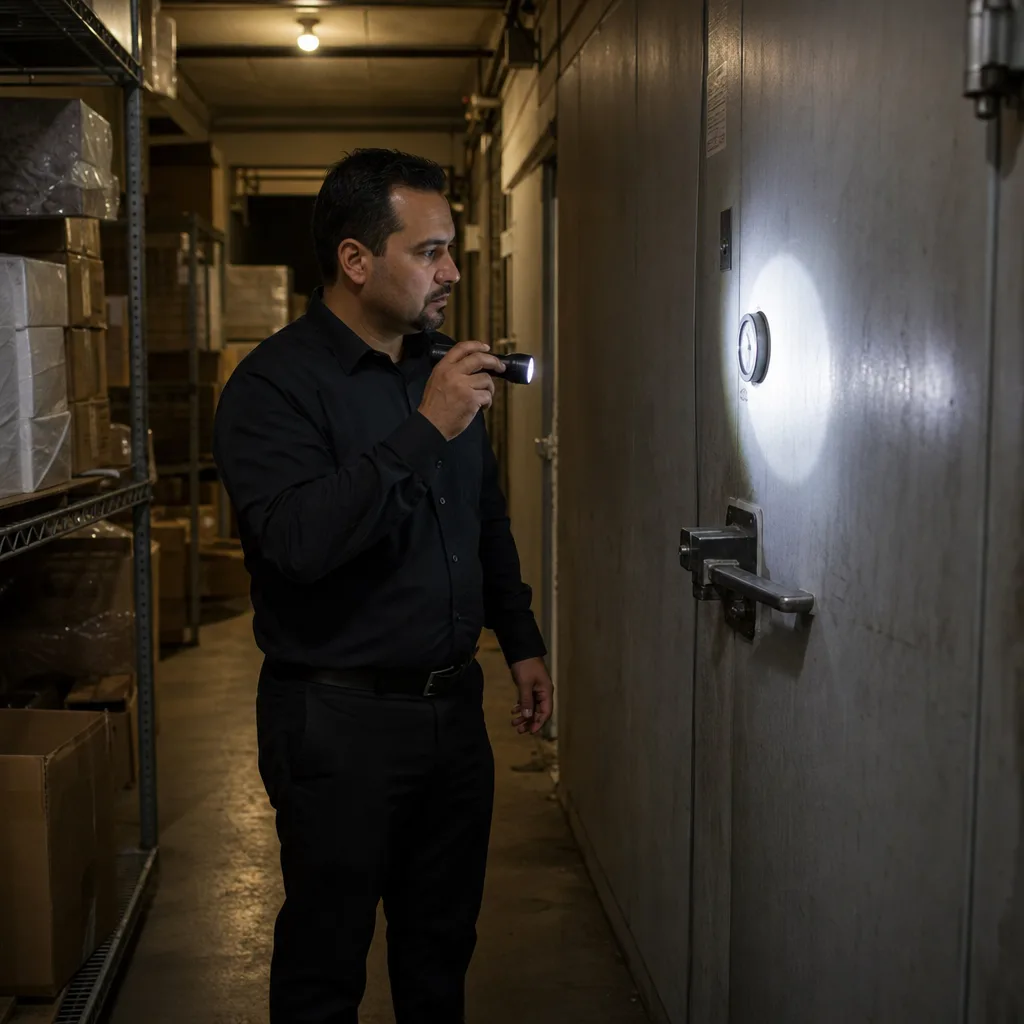
The biggest factor is how far the problem spread before anyone caught it. A condenser fan motor that quits is a fairly simple swap. But if that motor stopped days ago, the compressor may have been running hot the whole time with no air moving across the coil. Now you might be looking at two parts instead of one. A dirty condenser coil works the same way. It makes the whole system strain, and parts that strain wear out sooner. That’s why the early warning signs covered above matter so much for your wallet.
Refrigerant leaks take more work than most people expect. A good repair means finding the leak, fixing it, pulling the system into a vacuum to clear out air and moisture, and then recharging it. Each step takes time and equipment. A quick top-off costs less today, but it doesn’t fix anything. You’ll pay again when the charge leaks back out.
Part availability can change both the price and how long you wait. Common parts like fan motors, capacitors, and relays are usually easy to get. A brand-specific control board or expansion valve may have to be ordered, and some cost more simply because only one maker builds them.
Age plays a role too. Older equipment may run on a refrigerant that’s no longer made, so recharging it gets expensive. Replacement parts for discontinued models can also be hard to track down. At some point, putting more money into an old box stops making sense. A good technician should tell you when you’ve reached that point instead of letting you find out after three repair bills.
How a company bills matters just as much as what breaks. Some contractors charge by the hour plus parts. With hourly billing, a slow diagnosis or an extra trip to the supply house shows up on your bill. Flat-rate pricing sets the price for the job before work starts, so the number doesn’t grow while the tech works. That’s how we price, as covered above.
Before you approve any repair, from us or anyone else, ask:
- Is this the full price for the job, or could it change?
- If you find a second failed part, will you stop and quote it before going ahead?
- Is the part available now, or does it have to be ordered?
- Given the unit’s age, does repairing it still make sense compared with replacing it?
A few simple habits help keep your costs down. Keep the area around your condensing unit clear so it can breathe. Have the unit’s model and serial number handy when you call, because that helps pin down the right part faster. Make sure the tech can get to the equipment easily, whether it’s on a roof, in a back hallway, or behind a prep line. Most of all, call when something first seems off. Fixing one part costs far less than fixing the three it took down with it.
Frequently Asked Questions
Common questions about Commercial refrigeration
What makes a commercial refrigerator different from the one in my kitchen at home?
A commercial unit is built to run nonstop and hold steady temperatures under much heavier use than a home fridge. It uses stronger compressors, fan-driven cooling, and tougher gaskets and shelving to handle constant door openings in a restaurant or store. Because it runs all day, every day, worn parts like fan motors, gaskets, and start components fail sooner and need faster attention than a home fridge ever would.
What is a cold storage refrigeration unit, and is that the same as a walk-in cooler?
A cold storage refrigeration unit is a broad term for any space built to hold product at a controlled cold temperature, which includes walk-in coolers, walk-in freezers, and reach-in units. The difference between them usually comes down to size and temperature range. A walk-in cooler keeps product above freezing, while a walk-in freezer holds it well below. Both rely on the same basic parts covered in a repair visit: a working condenser, compressor, evaporator fan, and a sealed door to hold the temperature steady.
Ready to Get Started?
Call (469) 217-9095 Today, Get Service Today.