
Most people assume their HVAC is either cooling or not cooling, unaware that economizer mode HVAC settings can pull in free outdoor air to cut costs. What is economizer mode in HVAC is a question that rarely comes up until an energy bill does. Economizer mode, known formally as “free cooling” in the industry, is a built-in function that lets your system pull in cool outdoor air instead of running the compressor. It sounds simple, but the way it works and the savings it delivers surprise almost everyone who learns about it. This guide breaks down exactly how it operates, why it matters, and what you can do right now to get more out of it.
Table of Contents
- Key Takeaways
- What is economizer mode in HVAC systems
- Real benefits of economizer mode for your building
- Economizer mode vs. other HVAC settings
- How to maintain and optimize economizer function
- My honest take on economizer mode
- Ready to get more from your HVAC system?
- FAQ
Key Takeaways
| Point | Details |
|---|---|
| Free cooling by design | Economizer mode uses cool outdoor air to reduce or replace mechanical cooling, cutting energy use. |
| Real energy savings | Properly maintained economizer systems can save up to 30% on cooling energy costs. |
| Not the same as Eco mode | Economizer mode is a specific hardware function involving dampers and sensors, not a thermostat setting. |
| Maintenance is non-negotiable | Stuck dampers and drifting sensors can quietly erase all the savings economizer mode creates. |
| Works best with smart controls | Modern AI-based diagnostics help detect faults early and keep economizer systems performing at their peak. |
What economizer mode HVAC systems do
At its core, economizer mode is your HVAC system’s way of getting “free cooling” by using the outdoor environment instead of running its mechanical refrigeration cycle. When outside air is cool and dry enough, the system opens its outdoor air dampers wide, pulls that fresh air in, and uses it to handle the building’s cooling load. The compressor stays off or runs at reduced capacity. You get cooler indoor air without paying to run the equipment that normally makes it cold.
The key hardware involved is the damper assembly. Airside economizers adjust outdoor and return-air dampers to match available cooling capacity with the actual cooling demand at any moment. Temperature and humidity sensors monitor outdoor conditions constantly, and a controller decides whether to engage economizer mode or fall back to standard mechanical cooling.
Here is what happens step by step when conditions are right:
- Outdoor sensors detect that the outside air temperature and humidity fall within acceptable limits
- The controller signals the outdoor air damper to open beyond its minimum ventilation position
- Return air dampers partially close so more fresh outdoor air enters the supply stream
- The compressor load drops or shuts off entirely while the air handler fan keeps running
- Indoor temperatures stay comfortable because the incoming outdoor air is cool enough to maintain setpoints
Pro Tip: If your commercial HVAC unit has a manual damper position indicator, check it periodically. A damper locked in the minimum-open position means economizer mode has likely failed and your system is running on mechanical cooling every hour of every day.
The control strategies for when to engage this mode vary. The two most common are dry-bulb temperature control, which uses a single outdoor temperature sensor, and differential enthalpy control, which compares the energy content of outdoor air versus return air. Enthalpy-based control is more precise and delivers better savings in humid climates because it accounts for moisture, not just temperature.
Real benefits of economizer mode for your building
The financial case for a well-functioning economizer is hard to ignore. HVAC economizers reduce mechanical cooling loads by pulling in cooler outdoor air when conditions allow, and the compressor is the most energy-hungry component in any cooling system. Every hour the compressor stays off is an hour you are not paying full cooling rates on your electric bill. Pairing an economizer with ENERGY STAR certified HVAC equipment compounds those savings further.
The numbers back this up. ASHRAE estimates HVAC faults waste 5 to 30 percent of energy, and a non-functioning economizer is one of the most common culprits in commercial buildings. Flip that around and a properly functioning one delivers those percentage points back to you. For a medium-sized office running 10 or more hours a day through shoulder seasons, that translates to real dollars every month.
A facility manager in a mild climate like Dallas can expect meaningful compressor-off hours every spring and fall. That is not a marginal gain. That is a structural reduction in your cooling costs built directly into the system you already own.
Beyond money, the indoor air quality benefit is genuine. When economizer mode runs, you get significantly higher outdoor air exchange rates than the system delivers during standard recirculation cooling. Stale air, carbon dioxide buildup, and indoor pollutants dilute and exhaust faster. Occupants feel the difference, particularly in conference rooms or densely occupied spaces where CO2 can spike during standard operation.
There is also a mechanical wear argument. Fewer compressor run hours mean fewer heat cycles on the refrigerant circuit, less wear on contactors and capacitors, and a longer service life for the equipment. Boiler economizer research shows efficiency improvements of 3 to 15 percent with payback periods inside 12 to 24 months, and airside HVAC economizers follow a similar return-on-investment logic. The savings compound over years.
Economizer mode vs. other HVAC settings
This is where most homeowners and even some facility managers get confused. Economizer mode, Eco mode, and Fan Only mode sound like they might be related. They are not the same thing, and treating them as interchangeable is a costly mistake.
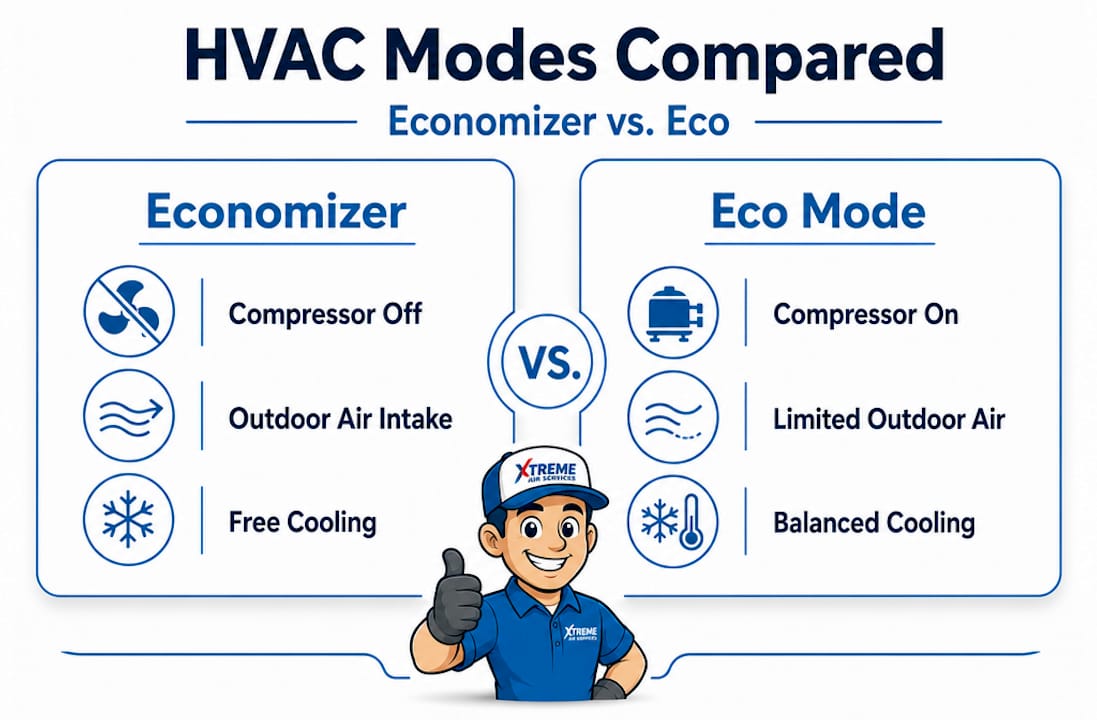
Eco mode balances cooling with energy savings but still runs the compressor. It typically widens the thermostat deadband or reduces compressor cycling frequency. Fan Only mode runs the air handler fan with the compressor completely off. Fan Only mode consumes less energy but delivers no active cooling. Economizer mode is different from both because it is a physical hardware function controlled by sensors and dampers, not a software setting on a thermostat.
| Mode | Compressor status | Outdoor air intake | Actual cooling | Energy use |
|---|---|---|---|---|
| Standard cooling | Running at full load | Minimum ventilation | Yes | High |
| Eco mode | Running, reduced cycling | Minimum ventilation | Yes, reduced | Moderate |
| Fan Only mode | Off | Minimum ventilation | No | Low |
| Economizer mode | Off or reduced | Maximum outdoor air | Yes, via outside air | Low to moderate |
The table makes the distinction clear. Economizer mode is the only one that delivers actual cooling while the compressor is off. That is its defining characteristic and its core value.
Control strategies also differ between residential and commercial applications. Residential systems with economizer capability typically use simpler dry-bulb controls. Commercial systems often use differential enthalpy control, which is more expensive to install but captures more savings in climates with variable humidity. In dry climates like much of the Southwest, even basic dry-bulb control works well because humidity rarely disqualifies cool outdoor air from being usable.
Pro Tip: If your building automation system has an economizer enable schedule, make sure it is set to run during shoulder seasons, spring and fall, not just summer. Many systems are configured conservatively and leave significant savings on the table during mild-weather months.
How to maintain and optimize economizer function
Understanding the concept is only half the work. Keeping the hardware in shape is what actually delivers savings year after year. Most economizer problems trace back to two components: dampers and sensors. Neither is complicated to maintain, but both are easy to neglect.
Follow this maintenance sequence at least once a year, preferably before cooling season starts:
- Inspect damper blades and linkages for corrosion, debris, or binding. A stuck damper is the single most common economizer failure. If it freezes in the closed position, you lose all free cooling. If it freezes open, you heat or cool a building with outdoor air regardless of whether conditions are favorable.
- Calibrate or replace outdoor air sensors. Temperature sensors drift over time. A sensor reading two degrees high can prevent economizer mode from ever engaging, even on days when it should run for hours. Enthalpy sensors in humid climates need annual validation against a known reference.
- Clean the filter on the outdoor air intake. Economizer mode dramatically increases the volume of outdoor air moving through the system. A clogged intake filter restricts that airflow, reduces the cooling effect, and puts extra strain on the fan motor.
- Review control setpoints. Setpoints installed for one climate may not fit your current situation. A control set to enable economizer only below 55°F outdoor temperature in a city where spring temperatures regularly reach 65°F is leaving money behind every mild day.
- Test the actuator operation end to end. Command the controller to open the damper fully, then fully closed. Watch the physical damper move and confirm it reaches both positions. Many actuators develop slip over time and never fully open.
Beyond scheduled maintenance, here are the warning signs that something is wrong with your economizer:
- Energy bills spike during mild weather when mechanical cooling should not be needed
- Your HVAC system cycles more frequently than normal during shoulder seasons
- Complaints about indoor air quality or stuffiness despite the system running
- The building automation system logs show economizer mode never engaging
AI-based fault detection identifies problems like stuck dampers and sensor drift earlier than any routine inspection schedule can catch them. Newer building automation systems with machine learning capabilities monitor economizer performance continuously and flag anomalies before they cause significant energy waste. If you manage a commercial property, HVAC maintenance services that include smart diagnostics are worth factoring into your annual service contract.
My honest take on economizer mode
I have been in and around HVAC systems for a long time, and economizer mode is one of those topics where I see a consistent gap between what the technology can do and what owners actually get from it.
Most of the time, the gap is not a hardware problem. It is an awareness problem. Homeowners and even some facility managers do not know the economizer exists on their system. They have no idea whether it is working. They call for service when something breaks but never ask whether the free-cooling function is running correctly.
What I have learned from servicing systems across different climates is that a neglected economizer is worse than no economizer at all. A damper frozen in the open position on a hot humid day pumps in air that the compressor then has to work harder to condition. I have seen energy bills go up from a “functioning” system because the economizer was stuck open in summer. That scenario is more common than it should be.
The other thing I want to push back on is the idea that economizer mode is only a commercial concern. Modern residential HVAC equipment increasingly incorporates fresh air dampers and smart ventilation controls that function on the same principle. If your home system has a fresh air intake with a motorized damper, you have economizer-adjacent functionality. Treating that component with the same maintenance discipline as a commercial unit pays off.
The future here is genuinely exciting. AI-based diagnostics are turning economizer optimization from an annual checklist into a continuous process. Systems that self-report damper position errors, flag sensor drift in real time, and automatically adjust control setpoints based on weather forecast data are already available. Getting there is not a luxury upgrade anymore. It is where the industry is heading, and the savings justify the investment.
— Xtreme
Ready to get more from your HVAC system?
If this article made you wonder whether your economizer mode HVAC setup is actually doing its job, that instinct is worth acting on. At Xtreme Air Services, we service and maintain HVAC systems for homeowners and facility managers across Dallas, Plano, Irving, and Sunnyvale, TX. Our technicians check damper function, sensor calibration, and control setpoints as part of a thorough inspection so you know exactly what you are getting from your equipment.
Clean air filters also matter more when economizer mode is running, because higher outdoor air volumes mean more particles hitting your filtration. Our MERV 8 pleated air filters are designed to handle that increased load without restricting airflow. Pair them with a professional inspection and you set your system up for a full season of efficient operation. Schedule your HVAC service with Xtreme Air Services today and stop paying for cooling you could be getting for free.
FAQ
What does economizer mode do in an HVAC system?
Economizer mode opens the outdoor air dampers to use cool outside air for cooling instead of running the compressor, reducing energy consumption while maintaining comfortable indoor temperatures.
How is economizer mode different from Eco mode?
Eco mode adjusts compressor cycling to balance cooling with energy use but still runs the compressor. Economizer mode is a hardware function that physically brings in outdoor air to cool the building without compressor operation.
How much energy can an economizer save?
A properly functioning economizer can save between 5 and 30 percent on cooling energy depending on climate, building type, and how well the system is maintained.
Why would my economizer stop working?
The most common causes are a stuck or corroded damper that cannot open or close properly, and sensor drift that causes the controller to misread outdoor conditions and prevent the mode from engaging.
Does economizer mode work in hot and humid climates?
Economizer mode works during cooler periods like spring and fall even in hot climates. In humid climates, enthalpy-based controls improve performance by factoring in moisture content so the system only engages when outdoor air is genuinely favorable.
Recommended
- Heating & Air Conditioning Repair In Dallas, Plano, Irving & Sunnyvale, TX– Residential & Commercial HVAC Maintenance Services
- 20x20x1 MERV 8 Pleated Air Filter 4pk – Xtreme Air Services
Need professional help? Explore our commercial HVAC services.