
How a commercial boiler system works: the core process
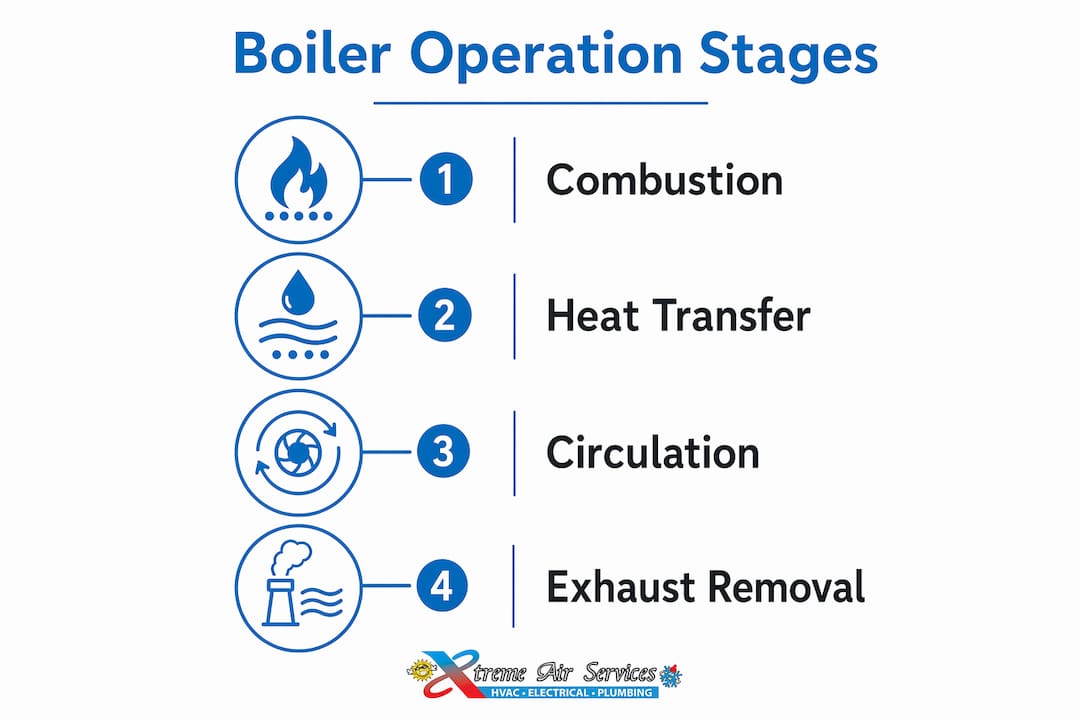
A commercial boiler system burns fuel to heat water, then circulates that hot water or steam through a building’s piping to deliver heat where it’s needed. The cycle runs continuously: combustion generates heat, a heat exchanger transfers that heat to the water, pumps push the heated water through the distribution system, and exhaust gases exit through the flue stack.
Four stages define every commercial boiler operation:
- Fuel combustion: The burner mixes fuel with air and ignites it inside the combustion chamber, producing high-temperature gases.
- Heat transfer: Those hot gases pass through the heat exchanger, transferring thermal energy to the water inside the pressure vessel.
- Circulation: Circulator pumps drive heated water or steam through the building’s piping to radiators, baseboard heaters, or fan coil units.
- Exhaust removal: Combustion byproducts exit through the flue stack, keeping the boiler room free of carbon monoxide and other gases.
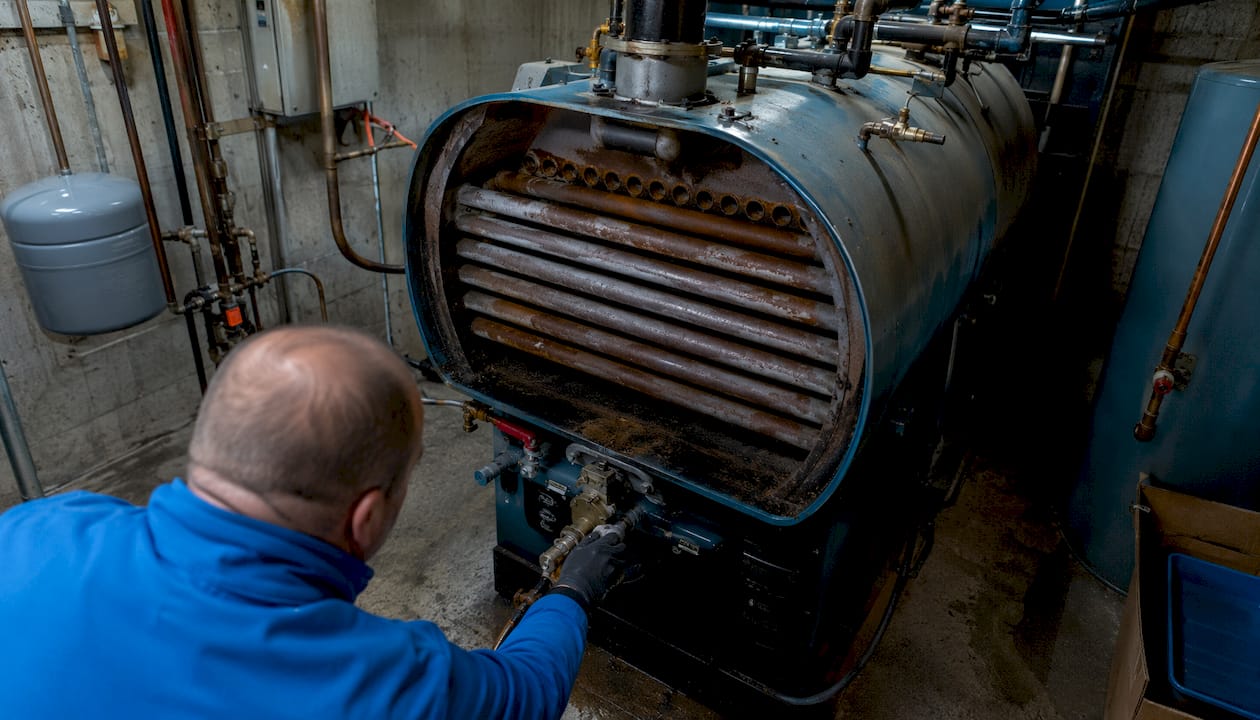
Two heat exchanger designs handle that transfer differently. In a fire-tube boiler, hot combustion gases travel through tubes surrounded by water. In a water-tube boiler, water flows inside tubes while hot gases surround them externally. Fire-tube designs dominate commercial buildings because they are cheaper and easier to maintain. Water-tube models handle higher pressures and larger capacities, making them common in heavy industrial settings.
Safety mechanisms run throughout the system. Pressure relief valves release excess pressure automatically, and expansion tanks absorb the volume increase that occurs as water heats up, preventing dangerous pressure spikes.
What fuels do commercial boilers use?
Fuel type shapes everything from burner design to emissions output and maintenance frequency. The four most common options each carry trade-offs:
- Natural gas: The most widely used fuel in U.S. commercial buildings. It burns cleanly, produces lower emissions than oil, and requires less burner maintenance.
- Fuel oil: Common where gas lines are unavailable. Oil burners require more frequent cleaning because combustion leaves residue in the heat exchanger and flue.
- Biomass: Wood pellets or agricultural waste. Biomass systems carry higher upfront equipment costs and need more frequent ash removal, but they can qualify for renewable energy incentives.
- Electricity: Used in smaller commercial applications or where gas and oil are impractical. Electric boilers use resistance coils or electrode units and produce zero on-site emissions, though operating costs tend to run higher.
Fuel-to-air ratio is critical regardless of fuel type. Too much air cools the flame and wastes energy. Too little air produces incomplete combustion, generating carbon monoxide and soot that foul the heat exchanger. Proper burner calibration keeps that ratio in the right band for clean, efficient burning.
How heat transfer and efficiency ratings work in commercial boilers
The heat exchanger is where fuel energy becomes usable heat. Hot combustion gases pass over metal surfaces, typically stainless steel or copper, and transfer thermal energy to the water circulating inside. Scale deposits or soot on those surfaces act as insulation, forcing the burner to work harder to reach the same water temperature.
Condensing boilers add a secondary heat exchanger that captures latent heat from water vapor in the exhaust gases before they exit the flue. That recovered heat would otherwise be wasted. The result is that condensing boilers push efficiency above 90% AFUE by reclaiming what conventional systems vent away.
Annual Fuel Utilization Efficiency (AFUE) measures how much of the fuel’s energy actually becomes usable heat. Modern commercial boilers achieve efficiency ratings between 80% and 98.5% AFUE, with condensing boilers reaching the top end by reclaiming latent heat from exhaust gases. A conventional non-condensing unit typically sits in the 80%–85% band.
Pro Tip: Stack temperature is one of the most reliable early indicators of heat exchanger fouling. A rising stack temperature often signals soot buildup or scaling before any other symptom appears. Log it weekly and investigate any sustained upward trend.
How control technology keeps your boiler running efficiently
Control systems do not generate heat, but they determine how efficiently and safely the boiler uses the heat it produces. They manage fuel-to-air ratios, ignition timing, pump operation, and safety interlocks in real time, adjusting combustion parameters based on sensor feedback.
Key control functions in a commercial boiler:
- Combustion management: Modulating burners adjust flame intensity to match current heat demand rather than cycling fully on and off, cutting fuel waste across partial-load conditions.
- Temperature and pressure monitoring: Aquastats and pressure sensors feed continuous data to the control board, triggering adjustments before conditions drift outside safe ranges.
- Safety interlocks: If sensors detect a flame failure, low water level, or overpressure condition, the control system shuts the boiler down automatically.
- Thermostat communication: Digital and analog controls receive signals from zone thermostats and adjust burner output accordingly, preventing the system from overheating unoccupied areas.
Faults in the electrical subsystem, such as a failed relay or misconfigured sensor, can trigger unnecessary shutdowns or let inefficiencies run undetected. Routine diagnostics on the control board catch those issues early.
How commercial boilers integrate with building management systems
A building management system (BMS) connects the boiler’s controls to a centralized platform that manages the entire facility’s mechanical systems. That integration gives facility managers visibility and control they simply cannot get from a standalone boiler panel.
BMS integration delivers several practical advantages:
- Scheduling: The BMS can pre-heat zones before occupancy and reduce output during nights and weekends, cutting fuel consumption without sacrificing comfort.
- Fault detection: Sensors feeding the BMS flag abnormal pressure drops, temperature deviations, or pump failures before they escalate into shutdowns.
- Remote monitoring: Facility managers can review boiler status, adjust setpoints, and acknowledge alarms from any connected device.
- Energy tracking: BTU meters and flow sensors feed consumption data to the BMS, making it straightforward to identify which zones are drawing excess heat and why.
For multi-building campuses or high-rise facilities, BMS integration is the difference between reactive repairs and planned maintenance. The role of building automation systems in reducing operational costs grows more pronounced as energy prices rise.
What efficiency ranges should you expect, and what moves them?
Most commercial boilers in active service operate within a broad range of AFUE efficiency levels. Where your system lands depends on several factors beyond the equipment itself.
Boiler age is the biggest variable. Units more than 15 years old often operate well below their original rated efficiency because of accumulated scale, worn seals, and degraded controls. A condensing boiler running at 95% AFUE will outperform a newer conventional unit at 82% on fuel cost alone over a heating season.
Operating pressure and water temperature also matter. Running a hot water boiler at lower supply temperatures, a practice called weather compensation, reduces standby losses and lets a condensing boiler stay in condensing mode longer. Load matching is equally important: a boiler sized too large for its building cycles on and off constantly, never reaching steady-state efficiency. Understanding BTU capacity relative to your actual heating load is the starting point for any efficiency improvement.
What does a solid commercial boiler maintenance schedule look like?
Regular maintenance prevents the two outcomes facility managers dread most: an unplanned shutdown in the middle of winter and a failed safety inspection. A practical schedule breaks down into three tiers.
Monthly checks cover water level, operating pressure, safety valve condition, and a visual inspection for leaks or corrosion. These take under an hour and catch the issues that develop quietly between service visits.
Annual service by a qualified technician includes combustion analysis, heat exchanger inspection, burner cleaning, control calibration, and flue inspection. This is also when soot and scale get removed before they degrade efficiency. Pairing this with a preventive maintenance plan keeps the service history documented and the system under warranty.
Multi-year tasks include full pressure vessel inspection, expansion tank replacement if needed, and pump seal replacement. Most jurisdictions require periodic third-party boiler inspections under state boiler codes, so confirm your local requirements.
What causes commercial boiler failures, and how do you troubleshoot them?
Most boiler failures trace back to a handful of root causes. Knowing them helps you distinguish a quick fix from a call to a technician.
Low water pressure is the most common complaint. It usually points to a leak somewhere in the distribution piping, a failed feedwater regulator, or a waterlogged expansion tank. Check the pressure gauge first, then inspect visible piping for drips before calling for service.
Ignition failure happens when the igniter wears out, the gas valve sticks, or the flame sensor is coated with residue and cannot confirm a flame. The control board typically logs a fault code that identifies which component failed.
Kettling is the rumbling or banging sound that occurs when scale builds up on the heat exchanger surfaces, causing localized boiling. A heating system evaluation can confirm whether descaling or heat exchanger replacement is the right call.
Pressure relief valve discharge means the system exceeded its safe pressure limit. Do not simply reset it. Find out why pressure climbed: a failed expansion tank, a stuck feedwater valve, or a faulty aquastat are the usual suspects.
Environmental compliance adds another layer. The U.S. Environmental Protection Agency regulates NOx and CO emissions from commercial boilers under the National Emission Standards for Hazardous Air Pollutants (NESHAP). Facilities above certain capacity thresholds must conduct periodic emissions testing and maintain combustion records. Staying current on those requirements protects you from fines and keeps your boiler insurable.
Key Takeaways
A commercial boiler system converts fuel into usable heat through four tightly controlled stages: combustion, heat transfer, circulation, and exhaust removal, with efficiency ratings between 80% and 98.5% AFUE depending on design and condition.
| Point | Details |
|---|---|
| Four operational stages | Combustion, heat transfer, circulation, and exhaust removal define every commercial boiler cycle. |
| AFUE efficiency range | Modern commercial boilers achieve 80%–98.5% AFUE; condensing models reach the top end by reclaiming latent heat from exhaust gases. |
| Control systems are critical | Controls manage fuel-to-air ratios, safety interlocks, and thermostat communication to prevent waste and unsafe conditions. |
| BMS integration pays off | Scheduling, fault detection, and remote monitoring via a BMS reduce fuel consumption and enable planned maintenance. |
| Maintenance prevents failures | Monthly checks, annual combustion analysis, and heat exchanger cleaning extend system life and prevent unplanned shutdowns. |
Xtreme Air Services offers HVAC maintenance plans that cover commercial boiler inspections, combustion analysis, and control calibration, keeping your system running at peak efficiency year-round. 
FAQ
What are the four stages of commercial boiler operation?
A commercial boiler operates through fuel combustion, heat transfer via the heat exchanger, circulation of heated water or steam through the building, and exhaust gas removal through the flue stack.
What AFUE rating should a commercial boiler have?
Modern commercial boilers achieve efficiency ratings between 80% and 98.5% AFUE, with condensing boilers reaching the top end by reclaiming latent heat from exhaust gases using secondary heat exchangers.
How often should a commercial boiler be serviced?
Monthly visual checks and annual professional service, including combustion analysis and heat exchanger cleaning, are the standard schedule for reliable commercial boiler operation.
What is the difference between a fire-tube and water-tube boiler?
In a fire-tube boiler, hot gases travel through tubes surrounded by water. In a water-tube boiler, water flows inside tubes heated externally by combustion gases. Fire-tube designs are more common in commercial buildings; water-tube models handle higher pressures in industrial settings.
Why does stack temperature matter for boiler efficiency?
A rising stack temperature signals soot buildup or heat exchanger scaling before other symptoms appear. Monitoring it regularly lets facility managers address fouling early, before efficiency drops or a failure occurs.