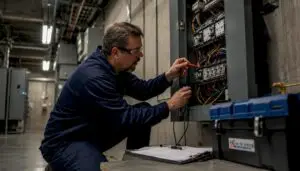


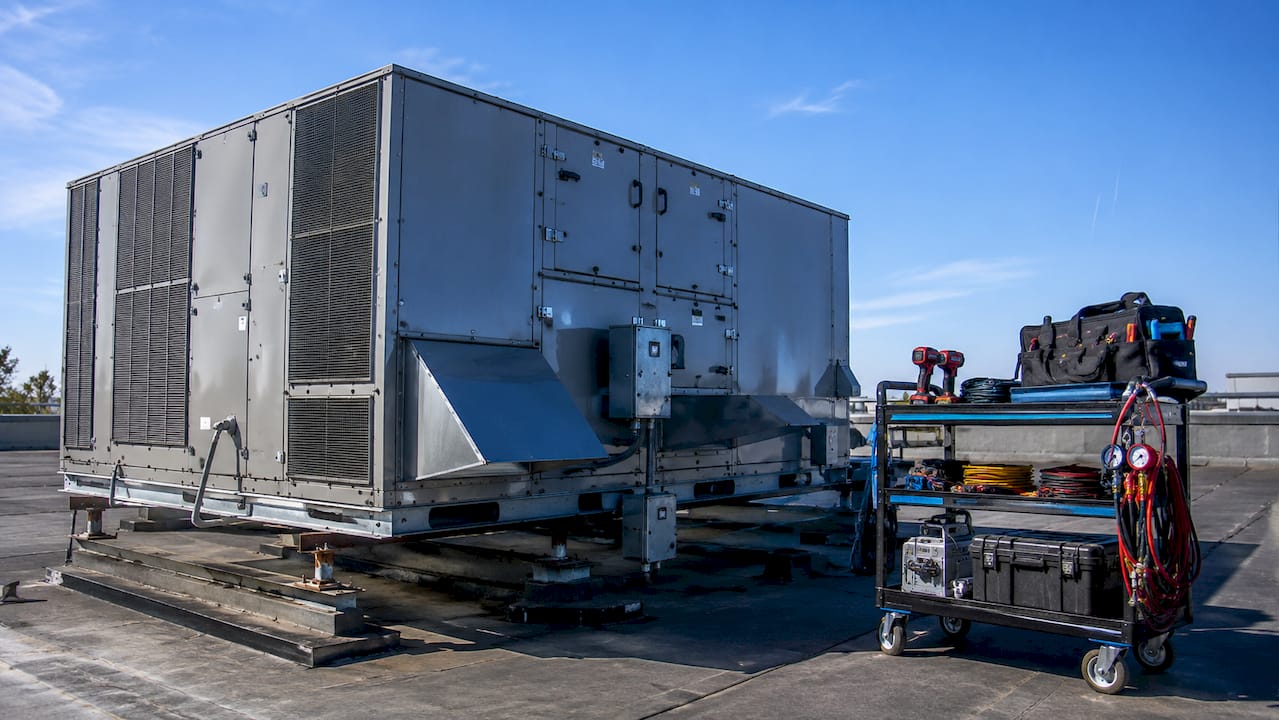
A rooftop unit (RTU) is a self-contained packaged system that houses a compressor, condenser, evaporator coil, blower fan, and heating source inside one weather-resistant cabinet mounted on the roof. Understanding how rooftop unit RTU works matters whether you manage a retail strip center or a small commercial building, because every heating and cooling decision traces back to that single unit above your head. RTUs follow AHRI (Air-Conditioning, Heating, and Refrigeration Institute) performance standards, which means the equipment you buy is tested and rated against consistent benchmarks. This guide walks you through every stage of RTU operation, from the moment air enters the unit to the moment conditioned air reaches your space.
How does a rooftop unit RTU work step by step?
A rooftop unit conditions air through a continuous four-stage cycle: intake, filtration, conditioning, and distribution. Each stage depends on the one before it, so a problem in any single stage affects the whole building.
Stage 1: Air intake and mixing
The RTU pulls two air streams into the unit at the same time. Return air comes back from inside the building through return ducts. Outdoor air enters through a separate intake damper. The unit mixes these two streams before filtration, which keeps indoor air fresh without wasting all the energy already used to condition it.
Stage 2: Filtration
Mixed air passes through filters before it touches any mechanical component. Filters catch dust, pollen, and debris that would otherwise coat the evaporator coil and reduce heat transfer. A clogged filter forces the blower to work harder and raises energy costs, so filter condition is the single most accessible indicator of system health.
Stage 3: Cooling or heating
This is where the refrigeration cycle takes over for cooling. The evaporator coil absorbs heat from the filtered air, which drops the air temperature. The refrigerant carrying that heat moves to the compressor, which raises its pressure and temperature. The hot refrigerant then flows to the condenser coil, where outdoor air carries the heat away from the building. For heating, the RTU switches to a gas furnace burner or an electric heating element depending on the unit type.
RTUs mix return and outdoor air, filter it, condition it through the evaporator or heating elements, and push it through ductwork using a blower fan. That closed loop is what makes the packaged design so reliable.
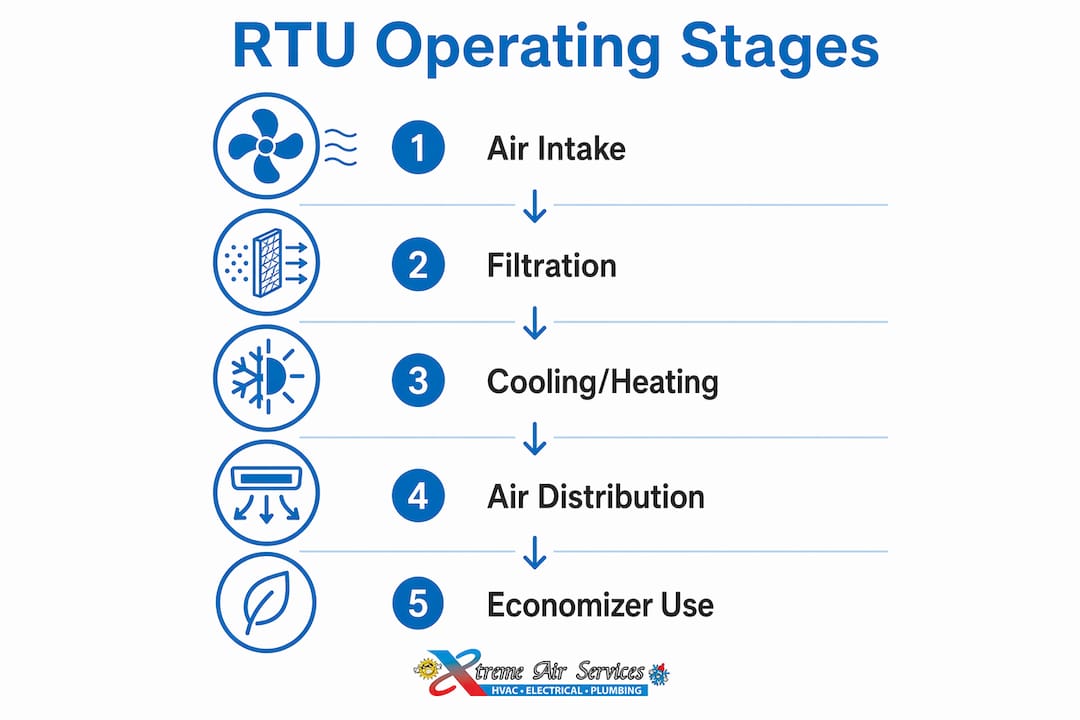
Stage 4: Distribution through ductwork
The blower fan pushes conditioned air down through supply ducts into the building. Blower fans in RTUs are powerful enough to push air through an entire building’s ductwork and maintain consistent distribution across every zone. The unit also connects to return ductwork, pulling spent air back up to the roof to repeat the cycle.
Pro Tip: If one zone in your building feels warmer than others, check the supply and return duct connections at the RTU first. A disconnected or crushed duct at the rooftop connection point is a common cause of uneven airflow.
The economizer advantage
Many RTUs include an economizer, which is a logic-controlled damper system. Economizers allow RTUs to use cool outdoor air when outside temperatures are low enough, providing free cooling without running the compressor. That reduces energy costs significantly during mild weather and extends compressor life.
What energy efficiency features do modern RTUs include?
Modern rooftop units go well beyond basic on/off operation. The efficiency gap between a standard RTU and a high-performance unit is large enough to affect annual operating costs in a measurable way.
Variable-speed compressors are the most impactful upgrade. A standard compressor runs at full capacity or not at all. A variable-speed compressor adjusts its output to match the actual cooling load at any given moment. Variable-speed compressors and VFDs reduce energy consumption and improve SEER2 efficiency ratings, which is the current federal standard for measuring seasonal cooling efficiency. Lower energy use translates directly to lower utility bills.
Variable frequency drives (VFDs) apply the same principle to the blower motor. Instead of running the fan at full speed constantly, a VFD slows the motor when demand is low. That reduces electricity use and cuts wear on the motor, extending its service life.
Economizer controls work alongside outdoor air sensors to decide when free cooling is available. The control system monitors outdoor temperature and humidity. When conditions are favorable, the damper opens wider and the compressor stays off. This is one of the most cost-effective features available in a rooftop unit because it uses no refrigerant cycle at all.
Smart sensors and building controls tie everything together. Modern RTUs connect to building automation systems (BAS) or programmable thermostats that track occupancy, time of day, and zone demand. The unit responds to real conditions rather than running on a fixed schedule. For facility managers overseeing multiple zones, this level of control means you can reduce conditioning in unoccupied areas without manual intervention.
- Variable-speed compressors match output to load, cutting energy waste
- VFDs slow the blower motor during low-demand periods
- Economizers provide free cooling when outdoor air is cool enough
- Smart sensors connect RTU operation to occupancy and zone demand
- SEER2 ratings give you a standardized way to compare unit efficiency before you buy
The combination of these features is why a well-specified RTU in a commercial building can deliver meaningful reductions in annual HVAC energy costs compared to a basic single-speed unit.
RTU maintenance tips that prevent costly breakdowns
Routine care is the difference between an RTU that lasts 15 years and one that fails at year 8. Routine filter replacement, coil cleaning, and compressor monitoring are the core practices that keep RTUs efficient and reliable. Each task addresses a specific failure mode.
Filter replacement
Filters should be checked monthly and replaced on a schedule based on building conditions. A retail space with high foot traffic generates more airborne debris than a small office. Dirty filters restrict airflow, which forces the blower to work harder and can cause the evaporator coil to freeze. Frozen coils stop cooling entirely and can damage the compressor if the condition persists.
Coil cleaning
Both the evaporator coil (indoor side) and the condenser coil (outdoor side) accumulate dirt over time. A dirty evaporator coil reduces heat absorption. A dirty condenser coil traps heat that should be expelled outdoors, which raises compressor head pressure and shortens its life. Coil cleaning is typically done once or twice per year depending on the environment.
Compressor and refrigerant checks
Low refrigerant is one of the most common causes of poor cooling in an RTU. Refrigerant does not get consumed. If levels are low, there is a leak somewhere in the system. A technician needs to find and repair the leak before recharging the system. Running a compressor with low refrigerant causes overheating and permanent damage.
Blower and belt inspection
RTUs with belt-driven blowers need belt tension and condition checks at every service visit. A worn belt slips, reducing airflow and causing the motor to overheat. Direct-drive units do not have this issue, but their motor bearings still need periodic lubrication.
Pro Tip: Schedule RTU service visits in spring before cooling season and in fall before heating season. Catching a refrigerant leak or a failing capacitor before peak demand means you avoid emergency service calls at the worst possible time.
- Replace filters monthly or on a schedule based on building use
- Clean evaporator and condenser coils at least once per year
- Check refrigerant levels and inspect for leaks at every service visit
- Inspect belts, bearings, and electrical connections twice per year
- Log every service visit with dates and findings to track performance trends
For a detailed breakdown of each service step, the RTU servicing guide from Xtremeairservices covers what property managers should expect at each visit.
How do RTUs compare to other HVAC systems?
Understanding when an RTU is the right choice requires comparing it against the two main alternatives: split systems and central plant systems. Each has a different cost profile, space requirement, and maintenance structure.
RTUs save interior mechanical room space by housing all equipment on the roof, which frees up floor area for productive use. That packaged design suits commercial, retail, and some residential buildings where interior mechanical space is limited or expensive. A split system, by contrast, places the condenser outside and the air handler inside, which requires dedicated interior space and refrigerant line sets running through the building.
The table below compares RTUs against split systems and central plant systems across the criteria that matter most to homeowners and facility managers.
| Criteria | Rooftop unit (RTU) | Split system | Central plant system |
|---|---|---|---|
| Installation complexity | Low. All components in one unit | Moderate. Two units, refrigerant lines | High. Chillers, boilers, air handlers |
| Interior space required | Minimal. Equipment on roof | Moderate. Indoor air handler needed | High. Dedicated mechanical room |
| Best suited for | Commercial, retail, light industrial | Residential, small commercial | Large commercial, campus buildings |
| Maintenance access | Roof access required | Ground level and attic access | Mechanical room access |
| Scalability | Add units per zone | Add units per zone | Central system serves whole building |
| Energy efficiency potential | High with VFDs and economizers | High with variable-speed inverters | Very high at large scale |
RTUs are not the best fit for every situation. Large buildings with complex zoning needs often perform better with a central plant because one high-efficiency chiller serving multiple air handlers can outperform many individual RTUs at scale. For buildings under roughly 50,000 square feet, the packaged simplicity of an RTU typically wins on total cost of ownership.
One underappreciated limitation of RTUs is roof load. A commercial RTU can weigh several thousand pounds. The roof structure must be engineered to support that weight, and the rooftop service coordination between HVAC technicians and roofing contractors matters more than most facility managers realize. Penetrations for ductwork and electrical conduit must be properly sealed to prevent water intrusion.
For a broader look at how RTUs fit within the full range of commercial options, the commercial HVAC systems guide from Xtremeairservices covers the full spectrum of equipment types and their applications.
Key Takeaways
A rooftop unit is a packaged HVAC system that integrates heating, cooling, filtration, and air distribution into one roof-mounted cabinet, making it the most space-efficient choice for commercial and light industrial buildings.
| Point | Details |
|---|---|
| RTU core function | All heating, cooling, and ventilation components are housed in one rooftop cabinet connected to building ductwork. |
| Refrigeration cycle | The evaporator absorbs indoor heat, the compressor raises refrigerant pressure, and the condenser expels heat outdoors. |
| Energy efficiency features | Variable-speed compressors, VFDs, and economizers reduce energy use and improve SEER2 ratings. |
| Maintenance priorities | Replace filters monthly, clean coils annually, and check refrigerant levels at every professional service visit. |
| Best use case | RTUs suit buildings under roughly 50,000 square feet where interior mechanical space is limited. |
What I’ve learned from years of working with rooftop units
The most persistent confusion I see in the field is the name itself. When a facility manager says “RTU,” they might mean an HVAC rooftop unit or an industrial Remote Terminal Unit, which is a microprocessor-controlled telemetry device used in SCADA systems. These are completely different pieces of equipment. An HVAC RTU heats and cools your building. An industrial RTU collects sensor data for control systems. Getting that wrong in a service call wastes everyone’s time.
The second thing I see consistently is facility managers who treat RTU maintenance as a reactive task. They call for service when the unit stops cooling, not before. That approach costs more money over time. A compressor that fails from low refrigerant costs several times more to replace than a refrigerant leak costs to repair. The math on proactive maintenance is not complicated.
What surprises most homeowners when they first deal with an RTU is how much the economizer changes the energy picture. Buildings in climates with cool springs and falls can run the economizer for months without touching the compressor. That is real money left on the table when the economizer damper is stuck closed or the controls are misconfigured. I always check economizer function first on any energy audit because it is the lowest-cost fix with the highest return.
The other thing worth saying plainly: understanding how your RTU operates makes you a better client for your service provider. You can describe symptoms accurately, ask the right questions, and recognize when a technician’s diagnosis makes sense. That knowledge protects you from unnecessary repairs and helps you catch problems early. Pair that awareness with a proactive maintenance approach and your RTU will deliver reliable performance for its full service life.
— Xtreme
Keep your rooftop unit running at its best
A well-maintained RTU delivers consistent comfort and lower energy bills year after year. The difference between a unit that lasts 15 years and one that fails early almost always comes down to the quality and consistency of its service history.
Xtremeairservices provides professional HVAC maintenance plans designed for both homeowners and facility managers. From filter changes and coil cleaning to full system inspections and refrigerant checks, the team handles every aspect of RTU care on a schedule that fits your building’s needs. An HVAC maintenance plan from Xtremeairservices keeps your rooftop unit running efficiently through every season, reduces the risk of unexpected breakdowns, and helps you get the full service life out of your equipment. If you are also dealing with indoor air quality concerns, the same team can assess your system and recommend the right upgrades.
FAQ
What is a rooftop unit in HVAC?
A rooftop unit is a packaged HVAC system that houses the compressor, condenser, evaporator coil, blower fan, and heating source in one cabinet mounted on the roof. It connects directly to building ductwork to deliver conditioned air throughout the space.
How does an RTU cool a building?
The RTU pulls indoor air across the evaporator coil, which absorbs heat from the air and transfers it to refrigerant. The compressor and condenser then expel that heat outdoors, and the cooled air is pushed through supply ducts by the blower fan.
How often should an RTU be serviced?
Professional maintenance should be scheduled at least twice per year, typically in spring before cooling season and in fall before heating season. Filter checks should happen monthly.
What is the difference between an RTU and a split system?
An RTU houses all components in one rooftop cabinet, while a split system separates the condenser outdoors from the air handler indoors. RTUs require less interior space but need roof access for all maintenance work.
Can an RTU provide both heating and cooling?
Yes. Most RTUs include either a gas furnace or an electric heating element alongside the refrigeration components, making them a single unit capable of year-round climate control.