
For most U.S. homeowners in 2026, the right starting point is a high-efficiency air-source heat pump sized by a professional Manual J load calculation. Heat pumps have recently become more commonly sold than traditional furnaces, modern units operate reliably in sub-zero temperatures, and the federal Section 25C tax credit offers up to $2,000 for qualifying heat pump installations — more than any other residential HVAC category. Before you call a single contractor, run through three checkpoints:
- Climate suitability: Heat pumps work well across most of the U.S.; in extreme cold climates, a dual-fuel setup (heat pump plus gas backup) is worth pricing out.
- Ductwork condition: Leaky or undersized ducts can cancel out a high-SEER2 rating before the first bill arrives.
- Electrical panel capacity: Many older homes need a panel upgrade to support a heat pump. Budget for it upfront.
ENERGY STAR frames every HVAC replacement as a 15–20 year decision. Get that decision right by requiring a written estimate that lists SEER2 and HSPF2 ratings, all installation scope, and permit details before signing anything.
Table of Contents
- What changed in 2026 that every homeowner should know
- What type of home HVAC system fits your situation?
- Why heat pumps are the right default choice for most homes in 2026
- How to read 2026 efficiency specs and which numbers to target
- Sizing, installed costs, and how long your system should last
- How to choose the right contractor and system for your home
- What to expect from estimate to first heating/cooling season
- Maintenance and warranty: what to do after installation
- The top-rated brands and which homes they fit best
- Your next steps: a short verdict and action plan
- Key Takeaways
- Why the brand matters less than you think
- Xtreme Air Services can handle your 2026 HVAC upgrade in Dallas
- Useful sources for homeowners who want to dig deeper
- FAQ
What changed in 2026 that every homeowner should know
The rules shifted enough that advice from even two years ago may steer you wrong.
SEER2 and HSPF2 replaced the old SEER/HSPF baselines. The new measurement protocol uses a more realistic static pressure, so a SEER2 15.2 is not the same as the old SEER 15. Older quotes and older equipment labels are not directly comparable. When you see a spec sheet, confirm it shows the “2” suffix.
Federal incentives now clearly favor heat pumps. Section 25C of the tax code offers up to $2,000 for qualifying heat pumps meeting ENERGY STAR Most Efficient thresholds, versus lower caps for central AC-only or furnace-only replacements. That gap makes the math on heat pumps more compelling than it was under prior credit structures.
Heat pumps are now the volume leader. Modern air-source units can operate reliably at sub-zero temperatures, and heat pumps cost significantly less to operate than gas furnaces in many scenarios. That operating-cost advantage, combined with the tax credit, is shifting the market fast.
Key 2026 changes at a glance:
- SEER2 minimum requirements vary by region (Southeast, Southwest, and Northern zones have different thresholds).
- ENERGY STAR Most Efficient designation now requires SEER2 ≥ 15.2 for central AC and higher bars for heat pumps.
- Smart thermostat integration and demand-response compatibility are increasingly standard on mid-tier and above models.
- Utility rebates through state and local programs stack on top of federal credits in many areas — check the ENERGY STAR rebate finder for your ZIP code.
What type of home HVAC system fits your situation?
Choosing the right system category is the decision that locks in your cost, comfort, and efficiency for the next 15–20 years. Here is how the main options stack up.
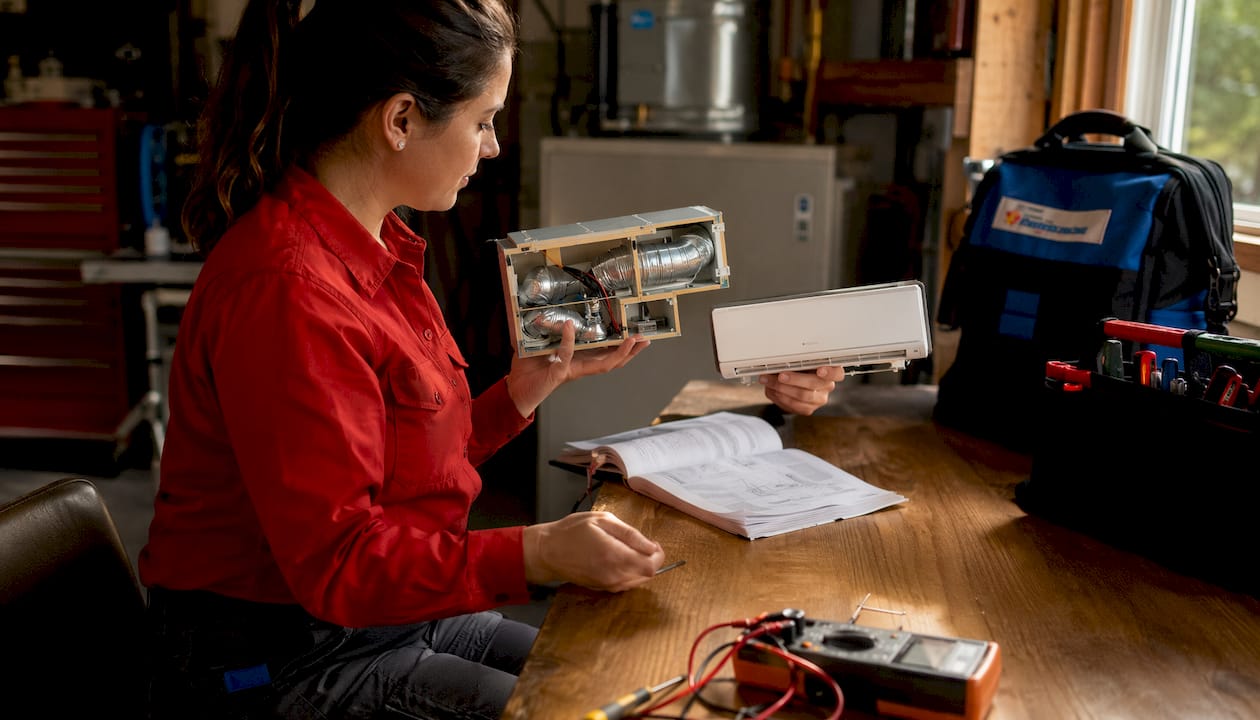
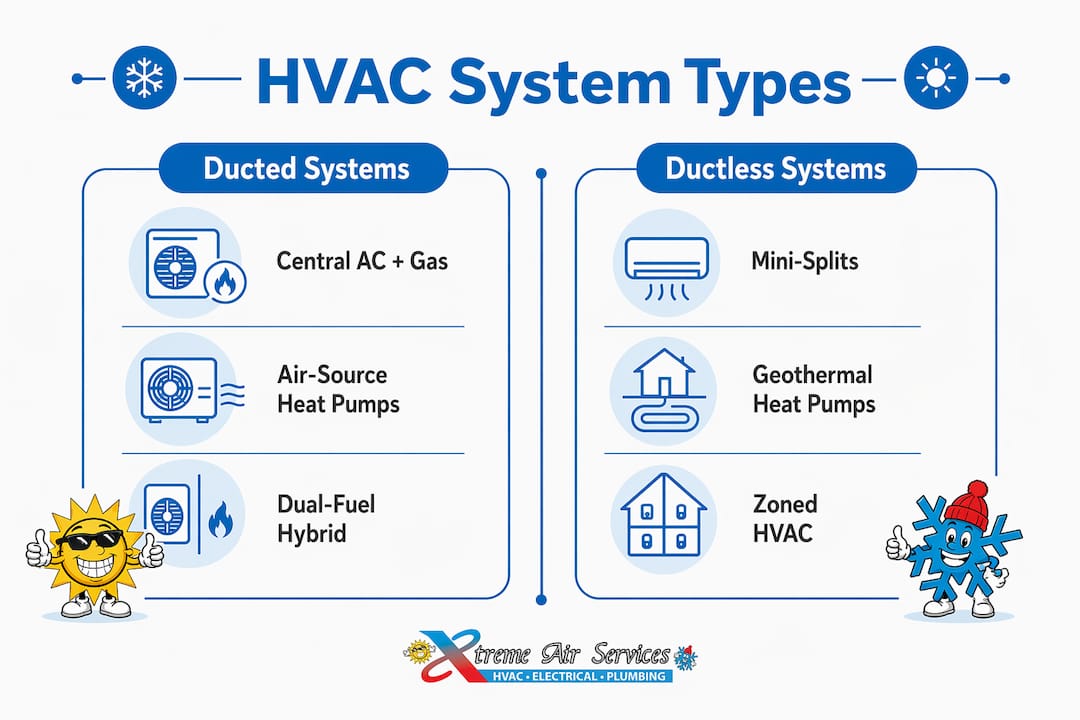
Central ducted systems (split-system AC with gas furnace) remain common in existing homes with ductwork already in place. They are familiar, widely serviced, and often the lowest-cost retrofit when ducts are in good shape. The trade-off: a furnace burns fuel, so operating costs are higher than a heat pump in most climates.
Air-source heat pumps (ducted) move heat rather than generate it, delivering both heating and cooling from one unit. They are the 2026 default recommendation for most homes. Consumer Reports lab testing found whole-house heat pumps to be cost-effective when replacing both furnace and AC simultaneously.
Ductless mini-splits solve the problem of rooms that are hard to condition — additions, garages, older homes without ducts. Installation is less invasive, but per-zone equipment costs add up quickly in whole-home applications.
Dual-fuel (hybrid) systems pair an electric heat pump with a gas furnace backup. The heat pump handles most of the year; the furnace kicks in only when temperatures drop below the heat pump’s efficient operating range. Industry experts recommend this setup specifically for very cold climates.
Geothermal (ground-source) heat pumps deliver the highest efficiency of any system type, but installed costs of $15,000–$30,000 make them practical mainly for new construction, large homes, or homeowners with a long payback horizon. Section 25D tax credits may apply.
| System type | Best for | Efficiency (SEER2 / HSPF2) | Typical installed cost | Noise / warranty | Lifespan |
|---|---|---|---|---|---|
| Central AC + gas furnace | Existing ducted homes, cold climates | SEER2 15.2–23.5 | $5,000–$8,000 | Moderate / 5–10 yr standard | 15–20 years |
| Air-source heat pump (ducted) | Most U.S. climates, replacing both AC and furnace | SEER2 15–23+, HSPF2 8–12+ | $6,000–$14,000 | Low–moderate / 5–10 yr standard | 15–20 years |
| Ductless mini-split | No-duct homes, additions, zoning | SEER2 15.2–23.5, HSPF2 9.5+ | $6,000 per zone | Very low / 5–7 yr standard | 15–20 years |
| Dual-fuel hybrid | Very cold climates, existing gas line | SEER2 15.2–23.5, HSPF2 8.5–9.5 | $7,000–$14,000 | Low–moderate / 5–10 yr | 15–20 years |
| Geothermal | New builds, large homes, long horizon | EER2 up to 25 | $15,000–$30,000 | Very low / 10 yr standard | 20–25+ years |
Pro Tip: If you have a VAV or zoned HVAC system already, ask your contractor whether a heat pump can integrate with existing zone controls before assuming you need a full ductwork overhaul.
Why heat pumps are the right default choice for most homes in 2026
The efficiency gap between heat pumps and combustion heating is not marginal. A heat pump moves three to four units of heat energy for every unit of electricity it consumes. A gas furnace, even a high-efficiency 96% AFUE model, converts fuel to heat at less than a 1:1 ratio. That physics advantage translates directly to lower monthly bills in most U.S. climates.
Modern cold-climate air-source heat pumps — a category that barely existed a decade ago — now operate reliably at temperatures well below zero Fahrenheit. The operating-cost savings versus gas furnaces are typically 30–50% in many scenarios, though the actual number depends on your local electricity and gas rates. In areas where electricity is cheap relative to gas (much of the Southeast and Pacific Northwest), the savings are even sharper.
Heat pumps are not the right primary choice in every situation. Homes with very low electrical capacity, propane-only fuel access in extreme cold, or existing ductwork in poor condition may need a different path. In those cases, a dual-fuel setup or a duct-sealing project before equipment replacement often makes more sense than a straight heat-pump swap.
Pro Tip: Before ruling out a heat pump because of cold winters, ask your contractor to price a dual-fuel hybrid. You get heat pump efficiency for most of the heating season and gas backup only for the coldest days.
How to read 2026 efficiency specs and which numbers to target
Three ratings matter most on a 2026 spec sheet.
SEER2 (Seasonal Energy Efficiency Ratio 2) measures cooling efficiency across a full season. Higher is better. The ENERGY STAR threshold sits at SEER2 15.2 for most regions; the best available models reach SEER2 23.5. For the Section 25C tax credit, confirm the unit meets ENERGY STAR Most Efficient criteria — not just the base ENERGY STAR label.
HSPF2 (Heating Seasonal Performance Factor 2) measures heating efficiency for heat pumps. Target HSPF2 8.5 or higher for solid efficiency; ENERGY STAR Most Efficient heat pumps typically require HSPF2 9.5 or above depending on the product category.
EER2 (Energy Efficiency Ratio 2) measures peak cooling efficiency at a single high-load condition. This number matters most in hot climates like Texas, Arizona, and Florida, where the system runs at full load for extended periods. A high SEER2 with a low EER2 can underperform on the hottest days.
Spec verification checklist before signing a contract:
- Confirm SEER2 and HSPF2 appear on the written quote, not just SEER/HSPF.
- Cross-check the model number against the ENERGY STAR certified products list.
- Ask for the AHRI certificate number, which independently verifies the matched system’s efficiency.
- Verify the unit qualifies for any utility rebate your contractor mentioned — rebate eligibility often has its own efficiency threshold separate from ENERGY STAR.
The DOE’s FEMP guidance shows that over an 18-year lifespan, a best-available SEER2 23.5 unit saves up to $6,724 in energy costs compared to a less efficient baseline model. That figure puts the efficiency premium in perspective when comparing bids.
Sizing, installed costs, and how long your system should last
Getting the size right matters more than the brand name on the unit. Improper sizing can reduce efficiency by up to 30% regardless of how high the SEER2 rating is. An oversized system short-cycles — it blasts on, hits the thermostat setpoint quickly, and shuts off before it can dehumidify properly. An undersized system runs constantly and still can’t keep up on the hottest or coldest days.
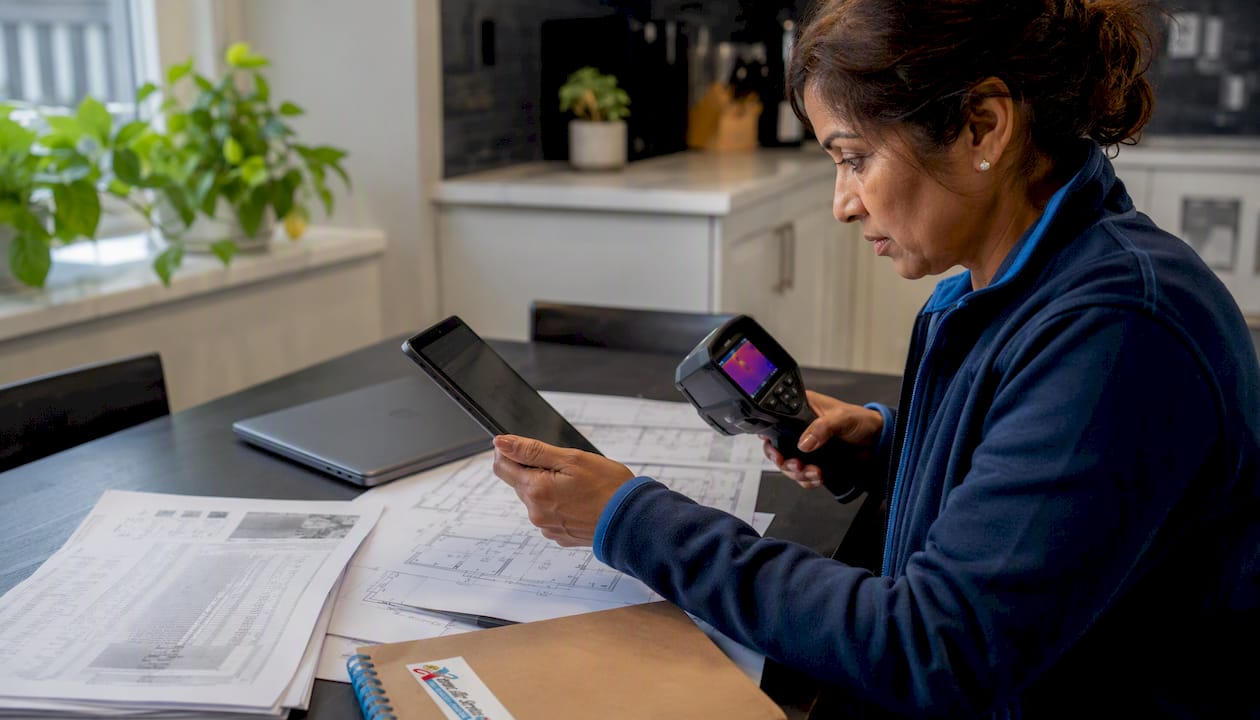
Proper sizing calculations, such as a Manual J load calculation, are the industry standard to determine system size. These calculations consider factors such as your home’s square footage, insulation levels, window area, orientation, local climate data, and duct layout. Any contractor who quotes a system size based only on square footage is skipping this step.
Typical installed cost ranges by system type:
| System type | Low estimate | High estimate | Major cost drivers |
|---|---|---|---|
| Central AC + gas furnace | $5,000 | $14,000 | Duct repairs, furnace flue, permits |
| Air-source heat pump (ducted) | $6,000 | $14,000 | Panel upgrade, duct sealing, permits |
| Ductless mini-split (per zone) | $6,000 | $14,000 | Number of zones, line-set length |
| Dual-fuel hybrid | $7,000 | $14,000 | Both heat pump and furnace components |
| Geothermal | $15,000 | $30,000 | Excavation, loop field, electrical |
Expected lifespans run 15–20 years for central systems and heat pumps, and 20–25 years or longer for geothermal. ENERGY STAR and Consumer Reports both frame HVAC replacement as a 15–20 year investment, which is why getting the sizing and installation right at the start pays off far more than saving a few hundred dollars on a lower-efficiency unit.
Payback timelines vary, but a heat pump replacing both a furnace and AC in a mid-size home typically recovers its premium over a standard split system within 5–8 years through energy savings and the Section 25C credit. Geothermal payback runs longer, often 10–15 years, depending on excavation costs and local energy rates.
Pro Tip: Before pricing equipment, budget $500–$2,000 for duct sealing and insulation. Sealing ducts can improve system efficiency by up to 20%, which means you may be able to install a smaller, less expensive unit and still hit your comfort and efficiency goals.
How to choose the right contractor and system for your home
The contractor matters as much as the equipment. A premium heat pump installed poorly will underperform a mid-tier unit installed correctly. Here is how to vet contractors before you commit.
Credentials to confirm:
- Valid state HVAC contractor license (verify with your state licensing board).
- General liability insurance and workers’ compensation coverage.
- EPA 608 certification for refrigerant handling.
- References from jobs completed in the past 12 months, specifically heat pump or high-efficiency installs.
- Familiarity with local permit requirements and willingness to pull permits.
Questions to ask during the quote:
- Will you perform a Manual J load calculation, and can I see the report?
- What is the condition of my existing ductwork, and is duct sealing or replacement included in this bid?
- Does this quote include electrical panel assessment and any required upgrades?
- How do I register the equipment warranty, and will you handle that at startup?
- What permits are required, and who pulls them?
Red flags to walk away from:
- A flat price quote with no load calculation and no duct assessment.
- Vague scope (“install new system”) with no model numbers, SEER2/HSPF2 specs, or permit references.
- Pressure to sign the same day or a demand for more than 10–20% upfront deposit.
- No written warranty documentation or refusal to discuss permit requirements.
When comparing bids, separate equipment cost, labor, electrical work, ductwork, and permits as line items. A bid that bundles everything into one number is impossible to compare fairly. Local contractors who service your area regularly tend to know local code requirements and utility rebate programs better than national chains.
Pro Tip: Get at least three written bids. The lowest bid is rarely the best value — look for the contractor who asks the most questions about your home before quoting a system size.
What to expect from estimate to first heating/cooling season
A well-run HVAC installation follows a predictable sequence. Knowing the steps helps you catch shortcuts early.
Typical timeline:
- Site survey and load calculation (1–3 days after initial contact): Contractor measures the home, inspects ductwork, checks the electrical panel, and runs Manual J.
- Permit application (3–10 business days): Contractor submits permit to the local building department. Never let a contractor skip this step.
- Equipment ordering (1–2 weeks for standard models, longer for specialty units): High-efficiency or cold-climate models may have lead times.
- Installation day(s) (1–2 days for most residential systems): Includes equipment placement, refrigerant line connections, electrical connections, and duct modifications.
- Startup and commissioning (same day or next day): Technician verifies refrigerant charge, checks airflow at each register, programs the thermostat, and confirms the system meets rated efficiency.
- Inspection (1–5 business days after install): Local building inspector signs off on the permit.
- 30–90 day follow-up: A good contractor schedules a callback to confirm performance through the first full heating or cooling cycle.
Homeowner prep before install day:
- Clear a 3-foot path to the indoor air handler and outdoor unit.
- Confirm electrical panel access is unobstructed.
- Arrange for an adult to be present the full day.
- Note any rooms with comfort complaints to share with the technician during commissioning.
- Review your seasonal HVAC prep checklist so you know what the first-season follow-up should cover.
Maintenance and warranty: what to do after installation
A new system’s warranty is only as good as the maintenance record behind it. Manufacturers increasingly require annual professional maintenance to keep extended warranty terms valid.
Recommended maintenance schedule:
- Monthly: Check and replace air filters (1-inch filters often need monthly replacement; thicker media filters may last 3–6 months).
- Annually: Professional inspection covering refrigerant charge, electrical connections, coil cleaning, and airflow verification.
- Every 3–5 years: Duct inspection for leaks, especially after any renovation work.
Warranty terms vary significantly by brand. Some manufacturers require product registration within 60–90 days of installation to unlock extended coverage — missing that window can drop a 10-year parts warranty to 5 years. Confirm registration is completed at startup, and get written confirmation.
Extended service plans are worth considering for heat pumps, which have more components (reversing valve, refrigerant circuit, defrost controls) than a straight AC. Pay-as-you-go works fine for homeowners who are disciplined about annual maintenance, but a plan removes the scheduling friction that causes people to skip years. HVAC maintenance plans typically cover the annual inspection and priority service scheduling.
Record-keeping checklist:
- Keep the Manual J report, permit, and inspection sign-off in a home file.
- Save all warranty registration confirmations with model and serial numbers.
- Log every service visit with date, technician name, and work performed.
- Store receipts for tax credit documentation (Section 25C requires the manufacturer’s certification statement).
Pro Tip: Photograph the model and serial number plates on both the indoor and outdoor units at installation. If a unit is ever damaged or needs warranty service years later, that photo saves a frustrating search.
The top-rated brands and which homes they fit best
Nine brands dominate the residential HVAC market in 2026. Each has a distinct positioning, and the right choice depends on your priorities and your contractor’s distribution relationships.
Trane and Carrier sit at the premium end. Both offer extensive heat pump lineups with SEER2 ratings reaching into the low-to-mid 20s, strong dealer networks, and 10-year parts warranties when registered. Trane’s XV series and Carrier’s Infinity line are frequently cited in residential HVAC reviews for reliability and smart thermostat integration.
Lennox is the efficiency leader in the residential market. The Lennox Signature Collection includes units with some of the highest SEER2 ratings available for ducted systems. The trade-off is a higher equipment price and a dealer-only distribution model that limits installation options.
American Standard shares its engineering platform with Trane (both are Trane Technologies brands), which means comparable reliability at sometimes slightly lower price points depending on the dealer.
Bryant is Carrier’s value-tier brand, sharing core components with Carrier equipment. It offers a solid entry into high-efficiency systems without the Carrier premium, and it’s widely available through independent dealers.
Rheem and Ruud (sister brands) offer strong mid-market options with broad contractor availability. Rheem’s Classic Plus and Prestige series cover the SEER2 15–20 range well, and the brand’s heat pump lineup has improved significantly in recent years.
Goodman and Amana (both Daikin subsidiaries) are the value leaders. Goodman in particular is the go-to for budget-conscious replacements, with a lifetime compressor warranty on registered units that no other brand matches at its price point. Amana carries the same platform with a slightly more premium positioning.
York rounds out the major brands with solid mid-market options and a wide independent dealer network. York’s LX and YXV series cover the SEER2 15–21 range and include compatible smart thermostat options.
For most homeowners, brand choice matters less than contractor quality and installation scope. A Goodman installed correctly by a skilled technician will outperform a Lennox installed carelessly.
Your next steps: a short verdict and action plan
The heat-pump-first approach, sized by Manual J and installed by a licensed contractor, is the right call for most U.S. homeowners in 2026. The efficiency advantage is real, the federal tax credit is the highest it has ever been for residential HVAC, and the technology has matured enough that cold-climate concerns are largely solved for most of the country.
Homeowners who should consider alternatives: those in extreme cold climates without a gas backup option, those with electrical panels that cannot support a heat pump without a costly upgrade, and those replacing only one component (just the AC or just the furnace) where a full system swap is not yet warranted.
Action steps:
- Get two to three written bids from licensed local contractors.
- Require a Manual J load calculation report with every bid.
- Compare SEER2, HSPF2, and full installation scope line by line — not just the bottom-line price.
- Verify permit inclusion and warranty registration steps in writing.
- Check the ENERGY STAR rebate finder and your utility’s website for stackable incentives before signing.
- If you are weighing repair versus replacement, the $5,000 rule is a useful starting point: multiply the unit’s age by the estimated repair cost, and if the result approaches $5,000, replacement likely makes more financial sense.
Xtreme Air Services serves homeowners in the Dallas, TX area with HVAC installation, repair, and maintenance, including load calculations and full installation scope. Reaching out for a written estimate is a practical first step toward getting the right system sized and installed correctly.
Key Takeaways
Heat pumps sized by Manual J and installed by a licensed contractor are the best starting point for most U.S. homeowners in 2026, with federal tax credits up to $2,000 and operating costs typically 30–50% lower than gas furnaces in many scenarios.
| Point | Details |
|---|---|
| Heat pump as default | Modern air-source heat pumps typically cost 30–50% less to operate than gas furnaces and qualify for up to $2,000 in Section 25C tax credits. |
| Manual J is non-negotiable | Improper sizing can reduce efficiency by up to 30%; require a load calculation report with every bid. |
| SEER2 ≥ 15.2 target | ENERGY STAR Most Efficient threshold starts at SEER2 15.2; confirm the model number on the certified products list. |
| Duct sealing first | Sealing ducts can improve efficiency by up to 20% and may allow a smaller, less costly unit to meet your comfort goals. |
| Xtreme Air Services | Xtreme Air Services provides HVAC installation, repair, and maintenance in the Dallas, TX area, including load calculations and full installation scope. |
Why the brand matters less than you think
The HVAC industry has a branding problem. Homeowners spend hours comparing Trane versus Carrier versus Lennox when the variable that actually determines whether their new system performs well is the contractor who installs it. A mismatched refrigerant charge, a duct system leaking 20% of conditioned air into the attic, or a thermostat wired incorrectly will cost more in wasted energy over five years than the price difference between a mid-tier and premium brand.
The brands covered here — Trane, Carrier, Lennox, Goodman, Rheem, Bryant, American Standard, York, Amana — all make equipment that works well when installed correctly. The efficiency gap between a well-installed Goodman and a poorly installed Lennox is not in Lennox’s favor. That is not a knock on premium brands; it is a statement about where the real leverage is.
The other thing most articles underweight: the thermal envelope. Sealing duct leaks and adding insulation before replacing equipment often delivers more measurable comfort improvement than swapping a 15-year-old system for a new one in a leaky house. Addressing duct leaks and insulation first is the highest-impact step, and it makes the new equipment work the way its spec sheet promises.
The 2026 buying environment is genuinely better for homeowners than it was five years ago. The tax credit structure rewards the right choice. The technology has caught up to the marketing. But none of that matters if the contractor skips the load calculation, rushes the commissioning, or installs a unit two tons too large because it was what they had in the truck.
Get the Manual J. Compare the full scope. Hire the contractor who asks the most questions.
Xtreme Air Services can handle your 2026 HVAC upgrade in Dallas
When you are ready to move from research to a real quote, Xtreme Air Services offers HVAC installation, repair, and maintenance for homeowners and businesses across the Dallas, TX area. The team handles the full scope: load calculations, equipment selection, ductwork assessment, electrical coordination, and permit management — so you are not piecing together multiple contractors to get one system installed correctly.

Whether you are replacing an aging system, upgrading to a heat pump for the first time, or adding a maintenance plan to protect a recent install, Xtreme Air Services can walk you through the options and provide a written estimate with SEER2/HSPF2 specs and full installation scope included. For homeowners who want to protect their investment long-term, the HVAC maintenance plans cover annual inspections, priority scheduling, and the documentation that keeps warranties valid. Contact Xtreme Air Services to schedule a site survey and get a written quote for your 2026 HVAC upgrade.
Useful sources for homeowners who want to dig deeper
- ENERGY STAR — Heating and Cooling Efficiency: Covers efficiency ratings, duct sealing, proper installation, and the ENERGY STAR Most Efficient designation for heat pumps and central AC.
- ENERGY STAR Certified Central Air Conditioners: Searchable database to verify whether a specific model meets ENERGY STAR requirements.
- ENERGY STAR Rebate Finder: Find utility and state rebates by ZIP code that stack on top of federal tax credits.
- DOE — Purchasing Energy-Efficient Residential Central Air Conditioners: Detailed efficiency tables, SEER2 benchmarks, and lifetime cost savings data.
- Consumer Reports — Best Whole-House Heat Pumps: Lab-tested heat pump reviews with installed cost ranges and reliability data.
- ACCA Manual J: The industry standard for residential load calculations; useful for understanding what a proper sizing report should include.
- ACCA — Air Conditioning Contractors of America: Find certified contractors and verify contractor credentials.
FAQ
What is the best HVAC system for most homes in 2026?
A high-efficiency air-source heat pump sized by a Manual J load calculation is the best starting point for most U.S. homes in 2026, combining heating and cooling in one unit, qualifying for up to $2,000 in Section 25C tax credits, and typically costing 30–50% less to operate than a gas furnace.
What are the most reliable residential HVAC brands?
Trane, Carrier, Lennox, Rheem, and American Standard consistently rank among the most reliable brands in residential HVAC reviews; Goodman and Amana offer strong value with a lifetime compressor warranty on registered units.
What is new in HVAC systems for 2026?
The biggest changes are the SEER2/HSPF2 measurement standards replacing older SEER/HSPF baselines, a federal tax credit structure that favors high-efficiency heat pumps (up to $2,000 under Section 25C), and improved cold-climate performance that makes heat pumps practical across most of the U.S.
What is the $5,000 rule for HVAC?
Multiply your unit’s age by the estimated repair cost; if the result approaches $5,000, replacement is usually more cost-effective than repair — it is a quick heuristic, not a hard rule, but it helps frame the repair-versus-replace decision.
How long should a new HVAC system last?
Central systems and heat pumps typically last 15–20 years with proper maintenance; geothermal systems often exceed 20–25 years, according to ENERGY STAR and Consumer Reports guidance.