

For most commercial kitchens, that works out to service every 30 to 90 days, depending on volume and unit type. Watch your municipal FOG (fats, oils, and grease) program and the EPA’s guidance on sewer protection, since local sewer authorities often set a hard 90-day maximum regardless of your own measurements.
Three moves get you compliant fast:
- Put a recurring service appointment on the calendar now, not after a backup.
- Measure grease and solids depth at every service, not just when something smells wrong.
- Keep every hauler manifest and disposal receipt in one file for inspectors.
Pro Tip: Don’t wait for a slow drain to tell you it’s time. By the time you smell it, you’re usually well past the 25% threshold.
Key Takeaways
| Point | Details |
|---|---|
| Follow the 25% rule | Service the trap once grease and solids combined reach 25% of total liquid depth. |
| Match schedule to volume | High-volume kitchens often need monthly service; low-volume kitchens can stretch to quarterly. |
| Measure before you guess | Track accumulation for six months to set a predictable, site-specific schedule. |
| Document everything | Keep manifests, depth measurements, and hauler receipts on file for inspections. |
| Use a licensed partner | Xtreme Air Services coordinates plumbing service and documentation to keep grease trap maintenance audit-ready. |
Where to Verify Your Local Grease Trap Rules
- EPA: national FOG program context and why municipal controls matter for sewer protection.
- OSHA: safety requirements for confined-space and maintenance work.
- Check your municipal sewer authority’s FOG program page directly for mandatory minimums and manifest rules in your jurisdiction.
Table of Contents
- How Do Grease Traps and Interceptors Actually Work?
- How Often Should You Actually Clean a Grease Trap?
- What Factors Change Your Grease Trap Service Frequency?
- What Should a Grease Trap Inspection Checklist Include?
- Who Handles Each Maintenance Task, and How Often?
- When Should You Call a Professional Instead of Doing It Yourself?
- What Should a Grease Trap Maintenance Log Include?
- Keep Your Grease Trap Compliant Without the Guesswork
- Sources
- FAQ
How Do Grease Traps and Interceptors Actually Work?
Every grease trap relies on the same basic physics: fats and oils float, water flows through, and solids sink. Baffles inside the unit slow the water down long enough for that separation to happen before wastewater exits to the sewer line.
The unit type you have dictates how the schedule works:
- Under-sink passive traps are small, gravity-only units common in cafes and food trucks, and they fill fast.
- Hydromechanical grease interceptors (HGI) add air entrainment and flow controls, common under three-compartment sinks in mid-size kitchens.
- In-ground gravity interceptors sit outside or below the building and handle high-volume flow from full-service restaurants.
- Automatic grease removal units (AGRU) skim grease continuously and need daily or weekly skimming checks, but far fewer full pump-outs than passive units.
Trap type changes everything downstream: an AGRU shifts the workload to frequent small checks, while a passive under-sink trap shifts it to more frequent full cleanings.
How Often Should You Actually Clean a Grease Trap?
What changes by unit is how fast you get there. Municipal best-management-practice guidance sets that combined grease and solids depth trigger at 25% of liquid depth, and most local ordinances cap the maximum interval at 90 days even if you haven’t hit that mark yet.
| Unit Type / Volume | Typical Service Interval |
|---|---|
| Under-sink passive trap, low volume | Weekly check, monthly pump-out |
| Hydromechanical interceptor, mid volume | Every 30 to 60 days |
| In-ground gravity interceptor, high volume | Often every 1 to 3 months |
| AGRU, continuous operation | Daily skim, quarterly deep service |
A quick-service burger location running fryers all day will hit 25% faster than a coffee shop with a single espresso machine. Sample schedules that work well in practice:
- High-volume kitchens: weekly visual checks, monthly full-service contract with a licensed hauler.
- Mid-volume kitchens: biweekly checks, service every 60 days or at 25%, whichever comes first.
- Low-volume kitchens: monthly checks, quarterly professional service.
Adjust before Thanksgiving, the December holiday stretch, and graduation season. Grease loading spikes fast during banquet-heavy weeks, and a trap that was fine in October can hit 25% by the second week of December.
What Factors Change Your Grease Trap Service Frequency?
A fixed calendar only gets you so far. These variables push the real interval shorter or longer:
- Menu and frying volume: heavy fryer use loads a trap faster than a menu built around salads and cold prep.
- Trap capacity relative to kitchen output: an undersized trap for your covers count means more frequent service no matter what the calendar says.
- Plumbing layout: long drain runs cool grease before it reaches the trap, sometimes causing buildup in the line itself.
- Seasonal temperature: cold weather thickens grease and slows separation, often accelerating solids buildup.
- Local FOG ordinances: many sewer authorities require quarterly inspections regardless of your measured fill level.
Pro Tip: Ask your local sewer authority for their written FOG ordinance, not just a summary. Some municipalities set the 90-day maximum in writing, and citing the exact rule during an inspection carries more weight than “we clean it pretty often.”
What Should a Grease Trap Inspection Checklist Include?
Run this sequence every time, whether it’s a staff spot check or a full service visit:
- Secure lids and confirm the access panel seals properly before opening.
- Measure the floating grease cap depth with a measuring rod or sludge judge.
- Measure settled solids depth at the bottom of the trap.
- Add the two figures and divide by total liquid depth to get your combined percentage.
- Inspect baffles, inlet, and outlet tees for blockage or damage.
- Note any odor, slow drainage, or gurgling from nearby fixtures.
Once that combined depth hits 25%, schedule a pump-out. Don’t wait for the next calendar slot if you’re already at that threshold.
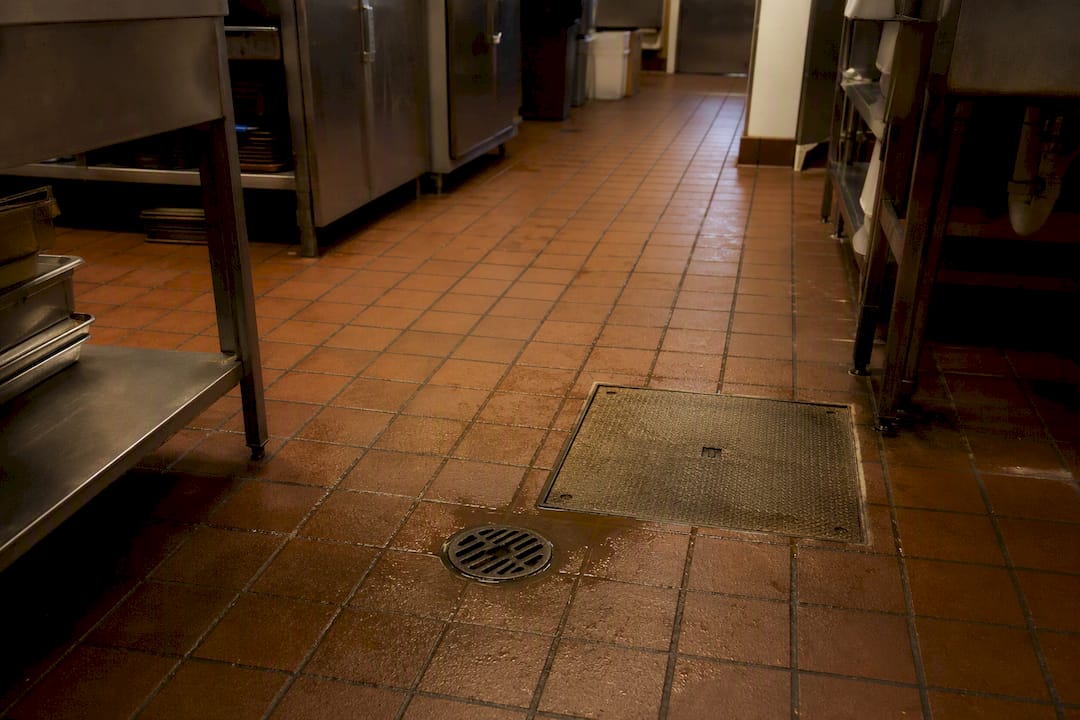
Warning signs that mean act now, not next week: slow-draining sinks, gurgling floor drains, sewage or rotten-egg odor near the trap, and visible grease in downstream cleanouts. A properly maintained commercial plumbing system rarely shows these signs between scheduled services.
Who Handles Each Maintenance Task, and How Often?
Grease trap care breaks into a clear chain of responsibility, from the line cook to the licensed hauler.
- Daily (kitchen staff): dry-scrape pots and pans before washing, use sink strainers on every basin, and collect fryer oil for rendering instead of pouring it down the drain. These three habits alone can cut FOG loading by roughly half compared to rinsing grease residue straight into sinks.
- Weekly (on-site facilities tech): check lid condition, confirm no leaks at seams, do a quick depth measurement.
- Monthly (technician or licensed hauler): pump out if the trap has hit 25%, inspect baffles and flow controls.
- Quarterly and annual (licensed hauler and inspector): full structural inspection, line cleaning if needed, ordinance compliance review.
Log four things at every event: the date, measured grease and solids depths, volume removed, and the hauler’s name with manifest number. Skipping the manifest number is the single most common gap inspectors flag.
Pro Tip: Assign one person, not the whole shift, to own the weekly measurement. Shared ownership usually means nobody actually does it.
When Should You Call a Professional Instead of Doing It Yourself?
Small under-sink traps are within reach for trained staff to skim and wipe down between full services. Anything larger, especially in-ground interceptors, calls for a licensed vacuum truck operator. Entering or working near a large interceptor also raises confined-space hazards that OSHA guidance addresses directly, including atmospheric testing and proper PPE before anyone opens a below-grade unit.
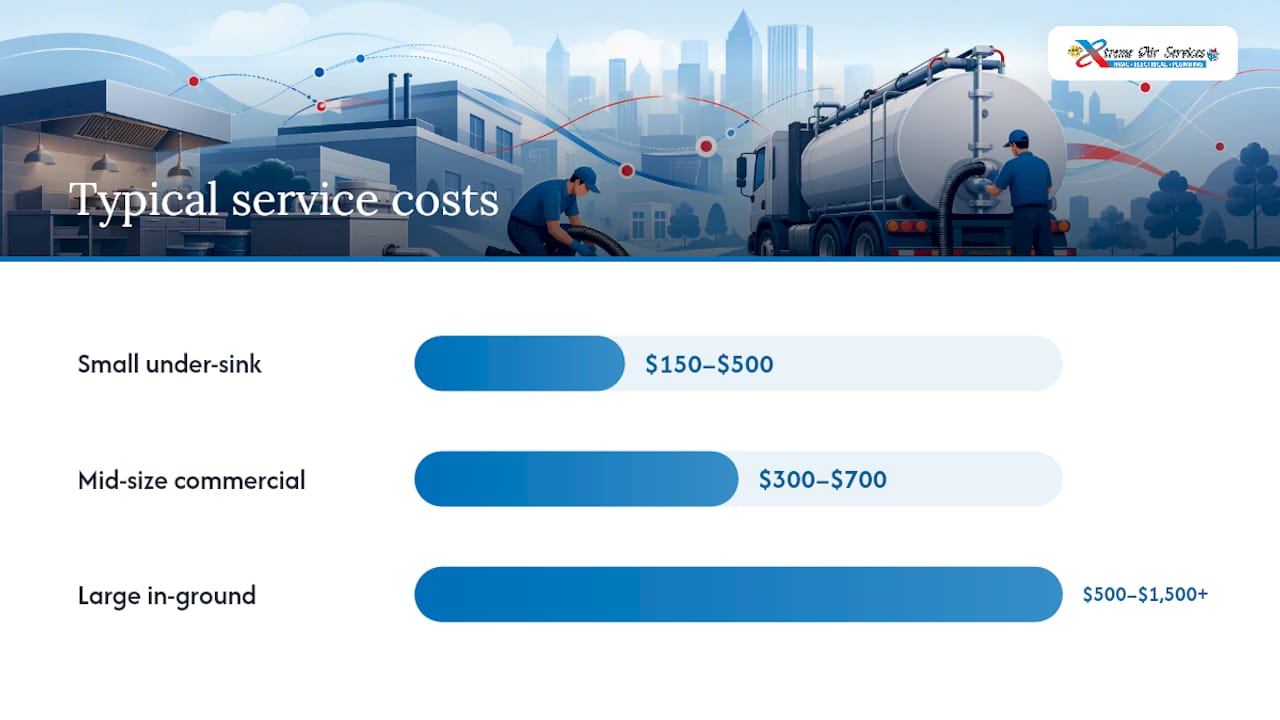
Budget expectations vary a lot by unit size. Small under-sink units typically run $150 to $500 per service, mid-size commercial units land between $300 and $700, and large in-ground interceptors often run $500 to $1,500 or more. Emergency or after-hours calls commonly cost 1.5 to 2 times the standard rate, which is exactly why a standing schedule pays for itself.
Disposal has to go through a licensed hauler with proper manifests:
- Always request a signed manifest documenting where the FOG waste was hauled and disposed.
- Never allow grease waste to go into a dumpster or storm drain; that’s illegal dumping in nearly every jurisdiction.
- Keep every receipt and manifest on file for at least the retention period your local authority requires.
If a blockage escalates past routine pumping, a hydro-jetting service clears hardened grease from the line itself rather than just the trap.
What Should a Grease Trap Maintenance Log Include?
A usable log needs these fields, whether it lives in a spreadsheet or a CMMS: service date, measured grease depth, measured solids depth, combined percentage, volume pumped, hauler name, disposal manifest number, technician notes, and a staff signature confirming the visit happened.
| Log Field | What to Record |
|---|---|
| Date and time | When the inspection or service occurred |
| Grease + solids depth | Combined percentage against total liquid depth |
| Volume removed | Gallons pumped, if applicable |
| Hauler and manifest | Company name and manifest number for disposal |
Digital logs beat paper for one simple reason: they can’t get lost in a back office during an inspection. Most municipal guidance recommends retaining records for three to five years, so build that retention window into whatever system you use, whether that’s a shared drive or your facility’s existing maintenance software.
A Facility Lead’s Take on Staying Ahead of the Schedule
The kitchens that never call for emergency service are the ones that measured accumulation for the first six months and built a real schedule from it, not a guess. Set the standing monthly appointment before your first busy season, not after a backup. Push your hauler visit up two weeks before any major holiday stretch, and keep every manifest in one folder an inspector can flip through in five minutes.
Keep Your Grease Trap Compliant Without the Guesswork
Xtreme Air Services coordinates the plumbing side of grease trap compliance the way a lot of facility teams wish their current vendor did: measured service intervals instead of a generic monthly visit, and documentation handed to you ready for an inspector, not assembled the night before one.

Beyond the trap itself, backups often trace back to the line running to it. A drain cleaning visit can confirm whether grease has hardened past the trap. A plumbing service can fold grease trap checks into a broader facility maintenance plan alongside your other systems. If you already run a maintenance plan for HVAC, adding grease trap service to that same recurring schedule keeps one vendor accountable for one calendar instead of juggling three. Request a site visit to get a service interval built around your actual kitchen output, not a generic 90-day default.
Sources
- Fats, oils, and grease: What we know after 23 years of FOG work | EPA
- OSHA safety publications (PDF)
- Grease Trap Cleaning: Cost & How Often (2026)
FAQ
How Often Should Grease Traps Be Serviced?
Do Grease Traps Need Regular Maintenance Even if They Seem Fine?
Yes.
How Much Does It Cost to Have a Grease Trap Cleaned?
Small under-sink units typically run $150 to $500 per service, mid-size commercial units run $300 to $700, and large in-ground interceptors often cost $500 to $1,500 or more, with emergency calls running 1.5 to 2 times standard rates.
How Often Should Grease Traps Be Cleaned in a High-Volume Kitchen?
High-volume kitchens with heavy fryer use often need service about monthly, with additional frequency adjustments during busy holiday periods, since grease loading accelerates faster than a standard calendar accounts for.