


Chiller Installation in Plano: Commercial Mechanical Contractor Work Done Right
Commercial chiller replacement sized for your building, with what's included and excluded explained before work starts.
What’s Covered on This Page
- Chiller Installation Is a Commercial Mechanical Project, Not a Home AC Swap
- Office Campuses and Multi-Tenant Buildings in Plano Rely on Central-Plant Cooling
- When You Need Repair Instead of a New Chiller Installation
- What Happens During a Chiller Installation Project
- What Drives Chiller Installation Cost
- What is the $5000 rule for HVAC systems?
- Does a chiller installation need a permit in Plano?
- How long does a commercial chiller take to arrive once it’s ordered?
Chiller Installation Is a Commercial Mechanical Project, Not a Home AC Swap
Chiller installation in Plano is for buildings that cool with chilled water, like office buildings, schools, medical spaces, and some manufacturing sites. If that’s your building, here’s the main point. A new chiller only works as well as everything it connects to. The piping, the pumps, the controls, and the power all have to be planned together. When they aren’t, you get a costly machine that never quite keeps up.
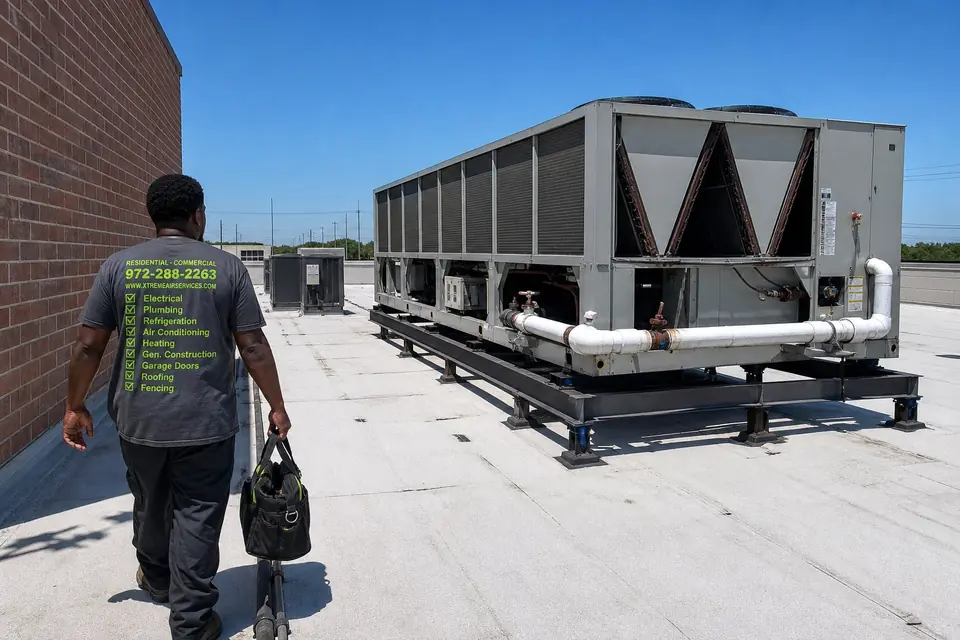
A home AC pushes refrigerant to a coil in your attic or closet. A chiller works differently. It makes cold water, often in the mid-40s, and pumps that water through a loop of pipes to air handlers across the building. Each air handler uses that cold water to cool the air in its zone. So when you replace or add a chiller, you’re really working on a whole cooling plant. That plant includes:
- The chiller itself. It’s either air-cooled, sitting on a roof or pad, or water-cooled, paired with a cooling tower.
- Chilled water piping and the pumps that move water through the building.
- Condenser water piping and a cooling tower, if the system is water-cooled.
- Controls that tell the chiller, pumps, and air handlers how hard to work.
- Electrical service sized for a large commercial motor load.
- A safe path to get the equipment in, which can mean a crane, roof access, or a tight mechanical room.
Each of those pieces changes the job. A like-for-like swap that uses your existing connections is very different from a new plant, a capacity upgrade, or a switch from water-cooled to air-cooled. North Texas summers matter here too. Your chiller has to carry the building through long stretches of triple-digit heat, so sizing it to your real load is what keeps tenants, patients, or production comfortable in August.
This is where one accountable team helps you. Xtreme Air Services is a licensed and insured mechanical, plumbing, and electrical contractor. Our Plano office is at 5055 W Park Blvd, Suite 400. Along with chiller installation, we also handle cooling tower installation, pump installation and repair, piping installation, commercial electrical, and building automation. That means fewer handoffs between trades when your project touches more than one system.
Now the honest part. If you own a house in Plano and your central air quit, you don’t need a chiller. Homes almost never use them. A chiller would be the wrong fit and far more than your house needs. What you’re looking for is AC repair or AC replacement, and that’s a much simpler, much smaller job. The same goes for a small shop or office cooled by a rooftop unit or split system. Unless your building already has a chilled-water loop, or an engineer has recommended one for a larger space, a standard commercial HVAC system is usually the right answer.
If you do run a chilled-water building, the rest of this page walks you through what drives the cost, what’s included, and how to tell whether your current chiller should be replaced or kept running a while longer.
Office Campuses and Multi-Tenant Buildings in Plano Rely on Central-Plant Cooling
If you manage an office building or a campus with several tenants, there’s a good chance one central plant cools all of it. One or more chillers make cold water in a single mechanical room or on the roof. That water then travels to air handlers that serve every floor and every suite. It’s an efficient way to cool a big building. It also means your chiller isn’t serving one customer. It’s serving everyone in the building at once.
That changes how a chiller installation has to be planned. In a single-owner building, a short shutdown is an inconvenience. In a multi-tenant building, it can mean a law office with clients in the lobby, a medical suite that has to stay cool, and a server room that can’t get warm. All of them lose cooling at the same moment. When you replace the chiller, you’re really managing the comfort, and sometimes the lease commitments, of every tenant who shares that plant.
Before any equipment moves, a solid plan for an occupied building should answer these questions:
- When can cooling go down? Many buildings plan the cutover for a cooler season, a weekend, or overnight hours so the fewest tenants feel it.
- Is temporary cooling needed? If the building can’t go without chilled water, a rental chiller may carry the load while the new one goes in.
- Does the building have more than one chiller? With two or more, one can keep running while the other is replaced. That keeps at least part of the building cool.
- Which tenants need special care? Server rooms, labs, and medical spaces often need steady temperatures around the clock.
- How will tenants be told? Clear notice from the property manager heads off a lot of complaints.
Controls matter more in a shared building, too. Your building automation system decides how hard the chiller works, when pumps speed up, and which air handlers get chilled water first. A new chiller has to talk to those controls correctly. If it doesn’t, you’ll hear about it as hot corner offices, cold conference rooms, and tenants turning their thermostats up and down all day. After the swap, the water flow often needs to be balanced so every floor gets its fair share. Otherwise the suites closest to the plant stay cold and the far end of the building stays warm.
North Texas heat raises the stakes. A Plano office building packed with people, lights, and computers has to shed a lot of heat on a summer afternoon. A plant that’s sized wrong, or that wasn’t tied into the controls properly, shows up first on the hottest days. Those are the days your tenants notice most.
This is why it helps to work with one team that handles more than the chiller. Along with chiller installation, Xtreme Air Services offers building automation systems, HVAC system balancing, mechanical system commissioning, and cooling tower installation. When the same licensed and insured contractor is responsible for the equipment, the controls, and the final balancing, you have one call to make if something isn’t right. You don’t have to sort out which trade should fix it.
When You Need Repair Instead of a New Chiller Installation
A chiller that’s acting up doesn’t always need to be replaced. A lot of chiller trouble comes from one worn part or from something elsewhere in the plant. If your machine is still in decent shape, fixing it is often the smarter use of your money. Here’s how to tell the difference.
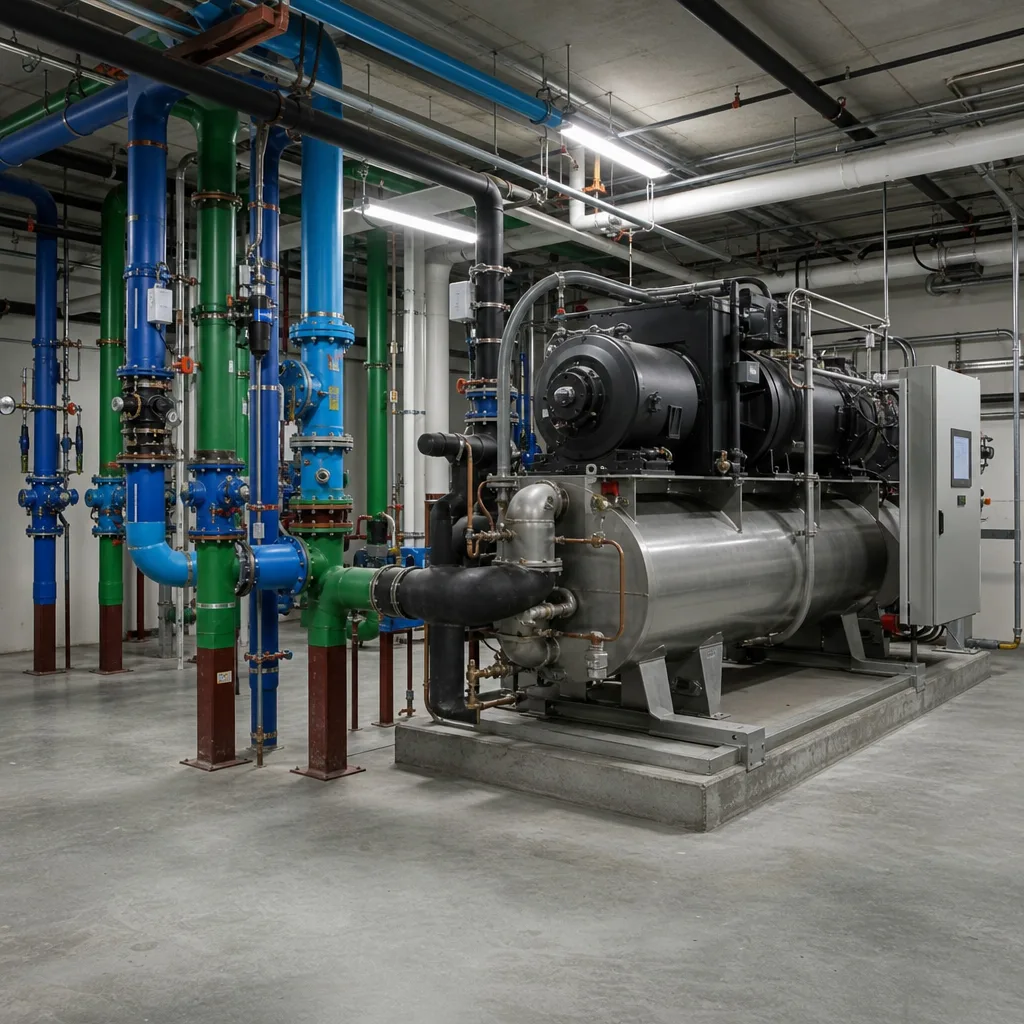
A repair usually makes sense when the problem traces back to a single part or a fixable cause, like these:
- A failed sensor, starter, contactor, or control board. These parts can stop a chiller cold, but swapping them is a small job compared with replacing the machine.
- A fan motor on an air-cooled unit. Rooftop chillers bake in Plano summers, and fan motors take a beating. One bad motor isn’t a reason to replace the whole unit.
- A refrigerant leak that can be found and sealed. If the leak is in a reachable spot and the coils or tubes aren’t badly worn, a repair and recharge may be all you need.
- Dirty or scaled condenser tubes on a water-cooled chiller. North Texas water is hard, and scale inside the tubes makes the chiller work harder and trip on high pressure. Cleaning the tubes and fixing the cooling tower water treatment can bring a lot of capacity back.
- Clogged strainers or low water flow. A chiller that shuts off on low flow may be fine. The real problem could be a plugged strainer, a stuck valve, or a weak pump.
That last point matters. Before anyone talks about a new chiller, the whole plant should be checked. Hot spots in the building can come from a failing pump, a cooling tower that isn’t shedding heat, an air handler with a dirty coil, or controls that are telling the chiller the wrong thing. If the chiller itself is healthy, replacing it won’t fix any of those. You’d spend a lot and still have the same complaints.
It’s also fair to hold off on replacement if your chiller is still in the middle of its working life and the repairs have been small and spread out. Keeping it running on a solid maintenance plan buys you time to budget and plan the next install on your schedule, not in the middle of a July breakdown.
Replacement starts to make more sense when the signs pile up:
- Big repairs keep coming back, like a second compressor failure or tubes that keep leaking.
- Your chiller runs on an older refrigerant that’s no longer made, so every recharge gets harder to find and costs more.
- Replacement parts are hard to get, and a breakdown could leave you down for weeks.
- The building’s cooling load has grown, and the chiller can’t keep up even when it’s working right.
- Your energy bills keep climbing while the chiller struggles through every hot afternoon.
If you’re not sure which side of the line you’re on, start with a diagnosis, not a quote for new equipment. Xtreme Air Services offers mechanical system troubleshooting and commercial HVAC repair and maintenance, so the first step can simply be finding out what’s wrong. If a repair will do the job, that’s the answer you should hear.
Ready when you are – get in touch today.
Call Today, Get Service Today. Xtreme Air Services — West Plano is ready to help.
What Happens During a Chiller Installation Project
Most of a chiller installation happens before the new machine ever shows up. The day the crane arrives is the part everyone sees. The weeks of planning before it decide whether that day goes smoothly. Here’s how a typical project moves from start to finish.
1. Site survey and load check. Someone walks your mechanical room, roof, piping, and electrical gear. They look at how the old chiller is connected, how much cooling the building really needs today, and how the equipment will get in and out. If your building has added people, servers, or square footage since the last chiller went in, this is where it shows up.
2. Equipment selection and lead time. Once the size and type are set, the chiller gets ordered. Large commercial chillers are often built to order, so lead times can stretch for weeks or months. That’s one more reason to plan a replacement before your old unit fails in the middle of summer.
3. Permits and utility coordination. Commercial mechanical and electrical work in Plano generally needs city permits and inspections. If the new chiller needs more electrical capacity than your building has now, the electrical service may have to be reviewed with Oncor, the utility that serves the area. Ask early whether your job falls into that category, because it can affect the schedule.
4. Shutdown and removal. On cutover day, the plant is shut down on the schedule you set for your tenants. The refrigerant in the old chiller has to be recovered. Federal rules don’t allow it to be vented into the air. Then the old unit is disconnected and hauled away. That haul-away is part of a standard Xtreme Air Services chiller installation.
5. Rigging and setting the new chiller. Air-cooled units on a roof usually need a crane. Water-cooled units in a basement or ground-floor mechanical room may come in on rollers through a wall opening or a wide door. Crane lifts in Plano office parks are often planned for early mornings or weekends to keep parking lots and drive lanes clear.
6. Connections. The new chiller gets tied into the chilled water piping, the condenser water piping if it’s water-cooled, the electrical feed, and the building controls. On a like-for-like job, the existing connections are reused. If the new unit sits in a different spot or has a different footprint, expect some piping or electrical changes.
7. Startup and testing. This is the step you shouldn’t let anyone rush. A proper startup checks that:
- Water is flowing at the right rate through the chiller
- The refrigerant charge and pressures are where they should be
- Safety controls trip when they’re supposed to
- The chiller responds correctly to the building automation system
- Leaving water temperature holds steady as the building load changes
Startup and testing are included in a standard Xtreme Air Services chiller installation. After that, the balancing and commissioning work covered above makes sure every floor gets the cooling it needs.
8. Handoff. At the end, you should get the startup readings, the equipment manuals, and a clear walk-through of how the new chiller runs. Whoever looks after your building day to day should know what normal looks like, so they can spot a problem early instead of finding out on a 105-degree afternoon.
Watch Our Video
See How We Handle Chiller installation in Plano
Xtreme Air Services — West Plano
What Drives Chiller Installation Cost
Chiller installation has a wide price range because no two plants are the same. A typical project with Xtreme Air Services runs $15,000 to $150,000. Our most common job is a standard like-for-like replacement that uses your existing connections with no major modifications. That job runs $42,000 to $96,000 and covers the equipment and materials, professional installation, startup, and testing.

Where your project lands in that range depends on a few things:
- Size and capacity. Chillers are rated in tons of cooling. A bigger building, or one that has added people, servers, and lighting, needs more tons, and that means more equipment.
- Efficiency. A higher-efficiency chiller costs more up front, but it uses less power to make the same cold water. In a building that runs its chiller through long Plano summers, those savings add up.
- Brand and model. Different models have different features, controls, and price points.
- Ease of access. A chiller that slides into a ground-floor mechanical room costs less to set than one that needs a crane lift to a roof or a wall opened up.
- Condition of what’s already there. Worn piping, old wiring, or a tired electrical feed may need work before the new chiller can run safely.
- Code upgrades and permits. Equipment that met code years ago may not meet it today. Bringing the plant up to current requirements adds cost.
- Custom fabrication. A new footprint can mean custom piping, supports, or sheet metal to make everything fit.
It’s just as important to know what a quote does and doesn’t cover. A standard Xtreme Air Services chiller installation includes the equipment and materials, professional installation, standard connections, startup and testing, and haul-away of the old unit.
Some work isn’t included unless it’s written into your quote: duct, electrical, or plumbing modifications, code corrections, and permits. That isn’t a trick. Those costs depend on what we find on site, so they can’t be priced until someone has looked. That’s why the site survey matters so much. It turns unknowns into line items before you sign anything.
When you compare quotes, ask each contractor the same questions. Is this a like-for-like swap, or does it assume new piping or electrical work? Are rigging, permits, and controls tie-in included? Is startup and testing part of the price? What happens to the old unit? Two numbers that look far apart often cover very different scopes of work.
You’ll get upfront pricing approved before work starts, so you know the number before anything moves. If the budget is tight this year, flexible financing is available on qualifying installations and larger jobs, on approved credit. That can let you replace a failing chiller on your schedule instead of waiting for a July breakdown.
Call now
Frequently Asked Questions
Common questions about Chiller installation
What is the $5000 rule for HVAC systems?
The $5000 rule is a quick way to decide between repair and replacement: multiply the repair cost by the age of the equipment, and if that number tops $5,000, replacement usually makes more sense than another repair. On a commercial chiller, this math has to account for more than the chiller itself. You also need to weigh pump condition, piping, and whether parts for an older refrigerant are still easy to find. If your chiller keeps needing fixes and parts are getting harder to source, that is a sign to look seriously at replacement rather than another repair.
Does a chiller installation need a permit in Plano?
Yes, commercial mechanical and electrical work in Plano generally needs city permits and inspections before the job can move forward. This matters most when a new chiller needs more electrical capacity than your building currently has, since that can require coordination with Oncor, the utility serving the area. Ask early in the planning stage whether your project falls into that category, because permit review can add time to your schedule. Building this step into your timeline up front helps you avoid delays once equipment is on order.
How long does a commercial chiller take to arrive once it’s ordered?
Lead times can stretch for weeks or even months, since large commercial chillers are often built to order rather than kept in stock. This is one of the biggest reasons to plan a replacement before an aging unit fails during a hot stretch. Waiting until a chiller quits in the middle of summer means running without reliable cooling while a new unit is built and shipped. Starting the sizing and ordering process early gives you more control over when the installation happens.
Ready to Get Started?
Call (469) 217-9095 Today, Get Service Today.