

Commercial ductwork is engineered to a fundamentally different standard than residential ductwork. It must handle higher airflow volumes, operate at greater static pressure, meet stricter sealing and insulation codes, and integrate with building design months before construction begins.
These are not minor variations. They represent a separate engineering discipline. Facility managers and business owners who treat commercial HVAC duct systems as scaled-up versions of home systems routinely face energy waste, code violations, and comfort complaints. Those problems cost far more to fix than to prevent.
Understanding why commercial ductwork differs from residential is the first step toward smarter decisions about design, maintenance, and capital investment in your building’s HVAC infrastructure.
Why commercial ductwork differs from residential in airflow and pressure
The single biggest engineering difference between commercial and residential duct systems is static pressure. Commercial systems operate at 1 to 3 inches of water gauge (in. w.g.), while residential systems typically run at 0.3 to 0.5 in. w.g.
That gap is not trivial. It means commercial ductwork must be built from heavier materials, sealed to tighter tolerances, and sized for airflow volumes that residential systems never approach.
A typical residential system moves 400 to 1,200 CFM (cubic feet per minute) through ducts serving a single family. A mid-size commercial building is different. It might require central air handling units (AHUs) or rooftop units pushing tens of thousands of CFM through ducts that span multiple floors and zones.
The sheer volume of air changes every design decision downstream, from duct cross-section geometry to fan motor sizing.
Static pressure control directly impacts airflow performance and occupant comfort in commercial buildings. When pressure is miscalculated or poorly measured during commissioning, some zones receive too much air and others too little.
This is why commercial commissioning documents break static pressure into individual components. Each one is verified to confirm that fan selection matches actual system conditions:
- AHU internal resistance
- Duct friction losses
- Terminal unit pressure drops
Here is what that means practically for facility managers:
- Fan selection errors caused by inaccurate static pressure data are one of the most common causes of underperforming commercial HVAC systems after installation.
- Duct sizing in commercial projects follows SMACNA (Sheet Metal and Air Conditioning Contractors’ National Association) standards, which specify duct dimensions based on velocity and pressure class, not just airflow volume.
- System balancing in multi-zone commercial buildings requires air balancing across dozens of terminal units, a process that residential systems rarely need at the same scale.
- Pressure class ratings determine the construction gauge and reinforcement requirements for commercial ducts, with higher-pressure systems requiring thicker steel and more frequent joint supports.
Pro Tip: When commissioning a new commercial HVAC system or validating an existing one, request a static pressure breakdown report from your mechanical contractor. This document should list measured pressure at the AHU, at key duct junctions, and at terminal units. If your contractor cannot produce this, your system balancing may be based on assumptions rather than measurements.
What materials and construction practices set commercial ductwork apart
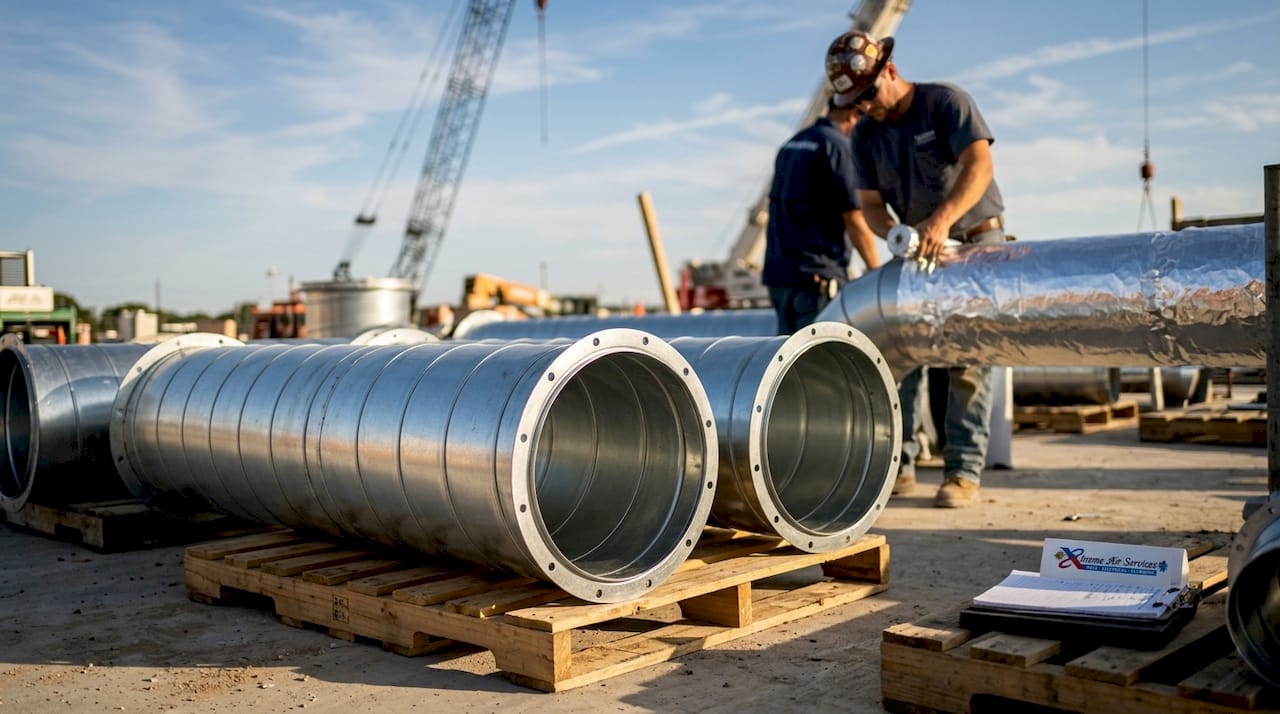
Commercial ductwork is predominantly constructed from galvanized steel, with rigid spiral round ducts used extensively for long main trunk runs. Residential systems, by contrast, rely heavily on flexible ductwork (flex duct) for branch runs and often combine sheet metal trunks with flex branches for cost and installation speed.
The choice of material is not arbitrary. It follows directly from the pressure, airflow, and durability requirements of each application.
| Feature | Commercial ductwork | Residential ductwork |
|---|---|---|
| Primary material | Galvanized steel, rigid spiral duct | Flexible duct, sheet metal combinations |
| Pressure class | 1 to 3 in. w.g. | 0.3 to 0.5 in. w.g. |
| Sealing standard | Mastic, UL-rated tape, tested to SMACNA/ASHRAE | Mastic or tape, code varies by jurisdiction |
| Fire and smoke control | Smoke and fire dampers required by code | Limited damper requirements |
| Lifespan expectation | 25 to 30 years with maintenance | 15 to 20 years |
| Installation coordination | Integrated with structural and MEP design | Installed after framing, minimal coordination |
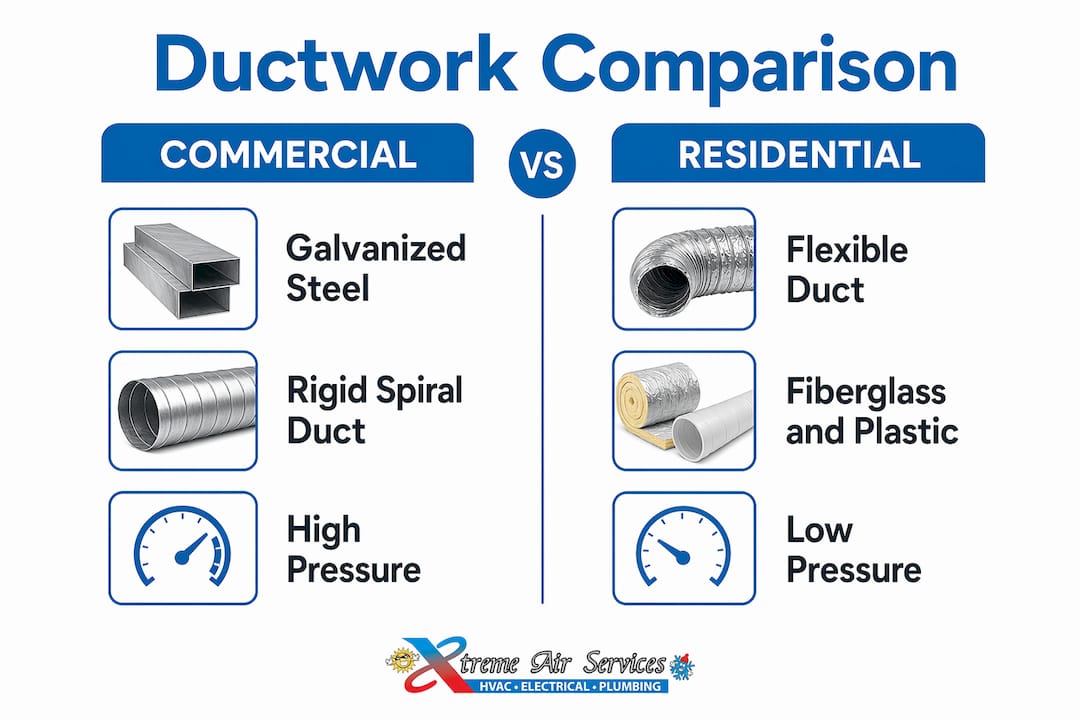
Rigid spiral duct outperforms flex duct in commercial applications for several reasons:
- It offers lower friction loss per linear foot.
- It maintains its cross-sectional shape under pressure.
- It resists the sagging and kinking that degrade airflow in flex duct installations.
In a building where duct runs may span hundreds of feet, those efficiency gains compound significantly.
Commercial ductwork construction also requires fire and smoke dampers at rated wall and floor penetrations. These code-mandated devices close automatically during a fire to prevent smoke and flame from traveling through the duct system.
Residential buildings have far fewer such requirements, and the dampers used are simpler in design. In commercial projects, smoke dampers must be tested and documented as part of the building’s life safety commissioning process.
The following construction practices distinguish commercial duct fabrication from residential:
- Commercial ducts are fabricated to SMACNA gauge and reinforcement tables, specifying steel thickness by pressure class and duct width.
- Joints in commercial systems use drive cleats, S-cleats, or flanged connections with gaskets, not the simple slip-and-crimp connections common in residential work.
- Commercial duct systems integrate with building automation systems (BAS) and airflow measurement stations that require straight duct sections for accurate readings.
- Access doors are installed at regular intervals in commercial duct systems to allow inspection, cleaning, and damper maintenance.
How do insulation and sealing requirements differ between commercial and residential?
Duct leakage is the single largest source of energy waste in commercial HVAC systems. Leaky commercial ducts can waste 20 to 30 percent of conditioned air before it reaches occupied spaces.
For a facility spending $50,000 per year on HVAC energy, that translates to $10,000 to $15,000 in annual waste from duct leakage alone. Residential leakage is also a problem, but the financial and comfort stakes are lower because the systems are smaller.
The regulatory framework reflects this difference. Residential duct systems under the IRC 2018 must meet a maximum leakage limit of 4 CFM25 per 100 square feet of conditioned floor area, verified by duct blaster testing.
Commercial projects follow ASHRAE 90.1, SMACNA, and local energy codes. These specify leakage as a percentage of system airflow, with acceptance criteria verified by commissioning teams using calibrated equipment.
The commercial standard is quantitative and contractually binding. The residential standard, while measurable, is enforced less consistently across jurisdictions.
Insulation requirements follow a similar pattern. Ducts located outside conditioned spaces must meet a minimum of R-6 insulation. Supply ducts in attics and other unconditioned zones often require R-8 under the IRC 2021 energy provisions.
Commercial buildings face the same baseline requirements but with greater complexity. Duct runs frequently pass through mechanical chases, ceiling plenums, and semi-conditioned spaces where maintaining insulation continuity is technically difficult.
Here is how sealing and insulation requirements break down in practice:
- Mastic sealant is the preferred sealing material for commercial duct joints because it remains flexible, fills gaps reliably, and does not peel like tape over time. UL-listed foil tape is acceptable for smaller gaps and residential applications but is not sufficient alone for commercial pressure-class ductwork.
- Duct blaster testing is standard in commercial commissioning. Contractors pressurize duct sections and measure leakage rates against the specified acceptance criteria before the system is accepted.
- Insulation continuity at duct transitions, hangers, and penetrations is a common failure point in commercial retrofits. Gaps in insulation at these locations create thermal bridges that reduce effective R-value and can cause condensation on duct surfaces.
- Commissioning documentation for commercial projects includes leakage test reports, insulation inspection records, and corrective action logs. This paper trail is required for LEED certification and many local energy code compliance pathways.
- Flex duct is largely absent from high-performance commercial applications because its corrugated interior surface increases friction loss and its insulation jacket is difficult to seal continuously at connections.
Pro Tip: If you manage a commercial building and have never had a duct leakage test performed, schedule one before your next HVAC equipment replacement. The test results will tell you whether your existing duct system can support new, more efficient equipment or whether duct repairs should be part of the capital project budget.
Duct sealing in commercial systems is treated as an energy-performance specification verified by quantified test results, not merely a construction detail. This distinction matters because it shifts accountability from the installer’s judgment to measurable outcomes that can be audited and enforced.
Why is early design coordination crucial for commercial ductwork?
Commercial HVAC systems are planned early in the construction process. Mechanical engineers coordinate duct placement, equipment sizing, and maintenance access alongside architects and general contractors before a single wall is framed.
This level of coordination has no real equivalent in residential construction. There, HVAC contractors typically arrive after framing is complete and route ducts through whatever space remains.
The reason commercial projects demand early coordination is straightforward: large duct runs require large spaces. A 24-by-48-inch rectangular duct serving a major air handling unit cannot be rerouted around a structural beam after the steel is erected.
Conflicts between ductwork, structural elements, plumbing, electrical conduit, and fire suppression piping must be resolved in the design phase using Building Information Modeling (BIM) clash detection, not on the job site with a cutting torch.
Early planning in commercial projects addresses several challenges that residential HVAC never encounters:
- Mechanical room sizing must accommodate AHUs, fans, and associated ductwork with adequate clearance for filter changes, coil cleaning, and motor replacement.
- Shaft and chase routing for vertical duct runs must be coordinated with the structural engineer to avoid penetrating load-bearing elements.
- Multi-zone system design requires that duct layouts support variable air volume (VAV) boxes, reheat coils, and zone dampers at each served area, all of which need access for maintenance.
- Ventilation code compliance under ASHRAE 62.1 requires that outdoor air quantities be calculated per occupancy type and that duct sizing support those minimums without excessive velocity noise.
- Smart controls integration means that duct layouts must include straight sections for airflow measurement stations and sensor taps that feed the building automation system.
Residential HVAC planning, by comparison, typically involves a Manual J load calculation, a duct layout sketch, and equipment selection. The process takes days rather than months.
That simplicity is appropriate for the scale involved. But it means residential contractors and homeowners have little experience with the coordination demands that commercial projects require. Facility managers who have only worked with residential contractors on small tenant improvement projects often discover this gap the hard way, when a duct conflict shuts down a renovation for two weeks.
Key takeaways
Commercial ductwork requires higher pressure ratings, stricter sealing standards, and earlier design coordination than residential systems. The scale, complexity, and energy stakes of commercial buildings demand engineering-grade solutions at every stage.
| Point | Details |
|---|---|
| Pressure and airflow scale | Commercial ducts operate at 1 to 3 in. w.g. versus 0.3 to 0.5 in. w.g. in residential systems. |
| Material standards | Galvanized steel and rigid spiral duct dominate commercial work; flex duct is limited to residential branch runs. |
| Leakage costs | Duct leakage wastes 20 to 30 percent of conditioned air, costing a $50,000 HVAC budget up to $15,000 annually. |
| Sealing accountability | Commercial sealing is verified by duct blaster testing against SMACNA and ASHRAE criteria, not left to installer judgment. |
| Design coordination | Commercial duct routing must be resolved in the design phase using BIM clash detection, not improvised during construction. |
What I have learned managing commercial and residential ductwork projects
The most consistent mistake I see facility managers make is assuming that a duct system that looks intact is performing well. In commercial buildings, duct leakage is almost always invisible.
The leaks occur at longitudinal seams, at fitting connections, and at access door frames. None of these are visible during a casual walkthrough. The only way to know your system is tight is to test it. Most buildings I have encountered have never had a formal leakage test performed on their existing ductwork.
The second pattern I see repeatedly is poor insulation continuity at duct hangers and transitions. A contractor will insulate a 200-foot duct run correctly and then leave a six-inch gap at every hanger bracket, because wrapping around the hanger takes extra time.
Over a large commercial building, those gaps add up to a meaningful reduction in effective R-value. They also create condensation points that eventually damage the duct surface and the ceiling below it.
The coordination gap between residential and commercial practice also shows up during retrofits. When a business owner hires a contractor experienced primarily in residential work to replace ductwork in a commercial tenant space, that contractor often makes three mistakes:
- Underestimates the static pressure requirements.
- Uses flex duct where rigid duct is required.
- Skips the leakage testing because it is not part of their standard workflow.
The result is a system that passes a visual inspection but fails to deliver the airflow the space needs.
My practical advice for facility managers: treat your duct system as a preventive maintenance asset, not a set-and-forget infrastructure component. Schedule duct inspections on the same cycle as your equipment maintenance, document what you find, and budget for sealing and insulation repairs before they become emergency replacements.
— Xtreme
How Xtreme Air Services supports your commercial HVAC ductwork
Xtreme Air Services provides professional HVAC inspection and maintenance services for commercial buildings, including duct leakage testing, sealing, and insulation assessment. If your facility has never had a formal duct performance evaluation, that is where the conversation starts.

A properly sealed and insulated duct system is the foundation of an efficient commercial HVAC operation. Xtreme Air Services technicians use calibrated equipment to measure leakage, identify insulation gaps, and document findings against SMACNA and ASHRAE benchmarks.
Whether you are managing a single-tenant office or a multi-floor commercial facility, the right HVAC maintenance plan keeps your duct system performing at the standard your building requires. Contact Xtreme Air Services to schedule a commercial duct inspection and find out what your system is actually delivering.
FAQ
What is the main reason commercial ductwork differs from residential?
Commercial ductwork operates at significantly higher static pressure (1 to 3 in. w.g.) and moves far greater airflow volumes than residential systems, which drives differences in materials, sealing standards, and design coordination requirements.
How much energy can leaky commercial ducts waste?
Duct leakage in commercial buildings can waste 20 to 30 percent of conditioned air, which translates to $10,000 to $15,000 in annual energy costs for a facility with a $50,000 HVAC budget.
What insulation R-value is required for commercial ductwork outside conditioned spaces?
Ducts outside conditioned spaces require a minimum of R-6 insulation, with supply ducts in attics often requiring R-8 under current energy codes. Commercial projects must maintain insulation continuity at all transitions and hangers.
Why is early design coordination more critical in commercial HVAC than residential?
Commercial duct runs are large enough to conflict with structural elements, plumbing, and electrical systems. These conflicts must be resolved during design using BIM clash detection because rerouting large ducts after construction begins is extremely costly.
How is duct sealing tested in commercial buildings?
Commercial duct sealing is verified using duct blaster pressurization tests that measure leakage against quantitative acceptance criteria set by SMACNA, ASHRAE, or local energy codes. Residential testing follows IRC leakage limits but is enforced less consistently.