Common commercial cooling system failures are the leading cause of unplanned downtime, energy waste, and costly emergency repairs in commercial buildings. The industry term for these events is HVAC system failure, though facility managers typically track them as commercial AC breakdowns by component. Compressor failure alone accounts for 25 to 30% of major commercial HVAC service calls, making it the single most expensive failure category you will face. Understanding the root causes across compressors, fan motors, electrical controls, coils, and economizers is what separates reactive facilities from those that run cooling systems at peak efficiency year after year.
1. Common commercial cooling system failures: an overview by component
The most frequent commercial cooling system failures cluster around five component categories: compressors, fan and blower motors, electrical and control systems, heat transfer coils, and economizer dampers. Each category has distinct failure signatures, and misidentifying one as another leads to wasted repair budgets. A facility that replaces a compressor when the real problem is a clogged filter has spent thousands solving the wrong problem.
Knowing which component is failing, and why, is the foundation of every effective maintenance program. The sections below break down each failure type with causes, symptoms, and the prevention strategies that actually work in commercial environments.
2. Compressor failure: the most expensive breakdown
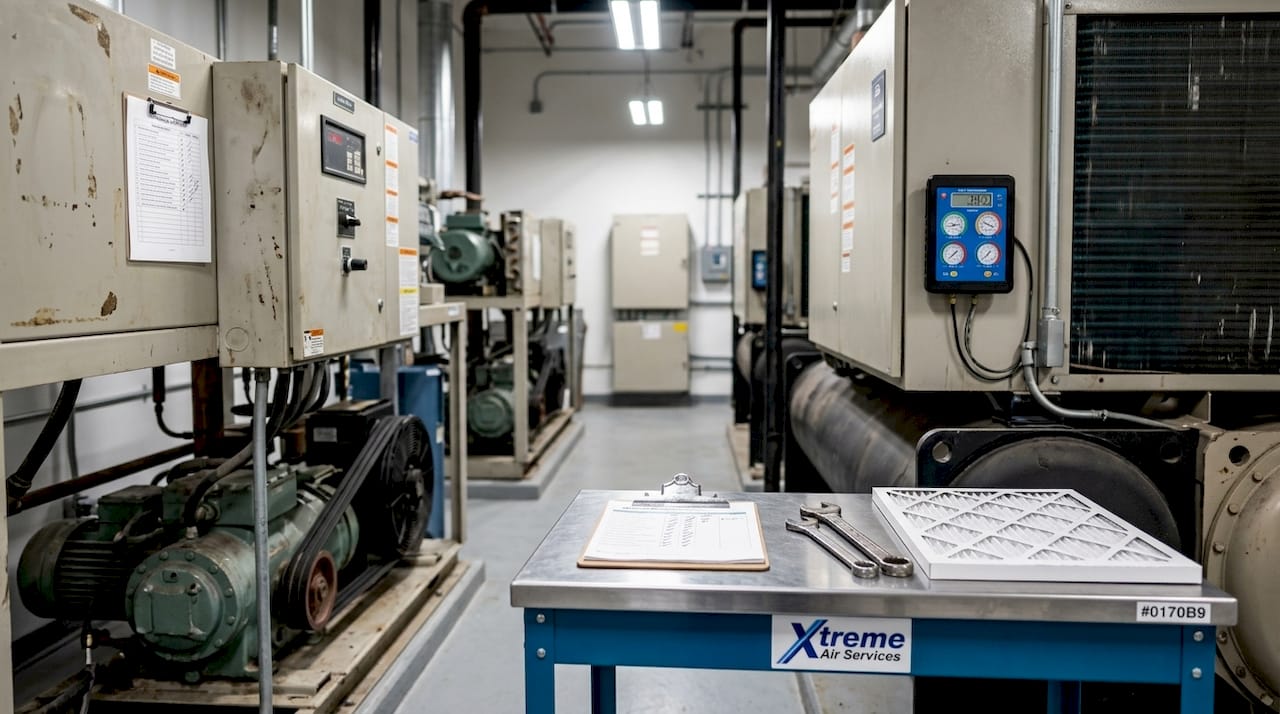
Compressor failure is caused by refrigerant imbalance, thermal stress, poor lubrication, and electrical faults. It is the costliest single failure in commercial HVAC because compressors are not field-repairable. When one fails, you are looking at a full replacement or a system swap.
The warning signs are specific. You will notice the system running continuously without reaching setpoint, unusual clicking or grinding sounds at startup, and tripped breakers tied to the compressor circuit. Overcharge and undercharge of refrigerant are both damaging. Overcharge causes liquid slugging, which destroys valve plates. Undercharge causes the compressor to run hot without adequate lubrication return from the refrigerant oil mixture.
Pro Tip: Schedule refrigerant pressure checks every six months on rooftop units. Catching a 5% charge deviation early costs under $200. Replacing a compressor costs $1,500 to $5,000 or more depending on tonnage.
Thermal stress compounds the problem in climates like Dallas, where rooftop units operate in ambient temperatures above 100°F for months at a time. High head pressure from a dirty condenser coil forces the compressor to work against elevated resistance, accelerating wear on internal components.
3. How dirty air filters cause cascading system malfunctions
Dirty or clogged air filters are the single most common cause of performance degradation in commercial HVAC systems. That single fact has more downstream consequences than most facility managers realize. Restricted airflow forces blower motors to work harder, reduces heat transfer across the evaporator coil, and triggers safety lockouts that shut the system down entirely.
The cascade works like this. A clogged filter drops static pressure across the air handler. The evaporator coil surface temperature falls below 32°F because warm air is no longer moving across it at the designed rate. Moisture in the air freezes on the coil surface. Ice buildup further blocks airflow, and the system either short-cycles or locks out on a safety switch. By the time a technician arrives, the symptom looks like a refrigerant problem or a controls fault, not a $10 filter.
- Replace filters on a schedule tied to actual pressure drop readings, not just calendar dates
- Install differential pressure gauges across filter banks in high-traffic commercial buildings
- Use MERV 8 to MERV 13 filters appropriate for the system’s fan static pressure capacity
- Document filter change dates and pressure readings in your CMMS for trend analysis
Linking filter pressure readings with refrigerant trends avoids the most common misdiagnosis in commercial cooling troubleshooting. A technician who checks refrigerant pressures without first verifying filter condition is working backward.
4. Refrigerant leaks and their impact on system efficiency
Refrigerant leaks reduce system efficiency by up to 20% and accelerate compressor wear at the same time. The EPA mandates that leak repair must be completed within 30 days after detection when the annualized leak rate exceeds 10% of system charge. That is not just an environmental rule. It is a direct operational cost trigger.
A system running at 85% refrigerant charge does not cool 15% less. It works 20% harder to deliver the same output, which means higher electricity bills, faster compressor wear, and a shorter system lifespan. The efficiency loss is nonlinear, which is why small leaks that go undetected for months cause disproportionate damage.
Refrigerant leak management requires more than fix-on-fail responses. Proactive inspection, documentation, and timely repair tied to regulatory thresholds is the standard that protects both your equipment and your compliance record. For commercial buildings using older R-22 systems, leak management is especially critical given the cost and scarcity of that refrigerant.
Pro Tip: Use electronic leak detectors at Schrader valves, service ports, and brazed joints during every scheduled maintenance visit. Ultrasonic detectors work well for finding leaks in noisy mechanical rooms where electronic detectors struggle.
5. Frozen evaporator coils and condensate drain blockages
Frozen evaporator coils result from restricted airflow, low refrigerant charge, or control failures that allow coil surface temperature to drop below 32°F. The symptom is a system that runs continuously without delivering cooling. Occupants report warm air from supply registers while the unit appears to be operating normally. That combination is the diagnostic signature of a frozen coil.
Here is how to address it systematically:
- Shut the system down and switch the fan to “on” mode to thaw the coil without heat. Never use a heat gun or open flame near refrigerant lines.
- Check and replace the air filter before restarting. A frozen coil caused by airflow restriction will refreeze within hours if the filter is not changed.
- Measure supply and return air temperatures (delta-T) after restart. A delta-T below 14°F suggests a refrigerant charge issue requiring a certified technician.
- Inspect the condensate drain pan for standing water, which indicates the drain line is partially or fully blocked.
- Flush the condensate drain with a diluted bleach solution and verify free flow before returning the unit to service.
Blocked condensate drains cause water damage and mold growth in commercial buildings, and a single overflow event can saturate ceiling insulation and trigger liability claims. Quarterly drain inspections are the minimum standard for commercial air handlers. In humid climates, monthly checks during peak cooling season are justified.
Pro Tip: Install condensate overflow switches on all commercial air handlers. These $25 to $50 devices shut the system down before a drain overflow occurs, preventing water damage that can cost tens of thousands of dollars to remediate.
6. Thermostat, controls, and building automation system faults
Thermostat and building automation system faults are frequently misdiagnosed and generate cascading comfort complaints across entire floors or zones. The failure modes are less dramatic than a seized compressor, but their cumulative impact on energy costs and occupant productivity is significant.
The table below shows the most common control system faults, their causes, and their operational effects:
| Fault type | Common cause | Operational effect |
|---|---|---|
| Sensor drift | Age, contamination, poor placement | System heats or cools to wrong setpoint |
| Wiring fault | Corrosion, rodent damage, loose terminals | Intermittent operation, false alarms |
| Programming error | Incorrect schedules, setback misconfiguration | After-hours cooling running unnecessarily |
| Economizer control failure | Actuator wear, linkage corrosion | Damper stuck open or closed |
| BAS communication fault | Network issues, outdated firmware | Loss of remote monitoring and override capability |
Sensor drift is the most insidious fault because it produces no error codes. The system appears to be operating normally while conditioning spaces to temperatures 3 to 5 degrees off setpoint. In a large commercial building, that drift translates directly to measurable energy waste every month.
Economizer damper failures, including failing open or closed, compound the problem. A damper stuck open in winter introduces uncontrolled cold air that the heating system must overcome. A damper stuck closed eliminates free cooling during mild weather, forcing mechanical cooling to run when outside air could handle the load at zero energy cost. Both conditions also affect indoor air quality and can trigger ASHRAE 62.1 compliance issues.
Calibrate all zone sensors annually. Verify economizer actuator operation and damper position feedback at every scheduled maintenance visit. For buildings using Johnson Controls Metasys, Siemens Desigo, or similar BAS platforms, keep firmware current and audit control sequences after any system modification.
7. Blower motor and fan belt failures
Blower motor failures and fan belt wear are among the top causes of unexpected air handling shutdowns, and they reduce airflow before they cause a complete failure. That gradual degradation is what makes them dangerous. The system keeps running, occupants notice it is less comfortable, and by the time a technician is called, the motor or belt has been operating in a damaged state for weeks.
Motor failures follow two primary paths. Capacitor degradation causes hard-start problems and reduced torque, which shows up as slow startup, humming at startup, or the motor failing to start on the first attempt. Bearing wear produces audible symptoms: a grinding or squealing noise that gets louder over time. Both conditions are detectable well before failure if you are listening during routine inspections.
Fan belt failures follow a different pattern. Glazing from heat and age reduces friction between the belt and pulley, causing slippage that reduces fan speed without triggering any fault code. Misalignment accelerates wear on both the belt and the pulley grooves. A belt that looks intact may be delivering 15 to 20% less airflow than design because of slippage alone.
- Inspect belts for glazing, cracking, and fraying at every maintenance visit
- Check belt tension with a tension gauge. Undertensioned belts slip; overtensioned belts accelerate bearing wear
- Lubricate motor bearings on a schedule specified by the manufacturer, typically every 2,000 to 4,000 operating hours
- Keep spare belts for every belt-drive air handler on site. A $15 belt that fails on a Friday afternoon becomes a $500 emergency call if you do not have a replacement
For commercial HVAC air balancing, blower performance is the baseline measurement. If measured airflow at supply registers drops more than 10% from the last balance report without a filter change, a blower motor or belt issue is the first place to look.
8. Coil fouling and its effect on cooling capacity
Coil fouling causes up to 30% loss in cooling capacity and 35% extra energy use when left unaddressed. Those numbers represent a system that is consuming more electricity to deliver less cooling, which is the worst possible operating condition from both a cost and reliability standpoint.
Condenser coils foul from airborne debris, cottonwood, and biological growth. Evaporator coils foul from dust that bypasses filters and from microbial growth in the wet environment of the drain pan. Both types of fouling reduce heat transfer by insulating the coil surface from the air or refrigerant it is supposed to exchange heat with.
Tracking coil performance with delta-T or approach temperature metrics is more effective than calendar-based cleaning. A condenser coil that approaches design temperature within 5°F does not need cleaning regardless of what the calendar says. A coil that is 15°F off approach temperature needs cleaning regardless of when it was last serviced. Performance-based maintenance prevents both premature cleaning and the far more costly problem of running fouled coils for months between scheduled service dates.
For preventive maintenance on commercial HVAC coils, the standard practice is to measure approach temperature or delta-T at every scheduled visit and trigger a cleaning work order when deviation exceeds your threshold. This approach eliminates guesswork and ties maintenance activity directly to measured system performance.
Key takeaways
The most effective strategy for managing common commercial cooling system failures combines component-specific diagnostics, performance-based maintenance triggers, and regulatory compliance for refrigerant management.
| Point | Details |
|---|---|
| Compressor failure is the costliest | Compressors account for 25 to 30% of major service calls; refrigerant checks prevent most failures. |
| Filters drive cascading failures | A clogged filter causes coil freezing, motor stress, and safety lockouts before any other component fails. |
| Refrigerant leaks require fast action | EPA mandates repair within 30 days of detection; leaks reduce efficiency by up to 20%. |
| Control faults are frequently misdiagnosed | Sensor drift and damper failures cause energy waste and comfort complaints without triggering fault codes. |
| Performance metrics beat calendar schedules | Delta-T and approach temperature tracking prevents both premature cleaning and costly fouled-coil operation. |
What I’ve learned diagnosing commercial cooling failures firsthand
The most expensive mistake I see facility managers make is treating symptoms instead of causes. A system that short-cycles gets a new thermostat. A system that does not cool gets a refrigerant charge. Neither fix addresses why the problem occurred, and both fail within months.
The facilities that run the most reliable cooling systems share one habit: they track performance data between service visits. They know what their delta-T was last quarter. They know their compressor amperage draw at design conditions. When something changes, they catch it early because they have a baseline to compare against. Facilities that only look at their HVAC when something breaks are always playing catch-up.
I also want to push back on the idea that preventive maintenance is primarily about avoiding big failures. It is, but the bigger financial argument is energy cost. A commercial building running fouled coils, a slipping fan belt, and a slightly undercharged refrigerant circuit simultaneously is spending 20 to 30% more on electricity than it should be. That cost is invisible because it shows up as a slightly higher utility bill, not a repair invoice. Structured maintenance programs pay for themselves in energy savings before they ever prevent a single breakdown.
The other thing I would tell any facility manager is this: accurate diagnosis before any repair is non-negotiable. Verify airflow first. Check filter condition. Measure delta-T. Then look at refrigerant pressures. That sequence catches 80% of commercial AC breakdowns before you spend a dollar on parts.
— Xtreme
Keep your commercial cooling system running with Xtreme Air Services
Preventing the failures covered in this article requires more than good intentions. It requires a structured maintenance program with documented inspection intervals, performance baselines, and technicians who know what to measure.
Xtreme Air Services provides commercial HVAC maintenance plans designed specifically for facility managers and business owners who need reliable cooling without surprise repair bills. From compressor health checks and coil performance tracking to refrigerant compliance documentation and controls calibration, the team covers every failure category outlined in this article. For buildings with electrical faults tied to HVAC controls, Xtreme Air Services also provides commercial electrical services to address wiring, panel, and BAS power issues in one visit. Contact Xtreme Air Services to schedule a commercial cooling inspection before peak season.
FAQ
What causes most commercial HVAC systems to fail?
Dirty air filters, refrigerant leaks, and compressor stress from thermal overload cause the majority of commercial HVAC failures. Compressor failure alone accounts for 25 to 30% of major service calls.
How often should commercial cooling systems be inspected?
Commercial cooling systems require a minimum of two full inspections per year, with filter checks and condensate drain inspections quarterly. High-use systems in hot climates benefit from monthly filter pressure checks during peak cooling season.
What are the signs of a refrigerant leak in a commercial AC system?
Signs include reduced cooling capacity, ice on refrigerant lines or the evaporator coil, higher-than-normal electricity bills, and a system that runs continuously without reaching setpoint. EPA regulations require leak repair within 30 days once detected above threshold.
Can a frozen evaporator coil damage the compressor?
Yes. A frozen evaporator coil restricts refrigerant flow back to the compressor, which can cause liquid refrigerant to enter the compressor and destroy internal components through liquid slugging. Thaw the coil completely and resolve the root cause before restarting the system.
How do I know if my commercial cooling issues need repair or full replacement?
If the system has repeated compressor failures, refrigerant circuit problems across multiple components, or is more than 15 years old with declining efficiency, replacement is often more cost-effective than continued repair. Review the repair vs. replace criteria for a structured decision framework.
Recommended
Need professional help? Explore our commercial air conditioning and heating.