If your AC fan isn’t spinning, the top suspects are a failed capacitor, blocked or jammed blades, or a tripped breaker cutting power to the outdoor unit. Turn the thermostat off and shut off power at the outdoor disconnect or breaker before touching anything. A humming outdoor unit with a still fan usually points to the capacitor. Dead silence usually means power never reached the unit.
TL;DR:
- Most outdoor AC fan failures are caused by a faulty capacitor, debris blocking the blades, or a tripped breaker that cuts power to the unit.
- Homeowners can diagnose simple issues by performing the stick test to check if fan blades spin freely or verifying if the breaker has tripped before calling a technician.
- Visual inspection of the capacitor and contactor can identify obvious electrical problems, but testing and replacement require a licensed professional for safety and accuracy.
- Regular maintenance like changing filters and clearing debris can prevent many fan problems and reduce the risk of system failure during the hottest months.
- Running the outdoor unit without the fan functioning risks damaging the compressor, so prompt diagnosis and repair are essential for system longevity.
Table of Contents
- What’s Causing Your Outside AC Fan Not Working
- How Do I Reset My Outside AC Fan?
- Understanding the Electrical Parts Behind a Dead Fan
- Fan Blades and Motor: What You Can Check Yourself
- Signs You Need a Professional Fan Repair
- Keeping Your AC Fan From Failing Again
- Why Xtreme Air Services Handles This Every Week
- What Homeowners Get Wrong About Fan Repairs
- Get Your AC Fan Fixed Right the First Time
- Sources
- FAQ
What’s Causing Your Outside AC Fan Not Working
Matching what you hear and see to a cause narrows the fix fast. Run through these in order of how often they actually happen.
- Tripped breaker or lost power. No hum, no motor noise, nothing. Check your electrical panel for a breaker that’s flipped to the middle position and your outdoor disconnect box (the gray metal box near the condenser) to confirm the pull-out fuse is seated.
- Failed run or start capacitor. The compressor hums but the fan sits still. This is by far the most common reason for a condenser fan not turning, especially on units more than seven years old. A quick “stick test,” covered in the next section, confirms the diagnosis in under a minute.
- Bad contactor or control relay. You hear a click from the outdoor unit but nothing spins, or you hear nothing at all because the contactor never closes to send power to the fan circuit.
- Debris or a bent blade. Leaves, cottonwood fluff, a dropped acorn, or a blade that’s been knocked out of true by a lawnmower can physically stop rotation even with full power reaching the motor.
- Motor failure or seized bearings. The motor housing feels hot to the touch, you hear grinding, and the blades won’t turn even when nudged by hand with the power off.
- Indoor airflow problems. A clogged filter or low refrigerant charge can freeze the evaporator coil, which chokes airflow and can trip a safety switch that shuts the whole system down, fan included.
- Compressor overheating. A struggling or failing compressor sometimes trips a breaker repeatedly, which looks identical to a simple fan problem until you notice it keeps happening.
The indoor blower and outdoor condenser fan run on separate circuits, so an outdoor fan that’s dead while your indoor blower runs fine narrows your search to that unit’s own power supply, contactor, or motor. That’s a useful shortcut when you’re standing in the yard trying to figure out where to even start looking.
How Do I Reset My Outside AC Fan?
Work through these steps in order. Stop and call a technician the moment you hit anything involving stored electrical charge or a hot motor.
- Kill the power first. Set the thermostat to off, then flip the breaker for the outdoor unit and pull the disconnect switch or fuse block next to the condenser. Confirm the fan has fully stopped before going near it.
- Power-cycle the system. Wait about five minutes, restore power at the breaker and disconnect, set the thermostat back to “Cool” a few degrees below room temperature, and listen for the outdoor unit to kick on.
- Check the breaker itself. If it tripped again right after resetting, don’t force it a third time. A breaker that keeps tripping is protecting you from a real fault, not being oversensitive.
- Inspect the outdoor unit visually with power off. Remove the top grille (usually four screws) and look for leaves, sticks, or a bent blade catching on the housing. Clear debris by hand or with a soft brush.
- Check your air filter. A filter that hasn’t been swapped in months can starve airflow and freeze the evaporator coil, which sometimes shuts the whole system down as a safety measure.
- Run the stick test, power still off. Using a long wooden dowel or stick, not a metal tool, gently push one fan blade to see if it spins freely. If it spins easily but never starts on its own, a capacitor is almost certainly the culprit.
- Write down what you noticed. Humming or silence, grinding or clicking, hot motor or normal temperature. That short list saves your technician real diagnostic time.
Pro Tip: Take a 15-second video with your phone before you call anyone. A technician who can hear the hum or see the stalled blade over the phone often arrives with the right part already on the truck.
Understanding the Electrical Parts Behind a Dead Fan
A run capacitor stores an electrical charge that gives the fan motor the torque it needs to start spinning, then keeps it running smoothly. When it fails, you typically get a hum with no rotation, a case that looks visibly swollen or bulged, or in worse cases, a leaking brown residue around the top.
- Bulging or leaking capacitor casing
- Fan hums steadily but never starts turning
- Repeated clicking from the contactor with no fan response
- Burnt or pitted contactor points visible through the housing
A contactor is the switch that lets the thermostat’s low-voltage signal close a much higher-voltage circuit to actually power the fan and compressor. Burned contacts inside it can stop that connection cold, even when everything else in the system checks out fine.
Here’s the boundary that matters: you can safely look at these parts with the power off, but capacitors hold a lethal electrical charge even after the unit is unplugged, and testing capacitance or amp draw accurately requires a meter and training most homeowners don’t have. Leave the capacitor replacement itself to a licensed technician. A breaker that trips more than once after a reset is a signal worth taking seriously, not a nuisance to work around.
Fan Blades and Motor: What You Can Check Yourself
Mechanical problems split cleanly into two categories: what you can clear yourself, and what needs a new part. Clearing a stuck leaf is a five minute job. A shot motor is not.
- With power fully off, check blades and the surrounding shroud for cracks, dents, or contact points where a bent blade is scraping the housing.
- Grab the shaft and check for side-to-side wobble; play in the shaft indicates worn bearings, which usually calls for motor replacement rather than a quick fix.
- A grinding sound or a motor that’s hot enough to make you pull your hand back is a strong sign the motor itself has failed.
- Never run the unit with a cracked blade or a motor you suspect is seizing. A blade that lets go mid-spin can damage the coil or housing around it.
Signs You Need a Professional Fan Repair
Some situations aren’t DIY territory, period. Call a licensed technician right away if you notice any of the following.
- A burning smell coming from the outdoor unit
- A capacitor that’s visibly bulging, leaking, or cracked
- A breaker that trips again after you’ve reset it once
- A motor housing that’s hot to the touch or making grinding noises
Any of those point to a capacitor or motor swap, and both jobs involve either stored electrical charge or specialized pulling tools that aren’t worth the risk of a DIY attempt. A technician arriving for a fan complaint typically runs an amp draw test, checks capacitance against the rated microfarad value, inspects the contactor for pitting, and confirms refrigerant levels before deciding whether it’s a repair or a bigger system replacement conversation. Have your model number, a description of the noise or smell, and any video you took ready when they arrive. It shortens the visit and usually the bill.
Keeping Your AC Fan From Failing Again
Most of the failures above are preventable with a handful of boring, cheap habits repeated on a schedule.
- Swap the air filter every one to three months; a clogged filter starves airflow and stresses the whole system, not just the fan.
- Walk out to the condenser after any storm and clear leaves, grass clippings, or fluff away from the housing; do a lighter check monthly during pollen and cottonwood season.
- Book a professional tune-up before the summer heat arrives. Capacitors and contactors fail disproportionately during peak-heat months when the system runs hardest, so catching a weak capacitor in spring beats replacing a dead one in July.
- Consider an HVAC maintenance plan that schedules these visits automatically instead of relying on memory.
Why Xtreme Air Services Handles This Every Week
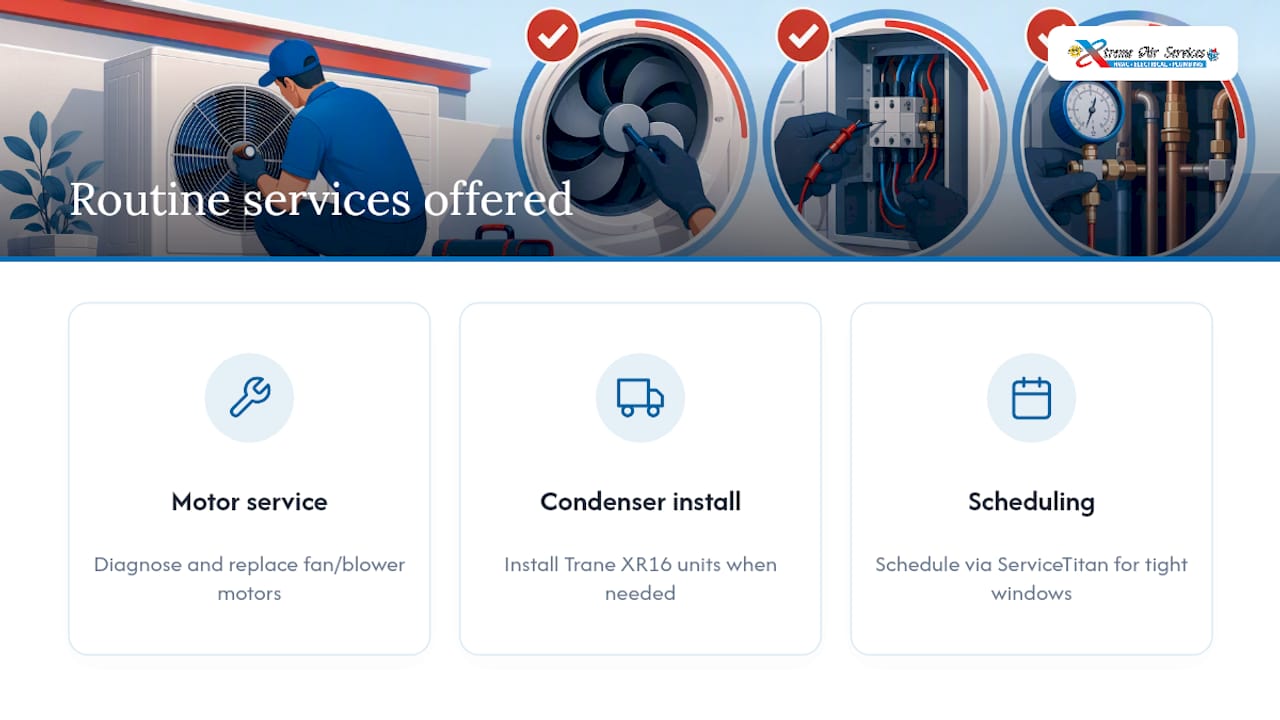
Xtreme Air Services diagnoses and replaces failed AC fan motors and blower motors on a routine basis, installs Trane XR16 condenser units when replacement makes more sense than repair, and schedules every service call through ServiceTitan so appointment windows stay tight and predictable. Browse the air conditioning repair service page for details on what a diagnostic visit covers.
What Homeowners Get Wrong About Fan Repairs
Most guidance on a dead AC fan either dumps too many possible causes on the reader at once or oversells what a homeowner should attempt alone. Neither helps you at 6 p.m. on a Tuesday in July.
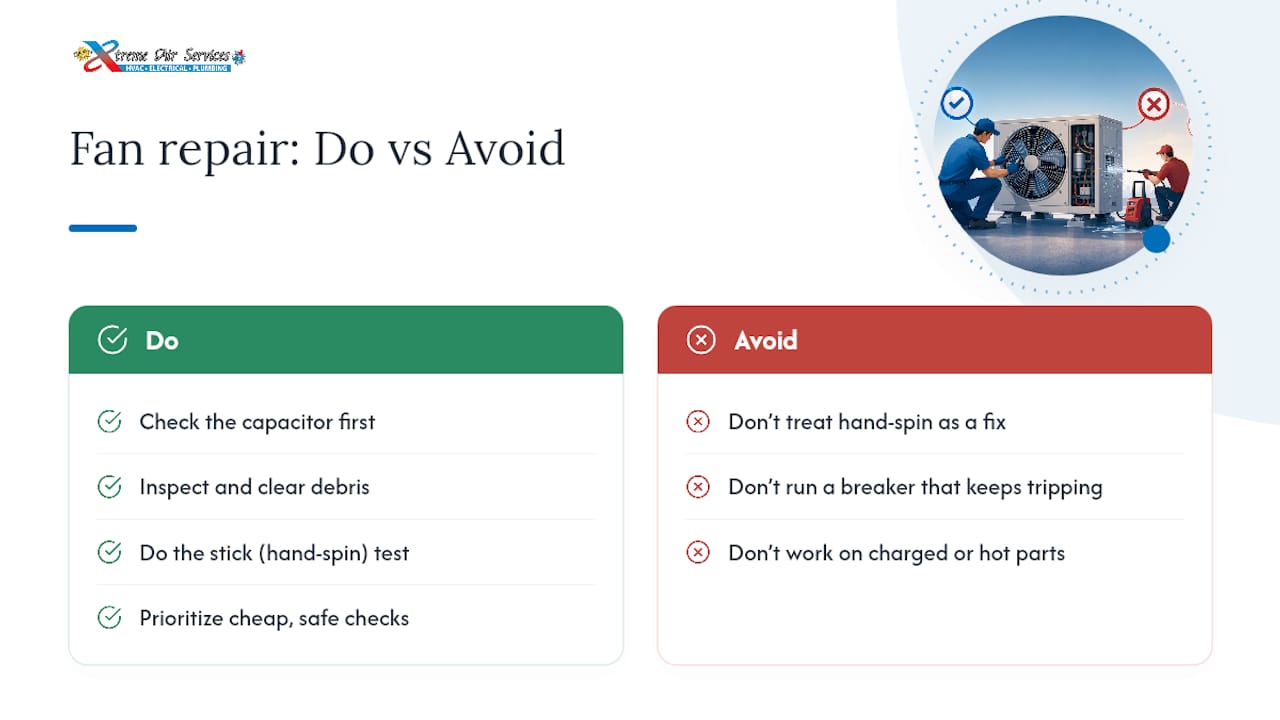
The honest priority order is capacitor, debris, breaker, in roughly that frequency. Most people skip the stick test because it feels too simple to be real diagnostics, but a fan that spins freely by hand and hums on its own tells you almost everything you need to know before a technician even shows up. That’s not a repair, though, and treating it as one is where homeowners get into trouble. It buys you a diagnosis, not a fix.
The bigger mistake is hesitating on a breaker that keeps tripping. That’s not a system being finicky. It’s a component telling you it’s actively failing, and running it anyway risks the compressor, which costs far more than a capacitor ever will. Prioritize the cheap, safe checks first. Respect the boundary the moment stored charge or a hot motor enters the picture.
— Xtreme
Get Your AC Fan Fixed Right the First Time
A stalled fan on a 95 degree afternoon isn’t a problem to gamble on with a YouTube tutorial and a multimeter you bought yesterday. Xtreme Air Services sends licensed technicians who carry the right capacitors, contactors, and Trane XR16 parts on the truck, so most fan repairs get resolved in a single visit instead of a wait for a special order.

If your fan keeps failing every season or your system is getting old enough that repair costs are stacking up, it’s worth asking whether repair or replacement makes more financial sense long term. For most homeowners, though, the smarter move is getting ahead of it: an HVAC maintenance plan puts a technician’s eyes on your capacitor, contactor, and motor before peak summer heat finds the weak part for you. Schedule a diagnostic visit today and get a straight answer on what’s actually wrong.
Sources
- AC Fan Not Spinning: 7 Causes and Step-by-Step Repairs
- Diagnose & Repair AC Condenser Unit Fan
- AC Fan Not Spinning But Unit Is On (7 Easy Fixes That Work Fast)
FAQ
How do I reset my outside AC fan?
Turn the thermostat off, flip the breaker and outdoor disconnect off for about five minutes, then restore power and set the thermostat to “Cool” a few degrees below room temperature. If the fan still doesn’t spin after that reset, the issue is a component failure, not a simple power glitch.
What should I do if my AC blower fan isn’t spinning?
Check your air filter first, since a clogged filter can freeze the evaporator coil and trigger a safety shutdown that stops the blower. If the filter looks clean and the blower still won’t run, the problem is likely electrical and worth a technician visit.
How can I tell if it’s the fan motor or the capacitor?
With the power off, gently push a fan blade with a wooden stick. If it spins freely once nudged but never starts on its own, the capacitor is the likely cause. If the blade won’t move at all or grinds, suspect the motor or bearings instead.
Can I run my AC if the outdoor fan isn’t working?
You shouldn’t. Running the compressor without the condenser fan spinning causes the unit to overheat fast, which can damage or destroy the compressor within minutes and turn a cheap repair into a full system replacement.