

A VAV HVAC system is defined as a heating, ventilation, and air conditioning system that controls indoor temperature by varying the volume of supply air delivered to each zone while keeping that air at a constant temperature, typically around 55°F. Unlike older constant air volume (CAV) systems that blast the same amount of air regardless of demand, a variable air volume system adjusts airflow to match exactly what each space needs at any given moment. Manufacturers like Trane and AAON have made VAV the industry standard for medium-to-large commercial buildings above 10,000 square feet. For facility managers overseeing office buildings, schools, or medical centers, and for homeowners exploring high-performance HVAC options, understanding how VAV works is the first step toward smarter energy decisions.
What is a VAV HVAC system and how does it work?
A VAV HVAC system works by sending conditioned air from a central air handling unit (AHU) through a network of ducts to individual VAV terminal units, commonly called VAV boxes, installed in each zone. Each VAV box contains a damper that opens or closes based on signals from a zone thermostat. When a room calls for more cooling, the damper opens wider. When the room reaches its set point, the damper throttles back. The result is precise, zone-by-zone temperature control without changing the temperature of the supply air itself.
The role of the air handling unit and VFD
The air handling unit sits at the heart of every VAV system. It conditions the air to that constant supply temperature and pushes it through the duct system. A variable frequency drive (VFD) attached to the AHU’s supply fan is what makes the whole system energy-smart. The VFD modulates fan speed based on the collective demand from all VAV boxes. When most zones are satisfied and their dampers are partially closed, the VFD slows the fan down rather than forcing air against closed dampers. That reduction in fan speed translates directly into reduced electricity consumption.
How sensors and thermostats communicate
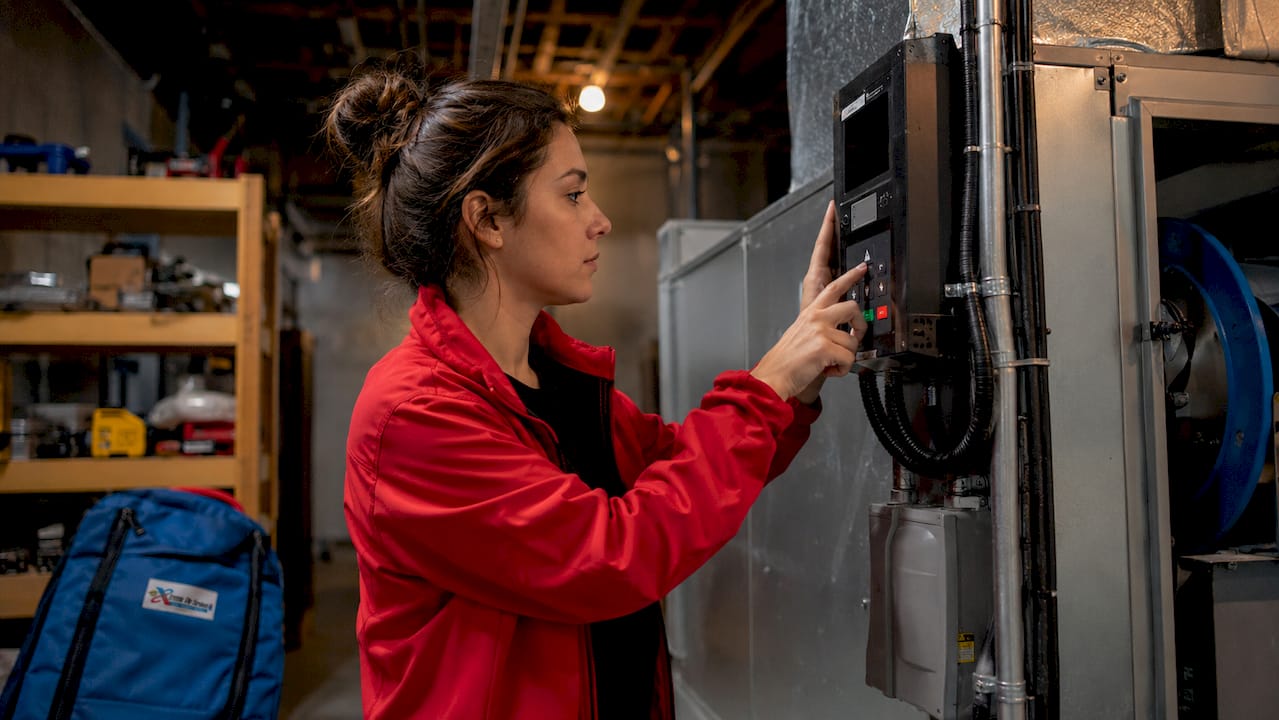
Each VAV box receives commands from a zone thermostat or sensor that monitors room temperature in real time. The thermostat sends a signal to the VAV box controller, which adjusts the damper position accordingly. That same controller reports back to the central Building Management System (BMS), which coordinates the entire network. The BMS tracks every zone simultaneously and tells the AHU fan how hard to work. This closed-loop communication is what separates a well-tuned VAV system from a system that just moves air around.
Single-zone vs. multi-zone VAV systems
Single-zone VAV systems skip the individual VAV boxes entirely. Instead, the AHU itself modulates airflow to serve one large space, such as a retail floor or a gymnasium. Multi-zone VAV systems use multiple VAV boxes to serve distinct areas with different load profiles, which is the configuration most facility managers encounter in office buildings and schools. Single-zone setups are simpler and less expensive, but they cannot address the temperature variation between a sun-drenched conference room and a shaded server closet.
Pro Tip: When reviewing a VAV system proposal, ask the contractor to show you the sequence of operations document. This document defines exactly how the BMS, VFD, and VAV boxes communicate. A vague or missing sequence of operations is a red flag for future performance problems.
What are the energy efficiency benefits of VAV systems?
VAV systems deliver measurable energy savings because they match supply to demand rather than running at full capacity all day. The transition from CAV to VAV is frequently driven by energy codes like the International Energy Conservation Code (IECC), which recognize VAV’s superior efficiency during off-peak hours. In a typical office building, occupancy and heat loads fluctuate constantly throughout the day. A CAV system ignores those fluctuations. A VAV system responds to them in real time, reducing fan energy whenever demand drops.
Humidity control as a hidden advantage
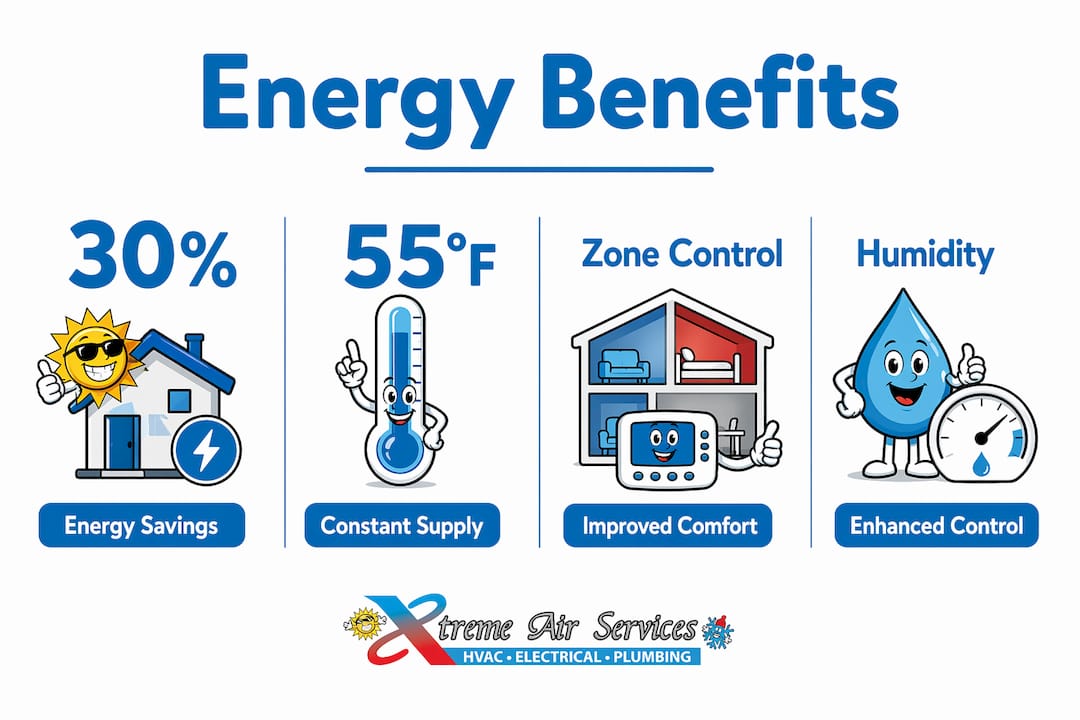
One underappreciated benefit of variable air volume systems is dehumidification performance. Because the supply air is always delivered at a constant 55°F temperature, the cooling coil in the AHU consistently wrings moisture out of the air. CAV systems that cycle on and off can allow humidity to creep back up between cycles. VAV systems maintain steady dehumidification as long as any zone is calling for cooling, which keeps indoor relative humidity in a comfortable and healthy range.
VAV vs. CAV vs. VRF: a direct comparison
Understanding the advantages of variable air volume means knowing what it competes against. The table below compares the three most common commercial HVAC approaches across the factors that matter most to facility managers and building owners.
| Feature | VAV system | CAV system | VRF system |
|---|---|---|---|
| Airflow control | Variable volume, constant temp | Constant volume, constant temp | Variable refrigerant, no central air |
| Energy efficiency at part load | High (VFD reduces fan power) | Low (fan runs at full speed always) | Very high (compressor modulates) |
| Zone control | Excellent with multiple VAV boxes | Limited without reheat coils | Excellent with individual fan coils |
| Humidity control | Strong (constant coil operation) | Moderate | Moderate (depends on configuration) |
| Best application | Buildings over 10,000 sq. ft. | Small, constant-load spaces | Retrofit projects, smaller buildings |
| Upfront cost | Moderate to high | Low to moderate | High |
“VAV systems improve occupant comfort and reduce energy use especially in commercial buildings with variable occupancy and load profiles.” — AAON
VRF systems, offered by manufacturers like Daikin and Mitsubishi Electric, use refrigerant piping instead of ductwork and excel in retrofit scenarios where running new ducts is impractical. VAV systems outperform VRF in large, ducted buildings where central air filtration and ventilation control are priorities. The right choice depends on building size, duct infrastructure, and load variability. You can explore how these systems fit into broader facility planning in this commercial HVAC systems guide from Xtremeairservices.
Common design challenges and pitfalls in VAV systems
VAV systems are not plug-and-play. Several design and commissioning decisions determine whether a system performs as promised or becomes a source of constant complaints.
-
Minimum airflow thresholds. VAV boxes cannot close completely. Minimum airflow is typically 25 to 30% of maximum design flow to maintain acceptable indoor air quality and ventilation. When a zone’s cooling load drops below that threshold, the system stops modulating and may activate a reheat coil to prevent overcooling. If reheat is electric resistance, the energy cost can offset the savings from reduced fan speed. Specifying hot water reheat instead of electric reheat is a common way to manage this trade-off.
-
Overcooling in shoulder seasons. Spring and fall present a specific challenge for VAV systems. Outdoor temperatures are mild, internal loads are low, but the AHU is still delivering 55°F air. Without careful controls programming, zones can overcool even at minimum airflow. Sequence-of-operations programming that raises the supply air temperature setpoint during mild weather, a strategy called supply air temperature reset, is the standard solution.
-
System balancing after installation. A VAV system that is not properly balanced will have zones that never reach setpoint and others that are always too cold. Proper HVAC air balancing involves measuring and adjusting airflow at every VAV box to match design specifications. This step is frequently rushed or skipped on budget-constrained projects, and it is almost always the first thing to investigate when occupants complain.
-
BMS integration quality. BMS intelligence is the key to achieving the energy savings VAV systems promise. A VAV system running on a poorly configured BMS behaves like a CAV system with extra hardware. Investing in proper BMS commissioning and periodic recalibration pays back in energy savings and reduced service calls.
Pro Tip: Request a post-installation commissioning report that documents measured airflow at every VAV box. If the contractor cannot provide this, schedule an independent air balancing test before accepting the system.
How do different types of VAV systems compare?
Not every VAV installation looks the same. The system type should match the building’s size, layout, and load characteristics.
| System type | How it works | Best use case | Key limitation |
|---|---|---|---|
| Single-zone VAV | AHU modulates airflow to one space | Retail floors, gyms, auditoriums | No zone-level control |
| Multi-zone VAV | Multiple VAV boxes serve distinct zones | Office buildings, schools, hospitals | Higher installation cost |
| Dual-duct VAV | Two supply ducts (hot and cold) with variable flow | Legacy CAV retrofits | Complex ductwork, higher cost |
| Fan-powered VAV | VAV box includes a small fan for reheat distribution | Perimeter zones with high heat loss | Added maintenance on box fans |
Dual-duct VAV systems are relatively rare in new construction but appear frequently in buildings that were originally built with dual-duct CAV systems. The retrofit converts the constant-flow terminal units to variable-flow units, capturing energy savings without replacing the entire duct infrastructure. Fan-powered VAV boxes are common along building perimeters where winter heat loss creates a simultaneous heating and cooling demand in adjacent zones.
For homeowners, a true multi-zone VAV system is uncommon in residential settings because most homes lack the duct sizing and central AHU infrastructure that VAV requires. However, single-zone VAV setups are appearing in larger custom homes and home additions where a dedicated AHU serves a specific wing. Understanding how air handlers work in your HVAC system is a practical starting point before evaluating whether a VAV configuration makes sense for your home.
Practical maintenance and troubleshooting for VAV systems
Keeping a VAV system performing at its best requires consistent attention to both the mechanical components and the control logic. The following practices apply whether you are a facility manager overseeing a 50,000-square-foot office or a homeowner with a single-zone VAV setup.
-
Inspect VAV box dampers annually. Damper actuators wear out over time and can stick in a partially open or closed position. A stuck damper causes one zone to be perpetually too hot or too cold regardless of what the thermostat says. Annual inspection catches actuator failures before they become occupant complaints.
-
Calibrate zone thermostats and sensors. Sensors drift. A thermostat reading 2°F high will cause its VAV box to throttle back prematurely, leaving the zone warmer than the setpoint. Calibration takes minutes and prevents hours of troubleshooting.
-
Check VFD operation and filter condition. A clogged air filter forces the VFD to run the fan harder to maintain duct static pressure, erasing the energy savings the VFD was installed to deliver. Replace filters on schedule and log VFD operating frequency to spot trends before they become failures.
-
Review BMS trend logs quarterly. Modern BMS platforms log temperature, airflow, and energy data continuously. Reviewing those trends reveals patterns like a zone that always calls for maximum cooling or a VAV box that never modulates. These patterns point to equipment problems, occupancy changes, or control logic errors that are far cheaper to fix early.
-
Schedule professional diagnostics every two years. A certified HVAC technician can perform a full system functional test, verify sequence-of-operations compliance, and identify components approaching end of life. Pairing this with a structured HVAC maintenance plan keeps the system running efficiently and extends its service life significantly.
For facility managers specifically, the commercial HVAC preventive maintenance practices outlined by Xtremeairservices provide a structured framework for scheduling and documenting VAV system care across multiple buildings or campuses.
Key takeaways
A VAV HVAC system delivers superior energy efficiency and zone comfort by varying airflow to match real-time demand, but only when properly designed, balanced, and maintained.
| Point | Details |
|---|---|
| Core definition | VAV systems vary air volume at a constant 55°F supply temperature to match zone demand. |
| Energy savings mechanism | VFDs reduce fan speed as zone demand drops, cutting electricity consumption at part load. |
| Primary design risk | Minimum airflow thresholds and overcooling require careful controls programming to avoid energy waste. |
| System type selection | Match VAV type (single-zone, multi-zone, dual-duct) to building size and load variability. |
| Maintenance priority | Annual damper inspection, sensor calibration, and BMS log reviews prevent most common failures. |
Why VAV systems reward the buildings that commit to them
After years of working on HVAC systems across commercial and residential properties, I have seen VAV systems perform brilliantly and I have seen them become expensive headaches. The difference almost never comes down to the hardware. It comes down to whether the building owner treated commissioning as a one-time checkbox or as the beginning of an ongoing relationship with the system.
The most common misconception I encounter is that a VAV system will automatically save energy just because it was installed. It will not. VAV systems selected for constant-load environments add complexity and cost without delivering proportional savings. A small retail space with a predictable load profile is often better served by a simpler system. VAV earns its keep in buildings where occupancy, solar gain, and internal loads shift throughout the day.
What I tell facility managers is this: budget for the BMS the same way you budget for the AHU. The performance benefits of VAV come from control intelligence, not from the ductwork. A well-programmed BMS with supply air temperature reset, demand-controlled ventilation, and occupancy scheduling will outperform a poorly integrated system by a wide margin on the energy bill. Pairing VAV with economizer mode during mild weather adds another layer of free cooling that compounds the savings.
The future of VAV is in tighter integration with building automation platforms and predictive analytics. Systems that learn occupancy patterns and pre-condition spaces before people arrive are already available from vendors like Trane and Johnson Controls. For buildings investing in VAV today, specifying open-protocol BMS platforms like BACnet ensures those future upgrades remain accessible without a full controls replacement.
— Xtreme
Ready to optimize your building’s HVAC performance?
Xtremeairservices works with homeowners and facility managers across the region to assess, maintain, and upgrade VAV HVAC systems for maximum efficiency and comfort. Whether you need a full system commissioning review, a recurring maintenance plan, or expert guidance on upgrading from a CAV system, the Xtremeairservices team has the experience to get it right.
Our HVAC maintenance plans are structured specifically for variable air volume systems, covering annual VAV box inspections, VFD checks, BMS calibration, and filter service. For facility managers overseeing multiple properties, Xtremeairservices also offers commercial HVAC service agreements that keep every system on schedule. Contact Xtremeairservices today to schedule a consultation and find out exactly what your VAV system needs to perform at its best.
FAQ
What is a VAV HVAC system in simple terms?
A VAV HVAC system controls indoor temperature by adjusting how much conditioned air flows to each room or zone rather than changing the air temperature itself. It delivers more air when a space needs cooling and less air when the space reaches its set point.
How does a VAV system differ from a CAV system?
A CAV (constant air volume) system delivers the same amount of air continuously regardless of demand, while a VAV system modulates airflow to match actual load. VAV systems consume significantly less fan energy at part-load conditions because a VFD slows the supply fan when demand drops.
Are VAV systems suitable for homes?
Most residential homes use simpler split systems rather than VAV, but larger custom homes with dedicated air handling units can benefit from single-zone VAV configurations. Multi-zone VAV is typically reserved for commercial buildings above 10,000 square feet.
What causes temperature inconsistencies in a VAV system?
The most common causes are stuck VAV box dampers, miscalibrated zone sensors, and improper system balancing after installation. A BMS trend log review and annual damper inspection catch most of these issues before they affect occupant comfort.
How often should a VAV system be serviced?
VAV systems benefit from annual mechanical inspections covering dampers, actuators, filters, and VFD operation, combined with quarterly BMS log reviews and a full professional commissioning check every two years.
Recommended
- Types Of Commercial HVAC Systems: 2026 Facility Guide
- What is an HVAC System and How Does It Work? – YouTube
Need professional help? Explore our commercial air conditioning and heating.